School site visits are an important part of our teaching and cultural preparation. I'm really glad that Fulbright puts us through such thorough training. It really shows that they're not just aiming to throw native English speakers into classrooms and hoping for the best, but that they're committed to creating a crop of competent teachers as well as cultural ambassadors. They want us to understand as best we can what our year is going to be like before we even begin.
 |
| The classroom I visited at Chungnam Science HS. For a lesson on how a bill becomes a law, the students are watching Schoolhouse Rock! :) |
We were allowed to choose to visit one school from a variety of combinations: elementary, middle, or high × all-boys, all-girls, or co-ed × urban, suburban, or rural = 27 possible choices of school (actually 25, I think, because all elementary schools are co-ed, and, well, actually 24 for me, because some ETAs are here specifically to teach elementary, and I'm not one of them, so I could not choose any of the elementary schools). I decided to visit a very advanced-level science high school (co-ed and urban, but also a boarding school because it was on the very edge of Daejeon). It was called 충남과학고등학교 (Chungnam Science High School), I believe.
 |
| This high school has its own observatory classroom! Talk about good government funding. But I doubt the students have any time to actually take their astronomy courses seriously, because they study all afternoon and evening after school. |
His unit was on political science, and his first-year students (who were roughly equivalent to our high school sophomores) were having a test on American government. But rather than having a sit-down test or even an oral exam, their test consisted of all the students playing the roles of State Department secretaries, Congresspeople, and even a President and Vice President as they wrote bill proposals, defended them in front of a Senate and House of Representatives, and passed them into law. The better the laws helped their country's health, happiness, economy, and security, the more points the class got as a whole.
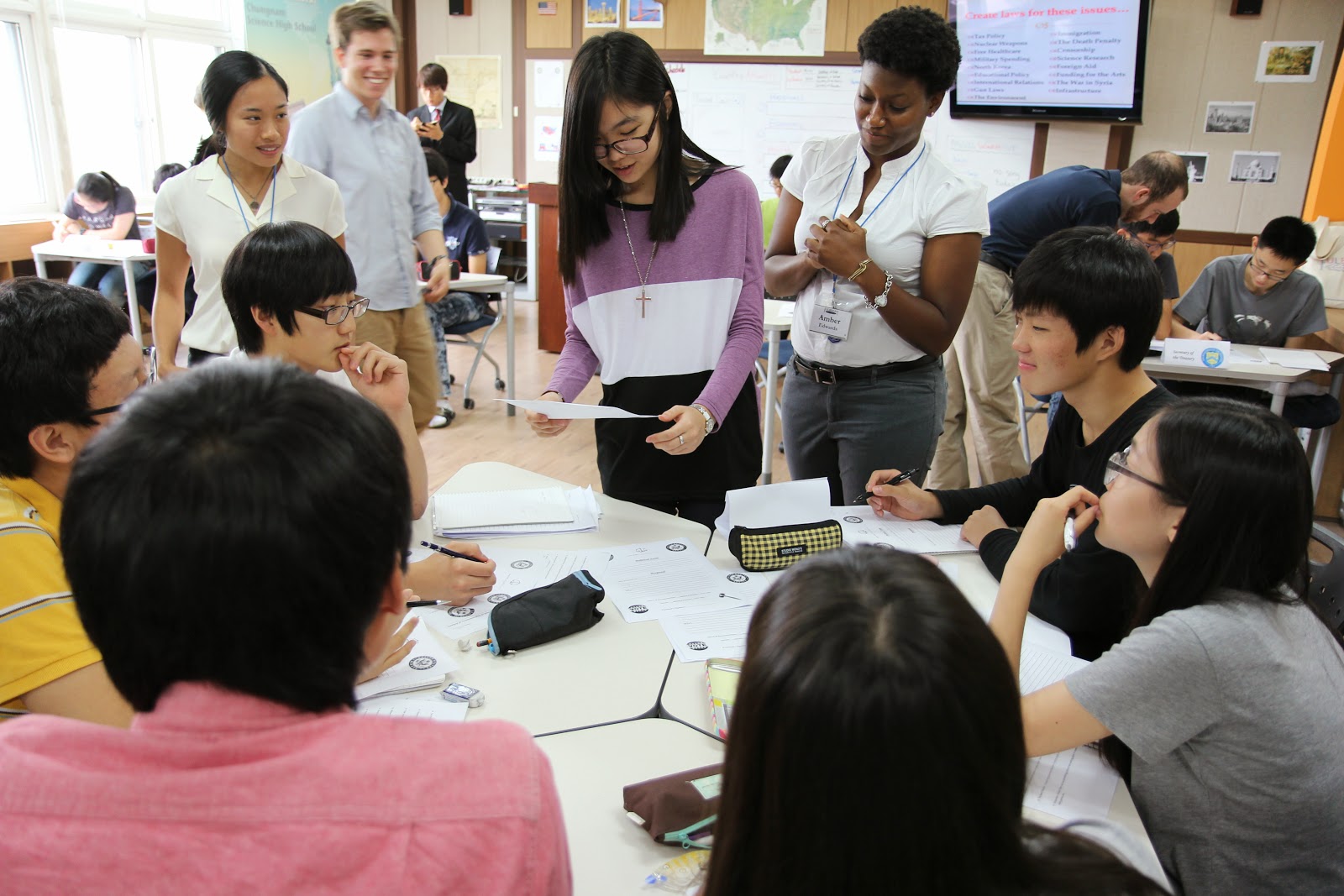 |
| A particularly good-at-English student, Chloe, proposes her bill on increasing subsidies for university tuition before the House of Representatives. Brian, the ETA, is the cute guy to the left of her, and Amy and Amber, other visiting ETAs, look on. |
Besides looking in on the class, we also took a short tour of the campus and ate lunch in the cafeteria with students, where I met Danielle, Sheldon -- who named himself after the character on Big Bang Theory -- and a kid who named himself Oppenheimer. Nerds. Brian also gave us a short lecture on some advice for getting ready for our classrooms and curricula. Some points I'll share:
- Plan on spending more time doing cultural ambassadorship than actual teaching.
- Technology is not very reliable.
- Teach students to be creative and independent thinkers, not just English-speaking robots.
- But also hold them to high standards and be strict about your classroom rules.
- Routine and creative warm-ups and games are good. Notebooks (journals) are good. Reward systems are good. Organization and continuity between lessons is good.
- Give constant feedback, even if it takes a long time! And... always smile!
Dear readers: any more advice for a future teacher? :)
 |
| Vika chats with the Department of State. |
So from this school site visit, I can say now that I would like to teach in a high school, not a middle school. I would prefer my students to have as high a level of English as possible, as well as the (slightly) higher maturity level that comes with fourteen- and fifteen-year olds. The chances aren't terribly high that I'll get the placement I want, but I'm glad that I at least have some sort of opinion of what I want to do. Quite a change from the norm of having no idea what I want to do (with regard to my future, for example).
Also, Korean classes and taekwondo classes begin tomorrow! I'm very excited for both!


