Showing posts with label North Korea. Show all posts

Wednesday, July 22, 2015

North Korean - South Korean translator app


It should surprise nobody by now that the languages spoken in North Korea and South Korea are not the same. The two countries have been geographically separated for decades, with no free communication allowed across the border between them. In addition to that, North Korea's government initiated purges of the language long ago to get rid of foreign words or borrowings (from English, Chinese, or Japanese) and replace them with pure Korean translations. As a result, while South Koreans might want to eat 아이스크림 ("ice cream", transliterated) on a hot summer day, a North Korean will dream instead of 얼음과자 ("ice snack").

When I visited North Korea last year, I found myself unable to understand much of the Korean that I heard being spoken. Of course, my Korean listening comprehension level is fairly low, but it wasn't just me -- even the Korean-Americans in my tour group who were fluent in (South) Korean had some difficulties. Most of it was due to the differences in vocabulary, but there was also the intonation of North Korean, which would have been considered a mere dialectal difference back when Korea was unified, but is now one of the markers of the two languages' divergence. (The line between "language" and "dialect" is a fairly blurry one, even for linguists.)

Anyway, when I came across this advertisement/PSA for a new app called 글동무 ("classmate"). I like the name -- the whole phrase means "classmate", which directly references the app's usefulness for North Korean students struggling to keep up in South Korean classrooms, and encourages a camaraderie among youth. Also, the first word (글) on its own means "writing" or "knowledge". The second part (동무) on its own can also mean "comrade", but I don't think that was intentional.

I have taught camps and tutored students from North Korea in South Korea before, and I can say that an app like this would be very helpful for most of them. (For others, especially younger students who basically grew up in China while their families were in hiding, it would perhaps be less useful than a Chinese-Korean dictionary, but those already exist.)

And in addition to the app's usefulness, its beautiful, simple design and hi-tech programming (it can use the phone's camera to identify unknown words automatically and offer translations immediately) are really compelling. This amazing app is the brainchild of linguists, computer programmers, and sociologists who saw a need in South Korea and came up with an elegant solution. I hope that the work I will do in the future can be as beneficial as this!

Monday, August 11, 2014

"Enter Pyongyang" Hyperlapse Video Review


A friend shared this video on Facebook, and I had to take a look. First impression: it's well-crafted and beautiful as a film. No surprise there, since Vimeo is the video sharing site to go to if you have something pretty to share! I'm a sucker for timelapse and hyperlapse (that is, timelapse + shifts in perspective) videos anyway, so simply watching this was a treat.

I'm a little concerned about the message it's sending, however. The pros are that the video will dispel myths that Pyongyang is completely destitute, crumbling to pieces, and cut off from the outside world. These are pretty much untrue, but that doesn't mean it's, like, a nice place to live. So the cons are that the video can easily give a false idea of what Pyongyang, or even all of North Korea, is like.

Here's what I thought as I watched the video: where is all that light coming from? There is so little electricity available in the city. The cityscape is not that bright at night. The computeres in the grand library are only on for a few hours each day. And where is all that color coming from? Maybe my camera is not as nice as the equipment used for this video, but the dominant color in every photo I took in North Korea is gray.

The subway is exactly how I remembered it, though. Like my tour group, the filmmakers were only allowed to see the few nicest and busiest stations of the two-line system. Even though the platform was grand and lit up, the train was dated and dark inside. I was caught by surprise by a tender moment when the sped-up footage slowed down to show an old man entering the station, and again when it paused to let a traffic cop stop and chat with a lady pushing a stroller, again when a little girl at the roller-skating rink spotted the camera. These brief moments that revealed ordinary human actions and interactions did make me smile.

But again, that does not mean North Korean society is harmonious or normal by any standard. The filmmakers worked closely with Koryo Tours, a North Korean tourism company, so it's not surprising that the footage shown was neat, aesthetic, and even attractive. It's the image a tourism company wants you to see. It's also the fabricated facade that the DPRK's totalitarian regime wants you to see. They don't want you to see that the inside of the gorgeous pyramidal Ryugyong Hotel is skeletal and unfinished, only that the lawns on the outside are green. They don't want you to see the dilapidated apartments in the western parts of the city that have no glass in their windows, only the newly-constructed ones (that, despite their appearances, have their electricity shut off at night just like every other building in the city besides the monuments). They don't want you to see anything outside of the capital city, either: none of the concentration camps, the starving gangs of orphan children in the northeast, the abandoned factories that have produced nothing for decades, the hills stripped completely bare of their forests, the desperate men and women who smuggle food, drugs, and people across the border to China. None of these things are supposed to exist in the Kim dynasty's sterilized image of the Victorious Fatherland. It's not that I expect them to show up in what is essentially a three-minute advertisement, but I'll be frank: the North Korea that you have just seen is not the North Korea that you need to see.

This video used awesome technology and uplifting music to reinforce the idealized image of Pyongyang. I wouldn't call it propaganda, and it's not like anything shown in the video is actually fake. But it's easy for pretty things to convince the world that pretty is all that exists, and I caution any viewer from drawing the conclusion that because a couple of professional filmmakers were allowed to tour the capital of North Korea with their cameras, the entire country is actually brimming with "dynamism and [a] sense of potential."

North Korea is a long way away from really opening up to the outside world, but when it does, I hope that someone with the same advanced equipment as well as a heart for millions of oppressed and suffering people can enter and show us more than this.

Sunday, August 3, 2014

The War Memorial of Korea

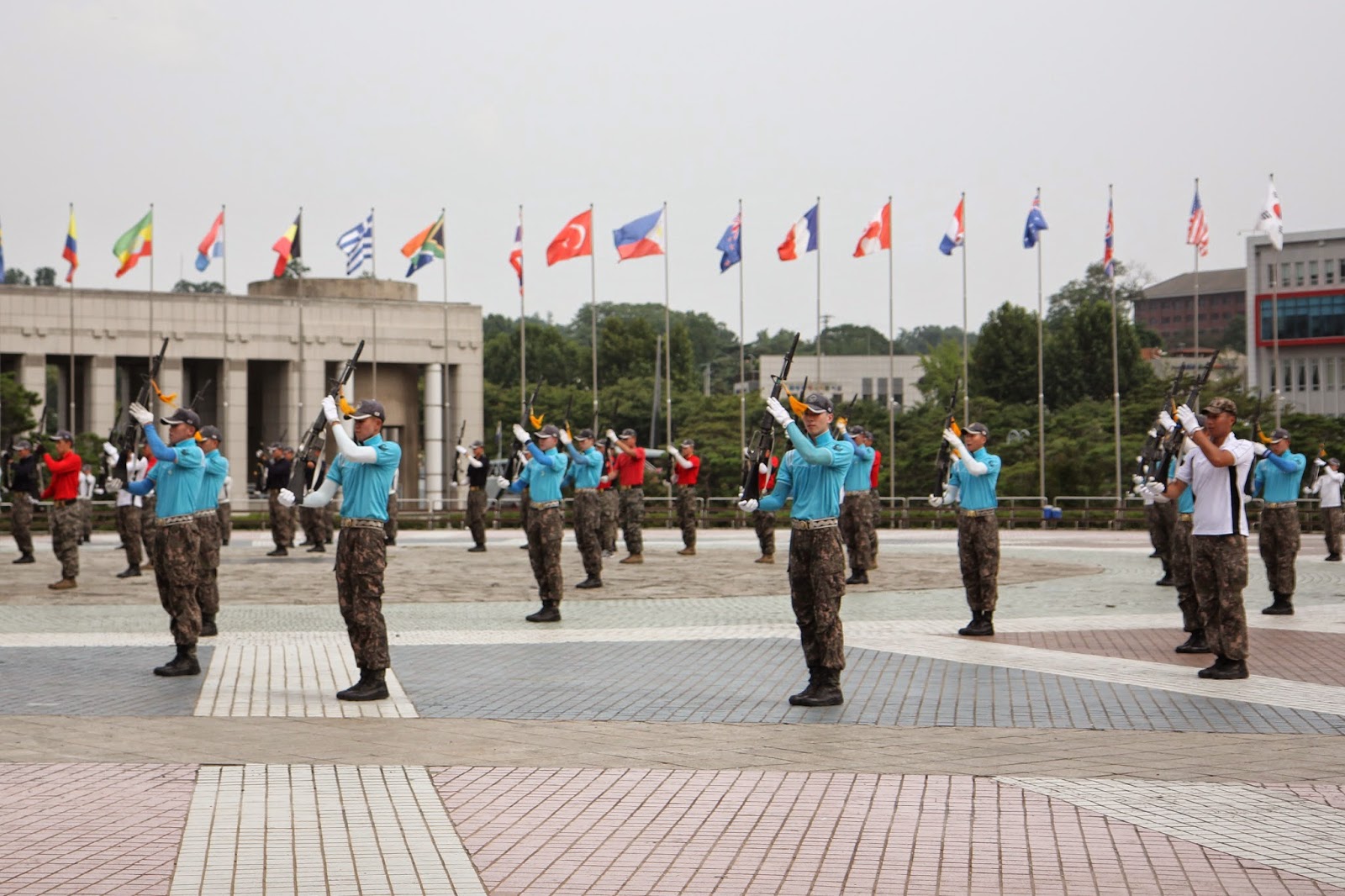
Color guard rehearsal at the War Memorial of Korea
One of the last things on my Korea bucket list was a visit to the War Memorial of Korea, a museum dedicated to Korea's bellic history. It may not be as exciting as shark diving or bungee jumping, but I enjoy visiting museums on my own. When I go with a tour, there is never enough time scheduled to see everything at a properly slow pace, and when I go with friends, we always end up separated anyway because our interests differ. So, I first paid a visit to the museum with Monica on Monday, and although we caught the tail end of a really interesting color guard rehearsal taking place in front of the museum, we found out that the museum itself was closed, as is the case every Monday.


So, I went by myself a few days later, and the following photos are from this second visit. I'd heard that its exhibits are extensive and worth an entire afternoon's visit, and indeed, I spent a good four hours wandering its halls.
A South Korean flag carried by a member of the student soldiers' battalion during the Battle of Pohang (August 1950).
Memorial to the soldiers who sacrificed their lives at White Horse Hill
What surprised me straight off the bat was that it was not a museum about just the Korean War, fought from 1950-1953. True, the museum had more than two floors dedicated to this important and transformative period in Korean history, but it actually was meant to cover the entire war history of Korea. That being the case, the exhibits actually began with coverage of the wars fought between Korea's ancient kingdoms, as well as confrontations with Japanese invaders leading up to the twentieth century. I didn't find these very interesting, though, so I hurried on through.

The next thing that surprised me was -- for lack of a better way to describe it -- the entertainment value of the exhibits. Of course, I don't think a museum should be boring, but the way this museum chose to keep up interest for visitors, particularly children, was rather odd to me. Take for example the re-enactments of famous battles using animatronics and CGI bombs and explosions. It reminded me, unfortunately, of North Korea's war museum in Pyongyang, which I visited last February. Having been recently renovated, that museum made use of state-of-the-art technology to immerse visitors in as "realistic" a recreation of the war as possible. I use scare quotes because the information presented as fact in Pyongyang's museum is clearly distorted to present a DPRK-positive account.
Life-size diorama and multimedia display of one of the battles along the Han River during the Korean War.
"Shooting Area" for the kids to experience what it's like to use an assault rifle in a wartime situation. Classy.
In any case, I remain amused at the cornier aspects of the museum, but at the same time impressed by the depth and breadth of the exhibits. All the important information was provided in English and Korean, and many interactive screens provided additional facts in Japanese and Chinese. There were many tour groups visiting, as well as many people just wandering the halls on their own, children running from the prop guns to the model fighter planes. This was one drastic difference from my experience in Pyongyang: there, I had to stay with the tour guide at all times and listen obediently to her propagandistic explanations of history. There was only one other tour group in the museum, and otherwise all was silent and cold. In Seoul, I had the freedom to go anywhere in the museum that I wanted, and overall it was louder and felt more alive.

On that note, I also happened to visit on a "fourth Wednesday", which is the one day each month when soldiers from a local garrison give a free public concert in the main hall of the museum. The performances were extremely diverse, from traditional Korean instruments to classical opera to a guy who played "Fly Me to the Moon" on the harmonica. I like how a museum can be an active performance space that engages the community instead of just an inert building to walk through.
These tenors sang "Funiculì, Funiculà", and they were really good! This was the firs time I've seen opera performed live by Koreans.
These two soldiers performed the traditional Korean instruments 해금 (haegeum) and 장구 (janggu).
I think my favorite exhibit in the museum, or at least the one that touched me the most, was the hall on the third floor dedicated to the UN forces sent by sixteen countries to aid in the Korean War effort. Not only was it well designed, it was also extremely detailed. The exact statistics on how many soldiers each country sent, who led them, and what special things they did were all listed, and their uniforms were on display along with small things like soldiers' diaries. I think it was noble of South Korea to devote so much space to thank the international community that helped them.

In contrast, Pyongyang's war museum presents the conflict as one of Korea versus the evil United States and barely mentions Russia, China, or the UN. There is supposedly an exhibit that covers the Chinese troops' (invaluable) participation in the latter half of the war, but it certainly was not part of our tour.
A memorial for the UN soldiers who participated in the war effort. The words on the wall read, " With the US as main force, 21 countries dispatched combat froces and medical aid units for the freedom of the Republic of Korea.
The last part of the museum that I visited was its outdoor display of ships, plans, tanks, and rockets used in various modern war efforts. Again, I couldn't help but compare it to the display of military artifacts in Pyongyang's museum, which consists entirely of abandoned and captured enemy vehicles. American and British tanks, planes, and even the USS Pueblo. North Korea keeps all of these old hunks of iron as "war trophies" and uses the more-recently captured vehicles liberally in its propaganda. In Seoul, however, all the vehicles are replicas, just another exhibit.
A few tanks, including one that looks almost cute!
Ships and planes at the War Memorial of Korea. You can see Namsan Tower in the hills in the background.
Well, that's all for the War Memorial of Korea! I spent a good, long afternoon there and learned a lot. I'd recommend it to anyone who wants to know more about modern Korean history. It's especially important for people living in Korea to understand the Korean War and get the story as told by South Korea (while comparing it with other accounts for balance and perspective).

The museum is located in Yongsan, not far from Itaewon. To get there, you can take the subway (lines 4 or 6) to Samgakji Station (삼각지역). From Line 4, leave from exit 1 and turn right, then following the road for less than five minutes. From Line 6, leave from exit 12 and follow road until you reach the museum. It is open from 9am-6pm every day except Monday. More visitors' information can be found here.
War Memorial of Korea

Thursday, March 27, 2014

Nothing to Envy


I recently finished the book Nothing to Envy, by Barbara Demick. The book is a compilation of stories from North Korean defectors, taken from six years of interviews of a hundred defectors. I was completely engrossed by the narrative that followed six defectors' lives from the death of Kim Il Sung, through the catastrophic famine of the mid-90s and the rise of the "underground railroad", up until the currency reform of 2009.

I've come away from the book reeling slightly, because it's hard to process the naked truth -- to be presented with real human evidence -- of North Korea's misery. A woman who watched her husband and son die of starvation. Her rebellious daughter who became mired in the underground business of trafficking defectors out of the country. An orphaned boy who skipped school to forage for food and learned nothing but how to survive.

The North Korea that they described matched the North Korea that I saw when I visited uncannily well. Even though I was mostly shown the relatively glitzy capital city, there was no denying that the country is in shambles. In the five years since Nothing to Envy was published, the DPRK went ahead with its Kim Il Sung centennial celebrations, financed extravagant renovations in the capital, and saw a power change from the Kim Jong Il to Kim Jong Un. Yet the brutality of the isolated and self-serving regime and the consequent humanitarian crisis continue. I was saddened when I realized that I was reading recent history during the chapters about the Arduous March: When I was growing up healthy and happy, children in North Korea were dying by the thousands. And then I was horrified when the atrocities kept on being recounted all the way into the past decade: When I was in college enjoying my freedom, adults in North Korea were risking their lives to get out of the deadly prison their country had become.

Now that I'm living in South Korea, our neighbors from the north are both easier and more difficult to ignore. While the bizarre DPRK government is portrayed in popular media as the forsworn enemy and its antics are noted in newspapers daily (and with increasing indifference), the spotlight is rarely shown on its people, especially those who leave and wind up here.

There are North Korean defectors living in my city, quite unnoticed. Nobody expects them. Nobody expects people to be different as long as they appear to fit in on the surface. In order to find their place in a hyper-competitive, trend-following, 빨리빨리 culture, they must change their clothes, hair, and speech. In order to land a stable job or become upwardly mobile, they must learn English. In order to discover self-worth and heal from past trauma...

The current defector resettlement program is a huge social experiment to see if a stable, equitable society is possible in the case of reunification under Southern democracy. To that end, South Korea wants its defector citizens to assimilate, to shed their northern identities, to forget the land they've come from.

But knowing what I know now, I simply don't think that it's possible to forget.

Wednesday, March 26, 2014

News on North Korea

Just some links tonight. Some of these stories I've wanted to share for quite some time, so I might as well just lump them all into one post. Happy reading!

What It's Like to Meet a Brother You Haven't Seen in Six Decades (TIME) -- a moving piece about two brothers who participated in last month's North-South family reunions (남북 이산가족 상봉). A former Fulbrighter contributed to the article!

North Korean elections provide clues to reclusive Stalinist state (CNN) -- an analysis of the DPRK's rather pointless elections. Kim Jong Un, unsurprisingly, won 100% of the vote. More interestingly, the election is used by the ruling party as a kind of census: if someone fails to show up to the polls and they're not accounted for in a prison camp or something, it's a sure sign they've defected.

The Land Where the Lord Has No Work! (DailyNK) -- following the release of an Australian missionary who was detained in Pyongyang while I was there, a North Korean website ran some propaganda claiming that the nation's brand of socialism is so successful that Jesus himself "would have nothing to do even if he came." Bold statement.

Understanding Christian witnessing in N. Korea (NK News) -- also touching on Christianity, specifically the motivation protestant Christians have for evangelizing in the DPRK, even though it is strictly prohibited, and the pros and cons of their methods of engagement. There's a lot of good analysis in this article, as well as some quotes from one of the organizers of the Pyongyang Project, my DPRK tour group. Fun fact: one hundred years ago, Pyongyang was a center of religious revival in Asia; it was called the "Jerusalem of the East". Today, Christians are ruthlessly persecuted unless they belong to one of a few state-run churches in the capital.

Mixing with the Cleanest Race: My upbringing in North Korea (NK News) -- part of a highly unique series written by Monique Macias, a Guinean who was raised in Pyongyang under the care of Kim Il Sung. Her experience is truly like none other.

Pyongyang's Hunger Games (New York Times) -- an explanation of some appalling statistics on food aid, government/military spending, and the lavishness of the Kim regime, from the recent COI (Comission of Inquiry) released by the UN. In short: people are starving, and the government has the ability the help them but not the willingness.

Monday, March 10, 2014

North Korea Photo Journal on the DailyNK

The Joint Security Area of the Demilitarized Zone between North and South Korea. Taken from the North side.
For those of you interested in my experience traveling in North Korea last month, I have written a four-part series documenting what my tour group did and saw that the DailyNK is currently featuring on its website. You can view part one, "Celebrating the Day of the Shining Star", by clicking on this link.

I recommend subscribing to the DailyNK for a near-constant stream of news from North Korea that includes information from anonymous contacts within the country and NK News for serious, balanced analysis of North Korean media and all-around solid coverage.

[edit]
Here is part two: "A View from the Other Side", which includes my visit to the DMZ.
Here is part three: "Encountering North Korea-Style Education", which describes a visit to a school in Pyongsong.
Here is part four: "Touring the Showcase Capital", which focuses on the Kimjongilia exhibition hall and the Korean War Museum.

Tuesday, March 4, 2014

North Korean Literature from Words Without Borders

Juche Tower in Pyongyang
Something pushed me to set aside my work for a minute and Google "Arduous March" this afternoon. I wanted to find out if "March" referred to the month or the movement. The first search result was Wikipedia's article on the North Korean famine of 1994-1998. As it turns out, that march lasted much longer than a month.

The second result was an excerpt from an autobiography written by one Ji Hyun-ah that described her family's experiences with "the shadow of hardship" and the lengths to which they had to go to feed themselves as hundreds of thousands of North Koreans starved to death.

The excerpt was from a literary magazine called Words Without Borders, and I had a look around its website. Before I knew it, my entire afternoon had been sucked into reading piece after piece of literature in translation from around the world. I couldn't believe that I hadn't known about Words Without Borders before now.

In particular, I wanted to read more works by North Korean defectors (keep in mind that the only literature to come out of North Korea is propaganda). To my surprise, an entire issue last year was devoted to this very group. In May 2013, seven defectors' prose and poetry were published, and I quickly read them all. Here are some standouts:

A Blackened Land by Kim Yeon-seul tells a story of anger heartbreak with hard drug use as its culprit and the despotic Kim regime as its architect. It is accusatory and starkly bitter, almost enough to taste. Last fall I criticized the media for its sensationalist coverage of North Korea's rampant drug use; reading this firsthand account has surely altered the lens through which I look at the issue. Also of note: Kim Yeon-seul is from Chongjin, the hometown of the six defectors profiled in Barbara Demick's Nothing to Envy, which I am reading currently.

The Poet Who Asked for Forgiveness analyzes the poetry of Kim Chul, following its evolution as the government punished his failure to conform his art to party ideology with separation from his family and forced labor. The strict regulations over the substance of art reminds me of how Shostakovich composed magnificent symphonies during World War II but was creatively controlled by Stalin the whole time. But the communist prohibition of artistic freedom isn't just a smudge in the history of culture; it's still happening in North Korea, where every song on the radio and every movie in theaters grinds the gears of the juggernaut propaganda machine.

Another poem, "Pillow" by Jang Jin-sun, narrates a harrowing and heartbreaking scene in a Pyongyang marketplace. It reads very quickly, but it's easy to see the difference in theme in style -- even in translation -- between the work of a North Korean state poet and that of a North Korean state poet who has defected to South Korea, whose memories of life there are already ten years in the past.

I Want to Call Her Mother Again is tragic. It also offers a peek inside the hanawon where defectors go to adjust to life in South Korea. If you read only one thing to try to understand the experiences of North Korean refugees, this should be it.

Although North Korea was spotlit last year, literature from elsewhere on the peninsula has popped up more recently. The most recent "graphic lit" issue of Words Without Borders includes I Am a Communist, a translated excerpt from a graphic novel detailing a man's difficult life choices in the tumultuous years before the border between the Communist North and the not-so-Democratic South was sealed.

A few years earlier, there was a feature on a translated North Korean comic book (meaning that it was geared toward kids) titled "The Secret of Frequency A". In it, doe-eyed North Korean child geniuses help unravel a conspiracy theory that involves evil American and Japanese scientists killing all the animals in Africa with fatal acoustic signals.

And the final two pieces that I read which stayed with me powerfully were The Chef's Nail, a work of short fiction about a woman from Seoul who rode line 2 of the subway in circles all day -- powerful and mindbending -- and a short comic about mother tongues in Taiwan called Tongue-tied which resonated with me personally.

I'm thrilled to have stumbled upon something new, interesting, and of such high quality, but I'm vacillating over whether or not to subscribe to the magazine, because my Reader is already swamped with hundreds of articles, blog posts, and random junk that I'll never get around to... Nevertheless, I exhort you to check out Words Without Borders, especially if you're into literature in translation or literature of marginalized peoples, and especially especially check out the North Korea issue if you want a large and immediate dose of... tsuris? Litost? Pathos? Conviction.

Sunday, March 2, 2014

개학 - School's beginning!

Winter break is finally over. It's been a long two months, and I'm restless to get back to teaching! I wouldn't say I'm ready for 개학 (gaehak, the start of classes), though, since I've left a lot of my curriculum planning undone. Yeah, I really tried to make the most of my vacation this year, and that meant that I traveled and hung out with friends a ton but left all my work for the last minute. But as a last hurrah before I buckle down and hit the road running tomorrow morning, let us recap!

December 2013: I stayed at school during the week of Christmas, even though I'm contractually allowed to take off earlier, because I wanted to watch my students perform at their school festival. I baked a ton and then went to Seoul to visit friends, which always means eating a ton of food. Year-end festivities were put on hold so that I could finish my grad school apps.

January 2014: I reconnected with my homestay family, began a linguistics research project that took me to Jeju Island, then passed through Busan on my way to Japan for a five-day trip around Kyushu with my friend Erik! I took the hydrofoil ferry from Busan to Fukuoka, visited the Atomic Bomb Museum in Nagasaki, saw a volcano, dipped in a natural hot spring, and ate a lot of amazing food. After ten days at home, I was off again to backpack through Thailand and Laos for two weeks.

February 2014: After visiting the protest sites in Bangkok and riding elephants in Chiang Mai, I crossed the northern border of Thailand into Laos and cruised down the Mekong while enjoying the amazing views of a virtually untouched landscape. I spent one night in a rural Lao village, then traipsed around Luang Prabang and Vang Vieng, exploring waterfalls and caves. In two weeks, I made a dozen new friends and decided that backpacking is the best way to travel when you're young. Lastly, I came back full circle to Bangkok via Vientiane and flew back to Korea, just in time for my school's second graduation ceremony. One week of writing for Changwonderful, biking with Changwon Bike Party, and blogging as much as I could passed by too quickly, and then I found myself on a plane bound for Pyongyang. North Korea was weird and unforgettable, and you'll hear all about it soon.

I've been back in South Korea for a little over a week. I got a new haircut, went to a pizza party with friends in Seoul, baked banana bread and Nutella muffins, tried out a ton of cafes and restaurants in Changwon, visited Tongyeong on a whim, volunteered with North Korean defectors, and went to my first ever K-pop concert: K.Will in Busan!

Okay, it's too late. I can't write anymore. Here are photos of my winter break!
Graduation day; new haircut; Tongyeong mural village; Cafe Olympic in Nagasaki; brunch in Changwon; hanging out in Seoul; hanging out in Bangkok; Changwon Bike Party; hanging out in Pyongyang; elephant ride in Chiang Mai; canoe ride in Laos; K.Will concert; chilling in Vang Vieng; chilling in Luang Prabang; and 친구들~
Some of the things I've made and/or eaten: Nutella banana walnut muffins, honey toast at Ogada, Japanese hambagu steak in Changwon, homemade pancakes, citron tea at Cafe Hau, orange French toast at Flying Pan Blue, Sulbing, more Sulbing, raw horsemeat (basashi) in Nagasaki, and peanut butter jalapeno burger at Sharky's in Busan!
Happy March! I saw cherry blossoms in bloom today in Tongyeong. Spring is coming! And goodnight.

Friday, February 28, 2014

Volunteering with North Korean Defector Children

This photo is courtesy of the Facebook page of the Korean Red Cross Gyeongnam (대한적십자사 경남지사). It was uploaded today with a caption I've roughly translated as, "Today was the Mentor-Mentee Matching and Opening Ceremony for the KRC Gyeongnam's mentoring program with college students and defector children. After the matching, everyone went to the first floor baking kitchen to make muffins and have some great bonding time. We have a ton of enjoyable and edifying activities planned for the future. We are all rooting for you!"
As some of my readers may be aware, I recently traveled to North Korea (DPRK) on a tour with the Pyongyang Project. I have a lot to say about that trip, but because I'm still processing some thoughts (and because I haven't finished recapping Southeast Asia), I'll hold off on blogging about it for now.

However, I am remaining connected in a small sense to my experiences there by beginning a new volunteer activity this semester. Fulbright Korea sponsors many educational and cultural initiatives far beyond mere teaching, and one of its most successful programs has been the English tutoring program for North Korean defectors.

North Korean defectors are DPRK citizens who illegally leave the country to attempt to live and acquire citizenship somewhere else. If defectors successfully make it to South Korea (ROK) -- which is difficult and dangerous -- they can acquire South Korean citizenship and adjust to life here. But things don't get easier for North Koreans in the south. In addition to culture shock and the stress of daily life here, many find themselves at an economic disadvantage fueled in part by linguistic disparity.

North Koreans can face prejudice because they speak Korean a bit differently, but even worse, many defectors have had little to no English education, which bars them from applying to better-paying jobs and stymies economic mobility. As for children, many who have spent more of their lives living in China than in either of the Koreas, they must hit the ground running with their education and play catch-up for years before they can match their peers in linguistic ability.

One of the children I met today is a typical case: MS is fifteen years old but looks much younger than his age. He wasn't exactly shy, but he wasn't speaking much, either; the reason, I soon realized, was that he is more comfortable speaking Mandarin than Korean. He told me that he arrived in South Korea one year ago; prior to that, he spent eight years in China. As we chatted in Mandarin, South Korean volunteers looked on in interest, unable to understand. MS used Korean with his official mentors and the other children but Chinese with his younger sister and me. I taught him a handful of English words, but when I'd try to switch from speaking in Mandarin to English, he'd stop and say, "영어 어려워요." English is hard.

When MS enters high school in a year or two, he will be required to take intensive English grammar courses. Right now, he cannot even introduce himself. It is for people like MS that Fulbright organized its English teachers all across South Korea and began the English tutoring program. At the Hana Centers (where defectors go for resettlement and living assistance) in cities including Seoul, Daegu, Gwangju, Jeonju, Jeju, Busan, and Daejeon, Fulbright teachers conduct classes and/or one-on-one tutoring for defectors who want to improve their English. Changwon's Hana Center, which is operated by the Korean Red Cross, made plans to begin its English tutoring program this semester -- via me.

So that's how I found myself at the Gyeongnam Red Cross building, making chocolates and baking muffins with twenty adorable and high-energy kids and twice as many local college students, who were the defector childrens' official mentors for the year. The classes will begin in a week or two, but for today, I was just there to meet my future students and have some fun. And I did just that! I've never made chocolates before, and to do so with a bunch of kids with wild imaginations and a rather typical lack of self-control was the best way to learn how, I reckon.
Handcrafted chocolates courtesy the kids of the Gyeongnam Hana Center!
Some of the children were very reticent, but others opened up very easily. One bold girl who told me her name was Sandy and tried out her entire English vocabulary on my throughout the day was utterly incredulous when I told her that I was American. (Even some of the college students mistook me for another mentor who happened not to have a mentee.) But Sandy insisted that I was Korean and was just pretending not to speak Korean well because I was the English teacher. I don't know if I managed to convince her in the end, but the playful misunderstanding didn't keep us from having a great time when we played tag outside or packaged the colorful chocolates and freshly-baked muffins into bags to take home.

I had such a wonderful day today, and I can't wait to see Sandy, MS, and some of the other kids soon in my classroom. I'm nervous about teaching low-level students for the first time, but I'm committed to this and I know it'll all work out.

Sunday, December 1, 2013

Being gay in the DPRK - article from NK News

Just a link today to a story I read in the NK News about attitudes toward homosexuality in North Korea (DPRK).

It is striking that there is reportedly a complete lack of awareness of sexual minorities in the communist state. I mean, when it comes to countries like Iran, where the conservative (and willfully blind, in my opinion) leadership claims that, "We don't have any gays", the denial is outright preposterous, since, well, it's Iran, and its religious revolution didn't happen so long ago that people have forgotten how liberal it was before.

But North Korea has been shuttered away from the world for sixty years, which is enough time for a few generations to become convinced that the only reality that's ever been is the one their government has taught them. And in this reality, homosexuality cannot even be conceptualized. It's so invisible that there aren't even any laws against it.

I don't expect things to stay this way forever, though. The more North Korea opens up, and the more exposure it gets from South Korea and other neighboring countries, the more the conflict between homosexuality and the pro-heterosexual nuclear family ideals of the communist regime will grow. I mean, surely gay-positive South Korean dramas like Life is Beautiful and Reply 1997 have made their way across the border via the black market by now?

One more thing: a Westerner who organizes tours of North Korea (Yes, it's a thing. You can visit NK for vacation.) said that the country is "attractive as a gay tourist destination for the militarism, the kitsch, the innocence too."

Um, no. That's offensive. Can you please explain how militarism and kitsch appeal to gay tourists?

P.S. Crazy news: A US veteran was detained by North Korea just before he finished a tour and made to apologize for "war crimes" committed during the war sixty years ago. It's a strange story, and I could comment on it further, but... you should read about it, too. I hope and pray that he is released soon.

Sunday, August 25, 2013

The Media and North Korea (Part 2)

A continuation from yesterday's post about the bias I saw in Western media reports about North Korea. Admittedly, only one of the three articles I shared yesterday was a decent example. In any case, here are three more links for you all: one interview, one news story, and a website for a documentary, followed by my own commentary.

Sixty Years After the Korean War, the Cold War's Unending Conflict Continues (TIME, 7/7/13)

This article is an interview with a professor of East Asian Studies at Oberlin and author of a new book about North Korea. In the interview, Jager lays out an easily-digestible overview of North-South Korean relations since the end of the Korean War. I appreciate that she gives the side-by-side histories of both nations and strives to highlight the lasting cultural significance of the technically still-ongoing conflict.

The reason I'm sharing this article is that I believe it actually presents an unbiased view of how the politics are playing out at this time. Apart from the casual speculating about the North's nuclear arsenal (note that, of course, the interviewer had to end the article with the customary fear-mongering), I think that Jager gave a fair analysis of what's currently at stake for the North Korean regime in the near future. She did not focus on apocalyptic worse-case scenarios or call into question the sanity of the entire population. In fact, one gem in the interview was when she talked about the two Koreas' "legitimacy struggle". Mentioning that North Korea prides itself on the purity of its heritage, having avoided Japanese and American military and cultural influence (or contamination, if you will) over the past sixty years, she makes an unexpectedly valid point that there is not only one standard for determining which side "won" the conflict, if indeed there can be any victor. I know that Koreans from both the South and the North attach the utmost importance to their Korean identity, so I'm interested to see what they would each think of the other's claims to "true Koreanness".

North Korea Grapples with Crystal Meth Epidemic (Wall Street Journal, 8/20/13)

Okay, now this is the article that sent me over the edge. When I first read an article (or blog post?) in the Washington Post that was based on the information in this one, I was actually indignant because I felt that it was poorly-researched, misleading, and, of course, guilty of the same anti-North Korea rhetoric that has become all too common. The original article wasn't much better, as it turns out. According to these two pieces, it seems as if a North Korean province that borders China has seen a dramatic rise in users or addicts of crystal meth. The so-called epidemic began when North Korea's state-run meth labs become poorly regulated enough for common folks to take what they knew and conduct their own drug-fueled science experiments at home. Now, up to 50% (?!) of the residents of that region use crystal meth for recreation and as a home remedy for various illnesses.

When a fellow Fulbrighter shared this story on our Facebook group, I wrote that it sounded like rumor-mongering and that readers should take the articles with a grain of salt. But I should clarify: I am in no way contesting the truth of the article or the report in the North Korea Review upon which it's based. I'm not crying libel, and I'm not trying to defend North Korea.

The thing is, it is of little concern to me whether or not North Korea has a thriving underground meth trade. If it does, there's little chance of it spilling across the border and affecting me here (unlike the drug wars currently being waged in Mexico). If it doesn't, then that's fine, too. As it is, I have no way of knowing what's true or not. Furthermore, I think that the article's authors are also basing a lot of their story on guesswork. It really relies on the shock factor (I mean, look at that title: is that hyperbole or what?) for its substance.

Maybe there is a crystal meth problem, or maybe it's being overblown. But if I'm going to worry about the livelihood of North Koreans, I'm going to worry about their prison camps and starving rural villages first. You see, what concerns me most about this kind of story is how it typifies the way American media seize any potentially sensational headline related to North Korea and use it to fuel our own nation's xenophobia. It's always, "North Korea is going to bomb us!" "North Korea has spies everywhere!" "North Korea might have crashed the Asiana flight maybe possibly!" "North Korea is batshit crazy!" And now, "North Korea is drowning in crystal meth!"

North Korea is no longer a mysterious country. Though the public hardly knows anything more about it than it did years ago, it has come onto the international scene in an interesting way: it is now a half-feared, half-mocked blot on a map from which only bad news emanates. On the news, we never hear anything about its people. We are rarely encouraged to send aid or to help its purportedly starving millions, but North Korea is completely vilified. The journalism I see today seems only to aggravate this problem, because bad news sells.

We Americans are being fed only what we want to hear, and that, if anything, sounds like an addiction problem.

Letters from Pyongyang

Lastly, here is the website of a documentary by a Canadian-Korean filmmaker named Justin Lee who recorded the journey of his family as they tried to reunite with relatives in North Korea. Their trip played out like any other organized and monitored tour to the country, only they actually were able to interact with their North Korean family members (at least on a superficial level).

The trailer was full of pretty shots and boasted many film awards, but I couldn't find the actual film. In fact, I only happened across it from reading a review of it on 8Asians. The reviewer had an interesting take, calling it well-made but lacking depth, due partly to a dearth of original footage and partly to the absence of any real answers to the questions it poses. Perhaps another casualty of North Korea's information blockade -- not letting any secret information out -- and the Western media's entertainment filter -- not letting any relevant information in.

If I get a chance to watch it in the future, I will.

Saturday, August 24, 2013

The Media and North Korea (Part 1)

Anyone who calls South Korea home can attest that the presence of a nuclear political enemy just a few hours to the north does not, contrary to certain expectations, pose such a great threat to the day-to-day normalcy of life here. No matter what propaganda North Korea sends out from behind its tightly secured doors, people in the South don't pay much attention.

The same can't be said of Americans, who seem to fear North Korea more than is warranted. I think that the American media has a lot to do with this. While I don't obsess over the latest news pieces that address North Korean issues, I have been paying enough attention to notice that there is a strong negative bias against this subject. Not only is there never good news from North Korea, journalists tend to blow up the bad news, making problems out to be worse or more worrisome than they have to be.

I am not comfortable with the image of North Korea that Americans are being fed. To them, North Korea is a backwards country and a dangerous threat, a nation of brainwashed Communists who are all starving but also diligently training to go to war against the US as soon as the order is given from their dictator-king. It's like our own propaganda, supported by classic American xenophobia and the need for us to have an enemy so that we can feel protected from them. The more I read about North Korea on American news sites, the clearer this bias becomes.

Here's what I've been reading (3 links out of 6; the rest I'll post tomorrow):

While the Rest of North Korea Struggles, Pyongyang's Fortunate Few Go Shopping (TIME, 8/19/13)

This article seems to give some insight into the changes that are occurring in the North Korean economy, particularly highlighting the signs of an emerging middle class in the capital city, Pyongyang. However, it seems to be more important to the author to sharply contrast this with the survival struggles of the rest of the country, providing caveats to each sign of growth previously mentioned and ending with a criticism of the DPRK's human rights issues.

Now, I know that news reports must give a balanced view of any situation, and I don't deny that the social and economic problems in North Korea are very real. But I'm curious to know what the point of this article was, if not to contribute to the already well-established trope of North Korea being an incomparably problematic country. Even the headline says nothing new. The title could have been, "North Korea Is Just as Unequal and Scary as It's Ever Been, Or Maybe a Little More So". Breaking news, everyone.

Life Inside North Korea Revealed by College Student (Yahoo! Flickr moment, 6/13)

Benjamin Jakabek's flickr photostream
This short video (along with second one on the site and an accompanying blog post) displays some photographs taken by a college student who visited North Korea on a guided tour. I genuinely enjoyed seeing his photos and the moments he captured of happiness and leisure in Pyongyang. He visited during May Day, one day out of the entire year when people were allowed to "wander around freely without anyone following them." He got to see kids playing and families having picnics in the park.

On the other hand, I'm not as impressed by his attitude. Thanks to him being a Canadian "with no real political agenda," he was able to visit the "mysterious" country he's always been interested in. I wonder if he realizes how much privilege he actually has, as a white male Westerner with the means to travel? Did he ever reflect on how much his experienced depended on this privileged identity? I was a bit rattled by his insistence that things in North Korea looked normal, as well as his comparison of the morning Communist broadcasting to the daily calls to prayer of Muslim countries. It reeks of exotification.

At least he was smart enough to acknowledge that his tour was very tightly choreographed and monitored, but I'm afraid that what he's sharing, as well as the way in which he's sharing it, does exactly what the North Korean regime wants out of its rich Western visitors: paint a purely positive and humanistic portrait of the country.

It's difficult to strike a balance between constant vilification and broad stroke of propaganda; in my opinion, Jakabek's skewed piece falls too far on the end of the spectrum that brushes aside the country's problems in favor of a slick slideshow. It wasn't really a "glimpse of what ordinary life looks like for North Korea's 25 million citizens," especially since 22 million of them live behind the curtain he tried to peek behind but never did.

In 1983, All of Korea was Crying (KoreaBANG, 7/24/13)

Jo Rim-hwan's photography
Speaking of photography, this article from KoreaBANG has some very touching portraits. It also taught me something I definitely did not know: in the mid-1980's, about the time when South Korea's economy was rocketing skyward while North Korea's began to crumble, a South Korea television show called "Reuniting Separated Families" aired. This show aimed to bring families separated either by the 38th parallel or by other factors surrounding the Korean War, including Koreans who grew up outside of the peninsula. During recording sessions of the show, "thousands of people brought posters and signs to the front of the National Assembly, where television cameras would pass by and give them a chance at a nationwide audience." A Korean photographer took some very sad and moving photographs of them in their desire -- or desperation -- to see their families again.

This hope and heartache is one aspect of South Korea that I have hardly seen. Since the cessation of the Sunshine Policy, attitudes toward reunification and North Korea in general have cooled considerably. I hear South Koreans talk about the shift in public opinion somewhat sadly but without any conviction that things will change for the better (whatever that may entail).

- - -

Well, it does seem as if the links I posted went off tangentially from my main point. I do have a few more to share, but I'll post them tomorrow. I hope you enjoy reading and looking at those photos! What do you think about North Korea and the American media?

Wednesday, May 29, 2013

세계평화의 종 - The World Peace Bell

Let's break that down:
세계 (se-geh) means "world".
평화 (pyoung-hwa) means "peace".
의 (eh) is a possessive particle.
종 (jong) means "bell".
Fulbrighters and Hwacheon Peace Forum campers at the World Peace Bell. (taken by Ammy)
The World Peace Bell, located in its namesake park in Hwacheon, was cast in 2005 for the 60th anniversary of Liberation Day (August 15th, 1945 -- the end of Japanese colonial rule). The metal in this 37.5-ton Buddhist-style bell was recycled from empty ammunition cartridges from the Korean war and various conflict-ridden regions of the world. This gives the bell a certain special significance in its symbolism of world peace.

Making wishes. Btw, this bell is huge.
During the Hwacheon Peace Forum, we visited the World Peace Bell Park and learned about the bell, the nearby Hwacheon Peace Dam, and a little bit about the hopes of those who created this park. The dream, of course, is peace, but then there's also Reunification (통일/tongil). The top of the World Peace Bell is decorated with pigeons (비둘기, which represent peace, just like doves do; it's worth mentioning that pigeons and doves are in the same bird family). However, one of the pigeons is missing half of one of its wings. The missing piece is being kept with the promise that when North and South Korea are finally reunified, it will be reattached, thus finally completing the bell.

In the style of Buddhist bells, this one is rung by being struck on the outside by a large wooden beam (a battering ram?) The beam is very heavy, and it takes many people to swing it. All of the campers got a chance to strike the bell. The sound it made was very deep and powerful. As soon as it was struck, we were supposed to gather around the bell and place our hands or backs on it to feel the resonance, as well as to make a wish. I rested the back of my head on the bell after I had rung it, and it felt like a nice massage. While I did feel to an extent that the symbolism was a bit tacky, I did learn later that it actually costs about fifty cents for tourists to ring the bell, and each year, all of that money goes toward a full scholarship for one Ethiopian university student to study abroad in Korea, as thanks toward Ethiopia for fighting alongside Korea during the Korean war. I feel much better about that.

HL and SY with an otter (수달), which I believe is Hwacheon County's mascot.
After visiting the bell and watching a short video about the Peace Dam (평화의댐), the camp participants had some time to discuss what we had learned over the past two days and share our thoughts about peace and Korean Reunification. My two student partners, HL and SY, were two bright girls who, despite being good friends, plainly disagreed on whether Reunification would be good or not.

HL, whose father is in the army, was against 통일 because she knew the risks were great: Korea would be plunged into an economic and humanitarian crisis if it suddenly had to take care of millions of refugees from the North. SY, on the other hand, was more idealistic and remained convinced that North Koreans are "our family" and that the current separation was neither tenable nor the desire of most South Koreans. We didn't have enough time to elaborate on these thoughts, but I could tell that both of them had actually thought through their positions, and I appreciated that.

Both did agree, during our discussion, that the conversation about 통일 was likely more often had in Hwacheon than in other parts of the country, due to the county's proximity to the De-Militarized Zone between the North and the South. It seems like the farther away you get from the border, the less people tend to think about the issue. I know it hardly comes up in my life, way down here in Changwon, but it's not hard to see why people who live a mere thirty kilometers away from an enemy state would be more attuned to this dialogue. So, it was no wonder that the students of the Hwacheon Peace Forum, some of whom have participated in the camp several years in a row, were capable of expressing themselves so well about a matter very important to them. I was both impressed and inspired.

That said, I don't have any grand, sweeping conclusions to make about world peace or Korean Reunification. Not yet, at least. I've learned a great deal about this issue over the past few months, and I'd like to get all my thoughts down in writing at some point, so stay tuned.

Monday, April 22, 2013

Let's Talk About North Korea

The question of the day: "Are you worried about North Korea attacking South Korea?"

Fortunately, my eleven-student third-year classes did not take the exercise too seriously. They are allowed to choose between two daily questions. The other was, "What did you do last weekend?" But I only asked about North Korea because some of them walked into class talking about it. "Teacher," they said, "North Korea, missile, today!"*

And they were frivolously cheerful because if North Korea obliterated the South with nuclear weapons, then they would not have to take their midterm exams.

So I casually asked for their opinions, careful not to express my own views on the matter, and listened attentively to their responses.

Most students replied in the negative. "No, I'm not worried." Why, I asked. "Because Kim Jong-un is just making empty threats." Or "because North Korea will attack America first." And "because if they launch a missile at us, then the United States will launch a missile at them, and then they will be -- Boom! (Sound effects, gesticulations, laughter) Gone."

When it was KW's turn, I asked him which question he wanted. "Question two," he said.

"Are you worried about North Korea?" I asked.

"Yes," he said.

"Why?" I asked.

"Because my brother is... 군인? 군인... Soldier!" he said, finally, adding, "He would die."

"If North Korea attacks South Korea--" I began.

"If North Korea attacks South Korea, then my brother would die," KW finished.

Suddenly, MW's head jerked up and she exclaimed, "Oh! Me too!"

And SJ also had a moment of realization. "Me too!"

"Wait, no," said MW. "Not brother... cousin!"

I was taken aback. "You all have brothers in the military?" I asked.

JB, who was a little slow on the uptake, asked MW in Korean, "What's 'cousin'?" -- "사촌," she replied. "Oh," he said, "me too!"

Everyone laughed at the coincidences, but it was actually quite sobering. About half of my students had a family member or knew someone in the ROK military, thanks to the mandatory two years of service for all able-bodied males. If war broke out, we all acknowledged, their lives would all be in danger.

But would North Korea (북한/Bukhan) attack? Most people back in the States seem to be genuinely worried about their safety. But your average South Korean just shrugs off the menace. It's a delicate balance between knowing that North Korea is bluffing and does not have any logical reason to make good on its threats against the US and South Korea and taking into account the apparent lack of logic that defines the current Kim regime. North Korea is unpredictable, and unpredictable is dangerous. Right?

Right, except North Korea is predictable, and their belligerence is nothing new. That's why South Koreans are not scared. Perhaps deep down, they are thinking critically about what would happen in the worst case scenario (everyone dies, so that's that). But day by day, concerns over food, finances, and next week's exams are the top priorities, leaving no room for panic, or even anxiety, over North Korea.
A political cartoon from a local newspaper illustrating how South Koreans are more worried about the economic repercussions of war than either A) non-economic casualties or B) war breaking out at all. The text reads: 전쟁나면 서민만 고생... [1st missile] 담보 대출 연체 가압류 [2nd missile] 학자금 대출 연체 가압류 [3rd missile] 손해배상 가압류 [running man]: "안 나도 서민만 고생." Translation: If war breaks out, only the common people suffer... [1] foreclosure due to overdue mortgage loan [2] foreclosure due to overdue student loans [3] foreclosure due to compensation for damages [running man]: "Even if [war] doesn't break out, we suffer."
That's why I myself am not worried. At all. I mean, I don't even think about North Korea much, even though it is often on the news. But South Korea isn't into fear-mongering, at least with regard to this particular social issue. I feel like the American media is quite different, with doomsday reports on some networks having led some Fulbrighters' parents to call frantically from the US asking if the imminent nuclear apocalypse is grave enough to warrant leaving the country. Well, my parents haven't mentioned word one about North Korea or asked about my safety in the past month, so they're either unfazed by nuclear rhetoric or they just don't care.

But that doesn't mean I can't relate to the feeling of dread when one's family is at even the slightest risk of danger. Before class one day*, I found CY looking out the classroom window at the army training base across the valley from our school. It's so close to us that I can hear taps playing from the barracks when I walk home in the evenings, and when they run drills I sometimes spot colored smoke rising from the trees, even from my desk in the office. CY was now looking at the low gray buildings. "Three weeks later," she said quietly, "my brother will go there."

"Your brother is going to be a soldier?" I asked. "In three weeks?"

"Yes," she said.

"I see," I replied. "Are you going to miss him?"

CY nodded. Suddenly, it hit me.

"Ah! But, North Korea... Oh, okay. Oh, dear. That's tough. Are you worried? Your brother is not going to the border, is he?"

"No," said CY, pointing to the army base. "There."

"Oh, really? He's going to be right there? Well, that's good. He's very close. Can you visit him?"

She shook her head. "I think not."

"Well, I'm sure he will be fine," I said, actually unsure of anything I should say in that moment. "Two years is a long time, but I think he will be okay."

- - -

*This class and conversation took place about two weeks ago. I would have posted this then, but 1) I was busy and 2) it's not like the so-called North Korean threat has blown over quite yet, even if other international news has overshadowed it.

P.S. A recent Reddit IAmA featured a North Korean defector, answering users' questions about life in the communist state. A very interesting read.

Tuesday, March 26, 2013

TED Talk: My Escape from North Korea

The video I'm sharing here is a TED Talk given by Hyeonseo Lee, a North Korean defector. She escaped her destitute, totalitarian country when she was a teenager, lived in China for ten years, and finally made it to South Korea, where she struggled to keep up with fast-paced life in Seoul while making ends meet. Even more amazing is how she returned to North Korea secretly to help her family escape years later. Her story is one of perseverance and extreme courage. You should listen to her TED Talk.

It is because of people like Hyeonseo that I want to volunteer with North Korean defectors to teach them English. She herself admitted that it was difficult to gain a foothold in Korean society without any knowledge of English. (My opinion is that the prejudice toward English-speakers is mostly limited to Seoul and the largest cities. Plenty of Koreans I've met can't string an English sentence together but get along fine. But who knows for sure?) I often joke about how I'm having a great time vacationing in South Korea on the government's tab; and it's true to some extent: the Fulbright grant helps me live comfortably and also travel. But I have to remind myself daily that it's also a privilege for me to be able to share my knowledge of a globally-important language to those who need it the most. I could be so much more than just another foreigner English teacher. I just want to do my part to help.

Friday, February 8, 2013

Do You Hear the South Korean Air Force Sing?

"Les Militaribles"; image from iamkoream.com
If you were ever wondering if the South Korean (ROK) military was worried about North Korea's recent satellite launches, its bizarre hints of future rocket tests, or merely the fact that it is still technically at war with its neighbor... meh. Think again.

Given that the country's air force found the time to create a hilarious and brilliant parody of Les Misérables in the midst of a long, snowy winter in order "to lift spirits", somehow I don't think North Korea is much of a threat.

But this 13-minute mini-musical is amazing. I was surprised to hear conscripts singing so well, but as my friend pointed out, if two-year military service is mandatory for all able-bodied men of age in the country, then a dozen vocally trained guys are bound to find themselves in the air force. Since singing and acting is so much cooler than shoveling snow, I can only imagine how much fun these guys must have had making this project! Even the love interest -- because this is basically a musical K-drama, and there must be a love interest -- is a lieutenant (중위) in the airforce.

Watch this video (there are English subtitles!) and I guarantee you'll smile inside at the lengths to which Korea will go to 1) show off (Korean Javert > Russell Crowe, for serious), 2) boost its soldiers' and citizens' morale, and 3) prove they don't give a flip about North Korea.

Monday, December 10, 2012

Volunteering with North Korean Defectors (Gwangju pt. 2)

On Saturday afternoon of my weekend in Gwangju, I accompanied Katelyn and Jason to the "HaNa Center" where free English tutoring sessions, among other events and services, are provided for North Korean defectors.

While leaving the communist nation is a severe crime for its oppressed citizens, many still risk their lives to cross the dangerous borders, and some (over 2,000 a year, now totaling over 20,000) eventually find their way to South Korea, where they begin the lifelong task of assimilation. Because so many of these people have left their families behind and are almost completely unable to maintain communication with them, it certainly isn't easy.

Along with seeking gainful employment or trying to fit in at school, defectors also take on learning English, still considered the key to a more prosperous life. This is where the HaNa centers come in. ("Hana" (하나) is the Korean word for "one", and it represents the desire for the eventual reunification of the two Koreas.) Some Fulbright ETAs volunteer weekly or bi-weekly at HaNa centers to teach and tutor defectors who range from children learning the alphabet to adults preparing for job interviews.

I am not allowed to say much more about these centers, where they are, or who is involved, etc. (and I didn't even take any photos at the center itself), but my short experience there was memorable.

The three of us were the first to arrive, and my first priority was to sit by the space heater and dry my socks and shoes. One student came, an older woman, and the other two ETAs went over her learning materials with her for a bit, until she started asking more complex questions in Korean, and I was summoned to translate (granted, my Korean is only marginally better than theirs, so I don't know how helpful I really was. Honestly, how do you explain what the meaning of "the" is, even in English, let alone in broken Korean?).

I proceeded to spend the next hour and a half going over verb tenses, some random everyday vocabulary, and some trickier aspects of English pronunciation with her. It was a bit repetitive, but she was a really energetic personality and the time flew by. As it did, four more students arrived, all of them school-aged, plus one toddler who spent an hour being chased around the classroom by another ETA who came later. So, all in all, there were four ETAs and six students, which amounted to what Jason and Katelyn called the largest turnout they'd had in a while. It's a good thing I was there to help out!

But... I guess what struck me most about volunteering at the HaNa center was that it was so ordinary. Really, it's no different from the volunteer-based Korean class I attend weekly, only there I'm the student and not the teacher. There wasn't anything particularly special or different that I noticed about the Koreans there. I didn't have any expectations going in, but I came out having enjoyed my afternoon, and if proximity weren't such a huge issue, it's something I would definitely do regularly. My student seemed disappointed when I told her I was only visiting for the weekend and wouldn't be back next week.

Here is a short news piece from the Gwangju News on the HaNa center in Gwangju, with quotes from Fulbright ETAs.

And here is an interesting short news segment from BBC on North Korean defectors who will be able to vote, for the first time, in South Korea's upcoming election. Looks like they tend to swing conservative!

Sunday, October 28, 2012

Legacy

I've just watched this YouTube video and it's given me quite a bit to think about. The video is part one of an interview with Kim Han-sol, the eldest son of Kim Jong-nam, who is the eldest son of Kim Jong-il. So, this kid is the grandson of North Korea's recently-deceased dictator.

He's currently studying at United World College in Mostar, Bosnia and Herzegovina, and sat down with the president of his school to talk about his childhood and his dreams for the future. You can watch the first part of the interview (starts at 1:35, and is interspersed with footage of North Korea and some captions in Swedish at random intervals) below.
Some of my stray thoughts:

1. Han-sol is studying at a school that was founded with the explicit intent to educate the next generation about peace and conflict resolution. I think that's a promising start. All of his friends are multicultural and come from all over the world. His roommate was from Libya and told him stories of the Libyan Revolution. He has a few South Korean friends with whom he's traveled. For someone of his family background to have had these kinds of experiences by the time he enters college is a great privilege. It sounds like he acknowledges this, too, and hopes one day to work for peace and -- get this -- unification of the Korean peninsula.

2. He has never met his grandfather or his uncle (Kim Jong-eun, the current leader of North Korea). His immediate family has actually fallen out of favor with the current dynasty in power, and they live in Macau. Han-sol received his high school education at an international school in Macau. He says that he always wanted to meet his grandfather, though, and isn't sure if Kim Jong-il even knew that he exists before he passed.

3. His parents taught him to keep an open mind and always look at both sides of an issue. Political neutrality, in other words. They told him to forget about his background and try to live the life of an ordinary citizen in order to better understand his people. He also remembers to be thankful before he eats a meal, thinking about those starving back in his home country. From this and the previous stray thought one can conclude that this young man is very far removed from the current regime in North Korea not just geographically, but also politically and even ideologically.
"I've had some friends from South Korea in Macau, and it's quite interesting because the two countries, they are trying to work to build peace together for unification, but at the same time there are laws that say North and South Koreans shouldn't interact with each other even outside of Korea. 
And me and my South Korean friends, at first it was kind of awkward when I first met them. But then, little by little, we started understanding each other, again, through the same classroom experience. And also sometimes we share our stories from back home and realize how similar we are. Same language, same culture, and it's just political issues that divide the nation in half. And now, today, we are really close friends and we travel together and it's such a wonderful feeling."
4. I'm not sure what he means when he says that the two countries are trying to work to build peace together for unification. That's not happening, as far as I can tell. Furthermore, it is not only political issues that separate the Koreas now, but also the fact that there is an economic and humanitarian crisis in one country while the other is still riding the crest of a huge economic boom. It makes me wonder how much he really knows about what is happening in the rural areas and the prison camps, places outside of Pyongyang or his mother's hometown. Or maybe he's just being very careful with what he says (but not so much that he avoids mentioning "unification" altogether).

5. Otherwise, he appears to be unhesitatingly idealistic, as well as proud of his school. He loves its diversity. He likes chatting with his friends for hours about politics and cultural differences and similarities. Best of all, he has big dreams about world peace. I think he'd have fit in very well at Swarthmore...
"I've always dreamed that one day I will go back and make things better and make it easier for the people there. I also dream of unification, because it's really sad that I can't go to the other side and see my friends over there."
6. He speaks English quite well, with a slight Korean accent and just a hint of a Slavic accent... am I just imagining that? Especially when he says "topics". Otherwise, his diction is otherwise very similar to a typical college freshman. He's careful with his words, but he rambles. He says "like" a lot.

7. The interviewer is definitely pushing an agenda. She's kind of annoying in that way. Shh, just let him speak. Crack more jokes so he smiles more, okay? Oh -- but before I forget, something hilarious happens in the last ten seconds of the interview (in part 2): Elisabeth Rehn tells Han-sol that he's a sweet kid and that she'd have liked to have him as a grandson. "But you have already... your own parents," she continues. She was totally going to say "grandparents". Oh, except... Yeah.

8. Lastly, I wonder if Kim Han-sol has a future in politics? It's very unlikely under the current regime, of course, what with his family being in quasi-exile, and well, to be frank, after giving this interview he'll probably never be able to visit North Korea again. Nevertheless, he looks and sounds promising. He probably has a bright future ahead of him regardless of what he chooses to do. I wish him all the best!

Translate