Showing posts with label musings. Show all posts

Sunday, August 9, 2015

Until Next Time

I was tempted to make a list of the things I regret not having had time to do during this summer that I've spent in South Korea. But I thought better of it. A more positive use of my time would be to count all my blessings from the past ten weeks, short as they were.
저는 이번 여름을 한국에서 지냈는데 시간이 없어서 못 했던 것에 대해 생각 하고 싶었지만 하지 않기로 했다. 대신, 이 10주간 축복들을 회상하는 건 할 가치 더 있다고 생각한다.


I lived on my own and I learned so much. My understanding of the Korean language and culture have progressed as much as I had anticipated, if not more.
저는 혼자서 살았고 많이 배웠다. 제가 한국말과 한국문화를 이해하기가 생각 만큼 (아니면 생각 보다) 나았다.


I had reunions both planned and unexpected; all brought me joy. I made many new friends from many different countries and reconnected with old ones, too.
친구를 만나는 건 예상한 것도 있고, 우연히 만나는 것도 있고, 다 좋아했다. 여러 나라에서 온 새로운 친구들을 많이 사귀었고 예전의 친구들을 다시 만났다.


I watched a lot of really good movies (and one musical)!
아주 좋은 영화들과 뮤지컬 하나를 봤다!


I explored forests; I climbed mountains; I ran around in rainstorms.
숲을 탐험하고, 산을 올라가고, 소나기에서 뛰어다녔다.


I discovered new and exciting areas of a city I thought I was fairly familiar with.
서울은 제가 잘 알다고 생각 하는데 새롭고 재미있는 지방을 찾았다.


I marched in a parade; I showed my pride; I fell in love.
행진을 하고, 자기 자존심을 표시하고, 사랑에 빠졌다.


I read a lot and wrote a lot (not all of it in this blog).
많이 읽고  많이 썼다.

And for all of these amazing opportunities I think the scholarship I got from school and I thank God from whom all blessings flow.
이렇게 굉장히 좋은 기회에 대해서, 저에게 장학금을 주셔서 대학원을 감사하고, 하나님이 저를 사라해서 축복 너무 많이 주셔서 감사합니다.

Tomorrow, I go back to California for grad school, year two. I don't know when I will come back to Korea. But that's what I said last time, and as it turned out, I was back within a year. So we'll just leave it at that.
내일 저는 캘리포니아에 돌아간다. 언제 다시 한국에 올지 완전히 모른다. 하지만 지난번에 똑 같은 말을 했는데, 결과는 1년만에 다시 왔는 거... 그러면 그냥 기다려 봅시다.

다시 만날 날이 있겠다!

Friday, August 7, 2015

국제 시장 - "Ode to My Father"

In Korean class, we watched a film called "국제 시장". The Korean title translates to "International Market", a reference to the famous traditional marketplace in Busan, but its English title is "Ode to My Father".
"The greatest story of the most ordinary father"
I didn't know too much about the film beforehand, only that it is currently South Korea's second-highest grossing film ever (despite only being released last December). Also, people tend to describe it as South Korea's version of "Forrest Gump". I could certainly see many thematic parallels: both movies follow the life of one man across a backdrop of important national events and tell tales of loss and reconciliation, change versus tradition, and hope amidst terror.

The story is about a man named Deok-soo who, as a child, loses his father and a younger sister during the Hungnam Evacuation (during the Korean War). Along with his other younger siblings and his mother, the family relocates to Busan and struggles to get by even after the armistice, with Deok-soo begging for change and chocolate bars from American GIs after school. Always needing more money to support his family, Deok-soo spends his entire adolescence and early adulthood working odd jobs and even moves to Germany to work in dangerous coal mines. The dramatic and colorful stories from the past are interspersed with scenes in present-day Busan, when Deok-soo is an old man (who speaks with some excellent Busan satoori) reliving his memories one by one.

Everyone says that "Ode to My Father" is a sad movie. While that is certainly true -- I cried more than once -- I think it's more accurate to call it a movie that exemplifies the Korean sentiment known as 한 ("han"). Now, han is hard to explain. According to this article in the Korea Times, it is a "deep-seated sense of grief and grievance [against] very powerful agents of injustice." It is a mixture of sorrow and resentment in response to wrongdoing and manifests itself emotionally in a variety of ways, not just sadness. More peculiarly, however, han can accumulate, both within a person and among a community, or even, as it is most often cited, throughout a nation. Han can become the emotional vehicle for a national lament, and it is this kind of han that "Ode to My Father" so masterfully epitomizes.

Deok-soo as a young beggar boy in 1950's Busan
You see, South Korea possesses a history that bursts at the seams with woe. It may be a developed country today, but for the past seventy years, it has struggled with brutal colonization, abject poverty, a civil war that divided its people, utter dependence on Western nations, and throughout all of this, a sense of shame that it could not provide for its people until it finally pulled itself by its bootstraps into the twenty-first century. Thus, Korea as a nation feels han: because families like Deok-soo's were separated by a war they did not start, because it could not afford to educate all of its children, because young men had to labor and die in far-flung foreign countries in order to make enough money to send home. Every remarkable event in this one character's life was connected in some way to the constant struggle against an invisible -- or perhaps many-headed -- oppressor.

It's no wonder that this film's most ardent fans comprise the generation that lived through all of these atrocities. Korean 할머니 and 할아버지 (grandmothers and grandfathers) now in their seventies and eighties, as well people who grew up in the tumultuous decades following the Korean war, really drove the tickets sales that boosted its ranking. It's said that the older generations watched and rewatched the movie not just to experience the catharsis that came with two hours of nonstop han, but also because of 그리움 ("keulium"), or nostalgia. Despite the bleakness of the characters' lives in the movie, there are small moments of joy and a dogged determination to hold on to the past.

Deok-soo dancing with his first love in 1960s Germany
For example, although Deok-soo's life in Germany is almost literally a hellhole (for twelve hours a day, at least), he still gets to meet the love of his life, a Korean nursing student at the local hospital named Young-ja. There's a sense in their scenes together that the wonders of youth and infatuation can make months of eating stale bread while covered head to toe in coal dust worthwhile. And as the present-day Deok-soo continuously refuses to sell the humble imported goods shop he inherited from his aunt, we see a familiar narrative: the small business owner in conflict with with impertinent developers who only want high-rises and care nothing for tradition.


It is in this area, however, that one might be able to pick at a weakness in the film, namely the way it has whitewashed or wholly ignored certain parts of Korean history, under the guise of patriotism. This is a tricky issue to handle, because the director, Yoon Je-kyoon, has already stated that the film has no political aims or undertones. However, it isn't possible to create a movie meant to inspire a love of country without at least passively taking a stand on certain very unlovable things about Korea's recent past. Even I noticed the lack of any mention of the huge political unrest during the early 80s. And while Forrest Gump got to meet US Presidents Kennedy, Johnson, and Nixon, Deok-soo doesn't even brush the collar (옷깃만을 스쳐도 인연이다!) of any of his country's leaders, whose regimes were often dictatorial, and the absence is more than a bit conspicuous.

This excerpt from an LA Times review brings up another point I wanted to make: Lee Taek-kwang, a professor at Kyunghee University in Seoul, [says] that "Ode" reflects the conservative ideology that for many years exhorted South Koreans to forego individual rights in the name of national development. Referring to one scene in "Ode" where Duk-soo shuns a discussion with his wife to stand at attention for the national anthem, Lee told the Kyunghyang that "Ode" "effectively endorses the idea that the state can exploit its people."

At first I found the aforementioned scene to be funny, but after a moment's thought, I realized that it was actually convicting. The film's protagonist is endearing and the sacrifices he makes for his family are awfully inspiring, yet a close scrutiny of his life and ideology from another angle reveals that he is no more than the model citizen that an autocratic, brutally capitalist government wants. Although Deok-soo ostensibly joined the Korean forces in Vietnam because he needed money to help his family, the narrative is structured such that it is his patriotism that brings him back to the battlefield. He is not a powerless refugee, but a savior to the people fleeing war, as he did when he was a child; and there is a hefty message in that.

Yoon created "Ode to My Father" as a dedication to his actual father, who died when the director was in film school. He claims that he wanted to help Korea's younger generation understand the tribulations that their parents and grandparents had to endure to help bring the country to where it stands proudly today. In this sense, he has certainly created a masterpiece tear-jerker that drives the point home. A simple scene in which Deok-soo pens a letter from Vietnam to his wife really struck my heart: in it, he wrote, "It’s such a relief that it was us, and not our children, who were born during such a difficult time," and Young-ja sobbed on the floor of her home while I cried silently in my seat. The singular thought that filled my mind as I walked home that day was, "How little I know about what life was like for my father and grandfather and their generations! How scarcely I've asked them about their past sufferings!"

I wonder, often, how much today's young Koreans, including those in this country and in the global Korean diaspora, understand the concept of han. It's supposed to be a national sentiment, so can someone outside the country's borders carry it? Or is it solely the ethnic connection, which even a child adopted from Korean is meant to be able to feel because of the blood that runs through their veins? Or both? (I am certain the director intended both.) So then what about a random non-Korean American like me, who has learned about Korean history and spent a good chunk of his adult life living here? When my soul hurts with compassion and sorrow from watching a movie like "Ode to My Father", I don't know if I can call that emotion han. I have built jeong () with many Korean people, some of whom feel like family, but does that make me a part of the in-group? Can han be learned or appropriated? Tough, abstract questions, these...

But I can say at least that watching this film has not only given me a better perspective on the historical context that grounds both Korean ipseity and collective identity, but also enlightened for me parts of the unique debate over how this identity ought to be preserved and represented now and in the future. Besides all of this, "Ode to My Father" is a beautiful and satisfying film, so I highly recommend it.

- - -

P.S. There is a very cool story about the casting of one of the actors in the film. I vaguely recognized her when she first appeared on-screen, but I never would have guessed exactly where I'd first seen her. But after I read an article about how she was cast, I was extremely surprised! You can read the article here, but I warn you that there are major plot spoilers in it. So if you plan to watch "Ode to My Father" but haven't yet, save this article until afterward. Seriously.

Saturday, July 25, 2015

인자와 겸손

"사람아 주께서 선한 것이 무엇임을 네게 보이셨나니 여호와께서 네게 구하시는 것이 오직 공의를 행하며 인자를 사랑하며 겸손히 네 하나님과 함께 행하는 것이 아니냐?" - 미가 6:8

"He has shown you, O mortal, what is good. And what does the Lord require of you? To act justly and to love mercy and to walk humbly with your God." - Micah 6:8

This particular Bible verse has been on my mind a lot recently. In context, the book of Micah is a collection of sayings by its eponymous prophet that detail God's judgment against Israel and other nations but also provide glimpses of hope for a better future. In this chapter, God is telling Israel, through his prophet, that what they need to do in order to get back into his good graces is not more burnt sacrifices or physical offerings, but three simple (yet also extraordinarily difficult) actions: act justly, love mercy, walk humbly.

공의를 행하며, 인자를 사랑하며, 겸손히 행하는 것이다.

I can understand where a lot of Christians are coming from when they point out sin and moral corruption in our society and generation. To stop wrongdoing from occurring by publicly calling it out looks like an act of justice. This is, after all, what prophets are best known for doing.

But that is only one-third of what the Lord requires of us, isn't it? All the protest and castigation directed toward sinners sounds less like justice and more like direct hatred when it is delivered with mercy or humility. I think this must be because it's so easy to nest in one's own moral high ground, and because it feels so good to be "in the right".

Indeed, mercy and humility are not easy virtues to carry. It's not comfortable to identify our own privilege and admit that we might have an unfair advantage over people we'd rather dismiss as lazy or sinful. It's difficult to look at something we believe is wrong and consider that we ourselves might be wrong. And it's nearly impossible to judge ourselves by the same standard by which we judge others.

As hard as it is to carry out these three simple tasks God requires, I don't think it is actually beyond any of us. A sermon preached at church a few weeks ago highlighted something that I've heard hundreds of times before but only recently began to see in a fresh and relevant light: "Change is brought about by everyday people."

평범한 사람이 변화를 가지고 오다.

This applies to the prophets of ancient Israel, and to most of the major "heroes" of the Bible. They were ordinary people. Sinful people. People who probably wouldn't have chosen the adventures they are now known for had they had the choice. Sometimes, prophets came from great lineage, and sometimes they were plucked out of an orchard randomly to deliver an important message.

If ordinary people could, in the Bible and in history, become vessels of such great importance, why not now? God doesn't require us to be financially successful, famous, or socially influential. Actually, all he requires is justice, mercy, and humility. 공의, 인자, 겸손.

Anyway, I didn't think I'd be gaining any major spiritual insights while spending a short summer in Korea, but as it turns out, I don't get to decide when God wants to tell me something, so I thought I'd share. Hopefully it can be a bit of encouragement to anybody who is fighting for social justice, anybody who finds themselves targeted by overwhelmingly "justice-happy" Christians, or anybody who considers themselves ordinary but still wants to let God do cool things in their lives.

Wednesday, July 8, 2015

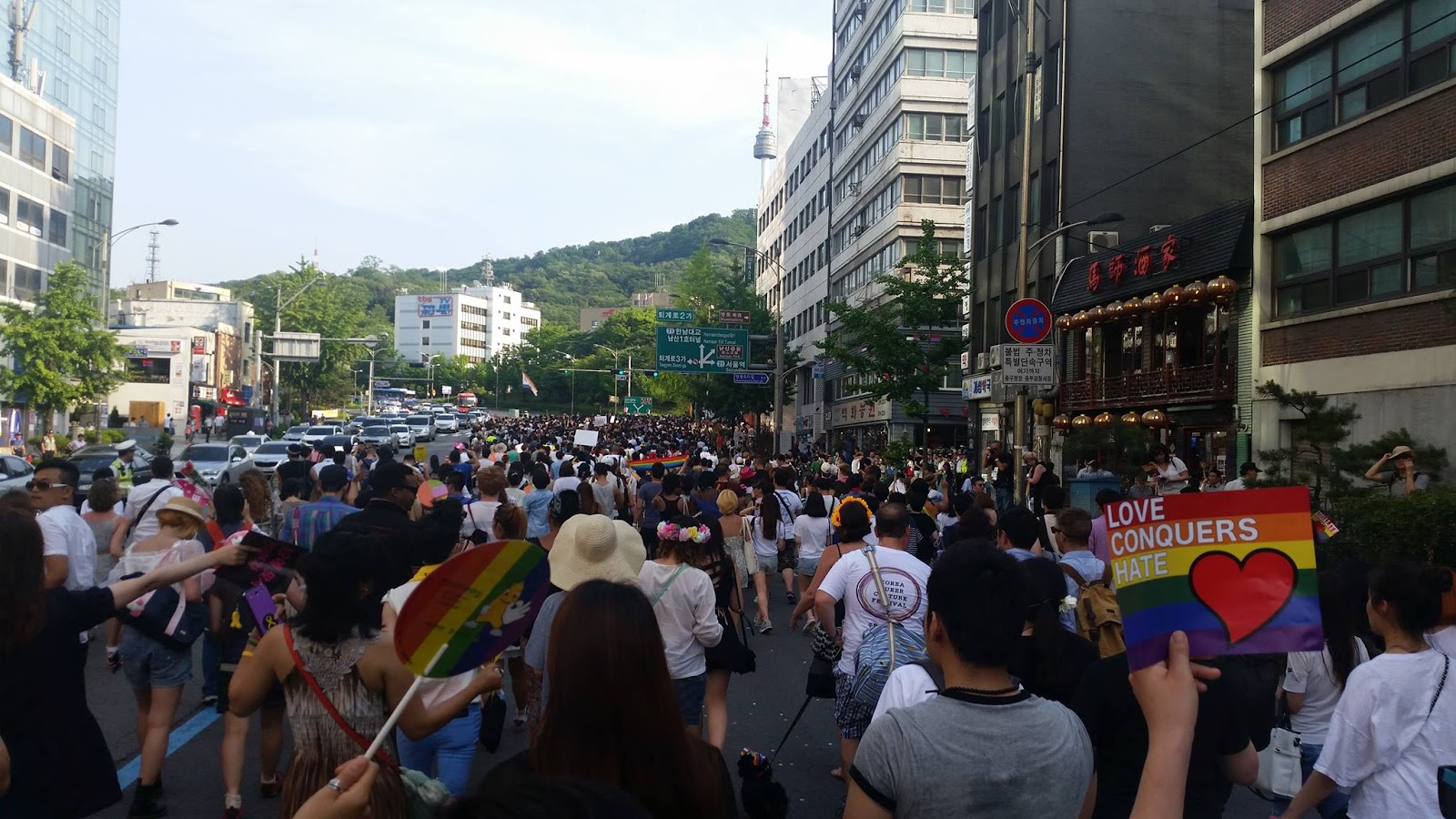
Korea Queer Culture Festival & Pride Parade 2015 (퀴어문화축제와 자긍심 퍼레이드)

"In a world where I can be myself, all love is equal."
This year's Korea Queer Culture Festival had its opening ceremony on June 9th and its closing parade on June 28th. I went to both events and took photos to share with you all.

(I have translated this post into Korean. But I have not had it checked at all, so it's going to be messy. Sorry in advance for the errors!)

올해 한국의 퀴어문화축제는 6월9일에 개막식이 열리고 6월 28일 자긍심 (프라이드) 퍼레이드가 열렸다. 저는 사진을 찍어려 갔다.

(저는 한국어를 잘 못 해서 실수가 많이 있르 것이다. 미안합니다!)

To my Christian friends: a good number of you may be against events like Pride and the values that it stands for. I understand this. Years ago I also used my religion and my deeply-held beliefs about Biblical morality to fuel my disapproval of all things that had to do with LGBTQ expression.

저의 기독교인 친구들에게: 아마 너희들중에 이런 행사와 성소수자의 이상에 반대하는 사람이 많은 것 같다. 저는 너희들의 생각을 이해한다. 저도 이전에 기독교와 성경을 믿기 때문에 동성애와 다른 성소수자의 표현을 싫어했다.

My point of view has changed, however. I believe now that it is only fair that LGBTQ people have the same rights as everyone else: the right to celebrate their own culture, the right to get married, the right to create families and contribute to society without being condemned or threatened because of their differences in gender or sexuality.

하지만 이제 저는 생각을 바꿨다. 지금 성소수자들이 평등권리를 받야 한다고 생각한다. 퀴어 문화를 즐기는 권리며, 결혼 권리며, 가족을 이루는 권리며, 혐오나 협박 없이 사회에 공헌할 수 있는 권리도 필요한다.

Furthermore, I believe that the Christians who have historically opposed LGBTQ activism have done so in a largely unloving and foolish way. While Christ calls us to love even our enemies, Christians were the first to cast stones at the oppressed sexual minority communities, or else stood by and watched discrimination become entrenched in society without lifting a finger to help. Christians should have been the first to help an oppressed minority, because God's love transcends petty human ideologies.

또 한, 이전에 성소수자의 활동주의에 반대하는 기독교인들은 야박하고 어리석게 했다고 생각한다. 예수님이 우리가 원수를 사랑하라고 했지만, 억압당하는 성소수자들을 공격하는 사람들이 기독교인들이었다. 선소수자들이 사외에서 차별을 당할 때 손가락도 까딱하지 않은 사람들이 기독교인들이었다. 오히려 기독교인들은 먼저 도와줘야 했었는데요. 왜냐하면 하나님의 사랑이 인간의 이상들을 초월하기 때문이다.
Seoul Pride Parade 2015
So here I was at Seoul's Pride Month events, happy to see Korea's LGBTQ community come together in strength and solidarity, and at the same time dismayed (yet unsurprised) to see huge numbers of conservative Christian protestors loudly declaiming against homosexuality, AIDS, public indecency, and gay marriage. They flew the Korean flag and a cross flag to symbolize the ideals of faith and tradition that drove them to protest, and they countered all of the Pride events with rallies and performances of their own.

그런데 제가 퀴어문화 축제를 다녔는데, 한국 성소수자들이 같이 모이는 것 하고 그들의 공동체의 결속을 보여줘서 고무적이고 감동적이었다. 반면에 수 많은 보수적인 기독교의 시위자들이 ‘동성애 아웃’, ‘에이즈의 광란’, ‘동성결혼 싫어’, ‘외설죄 반대’라는 구호를 시끄럽게 소리치는 것도 봐서 조금 속상했다. (역시 보수적인 기독교의 시위자들…) 신앙과 전통의 상진주의 위해 태극기와 기독교의 십자가 국기를 올렸고 퀴어문화축제에 반대의 그들은 자기의 행사를 열렸다.

I just want to show you what it looked like from the perspective of a non-Korean, Christian, gay man. I went to enjoy the events, and I went with friends, and I never at any point felt unsafe. I was happy to see the joy and pride at KQCF. I hope that the Christians who support LGBTQ rights will be encouraged that even in a conservative country like Korea, a celebration like this can happen. I also hope that the Christians who do not support LGBTQ rights will see despite their opposition, the right way to win hearts is not through anger, disgust, or despair, but through love.

저는 그냥 직접 목격한 것을 좀 보여드리고 싶다. 저는 한국인 아니며, 예수님을 사랑하는 게이 남성인데 올해 퀴어문화축제에 즐겁게 지내려고 갔다. 친구들이랑 무사히 다녀왔다. 제가 KQCF에서 행복한 분위기와 모든 사람들의 자긍심이 보일 수 있어서 기뻤다. 여러분, 성소수자를 지지하는 기독교인들이 한국과 같은 보수적인 나라에서도 이런 축제가 열려도 되는것에서 위안을 찾으시면 좋겠다. 그리고 성소수자의 권리에 반대 하는 기독교인들이 다음 진상을 아시면 좋겠다: 남의 마음을 얻는 것을 위해서 가장 좋은 방식이 분노, 혐오, 절망으로 아니고 사랑으로 해야한다.
Dance performances at KQCF 2015
To my Korean friends: a good number of you may be curious about what KQCF is, even though it has been held annually in Seoul for sixteen years now. Here's my short explanation: Some people think homosexuality is something that recently came from Western societies into Korea. Actually, LGBTQ (lesbian, gay, bisexual, transgender, and queer) people have been in Korea for hundreds of years, but the recognition that sexual minorities are normal and not mentally ill or perverted is more recent. And even more recently, there have been movements around the world to show acceptance of these sexual minorities.

저의 한국친구들에게: 아마 너희들중에 ‘퀴어문화축제’가 뭣인지 궁굼할 것 같다. 한국에서 지난 16년 동안 열렸거든요… 어쨌든. 동성애가 서양 사회에서 한국에 들어온 것이라고 생각하는 사람도 있다. 사실은 LGBTQ (레즈비언, 게이, 양성애, 트랜즈젠더, 퀴어 등) 사람들이 한국에 옛날부터 있었지만, 이 성소수자들이 실제로 정신 장애가 없고 변태가 아니라는 인식이 현대까지 안 나왔다. 그리고 더 최근에 전세계에 성소수자의 승인을 구하는 운동들이 시작되었다.

Seoul's "Korea Queer Culture Festival" began in the year 2000. LGBTQ activists have had to fight to gain recognition that LGBTQ people even exist in Korea. But there are more hurdles to overcome. Discrimination against LGBTQ people is widespread: in Korea, a gay or lesbian couple cannot get married, a person can be fired from their job for being queer, and, of course, LGBTQ teenagers can be bullied to the point of wanting to commit suicide. Activists and allies in Korea want to change laws and public opinion in Korea so that Korean society will become a safer place for sexual minorities.

서울의 ‘퀴어문화축제’라는 행사는 2000년에 세웠다. 이 전에 한국의 성소수자들의 존재를 대채로 인식되지 않았다. 요즘은 퀴어 사람들이 옛잘 보다 자주 보일 수 있지만 성소수자에 관한 사회의 문제가 많이 남았다고 생각 한다. 성소수자에 대한 차별이 정말 많다. 예를 들면 한국에서 게이나 레즈비언 커플의 결혼은 불법이다. 그리고 어떤 성소수자가 성적 성향 때문에 일에서 해고될 수 있다. 또, 퀴어 청소년들이 자주 자살하도록 괴롭힘을 당하고 있다. 한국 성소수자 운동가들 하고 동맹자(친구)들은 한국이 성소수자에게 안전한 사회가 되도록 한국의 법을 개정하고 여론을 바꾸고 싶다.

Of course, KQCF is also a big party, too. LGBTQ people value freedom, love, and equality for all people regardless of who they are. The reason the celebration can be a little bit wild is probably a direct response to the intensity of the community's historical oppression. If you go to a Pride event and see crazy costumes, leftist slogans, or people behaving in a way that is surprising to you, I encourage you to remain open-minded and remember that there is a reason for all of the things people do and believe, and that it is better to try to appreciate that reason than to immediately dismiss it because you don't understand.

물론 퀴어문화축제는 축제이잖아요. 성소수자들은 사람들의 차이에 상관없이 자유, 사랑과 평등을 소중하게 생각한다. 축제가 가끔… 광란(격렬?)하는 이유는 성소수자들의 역사상의 억압에 직접 반응인 것 같다. 너희들이 프라이드 행사에 다니시고 괴짜의 의상, 좌파 구호나 이상한 사람을 보시면, 므음을 열기를 바랍니다. 인간행동과 우리의 믿음이 개인에 딸라 다른 것을 잊지 마세요. 남의 다른 자가표현을 알아듣지 않아서 싫어하지 말고 그들을 이해해보시기 바랍니다.

To my LGBTQ friends: Have courage, and happy Pride!

우리 게이, 레즈비언, 양성애의, 트랜즈젠더, 퀴어 등 친구들에게: 용기를 가지세요. 힘내. 화이팅. 해피 프라이드!

Saturday, July 4, 2015

The Flag We Fly

Happy USA Day! Barack and Michelle Obama paid a visit to the US Embassy's booth at Seoul Pride last week!
Today is the Fourth of July, also known as Independence Day. This is the holiday when Americans commemorate their declaration of independence from Britain (way back in 1776) and celebrate American values such as liberty, freedom, democracy, and the right to shoot other Americans if we feel threatened by their existence. Just kidding about that last one...

Except that it's not actually something to kid about. As an American, I feel very lucky to have certain privileges such as the power of my passport, a top-tier education, and, well, freedom. But I would be remiss if I did not acknowledge that my country is flawed and deeply imbalanced. Though I have able to reap many benefits in my life, many of my fellow citizens suffer daily from systemic racism, hiring practices that put them at an inherent disadvantage, social expectations that don't support their self-expression, and a majority culture that shamelessly and ignorantly allows all of this oppression to happen.

Anyway. I'm proud to be an American, but I will not let my flag fly idly and be silent about the problems our country has to solve. What day is better to reflect upon how to improve America than the anniversary of her birth?

P.S. The photo above was taken at the Korea Queer Culture Festival! Many more photos and a recap post to come soon. Congrats USA, and thank you Supreme Court, for passing marriage equality in all fifty states. Happy Pride!

Friday, June 26, 2015

Return to Changwon

Last weekend, I returned to the city that I called home for two years, Changwon. Because I only had a few days to visit, I wanted to meet with as many people as possible, including my host family, friends from church, friends from language class, former colleagues, and even a former student. These were all people who changed my life in some way or another during my time in Korea, so I was very happy to meet them again. Happy is actually an understatement: from the moment I stepped off the train and saw my city with my own eyes once more, I felt a deep contentment and familiarity that must have come from a different level than the one that produces such fleeting emotions as happiness.

The familiarity was a curious feeling, too. From things as simple as getting on one of the city's insane buses again and remembering my old route home, to moments of reconnection like catching up on my host brother's now-terrifyingly enormous insect collection, to joyous reunions with old friends that included meeting new ones, every moment was tied to something or someone I'd known well all of eleven months ago. As quite a few people remarked, it was as if I'd only left yesterday. I think one year is not really that long a period of time, and most people did not visibly change (with the exception of my taekgyeon master's son, who is now in his terrible twos!). So it was indeed easy to kind of fall back into the swing of things. Except that never in my two years in Changwon did I have such a whirlwind of a weekend, consisting of reunions with dozens of different people.

Selfies galore, with: Eunjin, the CSHS English department, a former student, my taekgyeon masters, and a Fulbright buddy!
So here's what happened in detail. I took the KTX high-speed rail down to Changwon on Friday after class, and arrived in the evening in time to get dinner with Victoria, a fellow volunteer for Changwonderful, at TGI Friday's (how appropriate). Later that evening, I reunited with my taekgyeon 관장님 (gwanjangnim) and 사범님 (sabeomnim), the director and master/trainer at my old martial arts gym, and did the whole Korean drink-and-eat-and-drink-some-more thing. I had a wonderful time with them, and also discovered the greatness of flavored soju! I really cherished the opportunity to catch up with 관장님 and 사범님, because aside from people at school and my host family, I spent more time with them than anyone else in Korea. (관장님 even let me crash at his house over the weekend, and I spent a lot of time playing with his young son. 관장님 is like a big brother to me; I love his family and owe them so much.)

But even better, through my broken Korean, I was able to relate to the both of them some of my concerns about graduate school or about life in general, and they gave me some much-needed advice. You see, I often have doubts about my decision to continue in academia, partly because it's so hard and partly because I wonder if I'm actually doing anything meaningful with my life. I'm quick to point out that even though I am grateful to be back in California, I was actually happier on a day-to-day basis when I lived and worked in Korea. But 관장님 said something that reminded me of what many of my friends advised back when I was initially deciding on grad school: that I had to leave Korea to move on with my life.

I guess I don't like to be so blunt about it, but either way, since I've turned the page on that chapter, it's no use trying to go back to it as if I haven't already started the next one. I was also touched when 사범님 told me, or perhaps admitted to me, that in his many years of training in taekgyeon, he never worked so hard or enjoyed it so much as when I attended the gym. Heh, that definitely could have been the 순하리 talking, but I appreciated it nonetheless.

On Saturday, I joined 관장님 for his Saturday youth sports classes, including soccer, jump rope, and dodgeball. I met up with my old language partner Eunjin for lunch in the Garosu-gil area, and we had a great time catching up and discussing everything from our past baking adventures to movies staring 빵형 (aka Brad Pitt... brownie points if you get the joke!). I am so grateful that even though Eunjin's English is better than my Korean, she is always patient with me and will let me struggle through an explanation of how the book and movie versions of World War Z are completely different but good in their own ways without embarrassing me at all. And in the evening, I had dinner with my host family (I lived with them for my first year of Fulbright) and caught up on old times. Their dogs are still super cute and super annoying.

On Sunday, I met up with one of my former students, JW, who is now in his second year of university! He contacted me on Facebook and said that he was going home to Changwon, so he wanted to meet up. I was thrilled, because I don't have many opportunities to meet former students, especially those who don't currently live in Seoul. JW really wanted to practice his English, and I felt just like I was back in school doing lunchtime conversation club again. Except this time JW was really eager to talk about university life, and he asked for American TV show recommendations.

I also got lunch with Courtney, who is the Fulbright teacher who has taught at CSHS for the past year, and we discussed life in Korea and the ways she's grown and learned this past year. We also talked about religion and sexuality. I am so impressed with the way Courtney's mind works. It's wide open and ready to listen to anything and everything, as if everyone she encounters is a vendor giving out samples of food she's never seen or tasted before, and it is all delicious. She has embraced the differences of others, as well as the discomfort and the weirdness of living in a foreign country, far from home for a year, with as much energy as a kid at an amusement park who might not be tall enough to get on all of the rides but doesn't care a bit.

In the afternoon, I went back to Redeemer Changwon, a small church that meets at a cafe in the downtown area. I began going to the church a year ago when it was just a handful of friends wanting a fresh, community-based church experience. I was happy and encouraged to see how it's grown since then. And my old friend Traylor gave the sermon, too! Good on him. He preached from 1 John, which, curiously, is a book that I've heard quite a few sermons on in the past few months. It can't be pure coincidence... It was great to catch up with the church folks again, and meet some new friends. We all went to dinner together afterward at El Loco, an excellent Mexican restaurant with prices much more reasonable compared to here in Seoul.

Monday was the long-awaited day in which I went to visit the school where I taught for two years. As soon as I walked on campus, I felt really... in place. As if it were just any other school day and that I should probably get to my classroom or office in a minute. It was exciting to bump into old teachers and students and see them do a double-take. Many of them stopped to greet me and chat in Korean, and they kept saying, "어떻게 왔어요?" Those two words literally mean how and came, so I interpreted it as, "How did you come here?" So I told them that I took a train. To my embarrassment, it's actually, "How come you came here?" So I modified my answers: "I'm here to visit." And to reconnect. And to relive some amazing memories.

Courtney was gracious enough to let me visit her classes that day, including her two classes with the third-year students, who were my second-years last year. I was excited to see them, and they were excited to see me, and they kept commenting about my hair, so I told them about topknots and 상투 and they vacillated between thinking it was cool and thinking it was horrible. Yet for all the thrill of the reunion, let's be honest: it was still English class, and they were still pretty loathe to speak English! Not that much has changed, I suppose! It was actually a bit sad to see how these third-years seemed so tired after so much time stuck in the grueling high school routine. I am looking forward on their behalf to four or five months from now, when they will have finally finished. I also got to meet and play a game with a class of first-years, i.e. students who had no idea who I was. That was a riot, too! They are just the same as my old classes of energetic, not-yet-jaded first-years. They associate California with beaches and CalTech, wail when I tell them that I don't have a girlfriend (and don't want one), and think that my being able to write a few words in hangul on the board is worthy of infinite admiration.

Besides visiting students, I also got lunch with Courtney and the other English teachers, Saerona, JJ, and a new teacher I hadn't met before. It was so sweet of them to be so welcoming and hospitable. Saerona also made me a small gift. (I'd brought some chocolate from the US, but I wish I'd brought the San Francisco coffee again, as I did once, because the teachers in the main office still remembered how good it was... haha.)

And then, too soon, the day was over, and I got on a bus to go back to Seoul. After seventy-two hours, my heart was full.

- - -

I really want to go back to Changwon again, but I don't really know how feasible that will be, as my schedule gets busier and busier, and the time I have left in Korea is already winding down. I wanted to write more about this fantastic, nostalgic, much-needed weekend. Every meal and every conversation deserves its own post, actually. But most of it wouldn't be of very much interest to anyone but myself. I've just spewed out a lot of words on the Internet about something that is very inconsequential to the world at large... what's the point. Well, if there's anything you take from the post, I hope it's this: there was nothing that I loved in Korea more than the people that I met here and formed positive relationships with, and they are the only thing that will keep me coming back.

Saturday, September 27, 2014

Memories

I forget things easily, and I'm sad to admit it. The other day I was browsing my Facebook news feed when I saw that one of my former students had changed his cover photo to a cute picture of his entire class. I smiled when I saw the picture, then clicked on it to take a closer look. I saw three rows of familiar faces smiling for the camera, hands in the familiar "V"-sign I'd even begun to use after living in Korea for two years.

Nobody was tagged in the photo yet, so I tried to remember the names of the students in that particular homeroom class. And that's when I realized that I couldn't. Many names came back to me easily, but others escaped me completely. I had iterations of various Korean names floating around in my head, but I couldn't attach them to faces. I almost panicked because it dawned on me that my attachment to Korea has already begun to weaken and fade. I've been home for almost two months, haven't seen my students in nearly three, and despite all the messages I send on Facebook or the photos and status updates they post every day, I am beginning to forget who they are.

On one hand, this is only natural. We can pour our hearts out onto people and connect in life-changing ways, but when it's time to move on, the old links break while new ones form; the empty jar gets filled with other people. Social media and other forms of technology can only sustain it for so long. Maybe we just wern't meant to keep in touch with everyone forever.

Which do I fear more, forgetting or being forgotten? I hope that I left a lasting legacy on my students, at my school. But I know full well that I will eventually become nothing more than a memory, maybe also a photo. Courtney, who is now teaching at my school, has been doing an amazing job with my old students, as far as I can tell. And I'm happy about it. If they have so much fun in her class that they forget all the (boring) things that I ever taught them, I'll have peace of mind. But the jealous litle devil in me also wants them to miss me. To think, "I wish Andrew Teacher were still around," even though it's just a pipe dream.

Well, Courtney messaged me the other day with a photo she took of a second-year student's journal entry. And when I read what JH had written, I felt all warm inside. It really made my day.
"Since I have lived quiet good life, I have a lot of great memories. First, it is meeting teacher Andrew in CSHS. Andrew teacher is the most intelligent and kind teacher who I have ever met include Korean and foreigns. He always cheer us and keep us think optimistically. After I graduate BS in university, I'm going to meet him in US."

If you look carefully, you'll see that JH's second great memory is meeting Courtney at CSHS. I'm just so thrilled that English educators are making an impact on this young person's life. Maybe five or ten years down the road, he won't remember much of anything about either of us. (And maybe five or ten days for now I'll have forgotten what he looks like again.) But at least for now, we can know that we've done some good.

- - -

On another note, I will be closing this blog at the end of September. This is probably going to be my last post. There are some other things I've had sitting around in my drafts for a while, but it's unlikely that I'll ever get to them. If something does come up in my future that brings me back to Korea, then I see no reason why I wouldn't write again. But in the meantime, I'm starting up a new blog, this time on WordPress, that will document my adventures in graduate school. You can find it here.

I have loved writing and photographing my time in Korea, and I thank all my readers for having joined me at one time or another. If you were a friend from home, or the random parents of friends, or a complete stranger who stumbled across this by accident, thank you all the same! I hope you learned a thing or two and were inspired, possibly, to think or write or create in some way for yourself.

안녕히계세요. Peace.

Saturday, August 16, 2014

Disappearing Languages and Other Things

Interesting stats about the language imbalance in the world and current efforts to translate the Bible into indigenous languages, shared with me by a friend who did two years of missions in western Afria.

About four years ago, my dream was to become a linguist for Wycliffe who would go to remote areas of the world to translate the Bible into indigenous languages. That's changed, and a part of me regrets that my life has taken a different direction. Of course, I say that I will do whatever and go wherever God calls me, but I wonder if I backed down from the idea of working with Wycliffe because I was intimidated by the notion of actually being a missionary?

When people from my Christian community back home learn that I've been in Korea teaching English, their first assumption is that I went abroad to do missions work and taught on the side. Actually, I went abroad to teach English, and didn't do any missions work on the side. To reiterate: not a finger did I lift to contribute to this great cause for which I purport to live. And when I clarify this, well, it becomes a bit awkward. I wonder if I've let them down in some sense.

Now, my time in Korea is over. Memories are starting to be replaced by photos and blog entries, people are losing reasons to stay in touch. I've been home for one week, and in two more, classes will begin: my first steps toward obtaining a PhD in linguistics. Five years down the road, I'll be a "doctor"... and then what? What will I do after that? Where will I go? God only knows. (And does anything I'd ever had planned even matter to Him?)

A new chapter begins... But the book of life metaphor isn't perfect, I must admit. In a book, I can always turn back to an earlier page, read it again, maybe add an annotation. Seems more like I'm reading a message I'd scratched in wet sand at the beach, only to have the water wash it away.

It's hard to remember things.

- - -

P.S. Unrelated: I found out recently that a friend and fellow Fulbrighter in my year is the granddaughter of WC Townsend, the founder of Wycliffe Bible Translators and SIL International! Wow! Also, one of the Fulbright Korea grantees this year is the grandson of Noam Chomsky. It's like the heirs of linguistic royalty are partying up in Seoul right now. Haha.

Monday, August 11, 2014

"Enter Pyongyang" Hyperlapse Video Review


A friend shared this video on Facebook, and I had to take a look. First impression: it's well-crafted and beautiful as a film. No surprise there, since Vimeo is the video sharing site to go to if you have something pretty to share! I'm a sucker for timelapse and hyperlapse (that is, timelapse + shifts in perspective) videos anyway, so simply watching this was a treat.

I'm a little concerned about the message it's sending, however. The pros are that the video will dispel myths that Pyongyang is completely destitute, crumbling to pieces, and cut off from the outside world. These are pretty much untrue, but that doesn't mean it's, like, a nice place to live. So the cons are that the video can easily give a false idea of what Pyongyang, or even all of North Korea, is like.

Here's what I thought as I watched the video: where is all that light coming from? There is so little electricity available in the city. The cityscape is not that bright at night. The computeres in the grand library are only on for a few hours each day. And where is all that color coming from? Maybe my camera is not as nice as the equipment used for this video, but the dominant color in every photo I took in North Korea is gray.

The subway is exactly how I remembered it, though. Like my tour group, the filmmakers were only allowed to see the few nicest and busiest stations of the two-line system. Even though the platform was grand and lit up, the train was dated and dark inside. I was caught by surprise by a tender moment when the sped-up footage slowed down to show an old man entering the station, and again when it paused to let a traffic cop stop and chat with a lady pushing a stroller, again when a little girl at the roller-skating rink spotted the camera. These brief moments that revealed ordinary human actions and interactions did make me smile.

But again, that does not mean North Korean society is harmonious or normal by any standard. The filmmakers worked closely with Koryo Tours, a North Korean tourism company, so it's not surprising that the footage shown was neat, aesthetic, and even attractive. It's the image a tourism company wants you to see. It's also the fabricated facade that the DPRK's totalitarian regime wants you to see. They don't want you to see that the inside of the gorgeous pyramidal Ryugyong Hotel is skeletal and unfinished, only that the lawns on the outside are green. They don't want you to see the dilapidated apartments in the western parts of the city that have no glass in their windows, only the newly-constructed ones (that, despite their appearances, have their electricity shut off at night just like every other building in the city besides the monuments). They don't want you to see anything outside of the capital city, either: none of the concentration camps, the starving gangs of orphan children in the northeast, the abandoned factories that have produced nothing for decades, the hills stripped completely bare of their forests, the desperate men and women who smuggle food, drugs, and people across the border to China. None of these things are supposed to exist in the Kim dynasty's sterilized image of the Victorious Fatherland. It's not that I expect them to show up in what is essentially a three-minute advertisement, but I'll be frank: the North Korea that you have just seen is not the North Korea that you need to see.

This video used awesome technology and uplifting music to reinforce the idealized image of Pyongyang. I wouldn't call it propaganda, and it's not like anything shown in the video is actually fake. But it's easy for pretty things to convince the world that pretty is all that exists, and I caution any viewer from drawing the conclusion that because a couple of professional filmmakers were allowed to tour the capital of North Korea with their cameras, the entire country is actually brimming with "dynamism and [a] sense of potential."

North Korea is a long way away from really opening up to the outside world, but when it does, I hope that someone with the same advanced equipment as well as a heart for millions of oppressed and suffering people can enter and show us more than this.

Wednesday, August 6, 2014

Last Night in Korea

And all of a sudden, it's my last night in Korea. Wait, what? In twelve hours, I'll be on my way to Incheon Airport with two suitcases and a backpack, and in twenty-four, I'll be landing in San Francisco. I'll be home so very soon.

I haven't gotten around to blogging as much as I'd intended to this past week, so here are a few quick updates:

1. After bumming around in Seoul for a few days, I went to Goesan for Fulbright Orientation where I led four workshops over a few days. Two workshops were for discussing identity: one to support LGBTQ-identifying ETAs and another to support Asian-Americans. The next workshop was to introduce different methods and resources for people who want to continue studying Korean on their own throughout the year. Many ETAs showed up to this talk, which was very encouraging. The last workshop was for all fifty secondary school ETAs; it was a crash course on how to plan a unit. Honestly, if there's one thing I can say about teaching, it's that one hour-long lesson isn't nearly enough for any topic in education. But just as important as preparation is practice, plain and simple. I've been pretty encouraged by the enthusiasm and earnestness I've seen in the new ETA class. I'm confident that they'll do a great job this coming year.
Katelyn, Tracey, Seijin, and Jemarley taking a break from Fulbright duties to play Bananagrams at a local makkeoli bar!
Judith's and my unknown reunion!
And I know I've already said this, but I'm especially excited about the teacher who will replace me at CSHS, Courtney, because she is determined to be exactly the kind of teacher I think is most effective: passionate, accessible, and involved in students' lives.

Unrelated: to my great surprise, one of the new ETAs, Judith, is actually a family friend! Her parents have been good friends with my parents ever since my family lived in Philadelphia (nearly thirty years ago)! And, awkwardly enough, we've even met. Four years ago, our parents' church had a reunion in Philadelphia, both Judith and I attended. So we met, took photos, and even played Bananagrams together! We obviously didn't leave very lasting impressions on each other, since both of us thought we were meeting for the first time last week. I think it's hilarious! The world of Taiwanese-Americans can be very small, indeed.

2. During the weekend, a typhoon was sweeping by Korea, and it brought a lot of rain with it. I'd planned to go hiking with a friend, but instead, we went to Cheongju, a smallish-city with not too much to do. However, it was still bigger than rural Goesan. (Aside from a new cafe/jam space on the outskirts of town, where I karaoke-d for hours on Friday night with new friends, there's nothing to do in Goesan.) Katelyn and I watched a movie, ate great 칼국수 and 빙수 and explored Cheongju's own "mural village", Suamgol, in the midst of a drizzle. It wasn't the most exciting thing to do, but after being cooped up in the marble halls of Jungwon University for four days, it was excellent.
Katelyn and me in the colorful Suamgol, Cheongju. Brownie points if you can spot what's wrong with this picture...
4. I spent a good chunk of my last full day in Seoul running errands, and it was more than a little frustrating. I had to cancel my phone contract and my bank account. Long story short, it was more of a hassle than I'd expected, mostly because I had to do almost every transaction in Korean! I'd thought that big branches of phone stores and banks would have some competent English speakers in the capital city, but that was not the case. Even the resident English speaker at the bank tried explaining the procedure to me for about five minutes before switching back to Korean. Ugh, Koreal life. I managed to get these two simple tasks done in three hours, and in the meantime I picked up a few useful vocabulary words, such as 계좌 ("account") and 해지하다 ("to cancel"). Whew.

Catan! Photo taken by Katelyn
5. And as for my last night in South Korea? I hung out in Hongdae and played Settlers of Catan with my friends (역시... I mean, what else? It's what I did on my "last night" in the US two years ago.). Ooh, we also got dessert from Ben's Cookies. Their milk chocolate-orange cookies are amazing!

It was a chill and really enjoyable evening. There's nothing else I'd have rather done!

Hm... so how do I feel? In all honesty, this night doesn't feel at all different from any other night I've spent hanging out with friends in Seoul. I have a feeling that the reality of leaving won't hit me until I'm en route to the airport, or maybe not even until I've boarded the plane. Nostalgia doesn't kick in as early for me as it seems to for other people. But that's not to say I'm not cherishing every last moment I have here. Even though those moments are dwindling, why waste any of them dwelling on the very fact that they are? Too meta and unproductive for me.

Next time you hear from me, I'll either be at the airport or at home.

안녕하세요!

Wednesday, July 23, 2014

Drim School English Camp

Teachers and volunteers for the Drim School's first English camp! Left to right: Debbie, Hannah, Carolyn, Leslie, Min, me, Alanna, Dianna, and Nikki.
Hello from Cheonan! I have spent the past two days teaching at an English camp for the Drim School (드림학교). This school is a 대안학교 (alternative school) for teenagers and young adults who are North Korean defectors (탈북청소년). They study in order to catch up on years of lost or insufficient education, become more adjusted to life in South Korea, and eventually take Korean primary and secondary school exit exams so that they can apply to university.

The Drim School, founded in 2003, is affiliated with the Korea Theological Seminary (고려신학대학원) in Cheonan and has been working with Fulbright Korea for about five years. Fulbright ETAs teach volunteer English classes there weekly. This English camp, however, was the first of its kind at the school. The volunteers wanted to provide something similar to the summer camps that the Drim School students can't normally afford. We prepared a program with English classes, cultural activities, games, and lots of time to make new friends and build strong relationships.

I was assigned to teach the lowest-level English students, which means lessons on recognizing letters and the basics of English phonics. This was surprising for me at first, since I teach fairly high-level students at my regular school. However, I learned that the reason I was given the low-level students was that I can speak and understand at least some Mandarin Chinese. The students who cannot speak English are mostly those who have only very recently arrived in South Korea, usually from China. Since they have spent years living in China (and may even consider themselves Chinese rather than Korean), they are completely fluent in Mandarin but have little to no grasp of English. A handful are not even conversational in Korean, so even the regular Drim School teachers have some trouble communicating or connecting with them.

Me with some "star"* students during the scavenger hunt!
One such student was OH. He arrived in South Korea no more than one month ago and speaks only Mandarin and very basic Korean. It wasn't hard to figure out why he looked so lost and lonely all the time; while he could talk to most of the other students in Mandarin, every other exchange in his life was conducted in rapid Korean. Even though he is Korean, he was just as confused as any non-Korean is when they first get here.

OH was in my class, and at our first meeting I told all my students straight off the bat, in Mandarin, that if they ever had any questions or problems and wanted to ask me, they could do so in whatever language they felt most comfortable with. Since I was the only volunteer in the camp who could speak it, many students chose to chat with me in Mandarin (or in a mix of Mandarin and Korean). Even though I'm well out of practice, not having studied it for three years, I welcomed the opportunity to practice and, more importantly, to connect with kids who may have gone months or even years without a teacher who can understand them in what they consider their native language. It was so wonderful to see how OH opened up, not just to me, but to his peers as well, over the course of the camp. I don't really know what his performance was like during the past semester, but he certainly proved to be a diligent student, taking notes in my class and asking me questions, volunteering for every game, and putting in a genuine effort to memorize the numbers from one to twenty.

Besides English classes, I also co-led an extracurricular class on guitar and songwriting with my friend Alanna. At first, we had no sign-ups, but eventually we had too many students in the classroom to keep the class under control! It was very loud and very fun; we just taught two simple chords and a strumming pattern and wrote a simple song about love. (It tastes like sweet chocolate and feels like the warm sun.) I think that more than anything, the students learned that learning how to play the guitar isn't easy! I'd forgotten how much it hurts your fingers when you first start out. But I think they all enjoyed it, anyway.

Hannah and me with the 동그라미 (circle) group!
There were other cultural activities, like t-shirt tie-dyeing, baking, and a Konglish photo scavenger hunt, that were quite enjoyable. I'm really impressed with how much effort the other volunteers put into their classes and activities. I myself was scrambling to throw together my lessons right up until the start of camp, because I literally moved out of my apartment the day before it opened and had been very busy and just a bit frazzled. Though like any camp, it had its hectic moments, unexpected snafus, and last-minute schedule changes, overall, I think it went splendidly. It was only two days, but that was enough for me to get close with my students and show them some love.


The vice principal of the school mentioned in her closing ceremony speech tonight that she was grateful that through our camp, the kids could experience some of God's love. And it hadn't occurred to me before, but I guess it's true. The Drim School, along with the majority of non-governmental South Korean-led initiatives to help North Korean defectors and achieve peninsular reunification, is an evangelical Christian mission. I have to admit I rather admire the passion that the Korean church has for reunification (this is despite my personal misgivings about its actual possibility in the near future), and I am grateful for the way their devotion to God has translated into tangible good works for those in need.

My father, who just finished a missionary English camp of his own in Taiwan, asked me recently if I had used my time in South Korea to share the Gospel with my students or others in my community. The simple answer is no, unfortunately, but now I wonder if there can be such a thing as "passive witnessing," wherein my students know that I am a Christian and can observe how I live and act in light of this information, or else I volunteer with the Drim School and reinforce the school's teaching that all good things are a blessing from God, including fun foreign teachers who speak Chinese.

I also admitted to a friend a while back that I'd sort of marked the last two years in South Korea as a spiritual lost cause -- this was mostly in reference to my frustration with church before I started attending Redeemer -- but on the other hand, I might be looking at things overly pessimistically. No one is a lost cause to God. He isn't in the habit of giving up on people, so I won't give up, either.

Okay, sorry for the tangent. Anyway, I am very happy and grateful to have had the opportunity to help with the Drim School's very first English camp, and I wish my students all the best in the years to come. I'll surely visit them when I return to Korea in the future.

- - -
* I'm covering my North Korean defector students' faces with stickers in my photos, because I am not allowed to show them anywhere online for security reasons.

Friday, July 18, 2014

Last Day

“Good morning, UJ!”
“Teacher, last day!”
“Yes, today is my last day…”
Classes were canceled today (but of course) for student performances and the semester closing ceremony. I was disappointed that I couldn't have my last class with my first-years, but I had a lot of other stuff on my plate that I had to take care of, anyway. First on the list was a letter to the new teacher explaining everything about our school. I gave myself a week to finish it, and it ended up being 14 pages long. I also had to clean up the computers and my desk, which felt strange... and I ran around the school giving some teachers and students gifts at the last minute. Students kept coming into my office all day with goodbye letters they'd written for me, and I was very happy and grateful. But I was too busy to let my emotions take over.
"So you're leaving tomorrow?"
"Monday, actually."
"And you're never coming back?"
"No. Uh, I mean... well, I'll probably come back; I just don't know when."
"Wow..."
"You know, I always find that on important days, I'm not as emotional as I think I should be. What I mean is, after the day is over, I look back and think that I should have been more happy, or more sad."
"Well, I don't know. I think for me, I just want to act as I normally do. I wouldn't want my emotions to be dictated by my thoughts or expectations."
At the closing ceremony, I watched my students sing and dance for the last time... then awards were handed out, the principal gave a speech, and I gave some final words. Flashback to two years ago, when I looked out at 180 young faces for the first time and said, "안녕하십니까?" Seriously, two years ago?

My speech was short. I reiterated the three points I'd made (up on the spot) when I was interviewed for the school newspaper. What parting advice would I give my students? Number one: please try to get more sleep. Not in class, of course, but in your dormitories. Number two: although you are all bound to be high-achieving, successful people in the future, please remember that your worth, your value as a human being, cannot be measured by your academic performance. Remember that what is most important is not what school you go to or how much you make, but who you are inside. Number three: please keep in touch! Although I am saying goodbye, I prefer to say, "See you later." My eyes became a bit damp at the end, but I held actual tears at bay.
"Teacher, will I see you next semester?"
"No, you won't..."
"Oh, no... really?"
"I'm sorry!"
"Teacher, I almost cried when you talked... what was it? You said, 'remember your value'... I was so... ah... Teacher, I'll miss you!"
"건강하세요. Stay healthy and happy."
After the final bell rang, I paid one last visit to the hallway by the environmental science classroom, accompanied by the earth science teacher who was my gym buddy this past semester. He told me to stay healthy and gave me a hug. I said my goodbyes silently.
"Teacher, can we take a picture?"
"Of course! I love taking pictures!"
"Dear Andrew... I want to tell you something. When you were in this country, you made many people happy. At least the students of this school, could enjoy an english class every week. So, when you go back, you should be happy and proud of yourself that you gave us a big present i love, and a nice memory. I hope whenever you think of Korea, you feel really nice. Thank you for your existance!

Sincerely,
SJ"

That's when I cried. Finally. As I sat on my bed at home with farewell letters all around me and the rain and thunder going nuts outside. I was so touched, so blown away by the affection of people I've only known for a short time. Everyone wants to be able to make a difference in others' lives, and to be validated like this, with such genuine, heartfelt gratitude from a student, was just the thing to get this stoic to shed a tear.

I will miss this... but I won't say goodbye.

See you later!

Tuesday, July 15, 2014

작별 인사 스피치 - Farewell Speech

Today, I went to the community center Korean class for the last time, sat down to write a short essay for the last time, asked the Korean tutors to check my work for the last time... and gave a speech for the last time. I haven't been going to the class regularly this semester due to busyness, but it was an integral part of my life in Changwon for my first year and a half. I'm very thankful for the 창원한글학당 (Changwon Korean Class) because it helped keep me motivated to study Korean. Anyway, here's the speech I wrote, with the translations beneath.

시간이 너무 빨리 지나갔죠? 다음 주 월요일에 저는 창원을 떠날겁니다. 그 때 이 주일 반 후에 한국을 떠날겁니다. 저는 달력을 보다가 걱정하거나 멘붕 와야 한다고 생각하는데, 실제로는 아주 침착합니다. 대개 저는 감정적인 성격이 아니거든요. 제 친구들중에도 한국을 떠나는 선생님들이 많습니다. 그들은 마지막 수업 할 때 많이 웁니다. 그러나 저는 오늘 학교에서 작별 인사 스피치를 했을 때도 눈물 하나도 없었습니다.

Time's really flown, hasn't it? Next Monday, I'm going to leave Changwon. Two and a half weeks after that, I'm going to leave Korea. I ought to be looking at my calendar and worrying or freaking out, but actually, I'm calm. I'm usually not a very emotional person, you see. Many of my friends are also teachers who are about to leave Korea. They've been doing a lot of crying in their last classes lately. But as for me, even though I gave a farewell speech at school* today, I didn't shed a tear.

제가 안 울고 있는데, 그 이유가 떠나는게 안 섭섭해서가 아닙니다. 저는 진짜 아쉽습니다. 약간 가고 싶지 않습니다. 그렇지만, 이제 저는 앞으로 나가기 위해 준비되었습니다. 이년 동안 한국에서 굉장히 즐거웠습니다. 매우 축복받은 사람이라고 생각합니다.

So I'm not crying. But it's not because I'm not sad about leaving. In fact, I feel really sorry to go! I kind of don't want to leave. But I think I'm ready to move on now. I have really, really enjoyed my two years in Korea. I feel very blessed.

저는 미국에 돌아가서 캘리포니아 버클리 대학교에서 언어학 박사학위를 시작합니다. 저는 진짜 신나고 여기서 받은 경험이 저를 도와 줄 것 같습니다. 특히 여기 창원 한글학당의 선생님들에게 감사 드립니다. 선생님들은 저를 격려하셨고 한국어를 잘 가르쳐주셨고... 창원에서 살고 있는 외국인들에게 매우 귀중한 단체입니다. 써니 쌤 열심히 지도하셔서, 또 나미 쌤 참을성있게 가르쳐주셔거, 그리고 여러분 모두 사심없이 도와주셔서 감사 드립니다.

When I go back to the United States, I'm going to start working on a PhD in Linguistics at UC Berkeley. I'm really excited, and I think my experiences here will help me. I especially want to thank the teachers at the Changwon Korean Class. You teachers have encouraged me and taught me well. The foreigners who live in Changwon have such a valuable resource in you. Sunny, thanks for enthusiastically leading the class; Nami, thanks for patiently teaching me, and to everyone, thank you for all of your self-sacrificial help.

미래에 한국에 돌아오면 다시 뵐 수 있기를 바랍니다.

In the future, I hope that I can come back to Korea and that we can see each other again.
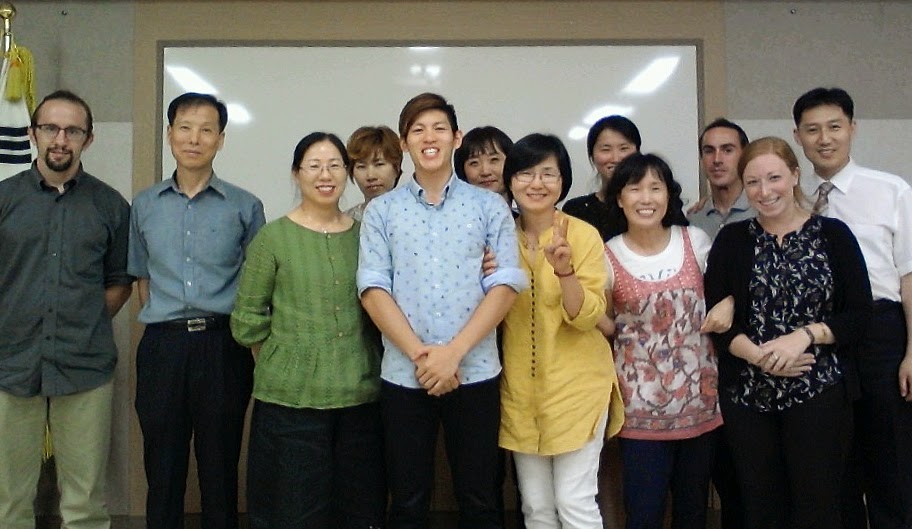
창원한글학당 - Changwon Korean Class. Nami is in yellow, and Sunny is in white on the far right.
- - -
There were not too many people at Korean class today, but the few that I really wanted to thank were there, so that was enough. Nami gave me a small farewell gift, a beautiful keychain. Man, I really am sorry to go!

*Yes, I also gave a goodbye speech at school today. It was before the end-of-the-year teachers' sports competition, which took the form of a ring-toss tournament this time. Anyway, the speech I wrote (and my co-teacher expertly translated) was a heck of a lot longer than this one. I awkwardly stumbled through it for like five minutes because the level of Korean that I was reading was way beyond me. But my principal really appreciated it, I guess. He kept saying, "아쉽다! 아쉽다!" That means, "It's too bad! It's too bad [that you're leaving]!" Perhaps I will post that speech in its entirety later.

Thursday, July 10, 2014

Gohyang

     He said, "I've been studying Japanese lately, been getting a real kick out of it, too."
     They were at a cafe that was situated above another cafe, looking over a busy intersection as umbrellas competed for space on corners not meant for the cars parked on them. Rain was in the air, not so much falling as existing, hovering, slowly being drawn toward surfaces like dust to a sheet of plastic wrap.
     As he spoke, she stirred the empty contents of her cup and watched him, noticing that his words left his mouth and fell straight down into his half-full glass instead of traveling up to meet his eyes. As he spoke, his gaze remained silent.
     He stopped and thought for a moment. "It's kinda ironic, I guess? I know what you're going to say: 'So when are you going to start studying Korean?'
     In fact, she was going to say that.
     "I've been here two years and I can still barely order chicken and beer." He chuckled. "But we're thinking of, you know, moving on."
     This was news. "Wait, hold on. You're going to leave Korea? And go to Japan?"
     She paused her stirring for dramatic effect, the director and only audience of a play staged between her chair and the middle of the table.
     A slight hesitation. "Not Japan, necessarily. But, you know, somewhere. Korea has never really felt like home."
     With the smallest suggestion of raised eyebrows, she quickly replied, "Well, of course it doesn't. No, your home is where your father was born."
     "What?" he asked, forehead wrinkling in confusion. "According to who?"
     "According to Korea," she answered, matter-of-factly. "That is, according to the traditional concept of hometown. Gohyang."
     "What, does that mean even if I live here for twenty years I still won't be--"
     "Right. 'You're not from around here.' You never will be, because your family isn't. But your real home, your gohyang -- what is it, South Carolina? Georgia? At least that will always be there."
     He paused to consider this, albeit briefly, and signaled this by glancing out the window, where green had just turned yellow, then yellow red. She looked into his eyes and, subconsciously, followed them outside. People had begun to cross.
    "In any case," he began, "we're obviously not going to go before our contracts are up, but we're, you know, keeping our options open."
     "And well you should!" she said loudly, causing his eyes to widen. "But look, permit me to give you some advice? As someone who has been here now more than half a decade?"
     She didn't wait for permission. "Forgive me if this comes across as condescending, but perhaps the reason you don't feel like Korea is home is that you haven't tried to make it your home. And no, I don't mean by making your parents move here and getting them fake birth certificates. No, just, maybe try to learn the language? Meet more people? Realize that there is a world outside of your apartment, your school, and your five favorite cafes downtown?"
     "I do do a lot of stuff," he countered. "And I really like my school, my kids. Maybe it's hard to explain how I feel. Things just haven't... clicked."
     "Korea isn't for everyone," she remarked calmly.
     He bristled, and immediately hoped she didn't notice. "Well, all the cafes are overpriced, anyways."
     "So where is your hometown, then?"
     "South Carolina was right." His eyes were a deep indigo blue. "And yours?"
     She thought for a moment with her mouth slightly ajar. "Well, it's complicated. Father's from Indiana, mother's from New York, but we've lived abroad for more years than we've been in the States. So uri gohyang... could be anywhere, really." She shrugged. "As long as it's not Eagleton."
     He gave a small smirk, finished the rest of his drink, and looked around. Every other pair in the cafe was a couple, communicating via a combination of texting and making doe-eyed faces. One girl had been taking photos of herself with her latte-sipping boyfriend in the background, pretending that his cuteness was candid. I will never understand this, he thought to himself. She cleared her throat.
     "You know how they say, 'Home is where the heart is'?" she said.
     "Not here, apparently," he replied. "I mean, who is the 'they'?"
     She had to think about this, but wasn't sure if she wanted to. So she met his gaze once more, saw that it had sharpened, and went with rhetoric instead.
     "Who indeed?"

Translate