Showing posts with label religion. Show all posts

Tuesday, July 28, 2015

The Gay Christian Debate

The Gay Christian Debate
July 25th, 2015

"Does the Bible condemn homosexuality?"

Last Saturday evening, a public debate was held at the Hamilton Hotel in Itaewon, Seoul, between Pastor Paul Warren from Sojourn Fellowship (Incheon) and Reverend Daniel Payne from Open Doors Metropolitan Community Church (Seoul), with moderation by Calon Webb. The topic of the debate was the position of the Bible on homosexuality. This topic has undeniably come under close scrutiny in recent months in South Korea, as the tension has mounted between some vocal conservative Christian groups and the country's LGBTQ community, especially after this year's Korea Queer Culture Festival on June 28th.

I attended the debate and took six pages of notes over the course of the 2.5-hour event. The purpose of this post is to recap the main points made by each pastor as succinctly as possible, and I will add some of my own thoughts at the end. The debate was conducted in English, and it was videotaped, so that a recording with Korean subtitles can be made available online in the near future.

Both pastors were allowed a twenty-minute opening statement. Reverend Daniel (henceforth DP), who takes an affirming position on homosexuality (i.e. the Bible does not condemn it), began by stating that both he and Pastor Paul (henceforth PW) approached the question under the assumption that the Christian Bible is the inspired and authoritative word of God, and thus that whatever the Scripture says and means should be followed by professing Christians. DP stated that the Bible is a very complicated book; it has historical, cultural, and linguistic contexts that must be understood. And homosexuality in its modern, twenty-first century context is different from homosexuality as addressed in the six most-cited "anti-gay" passages of the Bible. For example, the sin of Sodom was the sin of inhospitality, not homosexuality per se; also, the Levitical laws against homosexuality were a reference to pagan ritualistic temple prostitution. In these passages and in others, DP stated that homosexual activity of a very specific sort was condemned, but not committed homosexual relationships of the kind we may find today.

PW's opening statement led with the idea of a "back to Creation" ethic of sexuality that could be identified as a common theme throughout the entire Bible. For example, the account of the creation of the world in Genesis highlights the importance of male and female complementarity as part of God's design for humankind, and Jesus' teachings on marriage in the Gospels upholds this. PW countered DP's interpretations of the Sodom and Gomorrah story and the Levitical laws by insisting on no ambiguity in the wordings of what was the sin in question, and similarly challenged DP's explanations of certain Greek words used by the Apostle Paul in his letters to the early church.

Each pastor was then given ten minutes for a rebuttal. DP clarified that the Bible does clearly bless heterosexual relationships and marriage, but is merely silent on the issue of their modern homosexual counterparts. The Bible's sayings regarding marriage should be taken as a descriptive account of the cultural context, but not a proscriptive set of unalterable rules. PW re-emphasized that the descriptions of sins in the Bible were, when taken at face value, inclusive of any kind of homosexuality, and also added that the Bible in its entirety, and the direction it appears to point toward, should be considered in cases of modern issues like same-sex marriage.

Following the rebuttals, DP was allowed to ask PW specific questions in a cross-examination format, followed by the reverse. There was discussion of the meaning of the word "abomination" as found in Leviticus and the case of eunuchs mentioned in the New Testament. Most relevantly, PW reiterated that the Apostle Paul should have been aware of consensual adult homosexual relationships (from ancient Greek writings), so what kinds of relationships that are under question today are not actually new. And DP was asked to define a Biblically-based sexual ethic, so he referenced a passage in the book of Galatians that identifies godly actions and relationships as those that might produce "spiritual fruits", which does not restrict the relationships by gender or orientation.

After a short break, the members of the audience (totaling about fifty) were asked to submit questions to the two pastors. They were asked to clarify issues such as the Bible's stance on lesbianism, transgender people and relationships, and the literality of the Biblical ordinance to "be fruitful and multiply" (i.e. have children), among others.

Actually, the question I submitted was selected by the moderator, and I'd like to share it. I addressed my question specifically to Pastor Paul: "There are LGBTQ Christians in our churches. How do we include them in the church community without relegating them to a second-tier class of believers?" I asked this because I believe that regardless of what any church's official position on homosexuality is, the fact is that LGBTQ people exist and some want to be a part of the community; yet too often the solution is to allow LGBTQ Christians to be members but prohibit them from marrying or taking on leadership positions -- in other words, they are discriminated against. PW's response was, "We don't want to kick anybody out or say that anyone is less. Some might advocate celibacy for LGBTQ Christians. But according to the Bible, there are no second-tier believers; believing and repentance always go together." DP's response was rather pointed: "Your implication is that if I am in a gay relationship, then I can't be a true Christian. The traditional side can't truly love LGBTQ people who are in relationships, despite their intentions, from this point of view. The sad thing is that I've experienced, in Korea, young queer Christians who have ended their lives because of the church's traditional teaching."

It became a little bit personal at this point, but otherwise, the debate was completely civil. There were more audience-submitted questions about the importance of procreation, how an LGBTQ individual should deal with an unaccepting Christian family, how Biblical interpretation has changed through history, and whether or not God hates gays. In closing, each pastor was given ten minutes for a closing statement. Both of them used their time to cite certain eminent Biblical scholars from both pro-gay and anti-gay sides who interpreted the six most relevant Biblical passages in different ways. DP's closing remark: "The church has changed its mind about slavery, an institution undoubtedly supported by the Bible, and hopefully in the future it can do the same about homosexuality." PW's closing remark: "Sin should not prevent us from being Christian. The struggle we all have with sin is guaranteed. I welcome you all to take up your crosses to follow Jesus."

- - -

The debate ended with an audience poll on whether they thought the Bible condemned homosexuality or not. I was not counting the hands raised, but it seemed that all three times the poll was conducted (before the debate, in the middle, and at the end), the audience was split about three ways between Yes, No, and Decline to Respond. There was mingling afterward, and then a large contingent went out to eat a late dinner (including both pastors). All in all, I enjoyed the debate for the intellectual stimulation, and I learned a few new things. (As a religion major in undergrad, I have already read quite a bit on the subject of Christianity and homosexuality, but there is always more to discover.)

I realized that the event was certainly catered toward English-speakers, and thus the handful of non-English-speaking Koreans in the audience may have felt somewhat lost during the debate. Also, there were no references to the current same-sex marriage debate in Korea. But the video is now available on YouTube (click here!) and the Korean translation are being worked on, so when those are made available, I will edit this post to include them. To be perfectly honest, the Gay Debate has been going on for decades in the US and in Western Christianity, but in Korea and the rest of Asia it has only just begun, so in my opinion, this kind of exchange ideas needs to happen in Korean, and soon.

Lastly, I am fully aware that this blog post left out huge chunks of the debate -- I'm especially sorry that I could not include full discussions of the excellent audience questions at the end -- but if you are curious to know more about what was said, leave a comment! I would be happy to send you my six pages of notes...

- - -

P.S. I should also put in a plug for Open Doors, the church that I have been attending this summer. It is a gay-affirming church affiliated with the Metropolitan Community Church denomination and offers a weekly Sunday service in English with Korean translations, located in Itaewon. Any Koreans or foreigners in Seoul are welcome to attend, regardless of religious background, sexual/gender identity, or interest in Christianity! Haha. I've learned some good stuff here in the past few weeks and made new friends; I will be sorry to leave in August.

Monday, May 12, 2014

Subway Preacher

A subway evangelist on the Seoul Metropolitan Subway, Line 1 heading toward Cheonan.
The man was not drunk, nor was he selling anything. Both of those I have encountered before. But I believe this suited and well-groomed man, who stood at one end of a long subway car for fifteen minutes, talking incessantly to an inattentive audience, was the first subway preacher I've seen in my two years here.

He was loud, but not aggressive. At first, I tried listening to figure out what he was saying, but all I could catch were the names 하나님 (Hananim/God) and 예수 (Yesu/Jesus). As I was standing behind him, I took a few shots with my camera. All the other subway passengers focused intently on their books or phones; only one or two heads turned his way occassionally, embarrassed. When he was finished, he shrugged his large knapsack off of the overhead baggage shelf and walked straight into the next adjoining car.

In a 2012 survey conducted by the Seoul Metropolitan Rapid Transit Corporation, the public nuisance that subway passengers disliked the most on their commute was "propogation of religion", followed by intoxicated passengers.

Wednesday, March 26, 2014

News on North Korea

Just some links tonight. Some of these stories I've wanted to share for quite some time, so I might as well just lump them all into one post. Happy reading!

What It's Like to Meet a Brother You Haven't Seen in Six Decades (TIME) -- a moving piece about two brothers who participated in last month's North-South family reunions (남북 이산가족 상봉). A former Fulbrighter contributed to the article!

North Korean elections provide clues to reclusive Stalinist state (CNN) -- an analysis of the DPRK's rather pointless elections. Kim Jong Un, unsurprisingly, won 100% of the vote. More interestingly, the election is used by the ruling party as a kind of census: if someone fails to show up to the polls and they're not accounted for in a prison camp or something, it's a sure sign they've defected.

The Land Where the Lord Has No Work! (DailyNK) -- following the release of an Australian missionary who was detained in Pyongyang while I was there, a North Korean website ran some propaganda claiming that the nation's brand of socialism is so successful that Jesus himself "would have nothing to do even if he came." Bold statement.

Understanding Christian witnessing in N. Korea (NK News) -- also touching on Christianity, specifically the motivation protestant Christians have for evangelizing in the DPRK, even though it is strictly prohibited, and the pros and cons of their methods of engagement. There's a lot of good analysis in this article, as well as some quotes from one of the organizers of the Pyongyang Project, my DPRK tour group. Fun fact: one hundred years ago, Pyongyang was a center of religious revival in Asia; it was called the "Jerusalem of the East". Today, Christians are ruthlessly persecuted unless they belong to one of a few state-run churches in the capital.

Mixing with the Cleanest Race: My upbringing in North Korea (NK News) -- part of a highly unique series written by Monique Macias, a Guinean who was raised in Pyongyang under the care of Kim Il Sung. Her experience is truly like none other.

Pyongyang's Hunger Games (New York Times) -- an explanation of some appalling statistics on food aid, government/military spending, and the lavishness of the Kim regime, from the recent COI (Comission of Inquiry) released by the UN. In short: people are starving, and the government has the ability the help them but not the willingness.

Saturday, March 1, 2014

Chiang Rai and the White Temple

Jesse and me at the White Temple. It looks pretty, but wait until you get closer...
If you ever find yourself in northern Thailand, visit the White Temple. Once you see it, you will have a hard time forgetting the demon heads, the albino koi, and the glittering towers that have made Wat Rong Khun so famous.

Day 6 (Jan. 29): The White Temple (Wat Rong Khun)
Jesse and I teamed up for a few days in order to get from Thailand to Laos. On our first day together, we found ourselves lost in Chiang Rai, and it was hot. We'd been given incorrect directions to our hostel from the bus terminal, so we popped into a nearby cafe for Thai milk tea (it's orange and delicious!) and some complimentary Internet. I also got a souvenir cup from the cafe! Finally, we found FUN-D.

Chiang Rai hostel rec: FUN-D hostel is hands-down the best hostel I've been to in Southeast Asia. It is large, spacious, and clean. The staff are enthusiastic and knowledgeable, and the entire space is geared toward travelers in transit, since most of their clientele are simply passing through this small town on their way to Laos or Myanmar. It was a shame I only stayed there one night (as I, too, was in transit), because their facilities were top-notch, including a computer room, a restaurant and bar, and coin laundry! (I should have done my laundry...)

The helpful folks at our hostel checked us in promptly, and when we mentioned that we wanted to visit the White Temple, they sprang to action and flagged down a passing songthaew (like a big tuk-tuk, or a kind of pickup-truck taxi) and arranged a trip for us: 400THB for a round-trip ride to the temple, which is on the outskirts of town. That came out to about six bucks per person, which is more expensive than your usual local taxi, but since it was already getting late in the afternoon and we had to get there before it closed, we took the deal.
Wat Rong Khun, the White Temple in Chiang Rai.
Demon head on a tree!
No regrets whatsoever. Sooner than I expected, we'd arrived at the temple grounds, and my jaw dropped. It was gorgeous: a pure white building inlaid with glass that made it almost sparkle in the sun. A moat with fountains and statues of dragons added to the initial mystical impression. Then, I took a closer look and was stupefied: sculptures of monstrous heads hung from trees. Demonic guards threatened visitors with glittering white swords. Hands rose from a hellish pit before I crossed a bridge that led to the sanctuary. What the heck is this place, I thought.

Once inside the sanctuary, I saw a Buddha statue, tranquil as always, but on the wall opposite his placid smile, scenes of apocalypse had been painted on the wall: a mural depicting a demon swallowing a world on fire, with warlike images such as nuclear missiles and an unmistakable (and horrifying) depiction of the September 11th attacks. All throughout, a seemingly arbitrary selection of pop culture icons like Spiderman, Neo, the minions from Despicable Me, creatures from Avatar, Lara Croft, Michael Jackson, and even Doraemon, flew around the doomsday scene, some caught in the tentacles of destruction and others simply posing as the world ended. On the two adjacent walls, families of every race and ethnicity were depicted riding magic carpets toward Buddha and his version of heaven.

It was bizarre.

Unfortunately, no photos were allowed inside the sanctuary. So, here are more from the grounds around the temple complex. You should also definitely search online for more images; the list of weird and wonderful things to see is endless.
A crystal ball?
The truly creepy and unforgettable hands from hell.
More demon heads... wait, isn't that Hellboy? And Batman? And Freddy Krueger?
Wishes written on charms; tens of thousands of these were hung up on poles and resembled giant tin Christmas trees.
White reigns surpreme at this temple.
I walked through the temple without a clue as to what it was all about, but I knew there had to be some amazing story behind it. Some quick research tells me it was designed in 1997 (and will not be completed for at least another decade) and is meant to evoke Buddhist themes of life, death, and escape from evil in a way that is suited for contemporary society.

The White Temple will leave you in awe, I guarantee it. There's nothing quite like it in the entire country, I'm sure. I walked through the entire complex twice (entrance is free!) just before the site closed at 6pm, and I took as many photos as I could.

After returning to the city, we walked around and found nothing much of interest to do. There was a pretty clocktower, after taking a photo of which Jesse remarked, "Well, we've seen Chiang Rai. Now what?"

At night, we meandered around the night bazaar for a bit, munching on some snacks but mostly staring wide-eyed at others. Some of the fare at the bazaar included fried crickets, cockroaches, and mealworms! I passed on those, but I did eat green curry, a black sticky rice patty with peanut powder, fried eggrolls, and an ice cream sundae served in a fresh coconut! Also, we kept running into the same travelers we'd seen before. The backpacking route Jesse and I had just begun is a very well-traveled one; if you follow it, you're likely to end up moving at the same pace as many other people. Thus, this was to become a theme of the next few days: "Oh, I've seen you around, haven't I? So where are you headed next?"

For me, the answer is: Laos!
This nice lady grilled a black sticky rice patty and then rolled some peanut powder up into it and gave it to me wrapped in a banana leaf and it was delicious and the best part is that she smiled for this photo!
Hm... okay, not hungry.
Man in the 'Murica bandana scrapes a coconut shell clean for some ice cream!
Coconut ice cream sundae for 75 cents! What a treat!

Tuesday, February 11, 2014

A Church and a Temple

Day 3 (Jan. 26): Talat Phlu Baptist Church, Wat Traimit, and the Golden Buddha
I woke up bright and early on Sunday to meet my father's friend for church. He invited me to visit the small church on the outskirts of Bangkok where he gives sermons from time to time. The church is in Talat Phlu; we took the Skytrain all the way to the end of the line then walked quite a ways to get to it. The neighborhood was quiet in the morning; it seemed so distant from the bustle of downtown. Everything, in fact, was quiet in some sense for me: we arrived an hour before the service for a prayer meeting, but I could not speak the language, so I kept silent. I realized that I was about to sit through a church service and not understand a single thing. It would be a sort of spiritual listening exercise.

Of course, being an outsider meant that I drew attention, and a few people came over to talk to me. As it turns out, a handful of the older congregants, including the elderly woman in charge (perhaps an elder or deaconess?), could speak Mandarin. I mentioned before that Thai and Mandarin are both tonal languages; thus, I was unsurprised that the woman's Mandarin, while not completely fluent, was nearly flawless pronunciation-wise. I was grateful that I was actually able to communicate some. Later, during the post-service lunch, I met some of the youth and young adults in the congregation who spoke English fluently, and they proved to be invaluably helpful and friendly. The church gave me a gift and even bought my train ticket to Chiang Mai for me. I actually felt burdened(1) by it, but they just said, "Please pray for us, and come visit again!" Such generosity...

I explored the humble neighborhood around the church with one of the youth after lunch. It was very interesting to see a part of the city that had absolutely no foreigners in it. At least, no foreigners walking around. As multicultural as Bangkok is, the expats are limited to certain districts. Here, the only foreigners I saw were passing through on rainbow-colored boats cruising through the narrow, polluted canals. Every so often, they would stop to feed bread to frighteningly large fish that somehow survive in the dirty water. When I left, I braved the ancient, loud city buses and rode for an hour(2) to get to the train station; that evening, I was to travel north to Chiang Mai. However, I had a few hours to kill...
Wat Traimit in the late afternoon. The man in the portrait is the current Thai king (he's everywhere).
So after getting lousy directions from a tuk-tuk driver who wanted to scam me into a tour, I walked to Wat(3) Traimit, the home of the famous Golden Buddha. This was the first temple I went to in my travels, and what a precedent it set!

The Golden Buddha is the world's largest statue made of solid gold. That's right: solid gold. It's at least six hundred years old, although the temple it's currently housed in is a new construction. I walked straight past it on my first day in Bangkok (it's located in Chinatown), not realizing what was inside. This time, I had a good look around. It was undeniably impressive.

I do wish I'd paid more attention during my Eastern religions course in college, though, because I know embarrassingly little about Buddhism and couldn't tell you anything you can't learn on Wikipedia. Anyway, here's a photo I snapped of the Golden Buddha:
Three meters tall and five-and-a-half tons. Nine pieces of solid gold. Extravagance.
What you can't see is the constant stream of tourists taking photos with their phones and iPads. I was just as guilty: I tried taking a selfie with the big guy but with my dSLR, and it didn't turn out too well. Whatever! I think the designs of the rest of the temple were just as fascinating, including the doorway you see up at the top, and the rows of small metal bells ringing in the wind outside. Oh, and at the base of the temple there was a monk giving blessings, and he was so perfectly framed:
Buddha and a monk!
Temples are everywhere in Thailand, as numerous as churches are in Korea. I felt odd about visiting them for a couple of reasons: first of all, they're supposed to be places of worship, so isn't it disrespectful or at least inconvenient to have tourists constantly streaming in and out and breaking all of the rules? If I were trying to pray at a temple, I would get really annoyed at loudmouthed Americans treating my sacred space like a public park. It's a similar feeling to the one I had when I tried to walk around Notre Dame de Paris in respectful silence, but the people and their cameras were just too ubiquitous -- to say nothing of the priest trying to perform Mass at the same time. Secondly, due to my unfamiliarity with temples, they tend to look the same after a while. Only the really unique ones leave an impression on me.

So that's that. I'll leave you with some photos I took around Talat Phlu, the foreigner-free neighborhood where I spent the morning, and others around Bangkok, since the next time I'll write, it'll be about leaving the capital for Chiang Mai!
A woman selling delicious-looking fruits beneath an overpass in Talat Phlu. Look at those giant pomelos!
Photos of the king abound, even on the tin walls of outdoor living rooms.
Tourists on colorful boats cruise down the canals that also serve as dumping grounds for local residents. Charming.
Just... because.
My last meal in Bangkok: chicken noodle soup from a food cart. $1.50.
- - -
(1) I suddenly have memories of studying Marcel Mauss in my religion seminar...
(2) The length of the trip was partly due to absurd Chinatown traffic, construction, and the shut down of some major roads. However, it was only like twenty cents, and I saw quite a few interesting things from my seat. I'm a fan of buses in Southeast Asia.
(3) "Wat" means "temple" in Thai (and Lao).

Monday, May 13, 2013

Proselytizer

9:34pm, on my way to taekgyeon class. The streets of Palyong-dong are pretty busy. An older man (아저씨) in a suit looks at me as I approach, then steps forward and addresses me. The following exchange was in Korean:

아저씨: Excuse me, are you a student?
저: Hm? No.
아저씨: You're not a student?
저: No.
아저씨: I see. Well, I'm here to blah blah blah blah blah in this area blah blah blah blah blah...
저: ...
아저씨: Blah blah blah church blah blah blah mother of God blah blah blah...
저: Uh -- I'm really sorry, but I'm not Korean. I don't understand.
아저씨: Where are you from?
저: The United States.
아저씨: When did you arrive in Korea?
저: What?
아저씨: When did you arrive in Korea?
저: Last year.
아저씨: Your Korean is very good.
저: No, it's not. I just told you I couldn't understand a word you were saying. Oh, thank you.
아저씨: Are you religious?
저: What?
아저씨: Are you religious?
저: Oh, yes.
아저씨: Christian?
저: Yes.
아저씨: Have you heard of the new name for Jesus Christ?
저: Huh?
아저씨: Jesus Christ. Do you know about his new name?
저: Oh frick, you're in a cult, aren't you. No.
아저씨: You don't know?
저: I'm really sorry, but I'm kind of late. I have to go to a class at 9:40. I'm sorry.
아저씨: Oh, you're going to a hagwon?
저: Yes.
아저씨: Okay, well I blah blah blah blah blah...
저: Goodbye!
아저씨: Goodbye, thank you!

This is the second time this has happened to me in a week, although the first time was with Buddhist proselytizers. And to think people usually find me unapproachable...

Monday, April 1, 2013

The Story of Passover

Passover (유월절/Yuwol-jeol) is the week-long Jewish holiday that commemorates the escape of the ancient Israelites from slavery in Egypt. For my entire life, cognizance and even a basic understanding of what this holiday is all about has been prevented due to the timing overlap between Passover and Good Friday, the day when Christians remember the crucifixion of Christ. I have studied Judaism and I have many Jewish friends, but even I don't know much more than the average Christian about Passover. This year, however, I had planned -- long before I knew when Easter would be -- to go out of town to visit a Fulbright friend for a concert, and when I heard that he was going to celebrate Passover with other Fulbrighters, I invited myself along. I wanted to see what a Passover Seder was like, and I enjoy opportunities to embrace all things interfaith.

As it turns out, the small cohort of Jewish Fulbrighters had been planning a Passover get-together for quite a while. Although it would have been impossible to get together during the week, Friday night was open as an ideal time for us all. In the weeks and days beforehand, several of my friends had been preparing a menu, a haggadah, and making huge batches of food in advance. All I had to do was show up the evening of (it was a ninety-minute bus ride from Masan for me, and I left right after my last class of the day) and pitch in in the kitchen before we began the seder. (Due to long commutes and schedules running late, this was not until 11pm.)
Preparing chocolate-covered matzoh. (taken by Kaley)
This was my first seder, so I did not know how long it would take, but I got the feeling when we began that we were going to up for a while. We used a modern haggadah that emphasized peace and social justice and was distinctly pro-American and secular Humanist. One line from the invitation really struck me: "We remember together tonight because we are Jews and friends of Jews, and feel connected to the historic roots of Judaism." Because of this, I -- and the other several non-Jews present -- felt instantly welcomed into the traditional celebration.

Then, there was singing in Hebrew that I didn't know or understand, and there were lots of symbolic gestures involving different foods that I don't quite remember, but I still enjoyed it. One of the nicest things about the seder was that it was definitely one for friends: friends getting together in a foreign country who came from very different traditions (Ashkenazi, Sephardic, Reformed, Christian, atheist, whatever). It was very exemplary of the diaspora.

Another part that was quite interesting -- to me as well as to the other Jews there who had not used this kind of haggadah before -- was the Spilling of the Wine. Traditionally, the ten plagues of Egypt are recounted in this section of the seder. In addition to these, this haggadah added ten "modern plagues" that still afflict humanity today, including hunger, war, crime, racism, homophobia, pollution, and indifference to human suffering. Yeah -- very humanist. But also humbling and a good reminder of the hope and change that religions are meant to bring to the world.

In between the solemn moments and rituals, there was a lot of laughter and joking, which I thought was great. More traditional seders are exceedingly somber, as I've been told, and I'm glad the one I attended was very chill. I think the wine helped. As it were, we did not begin eating the actual meal until sometime around one in the morning, and the night petered out around three. (How European of us.)
Our amazing Passover feast! 맛있다!
Did I mention that the food was delicious? Adam is an excellent cook; he made potato pancakes and some excellent sauces for the meat dishes. Alanna took care of the matzoh ball soup, and there was also Israeli salad and a spinach and mango sautée. Not to forget dessert, we had dark chocolate-covered matzoh with salt and chopped almonds, charoset (which is not supposed to be a dessert per se, but...), and a charoset-inspired ice cream with wine-poached apples.

In short, I'm not going to forget this meal for a long, long time. It was that good.
Fulbright 친구, 유대인 and otherwise, at the hostel where we celebrated Passover.
Vocabulary
유월절 (Yuwol-jeol): Passover
유대교 (Yudaegyo): Judaism
유대인 (Yudae-in): Jew
성금요일 (Seong Geumyo-il): Good Friday (Holy Friday)

P.S. I studied a bit of Ancient Hebrew in college, and attending this Passover Seder motivated me to practice my very rusty transliteration skills by re-writing the Hebrew portions in my haggadah using the Hebrew alphabet -- or, at least, trying to. It made me miss my Hebrew class very much.

Hebrew Vocabulary
Seder (סֵדֶר‎): a Jewish ceremonial dinner, held on Passover, from the word which means "order".
Haggadah (הַגָּדָה): the liturgy for Passover which explains the origin of the holiday.
Charoset (חֲרֽוֹסֶת): chopped nuts, apples, spices, and wine. A dish that represents the mortar used by the Hebrew slaves.
Yayin (יין): wine! P'ri ha'gafen!
Pesach (פֶּסַח): the Hebrew word for Passover, from the word which means "skip".
Afikoman (אפיקומן): the larger of two pieces of matzoh ritually broken, set aside to be eaten at the end of the meal. Until that time, it is hidden and then looked for by the children of a household for a prize. From either a Greek word meaning "dessert" or a different Greek word that refers to the coming Messiah.

Sunday, March 31, 2013

Happy Easter!

Christ is risen!

Happy Easter, everyone. I have not been able to find an equivalent for that English, phrase. However, 부활절 (Buhwal-jeol), or Resurrection Day, is the Korean word for Easter.

I just returned from a fantastic weekend in Daegu, where I celebrated Passover with some Jewish friends, attended the annual concert of a Korean choir featuring a fellow Fulbrighter, made new friends, went shopping, and celebrated Easter at an international church.

It's late now, and while I'd like to write about the entire weekend, I actually have a bit of lesson planning to do. So, I'll be updating with photos and stories over the next few days.

In the meantime, please enjoy this photo of some cherry blossoms (벚꽃/beotggot). Easter is a celebration of resurrection and of life being renewed. All over Korea, the flowers are now in full bloom and spring is definitely here.
Cherry blossoms (벚꽃) in Changwon.

Sunday, September 30, 2012

Happy Chuseok!

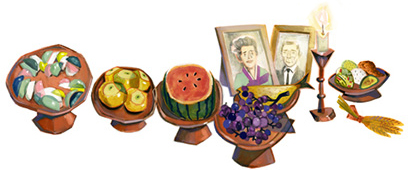
Happy Chuseok from Google!
Chuseok (추석) is the most important national holiday of Korea. It's billed to Americans as "Korean Thanksgiving", which is supported by both holidays' occurrence in autumn and the focus on food and family. But from what I've seen, there are more differences than similarities. Perhaps the most conspicuous difference is that the "family" focus of Chuseok is actually on deceased family.

Anyway, I was lucky enough to be able to spend Chuseok with my homestay family. They invited me to experience it, as most foreigners wouldn't get this kind of chance, and I was excited and accepted.

So I spent today in Daegu with my homestay family. (In fact, I spent most of the weekend in Daegu, and I'll have many more posts about my other adventures to write after this.) Custom dictates that a family will return to the father's hometown. So, we went to my homestay father's older brother's apartment, located in an old and quiet neighborhood where, thirty-some years ago, my homestay father grew up, biked to school, and played soccer.

Chalye jinaegi
The morning ritual was a 차례 지내기 (chalye jinaegi), a sort of memorial service for the family's late grandparents.

Despite the common translation of this as "ancestor worship", I would hesitate to call it that. I'm aware, of course, that not understanding the Korean language or really much at all about Korean culture, I could be totally off base. But the word "worship" has particular connotations that were absent from the scene I witnessed, with the grand exception of the prostration in front of the altar. Yet even in regards to that, well, Koreans bow a lot to many different people, and that is considered duly respectful, not idolatrous.

Anyway, the setup was really similar to the big rock unveiling ceremony that I attended last week: a table laden with food (fried sweet potatoes, fruits, dried squid and cuttlefish, a roasted chicken, rice, rice wine, rice cakes, and songpyeon (송편), but no pig head this time), incense, and candles. There was a paper screen with hanja on it that I couldn't decipher, and also smaller papers that represented the ancestors.

I was invited to take photos and film during the ritual, but even though I took advantage of this rare opportunity, I also felt so, incredibly awkward the entire time. "Oh, they're bowing, okay, this is a nice angle, oh, I wish the shutter weren't so freaking loud."
My homestay father burning the... well, burning something, which signaled the end of the ritual.
Some of the dishes prepared at the altar. Rice cake, fried vegetable pancakes, and a chicken!
After the memorial service, we ate all the food that was on the table. I'm just going to say that 송편 is delicious. It's probably the closest thing to mochi that you'll find in Korea. And then we ate ice cream and watched TV. Iron Man 2 was playing on a movie channel!
This is 송편 (songpyeon), rice balls filled with sweet stuff (in this case, sweet soybean paste).
In the afternoon, we set out for a mountainous area near Gyeongsan, a city southeast of Daegu, for the purpose of performing another 차례 지내기 at the actual grave of my homestay father's parents. We were joined by thousands of other families -- I'm not exaggerating -- who created an hours-long traffic jam in the mountains where the cemetery is located. I get the sense that most cemeteries in Korea are in the mountains; this obviously has something to do with Korea's very un-flat geography, but I wonder if it is also rooted in some traditional interpretations of spirituality and high elevation?
The hillside cemetery we visited, somewhere near Gyeongsan, with many families dotting the terraces.
Remembering 할머니 and 할아버지.
One thing is for sure: being in the mountains meant that the cemetery was gorgeous. It was very well-kept by thousands of people coming back to tend to it at least once a year, and the view from where we were was quite nice. Overall, the atmosphere at the cemetery was in fact more jovial, thanks to beautiful weather and lunch. Yes, after performing the memorial service, every family would take the food from the tombstone, spread out a blanket, and proceed to picnic. That was unexpected, I will confess. But it was also pleasant. There was more 송편! And fruits and bibimbap, too. We had a late lunch, and when we finished it was time to head back to Changwon.
Picnic time! The husbands drink and the wives prepare some bibimbap from this morning's leftovers.
Beautiful bouquets at every grave. They were all synthetic flowers, though! That's why they're so bright and perfect-looking.
On the long drive home (seriously, every highway in the country had a 교통 채증, or traffic jam, today), we passed a gorgeous sunset.
This was somewhere between Miryang and Changwon. I love Korea in the fall. Today's weather was so beautiful; I'm glad the typhoon that was slated to hit Korea today veered off course a few days ago. (It would've been the fifth!)
I'm going to close with two questions for my readers, especially if you are Korean. First, I've heard from three separate grown Korean women that Chuseok and other 명절 (myeongjeol), or traditional holidays, are incredibly work-intensive for the wives and mothers of a family, mostly because the food preparation takes forever and the men aren't expected to help. Because of this, they are sometimes resentful. For "progressive" Korean families, either in Korea or in the States, where gender roles are not as set in stone, is the workload ever shared among members of the family? And in the States, is the work actually less intense, in some respects, since less food is required and a cemetery visit is, in most cases, not possible?

Secondly, Chuseok obviously has deep roots in Confucianism. For Christian Korean families, how does this play out? I've noted earlier the dynamics of "ancestor worship" and harmless custom. Does Chuseok look different to a family that does not follow Confucian ideals?

And that's all! Happy Chuseok, everyone!

Friday, September 21, 2012

The Big Rock and the Pig Head

I witnessed something fairly unique yesterday. At around five-o'-clock, my co-teacher announced that there was going to be a special ceremony outside at the front of the school, and that it wouldn't take long, so I should attend. Curious, I joined her and all of the school's faculty and staff.

Front entrance of my school.
In this photo I took a few weeks ago of the front entrance of my school's campus,  there is definitely not a big rock on top of that small brick platform on the left. Instead, there are trees.

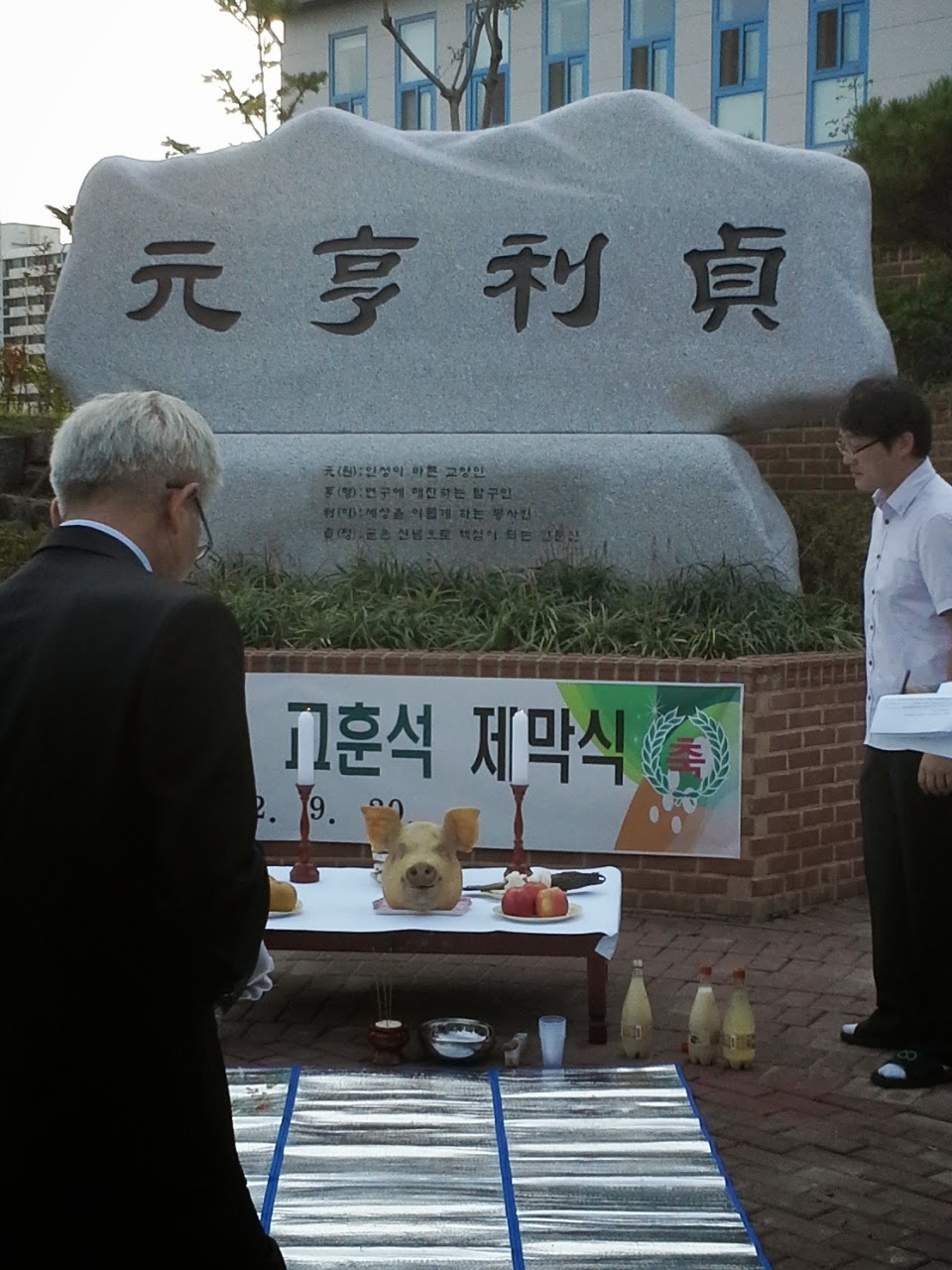
But now, there's a big rock on it! The trees are gone, replaced by an enormous sculpted hunk of granite with hanja and Korean carved into it. I remember seeing it for the first time earlier this week, but I must not have realized that it hadn't always been there.

So, when I arrived at the "special ceremony" with my co-teacher, the rock was covered by a large white sheet. As it turns out, this was an unveiling ceremony for the sculpture.

One of my coworkers told me that the four Chinese characters were the school's motto: 元亨利貞 (yuán hēng lì zhēn, something like "first, prosperity, benefit, loyalty"; and in Korean: 원형이정, won hyeong yi jeong). But she herself questioned the necessity of a giant boulder in front of our campus. It was, after all, a huge investment from the school, the price tag being an estimated $10,000 USD. (Her speculation -- in brief because I don't want to talk about school politics, yet -- was that a rather pushy member of the Parents' Union thought it inappropriate that our school didn't have one, and as he was himself in the business of carving big rocks, offered his services, astronomical costs aside.)
3... 2... 1...
Ta-da!
The unveiling ceremony was nice and official and all (look at those white gloves!), but after the rock was uncovered, what happened next was extremely interesting. A table was brought in front of the sculpture. The table was laden with fruits, candles, incense, a giant rice cake (떡), a dried fish wrapped in bundles of thread, and an entire pig head. Yup, the boiled head of a real pig, right in the middle of it all.

The principal (left) goes forward to give insa.
I watched in curiosity (and some strange apprehension) as my school's principal gave insa at the altar by prostrating himself three times in front of it and then putting an envelope of money inside the pigs mouth. My coworker explained the symbolism: the incense was to ward off bad spirits, and the pig was offered to good spirits to promise prosperity; that's why people put money in its mouth (and also stuck bills in its ears). And if the pig head happens to be smiling, you get extra good luck. The threads that were wrapped around the dried fish represented longevity. And the rice cake was... well, I think that was just there because Koreans eat rice cakes in every conceivable situation.

This was the first time I've ever seen a traditional Korean ceremony of this kind. My coworker also made it point to tell me that I was lucky to have been able to see it. Although it's a traditional ceremony, it's actually becoming less and less commonplace these days. She even admitted that it was the first time she had witnessed this kind of ceremony herself (but she is Buddhist, so I imagine that she is familiar with the whole insa thing in similar situations).

With the food on the altar and everything, I felt a mix of innocent foreigner interest and religious uneasiness. As a Christian, I knew that I was definitely not going to prostrate myself at the altar or put money in the pig's mouth, even though many of the other teachers and staff members did. And I'm glad that nobody pressured me to, either. As for the food, I had a brief moment of panic when I was offered a bit of rice cake and bit into it: does this count as eating food sacrificed to idols? But that quickly subsided when I remembered 1 Corinthians 8, in which Paul concludes that the mind prevails over matter in situations like these and you shouldn't make a big deal of things that... aren't a big deal.

So that said, I'm filing this one under "cultural experiences" and look forward to other random and unexpected happenings of a similar caliber. And with that, I leave you with the Lord of the Flies himself!
Aaaaaaahhhhhhhhhhhhh! (Oh and yes, this thing is actually eaten afterwards. A special machine flattens the thing whole and turns it into boiled pork slices, served with dipping sauce.)

Wednesday, August 1, 2012

On Identity - Christianity (기독교)

This is part 1 of a series I wrote on my self-identity in Korea. You can read part 2 here and part 3 here.

My thoughts are just going to be ramblings in this post, I expect, because it's been a long day and I just want to go to sleep. Taekwondo has left me sore in muscles I didn't know I had (anyone heard of hip adductors?), and I've done a lot of lesson planning the past few days, so I'm tired. 피곤해요 (pigonhaeyo)!

But I've been thinking a lot about identity lately, so -- you know me -- I want to write and share.

Aside from Korean language education and teacher training and practice, Fulbright also provides a host of "cultural workshops" for the ETAs in order to better acquaint us with the country in which we'll be living for one year. The workshops have been on a huge variety of topics, from the Korean education system (within whose constraints we must work), to eating etiquette, to volunteering opportunities, to the K-pop phenomenon. Most of them are lectures or discussions led by current and past ETAs who are simply sharing their experiences. And overall, they've been a mixed bag. Some are simply awful and feel like an unfortunate waste of two hours. Others are informative but boring, or interesting but useless. And then there's the magical workshop that's a combination of informative, engaging, and relevant. There haven't been too many of those.

Anyway, three of these cultural workshops I've attended have got my brain going on issues of identity in Korea. Specifically, issues of my identity (or identities) while I'm in Korea. They are: my identity as a Christian, my identity as a gay man, and my identity as a Taiwanese-American, or more generally as a non-Korean Asian.

(I've decided to write this post in installments, partly because I'm really tired right now and need to sleep, and partly because it's just way too long already. So... Part 1: Christianity. Part 2: Homosexuality. Part 3: Asian identity.)

Christianity in Korea
The workshop on Christianity in Korea was given by Stephen, this year's Program Coordinator. He shared a little bit about the history of Christianity in Korea, explaining that its roots don't go back that far (first Chinese Catholic priest arrived in 1795, first New Testament in 1882, etc.). At least, there have been missionaries in Korea longer than in Taiwan, which is my basis of comparison. Similarly to Taiwan, U.S. missionaries began arriving in the mid-nineteenth century, and with them came schools (Yonsei University) and hospitals (Severance Hospital), those positive aspects of Western influence. After the Korean War ended in 1953, many Christians fled the northern half of the country and resettled in the south. Today, about 33% of South Korea is Christian. Another third is Buddhist, and the last third is simply culturally Korean, which to me means vestiges of Confucian ethics tinting an otherwise atheistic worldview.

After the history review, Stephen went over what it's like to be a Christian ETA. He said that it was likely that our homestay family would be Christian and want us to come to church with them, which ordinarily I'd gladly do. Unfortunately, churches with English-speaking services are rare, only found in large urban areas. He did give us a directory of good (Protestant) churches in Seoul, Busan, and Daegu. But if we're not willing to make an hour-long weekly commute, weekly church in an intelligible language is going to be hard. For example, Anthony, who was an ETA this past year, was placed in a rural environment without a church to go to. He admitted that it was difficult keeping up his spiritual disciplines because of the isolation. But at least he had his network of Christian ETAs (for me this year, it'll be those who have been coming to our weekly Bible studies) to lean on when times got tough.

As for me, if I don't have access to a church whose services I understand and a tangible community that can help me grow, well, I'll be frank: my spiritual life is probably going to suffer for it. I'm not that strong. And when it comes to my relationship with God, it's not really at the point where just Him and me alone together works out perfectly. My whole life I've been surrounded by a Christian community in the places I've called home, but when I was away or abroad for months at a time without a church, well, I lost sight of myself. One of my more pinpoint-able worries before coming to Korea was that if I didn't get plugged into a Christian community, my spiritual life would go downhill.

Being spiritually alone while abroad can be a wonderful chance to challenge myself spiritually and see some growth. In the end, I can't always keep relying on others to maintain a relationship with God. But that doesn't mean I'm not anxious about the prospects of one year without a church.

Proverbs 3:5-6 comes to mind: "Trust in the Lord with all your heart, and lean not on your own understanding. In all your ways acknowledge him, and he will direct your paths." I'm going to remember this, and also that God is with me wherever I go, present wherever two or three gather, and I'll have faith that it's all going to be okay.

Translate