Showing posts with label Korean language. Show all posts

Wednesday, July 22, 2015

North Korean - South Korean translator app


It should surprise nobody by now that the languages spoken in North Korea and South Korea are not the same. The two countries have been geographically separated for decades, with no free communication allowed across the border between them. In addition to that, North Korea's government initiated purges of the language long ago to get rid of foreign words or borrowings (from English, Chinese, or Japanese) and replace them with pure Korean translations. As a result, while South Koreans might want to eat 아이스크림 ("ice cream", transliterated) on a hot summer day, a North Korean will dream instead of 얼음과자 ("ice snack").

When I visited North Korea last year, I found myself unable to understand much of the Korean that I heard being spoken. Of course, my Korean listening comprehension level is fairly low, but it wasn't just me -- even the Korean-Americans in my tour group who were fluent in (South) Korean had some difficulties. Most of it was due to the differences in vocabulary, but there was also the intonation of North Korean, which would have been considered a mere dialectal difference back when Korea was unified, but is now one of the markers of the two languages' divergence. (The line between "language" and "dialect" is a fairly blurry one, even for linguists.)

Anyway, when I came across this advertisement/PSA for a new app called 글동무 ("classmate"). I like the name -- the whole phrase means "classmate", which directly references the app's usefulness for North Korean students struggling to keep up in South Korean classrooms, and encourages a camaraderie among youth. Also, the first word (글) on its own means "writing" or "knowledge". The second part (동무) on its own can also mean "comrade", but I don't think that was intentional.

I have taught camps and tutored students from North Korea in South Korea before, and I can say that an app like this would be very helpful for most of them. (For others, especially younger students who basically grew up in China while their families were in hiding, it would perhaps be less useful than a Chinese-Korean dictionary, but those already exist.)

And in addition to the app's usefulness, its beautiful, simple design and hi-tech programming (it can use the phone's camera to identify unknown words automatically and offer translations immediately) are really compelling. This amazing app is the brainchild of linguists, computer programmers, and sociologists who saw a need in South Korea and came up with an elegant solution. I hope that the work I will do in the future can be as beneficial as this!

Friday, June 26, 2015

Return to Changwon

Last weekend, I returned to the city that I called home for two years, Changwon. Because I only had a few days to visit, I wanted to meet with as many people as possible, including my host family, friends from church, friends from language class, former colleagues, and even a former student. These were all people who changed my life in some way or another during my time in Korea, so I was very happy to meet them again. Happy is actually an understatement: from the moment I stepped off the train and saw my city with my own eyes once more, I felt a deep contentment and familiarity that must have come from a different level than the one that produces such fleeting emotions as happiness.

The familiarity was a curious feeling, too. From things as simple as getting on one of the city's insane buses again and remembering my old route home, to moments of reconnection like catching up on my host brother's now-terrifyingly enormous insect collection, to joyous reunions with old friends that included meeting new ones, every moment was tied to something or someone I'd known well all of eleven months ago. As quite a few people remarked, it was as if I'd only left yesterday. I think one year is not really that long a period of time, and most people did not visibly change (with the exception of my taekgyeon master's son, who is now in his terrible twos!). So it was indeed easy to kind of fall back into the swing of things. Except that never in my two years in Changwon did I have such a whirlwind of a weekend, consisting of reunions with dozens of different people.

Selfies galore, with: Eunjin, the CSHS English department, a former student, my taekgyeon masters, and a Fulbright buddy!
So here's what happened in detail. I took the KTX high-speed rail down to Changwon on Friday after class, and arrived in the evening in time to get dinner with Victoria, a fellow volunteer for Changwonderful, at TGI Friday's (how appropriate). Later that evening, I reunited with my taekgyeon 관장님 (gwanjangnim) and 사범님 (sabeomnim), the director and master/trainer at my old martial arts gym, and did the whole Korean drink-and-eat-and-drink-some-more thing. I had a wonderful time with them, and also discovered the greatness of flavored soju! I really cherished the opportunity to catch up with 관장님 and 사범님, because aside from people at school and my host family, I spent more time with them than anyone else in Korea. (관장님 even let me crash at his house over the weekend, and I spent a lot of time playing with his young son. 관장님 is like a big brother to me; I love his family and owe them so much.)

But even better, through my broken Korean, I was able to relate to the both of them some of my concerns about graduate school or about life in general, and they gave me some much-needed advice. You see, I often have doubts about my decision to continue in academia, partly because it's so hard and partly because I wonder if I'm actually doing anything meaningful with my life. I'm quick to point out that even though I am grateful to be back in California, I was actually happier on a day-to-day basis when I lived and worked in Korea. But 관장님 said something that reminded me of what many of my friends advised back when I was initially deciding on grad school: that I had to leave Korea to move on with my life.

I guess I don't like to be so blunt about it, but either way, since I've turned the page on that chapter, it's no use trying to go back to it as if I haven't already started the next one. I was also touched when 사범님 told me, or perhaps admitted to me, that in his many years of training in taekgyeon, he never worked so hard or enjoyed it so much as when I attended the gym. Heh, that definitely could have been the 순하리 talking, but I appreciated it nonetheless.

On Saturday, I joined 관장님 for his Saturday youth sports classes, including soccer, jump rope, and dodgeball. I met up with my old language partner Eunjin for lunch in the Garosu-gil area, and we had a great time catching up and discussing everything from our past baking adventures to movies staring 빵형 (aka Brad Pitt... brownie points if you get the joke!). I am so grateful that even though Eunjin's English is better than my Korean, she is always patient with me and will let me struggle through an explanation of how the book and movie versions of World War Z are completely different but good in their own ways without embarrassing me at all. And in the evening, I had dinner with my host family (I lived with them for my first year of Fulbright) and caught up on old times. Their dogs are still super cute and super annoying.

On Sunday, I met up with one of my former students, JW, who is now in his second year of university! He contacted me on Facebook and said that he was going home to Changwon, so he wanted to meet up. I was thrilled, because I don't have many opportunities to meet former students, especially those who don't currently live in Seoul. JW really wanted to practice his English, and I felt just like I was back in school doing lunchtime conversation club again. Except this time JW was really eager to talk about university life, and he asked for American TV show recommendations.

I also got lunch with Courtney, who is the Fulbright teacher who has taught at CSHS for the past year, and we discussed life in Korea and the ways she's grown and learned this past year. We also talked about religion and sexuality. I am so impressed with the way Courtney's mind works. It's wide open and ready to listen to anything and everything, as if everyone she encounters is a vendor giving out samples of food she's never seen or tasted before, and it is all delicious. She has embraced the differences of others, as well as the discomfort and the weirdness of living in a foreign country, far from home for a year, with as much energy as a kid at an amusement park who might not be tall enough to get on all of the rides but doesn't care a bit.

In the afternoon, I went back to Redeemer Changwon, a small church that meets at a cafe in the downtown area. I began going to the church a year ago when it was just a handful of friends wanting a fresh, community-based church experience. I was happy and encouraged to see how it's grown since then. And my old friend Traylor gave the sermon, too! Good on him. He preached from 1 John, which, curiously, is a book that I've heard quite a few sermons on in the past few months. It can't be pure coincidence... It was great to catch up with the church folks again, and meet some new friends. We all went to dinner together afterward at El Loco, an excellent Mexican restaurant with prices much more reasonable compared to here in Seoul.

Monday was the long-awaited day in which I went to visit the school where I taught for two years. As soon as I walked on campus, I felt really... in place. As if it were just any other school day and that I should probably get to my classroom or office in a minute. It was exciting to bump into old teachers and students and see them do a double-take. Many of them stopped to greet me and chat in Korean, and they kept saying, "어떻게 왔어요?" Those two words literally mean how and came, so I interpreted it as, "How did you come here?" So I told them that I took a train. To my embarrassment, it's actually, "How come you came here?" So I modified my answers: "I'm here to visit." And to reconnect. And to relive some amazing memories.

Courtney was gracious enough to let me visit her classes that day, including her two classes with the third-year students, who were my second-years last year. I was excited to see them, and they were excited to see me, and they kept commenting about my hair, so I told them about topknots and 상투 and they vacillated between thinking it was cool and thinking it was horrible. Yet for all the thrill of the reunion, let's be honest: it was still English class, and they were still pretty loathe to speak English! Not that much has changed, I suppose! It was actually a bit sad to see how these third-years seemed so tired after so much time stuck in the grueling high school routine. I am looking forward on their behalf to four or five months from now, when they will have finally finished. I also got to meet and play a game with a class of first-years, i.e. students who had no idea who I was. That was a riot, too! They are just the same as my old classes of energetic, not-yet-jaded first-years. They associate California with beaches and CalTech, wail when I tell them that I don't have a girlfriend (and don't want one), and think that my being able to write a few words in hangul on the board is worthy of infinite admiration.

Besides visiting students, I also got lunch with Courtney and the other English teachers, Saerona, JJ, and a new teacher I hadn't met before. It was so sweet of them to be so welcoming and hospitable. Saerona also made me a small gift. (I'd brought some chocolate from the US, but I wish I'd brought the San Francisco coffee again, as I did once, because the teachers in the main office still remembered how good it was... haha.)

And then, too soon, the day was over, and I got on a bus to go back to Seoul. After seventy-two hours, my heart was full.

- - -

I really want to go back to Changwon again, but I don't really know how feasible that will be, as my schedule gets busier and busier, and the time I have left in Korea is already winding down. I wanted to write more about this fantastic, nostalgic, much-needed weekend. Every meal and every conversation deserves its own post, actually. But most of it wouldn't be of very much interest to anyone but myself. I've just spewed out a lot of words on the Internet about something that is very inconsequential to the world at large... what's the point. Well, if there's anything you take from the post, I hope it's this: there was nothing that I loved in Korea more than the people that I met here and formed positive relationships with, and they are the only thing that will keep me coming back.

Tuesday, June 2, 2015

Profluentia et Imprudentia

I have to be more careful with my words. This was the realization that came hand-in-hand with a gentle reminder that I am currently living in a country where I am not fluent in the language. Wait, let me revise that: I am reminded daily that I cannot speak Korean well, and these reminders themselves are not always gentle. Like when I struggled for an hour to open up a checking account only to be told finally that without an ARC it just was not possible.

But this time, the reminder was gentle, and it came from a friend who has lived in Korea for longer than I have and knows a great deal more about it. We met up last weekend since he's currently doing his graduate studies at the same university where I'm taking language classes, and I have perhaps unceremoniously latched onto him as my go-to resource for cultural guidance and assistance with quotidian matters.

After I left Korea nine months ago, I forgot one of the basics of cultural communication, the one that is drilled into every language student's head from the very beginning: Korean culture is built on a hierarchy. In society, what this means is that the young and inexperienced always defer to their elders and superiors. Children obey their parents; younger students take orders from their seonbae (upperclassmen); the employer's word is law to their employees.

In language, this means that one's vocabulary and grammatical constructions change depending on whom you address. It's much more complex than a handful of polite terms. I would ask a favor of a friend using a wholly different grammatical form than that which I'd use to ask the same favor of my teacher or grandfather.

Of course, I didn't forget that this rule exists in Korean. What I have neglected to remain mindful of, then, is how strictly it actually applies to me.

You see, while I do I fairly a good job of blending in with the crowd here in Seoul (the expectation is that an East Asian face equals a Korean face, unless it's dressed in the outlandish garb of the Chinese tourist), as soon as I open my mouth, most people realize that I am very much American. My accent cues them off, and then my face and fashion sense fall into place with it. I guess this morning was an anomaly, when my new language instructor asked me if my parents were Korean, apparently surprised at my speaking fluency. Anyway, humblebrag aside, once I'm tagged as a foreigner, what has happened generally is that all linguistic rules are tossed and my stupid mistakes are forgiven. I can ask for a head of cabbage instead of a beer and nobody will fault me for it. I can stare dumbly at the real estate agent as he tries to explain the security deposit without him thinking that I am actually dumb. And, critically, I can use the wrong forms of address to everyone -- casual conjugations with a stranger, super-honorifics with my former student -- and I'll get a free pass because I'm still learning.

I am not saying here that I should make these kinds of mistakes. After all, as a perfectionist, I cringe when I catch myself saying something wrong or culturally inappropriate. But my point is that I do make these mistakes, yet I've been let off the hook so many times that I haven't really properly internalized the rules of what to say and when. Or at least, if I had had everything down after the first two years, I had promptly forgotten when I left.

And now I'm back and I'm making a fool of myself. Why? Because I'm here, newly determined to show that I have learned something after months upon months of intermittent language study, and along with this courage comes a fair bit of hubris, and from this hubris arises a situation in which my friend introduces me to his classmate, both of them my seonbae, and I immediately talk with him as if we've been buddies for years. So much for cultural competency.

Hence the gentle reminder: remember who you are and whom you're talking to. It may not be important to you, or any American for that matter, but it matters here.

My friend himself admitted that it took getting used to, being a graduate student in linguistics (a field generally as casual and laid-back as you can imagine; my professors at Berkeley eschew being addressed by anything other than their first names, for example), but in a country where hierarchy is deeply entrenched in the ivory bastion of cultural conservatism and academic tradition. The constant bowing, the formal pleasantries, the obligatory grad student drudgery for tenured professors: it's all here, and while my friend is just beginning to tire of it, I realize that I haven't even begun to process its reality.

If I really want to pursue Korean linguistics, then the hierarchy, ingrained as it is into both the language and the culture, is something I will have to acknowledge and accept. I don't like hierarchy; let me be clear about that if it isn't already obvious. But as an academic, I have to respect it, and step one is taking pains to use the proper honorifics in the right contexts.

Even with my Korean friends -- the ones with whom I converse freely in Korean, who only correct my many errors when I demand for them to -- I think it's time to be more disciplined about my language use. Who exactly is my nuna, my hyeong, my dongsaeng? It's admittedly a bit complex: is age the only factor? Should I ask my Korean friends for their opinion on how I should categorize them, or is that rude?

There's sure to be some discomfort as I recommence navigating this cultural landscape. I thought two years' worth of experience wasn't too bad, but it's nothing. And it's not just the hierarchy thing, either. I only have two months this time, and I wonder if tackling headfirst questions like my place in Korea as an American, the ups and downsides of rapid globalization, or the uncertain future of LGBTQ rights in this country are even worth my while. This summer, will I traipse through Seoul taking pretty pictures of food and blogging about the charmed expat life, or will I choose my words -- and thoughts and actions -- more carefully?

Saturday, August 2, 2014

Poké-Hanja!


I'm just going to leave this here for your enjoyment. I am so happy that this exists. (For those who need an explanation, it uses the Pokédex entries for Pokémon to explain certain Korean vocabulary words that can be written using hanja, or Chinese characters. In this case, 部分, or 부분, means "each part," as in, "Each part of the center of Acousta/Starmie's body, called the core, radiates a different colored light each time it is seen.")

Vocab!
Pokémon = 포켓몬 (Pocket Mon)
Hanja = 한자 (漢字)
Pikachu = 피카츄
Gotta catch 'em all! = 반드시 노려라 포켓몬! / 포켓몬 get 하겠어!

Monday, July 14, 2014

South Carnival (사우스 카니발) - 몬딱 도르라


This is too good not to share! My friend who teaches in Seogwipo on Jeju Island showed me this music video by a Korean ska band called South Carnival. The song is called "몬딱 도르라"*. Not only is this video cute and vibrant, the song is sung in Jeju-eo! The subtitles are written in Standard Korean, but if you listen closely (and can read/understand Hangul), then you can tell that what they're saying doesn't match up with the lyrics. And this is because Jeju-eo is quite different from Standard Korean.

I don't know enough about ska to consider myself a fan of the genre, but this song is currently stuck in my head for sure. Music is such a wonderful way to preserve language and culture!

*몬딱 도르라" (monddak doreura) is Jeju-eo for "함께 달리자" (hamkke dallija), which means "run together". Unfortunately, 도르다 in Standard Korean can also mean "to vomit," so maybe Koreans who are unfamiliar with Jeju-eo will be confused by the song title.

Monday, July 7, 2014

Jeju-eo Project Update

About six months ago, I introduced my self-directed research project about Jeju-eo, the endangered variety of Korean spoken on Jeju Island. Since then, I've been happily busy with the linguistic documentation work which I received a small Fulbright grant to do.

In January, I met with a professor of Jeju National University to get his insight and some inside information on what language activism looks like on the autonomous island province of Korea. Then, nothing happened for a while.
This is me giving my presentation on Jeju-eo at the Fulbright Spring Conference 2014. Even without anything concrete to show, I went way over time! But people gave me very positive feedback, at least! Photo taken by Katelyn.
It was not until April, during the Fulbright Spring Conference, that I actually had the opportunity to do any fieldwork! After giving a presentation of my research at the conference itself (which was a bit lacking, in my opinion, since I didn't have any actual data to show yet), I spent an entire afternoon with five native Jeju Islanders who helped me make recordings.

The fieldwork was fun but a bit nerve-wracking, at least for the first part. Through a friend of a friend, I met an elderly couple who live in a rural area outside of Jeju City. They are known to be very involved in the local language activism community, so fortunately, they were very willing to talk about Jeju-eo with a complete stranger, and told me many stories. For example, they explained why Jeju-eo sounded so clipped (shortened words make communication across long distances easier when wind is constantly blowing over the island) and highlighted the main differences between Standard Korean and Jeju-eo.

The nerve-wracking part was that I felt way out of my depth in terms of language ability. These people spoke no English, so all of our communication was done in Korean. It was tough for me to explain exactly how I needed them to elicit the words I wanted to record. Also, there was a lot of ambient noise in the recordings, because we were meeting in their house, which meant that they offered snacks and were busy eating them the entire time. Also, the background noise of refrigerators, clocks, and a farm have probably ended up in these recordings.
The friendly and hospitable first group of consultants. They welcomed me to come back any time in the future!
My second group of consultants were much easier to work with, since they were a mother and a daughter, and the daughter happened to be an English teacher. Again, I was connected through a friend of a friend, and again, even though I was just this random kid with a microphone, they were enthusiastic about helping and showed a great deal of generosity.

Because the linguistic barriers were no longer an issue, the second recording session went much more smoothly, and we worked for over an hour to collect over one hundred words, including many that are unique to Jeju-eo. These are the recordings that I have been putting into the Jeju-eo Online Talking Dictionary.

Ah, yes, the dictionary. The big project. I can freely admit that the lexicographical process is much more of a mountain than the molehill I expected it to be. Although I returned from Jeju Island happy and ready to dive right into the splicing, transcribing, annotating, and uploading work required to build up the dictionary from nothing, well, all of that work took a lot more time than I'd planned for. Weeks went by, and then months, and still I never got close to finishing. Then the semester got busy, and I had to put my project on hold.

Back when I did online lexicography in college, it was as part of a team. Despite my experience -- or perhaps beacuse of it? -- I underestimated my ability to do all the work on my own!

Finally, in early June, the deadline for my final report drew nearer, and I realized that it was now or never. I spent hours upon hours one weekend churning out data, giving myself just enough to work with for a few key observations in my report, and finished the eight thousand-word paper just before the deadline! This wasn't the worst I've ever procrastinated, but -- whew! -- It certainly was a wake-up call to the kind of work I might be doing in grad school. Note to self: no full-time jobs when you're doing full-time research, too. :)

Anyway, what I have to show for my work now is a modest online dictionary of Jeju-eo that you can browse at your leisure here. It's not complete by any means, and it's also imperfect. (This is mostly due to my imperfect translations and transcriptions. I do need help with the Korean, so if you know anyone who's willing to lend a hand or an ear, let me know!) But, as my friend Coby put it, "Something now exists that didn't exist before because of your work. That's awesome!"

In other news, I learned that a Fulbright Junior Researcher for the 2014-2015 grant year is going to be doing a similar project! Actually, let's be real here: her project is essentially exactly the same as mine. But she will have full funding for a year's worth of research and dictionary-making, and she will also be based on Jeju Island, so she can develop better connections and do more in-depth fieldwork. I've already been in touch with her, and I'm excited about the prospect of collaborating.

Wednesday, July 2, 2014

Haeinsa Cafe / Wordplay

A bit of cute wordplay at the Haein Cafe: 해맑게 인사하는 사람들...
A multi-orthographic linguistic puzzle! What does "海맑게 印寺하는 사람들" mean?

If you look carefully, you can see that this phrase uses two scripts: hanja, or Chinese characters, and hangul, the Korean writing system invented in the mid-fifteenth century. In ancient times, Korean was written entirely in hanja, but after Hangul was promulgated, it began to replace hanja. Today, few hanja are used, and then only in specific contexts; you might come across a few characters in newspaper headlines and official documents, but it's slowly falling out of common use.

Now let's examine these hanja. First, you have 海, which means "sea". It is pronounced 해 (hae). Then, you have 印 and 寺, which mean "stamp" or "mudra, a symbolic Buddhist gesture" and "temple", respectively. They are pronounced 인 (in) and 사 (sa).

Anyone familiar with Korean Buddhism will recognize these three hanja as the name of one of Korea's famous temples, 海印寺 (해인사/Haeinsa). What do they mean in the context of this phrase, however?

In fact, there's a bit of wordplay involved. As the Chinese characters are read with the Korean pronunciation, they are not intended to retain their written meaning. Instead of meaning "sea", 海 (hae) is simply part of the word 해맑게 (haemalkge), which means "brightly, purely". This 해 (hae) actually means "sun" in native Korean.

As for 印寺 (insa), the two words are essentially a homophone of 人事, or 인사 (insa). 인사하는 (insahaneun) means "greeting, bowing politely". And 사람들 (salamdeul) means "people", so...

Altogether, the phrase means something like, "People who greet brightly and purely." Maybe it makes more sense like this: "People who say hello with a warm smile (and a bow, because Korea)."

So as it turns out, the phrase has nothing to do with the sea or temples, but the clever part is that this was found printed on the menu for the cafe at Haeinsa. Thus, the cafe used the name of the temple as homophones to welcome its patrons. I love the ingenuity!

- - -
Stray observations:
1. The menu is printed on beautiful hanji (한지/韓紙), a thick, coarse paper that has dried leaves and flowers embedded in it.

2. The spelling of "cafe" in Korean (까페/ggape), is a little unusual. Usually, it's 카페 (kape), with an aspirated [k] from the American English pronunciation. Instead of that, ㄲ represents a tense, unaspirated [g]. Perhaps this came from an attempt to transliterate the French pronunciation instead of the English one.

3. More hanja (한자/漢字) in the top right corner: 茶來軒, or 다래헌 (daraeheon). I've never encountered this word before, but it means a traditional teahouse. Literally, "a house or high pavilion where you can order tea." NB: don't think Korean words written with hanja are just borrowed from Chinese. 茶來軒 means nothing in Mandarin, as far as I'm aware. Also, the more common words for "teahouse" are 찻집 (chatjip) and 다방 (dabang/茶房).

4. Unrelated to linguistics: why does Haeinsa have its own cafe, anyway? Is it so that after you worship and commune with nature, you can get an iced caramel macchiato to keep you tethered to modern society? I enjoyed my seven-dollar (?!) iced 유자차 (citron tea), but the very existence of the cafe seemed incongruous to me, like the Starbucks located inside the Louvre or the stuffed animals sold in the 9/11 museum gift shop. I guess cafes are now just as integral to Korean culture as thousand-year-old temples, so this is an unsurprising mix of new and old.

Friday, May 23, 2014

A Human Zoo - Animal Idioms in Korean and English

This week, I taught my students a few idioms that involve animals. Earlier this semester, a student had expressed the hope that we could do some drawing activities in class, so I gave each of them an animal and a marker, and we played pictionary. The results were hilarious, and the student who got her wish was literally bent over double in laughter as her friends drew what I suppose were meant to be cats... or were they tigers? Bears? Goats?

Unfortunately, I didn't take any photos. On the bright side, as I was checking their journals later, I found that some students had not only written down the English definitions of the idioms that I'd provided, they also jotted down rough translations in Korean. I went ahead and added all of them to my own vocabulary list:

big fish in a small pond - 우물 안 개구리
The Korean version of this idiom, which refers to someone important in a relatively small sphere of influence, is "우물 안 개구리는 바다를 모른다", which translates to: "The frog in the well knows nothing of the ocean." One of my students, HS, proudly asserted that he was a big fish, but his face fell when I told him that we were currently swimming in a very small pond.

black sheep - 이단아
이단 appears to mean a sort of rebel or maverick, and 아 means child, so although there is no Korean version of this idiom that means a person who is radically (and often problematically) different from their group, the image of a "maverick child" is just as memorable, I think.

bookworm - 책벌레
This one was extremely easy to guess. TG drew a box on the board and then a striped oval inside of it. Since 책 (book) 벌레 (bug) is a direct translation from English, it was also simple to understand. As it turns out, avid readers are not the only kind of people who can be described with a Korean idiom that references bugs. (Keep reading!)

copycat - 흉내쟁이
I got this translation from the dictionary; the students didn't write down any translations, either because it was easy enough to understand or because they were too busy laughing their heads off at the picture their classmate tried to draw. It appeared to be an anthropomorphized Doraemon: that is, the cartoon cat with hair and glasses, wearing human clothes. Anyway, 흉내 means "impersonation" and 쟁이 is a casual suffix that refers to a person who does a certain action.

dark horse - 다크호스
If you can't read Korean, the above phrase is a transliteration: da-kh ho-ss. The concept is evidently familiar in Korea. I wonder if they've seen Katy Perry's new music video?

eager beaver - 일벌레
I gave myself the responsibility of trying to draw this one, and it was difficult because few of my students knew what a beaver was (in Korean, it's 비버, another transliteration). Anyway, this idiom for an overly enthusiastic worker is called 일벌레 in Korean. You can see the word "bug" used again; a "work bug" is how they refer to workaholics, but I think it has a more negative connotation than eager beaver.

lone wolf - 외톨이 늑대
YH wrote in his notes that lone wolf was "외로운 늑대" -- a lonely wolf. The dictionary's translation is more accurate, I believe: 외톨이 means "lone" in the manner of choosing to be alone. There's a nuanced difference. But of course, in Korea, everyone assumes that if you are by yourself, then you are lonely. Single people and loners can never catch a break here!

scapegoat - 희생양
I had a lot of trouble explaining this one. Even a brief summary of the Bible story associated with this idiom didn't make much sense. I told him that a scapegoat is a person who takes the blame or punishment for someone else, sort of like if YH illicitly ordered fried chicken from his dorm room and got caught, but somehow NH was punished for it. Though I'm not sure if that's ever happened, NH is definitely the scapegoat of his class!

social butterfly - 외향적
First of all, JK's drawing for this was excellent: a simple butterfly outline plus the square Facebook icon. Too clever! 외향적 is actually the word for "extroverted" in Korean; I couldn't find the Korean version of the idiom that means a person who loves socializing and meeting new people. It surprised me which students considered themselves to be extroverted in my class. Rather than social butterflies, I might have thought of them as shrinking violets. But that just goes to show how much there is to my students that I have yet to discover!

tiger parent - 타이거맘
This idiom also resulted in a fun drawing: JM took his sweet time in creating a caricature of an anthropomorphized tiger, complete with khakis and briefcase. The idea of a "tiger mom" (which is what the Korean phrase says: ta-i-guh mam) is obviously very well known here. You could argue that Asian countries are where tiger parents originated, thanks to a certain Yale professor's infamous manifesto. I'm curious if there's an older, purely Korean idiom that refers to this kind of charater, though, because Koreans have been hell-bent on education for decades.

That's it for the ten animal idioms and their Korean versions! Can you suggest any other interesting idioms, in English or in Korean, that my students and I should know?

Tuesday, May 20, 2014

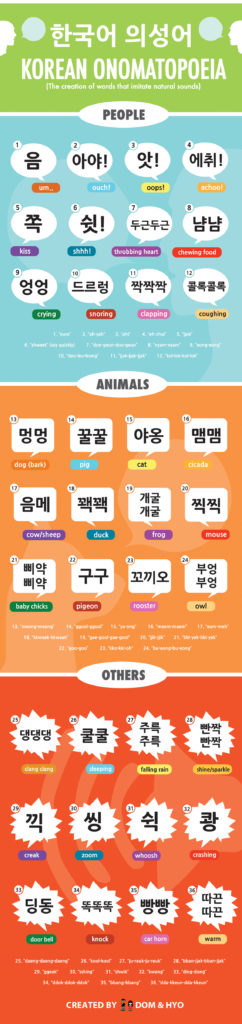
Wishy-Washy Korean Onomatopoeia (의성어) and Mimetic Words (의태어)

I'm no expert in Korean linguistics, but I have noticed something strange about Korean onomatopoeia (의성어) that I'd like to share with you. Aside from being astoundingly creative and multifarious, Korean onomatopoeia is intriguing because it takes the linguistic idea of iconicity and runs far, far away with it. There are thousands of ideophones in the language: onomatopoetic words that describe not just sounds but also certain kinds of sensory perceptions that don't necessarily make a sound.

nomz. Hi, Pusheen!
To begin with, common Korean onomatopoeia include: 냠냠 (nyam-nyam), which is how they write the nomz (eating), 음 (eum), which is their "hm", and 똑똑똑 (ddok-ddok-ddok), for when somebody knocks on the door.

Of course, linguists argue that not all onomatopoeia are iconic. How exactly does 쩌렁쩌렁 (jjeoleong-jjeoleong) sound like a shrill voice? Which sounds more like a heartbeat, lub-dub or 두근두근 (dugeun-dugeun)?

In any case, where Korean (and Japanese, as well) excels at onomatopoeia is their wealth of words that describe sounds that aren't actually sounds. For example, 따끈따끈 (ddaggeun-ddaggeun) is the "sound" of warm, fuzzy feelings. 빤짝빤짝 (bbanjjak-bbanjjak) is their version of twinkle. In Korean, these ideophones are called 의태어 (mimetic words), and their definitions always include the word 모양 (moyang), which means "shape" or "form".

Well, this is where things get confusing, because Korean 의태어 tend to be quite fickle. It seems that not everybody has been able to agree on just how to say -- or, more accurately, write -- the sound of a shimmering star, for example. This particular onomatopoeia is cited equally often as 빤짝 (bbanjjak) and 반짝 (banjjak), the difference contained in the first letter: ㅂ or ㅃ. The sounds are very similar, of course, as the second is simply a tense version of the first, but they are still considered separate phonemes.

As for meaning, some say that 빤짝 is a stronger shininess than regular old 반짝, due in part to the tensed phoneme. But what I see is a simple lack of standardization in these onomatopoeia. As in English, we may wonder if the sound of a train is really "choo-choo" or "toot-toot". Does a dog say, "woof," "ruff," or "arf"?

Another Korean example can be found in the aforementioned heartbeat: not only 두근두근 (dugeun-dugeun) but also 두글두글 (dugeul-dugeul).

When I first began noticing these rather murky boundaries surrounding onomatopoeia, it reminded me of a Korean adage my co-teacher taught me. It goes like this: "아 다르고 어 다르다." It roughly translates to "ah is different from oh," meaning that you must pay careful attention to how you say things. You wouldn't want to meet a cool guy (멋있다/meoshitda) and tell him you think it's he's tasty (맛있다/mashitda).

But how this figures into the difficulty I have in learning Korean onomatopoeia is that it seems that the rules for altering them are quite arbitrary: sometimes the vowels can be shifted, sometimes not. Sometimes it's unclear if the way someone pronounces a word is due to their regional dialect or if they're just saying it wrong.

Take a look at the sound of drizzle, which I learned as 보슬보슬 (boseul-boseul). I must take care not to accidently say 버슬버슬 (beoseul-beoseul), because according to the dictionary, that's the texture of crumbly pastries. So is 바슬바슬 (baseul-baseul). What I can say, though, is 부슬부슬 (buseul-buseul); it appears to be acceptable even though I have literally never heard it before.

For good measure, I just checked out the remaining possible vowels to insert into the first syllable and found that 비슬비슬 (biseul-biseul) means to take tottering steps, 배슬배슬 (baeseul-baeseul) and 베슬베슬 (beseul-beseul) mean to do something weakly and passively, or to shirk, and 뱌슬뱌슬 (byaseul-byaseul) is yet another variant of this. 브슬브슬 (beuseul-beuseul) was not in the dictionary, but I can't help but wonder, "Well, why couldn't this just be another way to describe mizzle or goldbricking?"

(One more: 벼슬하다 (byeoseul) is, in fact, not one of these 의태어, but it means to take up a public office.)

At lunch the other day, a teacher was trying to describe a former student whose face I was having trouble bringing up. "He was short and skinny, didn't wear glasses..." he struggled to use a descriptor that didn't apply to roughly half of our school's population. Finally, he said, "Well, he was 반질반질 (banjil-banjil)," and at that the teachers around us laughed and nodded in agreement.

My co-teacher tried her best to explain. 반질반질 is a word (an 의태어, in fact) used to describe the smooth or slick surface of a stone, but when applied to people, it paints a picture of someone who never wants to work and can think of a hundred ways to avoid responsibility without taking the blame. They're shirkers, charmers, and, well, now that I think about it, they're also 배슬배슬. That can't be a coincidence, can it?

반질 as a baby's bottom.
I offered the translation of "slippery" or "cunning", and also mentioned Ferris Bueller.

Anyway, as my co-teacher went on, another teacher offered that 반질반질 was the same as 밴질밴질 (baenjil-baenjil). When I looked this up in the dictionary, I discovered that 빤질빤질 (bbanjil-bbanjil) was also an option. So were 번질번질 (beonjil-beonjil) and 뻔질뻔질 (bbeonjil-bbeonjil). All of these words mean greasy, glossy, sleek, or smooth. And at that point, my search history on Naver dictionary looked ridiculous.

The common definition among all of these words happened to include another word unfamiliar to me: 빤빤하다 (bban-bban), which means "brazen". Unsurprisingly, 뻔뻔하다 (bbeon-bbeon) and 뺀뺀하다 (bbaen-bbaen) are acceptable variants. But don't get too far ahead of yourself: 반반하다 (ban-ban) means to be good-looking, and 번번하다 (beon-beon) means to have a fair complexion or to be... smooth.

Sometimes I feel like the dictionary is taunting me by sending me in circles.

It played one last trick on my co-teacher and me by telling me that "brazen" meant someone who had no 염치 (yeom-chi). When I asked my co-teacher what that was, she told me that there must have been a mistake: the word they should have used was 얌치 (yam-chi). As it turns out, 염치 and 얌치 have the same meaning, only my co-teacher had never heard of the former.

아 다르고 어 다르다! Does a small difference in pronunciation actually matter? If you look at Korean onomatopoeia, you might think that it's not important at all!

- - -

P.S. I found this fun list of cross-linguistic onomatopoeia during my "research".
P.P.S. Talented graphic designers Dom and Hyo made a infographic of some common Korean onomatopoeia, which I've reproduced below. Have fun studying!

Wednesday, April 30, 2014

O long-awaited nerdy grammar post...

Every day I receive dozens of messages on the school computer messaging system, and I skim them without really reading, because they're all in Korean, obviously. Sometimes my co-teacher will send along a message in English, especially if she wants my opinion on a question of English grammar. From time to time a non-English teacher will try their hand at English, too, to remind me about teachers' volleyball in the gym after school or ask about the teachers' English class I run.

But I disregard almost all of the Korean messages. If they're short and I have a spare minute, I'll translate them for the purpose of practicing Korean. But the information is usually mundane: administrative stuff, our school in a local newspaper, whatever.

The other day, however, I got a message from one of our secretaries, whose short message included lots of emoticons and an announcement about a new shipment of botttled water for us to take at our convenience. It had been a while since we'd had bottled water, for some unknown reason, so understandably, the secretary was excited. But I couldn't make head or tail of the very first phrase of her message:

아기다리고기다리던 물
a gi da li go gi da li deon mul

The last word, 물/mul, means "water". The rest of it was gibberish to me. If you can't read Korean, it's probably also gibberish to you. But I was mystified: it looked like one very long, nine-syllable word that had some crazy internal rhyme. Having studied Korean for two years, I wondered if this was a new word I'd never seen before, or really just some nonsense sounds thrown together to represent excitement onomatopoetically.

Agi... dali... gogi... dali... deon? 고기/gogi means "meat"... 다리/dali means "bridge"... and I know that 던/deon is a grammatical particle that marks a verb used as a modifer in the past tense. But this still made no sense to me, and I almost laughed out loud because of my confusion and the apparent absurdity of the phrase.

Then Google Translate came in to save the day! Google Translate generally does not work very well for Korean, but I gave it a shot this time, and the algorithms spit out, "Oh awaited". Suddenly, it clicked! Let's break this down:

아 = ah, oh, "O"
기다리고 = from the verb kidalida, which means "wait"
기다리던 = from the same verb, this time with the modifying particle

The sense, then, is that the water is something we have "waited and waited for". O long-awaited bottled water! I can brew tea in my office once again!

I realized that what confused me about the message was not just the unexpected (but completely normal in Korean) repetition, but also the fact that the secretary had neglected to use proper spacing. I see my students do this on Facebook from time to time, and it makes an already difficult-to-decipher wall of text even less compelling to try to read. I mean, imagineifijuststartedwritingmypostsonfacebooklikethisjustbeacuseiwasreallyexcitedoremotional! Um... no thanks! I'm glad that English has CAPSLOCK for that very purpose. AT LEAST WRITING IN ALL CAPS STILL PRESERVES SPACES BETWEEN WORDS.

Monday, January 6, 2014

제주어 (Jeju-eo)

Map of Korea, Jeju Island in pink.
My friend Jessica recently brought to my attention the extremely interesting fact that there is an endangered language spoken in Korea! I used to think that Korean was essentially the only language spoken in this country. Then, I learned about 방언/사투리, the fairly dissimilar regional dialects that make it possible for a Korean to tell where you are from after a minute of conversation.

As it turns out, the local dialect spoken on the island province of Jeju (제주) is even more unique than the dialects of the peninsula. It is so different, in fact, that it is nearly mutually unintelligible with standard Korean. For example, Jeju-eo has retained a low-back vowel that standard Korean no longer uses, and its lexicon includes hundreds of words borrowed from Mongolian, Chinese, and Japanese that don't all appear in standard Korean. In addition, standard verb endings, which are critical to Korean morphology, are completely different: compare Jeju-eo's 알앗수다 alassuda to standard Korean's 알았습니다 alasseumnida, both of which mean "I understand." Thus, a person from Seoul would not be able to understand most of what a Jeju Islander is saying if the latter is using Jeju-eo*.

Unfortunately, common use of Jeju-eo is slowly diminishing. Between 5,000-10,000 Jeju Islanders can speak it natively today, but the grand majority of them are senior citizens. Children are not being taught Jeju-eo at a rate fast enough to keep the language alive for the next generation. Consequently, a few years ago, Jeju-eo was classified as an endangered language by UNESCO.

This is exciting for me, because I want to become a linguistics researcher, and my passion is for endangered languages. Thanks to Jessica, I got a great idea for an independent research project for this upcoming semester. I will travel to Jeju Island, meet a professor at Jeju National University, and work on compiling an English-to-Jeju-eo online dictionary similar to the ones I worked on at Swarthmore. I received funding for my project from the Fulbright Korea Alumni Fund (also called the Castleberry Grant), and I'm thrilled that I can begin right away!

Here are some links to informative articles related to Jeju-eo:
- A professor at the University of Hawaii calls for the preservation and revitalization of Jeju-eo.
- A Jeju Islander reflects on the ongoing loss of Jeju-eo.
- A feature on a Jeju poet who writes only in Jeju-eo.

- - -

*The "eo" (어/語) in Jeju-eo means "speech", which is normally translated as "language", as in 영어 ("English language"). It is also called 제주방언 ("Jeju dialect"), but it seems that native speakers prefer to consider it a language, as do I. This is more an issue of politics/semantics than linguistics, however.

Translate