Showing posts with label Seoul summer. Show all posts

Sunday, August 9, 2015

Until Next Time

I was tempted to make a list of the things I regret not having had time to do during this summer that I've spent in South Korea. But I thought better of it. A more positive use of my time would be to count all my blessings from the past ten weeks, short as they were.
저는 이번 여름을 한국에서 지냈는데 시간이 없어서 못 했던 것에 대해 생각 하고 싶었지만 하지 않기로 했다. 대신, 이 10주간 축복들을 회상하는 건 할 가치 더 있다고 생각한다.


I lived on my own and I learned so much. My understanding of the Korean language and culture have progressed as much as I had anticipated, if not more.
저는 혼자서 살았고 많이 배웠다. 제가 한국말과 한국문화를 이해하기가 생각 만큼 (아니면 생각 보다) 나았다.


I had reunions both planned and unexpected; all brought me joy. I made many new friends from many different countries and reconnected with old ones, too.
친구를 만나는 건 예상한 것도 있고, 우연히 만나는 것도 있고, 다 좋아했다. 여러 나라에서 온 새로운 친구들을 많이 사귀었고 예전의 친구들을 다시 만났다.


I watched a lot of really good movies (and one musical)!
아주 좋은 영화들과 뮤지컬 하나를 봤다!


I explored forests; I climbed mountains; I ran around in rainstorms.
숲을 탐험하고, 산을 올라가고, 소나기에서 뛰어다녔다.


I discovered new and exciting areas of a city I thought I was fairly familiar with.
서울은 제가 잘 알다고 생각 하는데 새롭고 재미있는 지방을 찾았다.


I marched in a parade; I showed my pride; I fell in love.
행진을 하고, 자기 자존심을 표시하고, 사랑에 빠졌다.


I read a lot and wrote a lot (not all of it in this blog).
많이 읽고  많이 썼다.

And for all of these amazing opportunities I think the scholarship I got from school and I thank God from whom all blessings flow.
이렇게 굉장히 좋은 기회에 대해서, 저에게 장학금을 주셔서 대학원을 감사하고, 하나님이 저를 사라해서 축복 너무 많이 주셔서 감사합니다.

Tomorrow, I go back to California for grad school, year two. I don't know when I will come back to Korea. But that's what I said last time, and as it turned out, I was back within a year. So we'll just leave it at that.
내일 저는 캘리포니아에 돌아간다. 언제 다시 한국에 올지 완전히 모른다. 하지만 지난번에 똑 같은 말을 했는데, 결과는 1년만에 다시 왔는 거... 그러면 그냥 기다려 봅시다.

다시 만날 날이 있겠다!

Tuesday, July 28, 2015

The Gay Christian Debate

The Gay Christian Debate
July 25th, 2015

"Does the Bible condemn homosexuality?"

Last Saturday evening, a public debate was held at the Hamilton Hotel in Itaewon, Seoul, between Pastor Paul Warren from Sojourn Fellowship (Incheon) and Reverend Daniel Payne from Open Doors Metropolitan Community Church (Seoul), with moderation by Calon Webb. The topic of the debate was the position of the Bible on homosexuality. This topic has undeniably come under close scrutiny in recent months in South Korea, as the tension has mounted between some vocal conservative Christian groups and the country's LGBTQ community, especially after this year's Korea Queer Culture Festival on June 28th.

I attended the debate and took six pages of notes over the course of the 2.5-hour event. The purpose of this post is to recap the main points made by each pastor as succinctly as possible, and I will add some of my own thoughts at the end. The debate was conducted in English, and it was videotaped, so that a recording with Korean subtitles can be made available online in the near future.

Both pastors were allowed a twenty-minute opening statement. Reverend Daniel (henceforth DP), who takes an affirming position on homosexuality (i.e. the Bible does not condemn it), began by stating that both he and Pastor Paul (henceforth PW) approached the question under the assumption that the Christian Bible is the inspired and authoritative word of God, and thus that whatever the Scripture says and means should be followed by professing Christians. DP stated that the Bible is a very complicated book; it has historical, cultural, and linguistic contexts that must be understood. And homosexuality in its modern, twenty-first century context is different from homosexuality as addressed in the six most-cited "anti-gay" passages of the Bible. For example, the sin of Sodom was the sin of inhospitality, not homosexuality per se; also, the Levitical laws against homosexuality were a reference to pagan ritualistic temple prostitution. In these passages and in others, DP stated that homosexual activity of a very specific sort was condemned, but not committed homosexual relationships of the kind we may find today.

PW's opening statement led with the idea of a "back to Creation" ethic of sexuality that could be identified as a common theme throughout the entire Bible. For example, the account of the creation of the world in Genesis highlights the importance of male and female complementarity as part of God's design for humankind, and Jesus' teachings on marriage in the Gospels upholds this. PW countered DP's interpretations of the Sodom and Gomorrah story and the Levitical laws by insisting on no ambiguity in the wordings of what was the sin in question, and similarly challenged DP's explanations of certain Greek words used by the Apostle Paul in his letters to the early church.

Each pastor was then given ten minutes for a rebuttal. DP clarified that the Bible does clearly bless heterosexual relationships and marriage, but is merely silent on the issue of their modern homosexual counterparts. The Bible's sayings regarding marriage should be taken as a descriptive account of the cultural context, but not a proscriptive set of unalterable rules. PW re-emphasized that the descriptions of sins in the Bible were, when taken at face value, inclusive of any kind of homosexuality, and also added that the Bible in its entirety, and the direction it appears to point toward, should be considered in cases of modern issues like same-sex marriage.

Following the rebuttals, DP was allowed to ask PW specific questions in a cross-examination format, followed by the reverse. There was discussion of the meaning of the word "abomination" as found in Leviticus and the case of eunuchs mentioned in the New Testament. Most relevantly, PW reiterated that the Apostle Paul should have been aware of consensual adult homosexual relationships (from ancient Greek writings), so what kinds of relationships that are under question today are not actually new. And DP was asked to define a Biblically-based sexual ethic, so he referenced a passage in the book of Galatians that identifies godly actions and relationships as those that might produce "spiritual fruits", which does not restrict the relationships by gender or orientation.

After a short break, the members of the audience (totaling about fifty) were asked to submit questions to the two pastors. They were asked to clarify issues such as the Bible's stance on lesbianism, transgender people and relationships, and the literality of the Biblical ordinance to "be fruitful and multiply" (i.e. have children), among others.

Actually, the question I submitted was selected by the moderator, and I'd like to share it. I addressed my question specifically to Pastor Paul: "There are LGBTQ Christians in our churches. How do we include them in the church community without relegating them to a second-tier class of believers?" I asked this because I believe that regardless of what any church's official position on homosexuality is, the fact is that LGBTQ people exist and some want to be a part of the community; yet too often the solution is to allow LGBTQ Christians to be members but prohibit them from marrying or taking on leadership positions -- in other words, they are discriminated against. PW's response was, "We don't want to kick anybody out or say that anyone is less. Some might advocate celibacy for LGBTQ Christians. But according to the Bible, there are no second-tier believers; believing and repentance always go together." DP's response was rather pointed: "Your implication is that if I am in a gay relationship, then I can't be a true Christian. The traditional side can't truly love LGBTQ people who are in relationships, despite their intentions, from this point of view. The sad thing is that I've experienced, in Korea, young queer Christians who have ended their lives because of the church's traditional teaching."

It became a little bit personal at this point, but otherwise, the debate was completely civil. There were more audience-submitted questions about the importance of procreation, how an LGBTQ individual should deal with an unaccepting Christian family, how Biblical interpretation has changed through history, and whether or not God hates gays. In closing, each pastor was given ten minutes for a closing statement. Both of them used their time to cite certain eminent Biblical scholars from both pro-gay and anti-gay sides who interpreted the six most relevant Biblical passages in different ways. DP's closing remark: "The church has changed its mind about slavery, an institution undoubtedly supported by the Bible, and hopefully in the future it can do the same about homosexuality." PW's closing remark: "Sin should not prevent us from being Christian. The struggle we all have with sin is guaranteed. I welcome you all to take up your crosses to follow Jesus."

- - -

The debate ended with an audience poll on whether they thought the Bible condemned homosexuality or not. I was not counting the hands raised, but it seemed that all three times the poll was conducted (before the debate, in the middle, and at the end), the audience was split about three ways between Yes, No, and Decline to Respond. There was mingling afterward, and then a large contingent went out to eat a late dinner (including both pastors). All in all, I enjoyed the debate for the intellectual stimulation, and I learned a few new things. (As a religion major in undergrad, I have already read quite a bit on the subject of Christianity and homosexuality, but there is always more to discover.)

I realized that the event was certainly catered toward English-speakers, and thus the handful of non-English-speaking Koreans in the audience may have felt somewhat lost during the debate. Also, there were no references to the current same-sex marriage debate in Korea. But the video is now available on YouTube (click here!) and the Korean translation are being worked on, so when those are made available, I will edit this post to include them. To be perfectly honest, the Gay Debate has been going on for decades in the US and in Western Christianity, but in Korea and the rest of Asia it has only just begun, so in my opinion, this kind of exchange ideas needs to happen in Korean, and soon.

Lastly, I am fully aware that this blog post left out huge chunks of the debate -- I'm especially sorry that I could not include full discussions of the excellent audience questions at the end -- but if you are curious to know more about what was said, leave a comment! I would be happy to send you my six pages of notes...

- - -

P.S. I should also put in a plug for Open Doors, the church that I have been attending this summer. It is a gay-affirming church affiliated with the Metropolitan Community Church denomination and offers a weekly Sunday service in English with Korean translations, located in Itaewon. Any Koreans or foreigners in Seoul are welcome to attend, regardless of religious background, sexual/gender identity, or interest in Christianity! Haha. I've learned some good stuff here in the past few weeks and made new friends; I will be sorry to leave in August.

Tuesday, July 14, 2015

A Chance Run-In at a Baseball Game

Nexen Heroes (Seoul) vs. NC Dinos (Changwon) at the Mokdong Baseball Stadium, Nexen's home base.
Last weekend, one of my classmates invited me to a baseball game in Seoul. She's a fan of Seoul's team, the Nexen Heroes, and she knew that I was a fan of Changwon's team, the NC Dinos1. We went with other exchange students as well as my friend's homestay family, which included a teenage son, SW, who is crazy about baseball! All of us got seats in a section of the stadium heavy with Nexen fans, and SW was very enthusiastically using his pink thunder sticks to cheer on his team, so much that his parents kept telling him to sit down and be quieter.

Unfortunately for SW, the Nexen Heroes suffered a devastating (and, to be honest, embarrassing) loss against the NC Dinos, who are one of the best teams in the league this year despite being only two years old. The NC Dinos were leading by a few runs in every inning, which I pointed out gleefully to my rather disgruntled classmate. I took a quick selfie and posted it to Facebook, with the caption, "서울에서 넥센과 NC 다이노스 야구 경기를 보는데 다이노스를 혼자 응원해서 좀 쓸쓸하다 ㅋㅋ" (I'm watching a Nexen/NC baseball game in Seoul, but because I'm the only Dinos fan [in this section], it's kind of lonely, lol).

Then, in the sixth inning, something happened that made the Heroes commit error after error after error... maybe it was the fact that it had begun to drizzle? In any case, the Dinos were able to score ten runs at the top of the sixth, bringing the score to 16-5. Ten runs. What baseball team can score ten runs in a single inning?! The scoreboard couldn't even show double digits for runs, so after the tenth run, the numeral "9" was changed to an "A".

I stopped goading my classmate after that because I felt bad about how my team was trampling hers underfoot. Poor SW resorted to praying for a miracle beside me. On the other side of the stadium, however, the devout NC fans were singing and having a whopping good time. I have always been impressed with NC's fans -- I was once told that the Changwon team's fans all had to jump ship from the Busan team (Lotte Giants) when the Dinos were formed in 2012, and then they worked extra hard to build up their fan base in opposition to their neighboring city. As a result, the NC Dinos fans are among the most ardent in the country. I mean, this was a game held in Seoul (5 hours from Changwon), yet enough fans showed up in their section to hold their own against a stadium full of Nexen supporters and their sound systems, mascots, and cheerleaders.

One of my former students (from Changwon Science High School) is one of these die-hard Dinos fans. How did I find this out? Well, it was quite an unexpected and serendipitous meeting. Shortly after I posted the aforementioned photo to Facebook, she saw it pop up on her Facebook newsfeed. (We weren't friends on Facebook, but another one of my former students Liked the photo, and she saw that.) Realizing that we were both at the same game, she walked over to the other side of the stadium, judging by the background she could see in the photo, and then found me!

I was extremely taken aback when I saw her. This is a student who graduated in fall of 2012. I had only taught her for one semester and hadn't seen her (online or anywhere) for two and a half years! The first thing she said to me was (in Korean): "Teacher! Do you remember me?" It took me a moment because her hairstyle was different, and she definitely looked like a third-year college student, not a high schooler. But I remembered her name. In fact, I remember the exact conversation we had, nearly three years ago, when she explained why her name was rather unique among Koreans because it came from a native Korean word that had no hanja (Chinese character) counterpart -- her name means "sunset"2.

When I told her that I remembered her, she was so happy she didn't even know what to say next. Also, as it turned out, she hadn't kept up with her English studies, so she was very much speechless. She told me that she loved the Dinos and was even wearing a jersey that had been signed by the team. I was just amazed at this coincidental reunion. I wished my student best of luck in school, told her that we ought to meet up again sometime, and took another selfie before she went back to join her fellow fans. Later, during that improbable sixth inning, I texted her, saying, "WE'RE WINNING!" and she replied, in English, "Perfect!" plus a lot of emojis.

You know, I can't remember all of my former student's names. I can't even remember all of my current Korean friends' names -- it's just harder for me to mentally store and retrieve Korean names, compared to English ones. But I will never forget a student's face. And I'm glad my student didn't forget mine.

That night, I was thrilled that my team won, but what really made my day had nothing to do with the game at all. It had something to do, I believe, with the sunset.

- - -
1In Korea, professional sports teams are literally named after their corporate sponsors. Nexen Tire Corporation is a Korean tire manufacturing company. Its name is a portmanteau of "next century". The NC Dinos are owned by NCSOFT, a video game development company. Thus, I know many names of Korean sports teams, but I rarely know what city they are meant to represent.

2Okay, her name doesn't actually mean sunset. It actually refers to the glow of the sun at sunset or sunrise, which is... what, Rayleigh scattering? Or just... red sky (in the morning, sailors take warning...)

Wednesday, July 8, 2015

Korea Queer Culture Festival & Pride Parade 2015 (퀴어문화축제와 자긍심 퍼레이드)

"In a world where I can be myself, all love is equal."
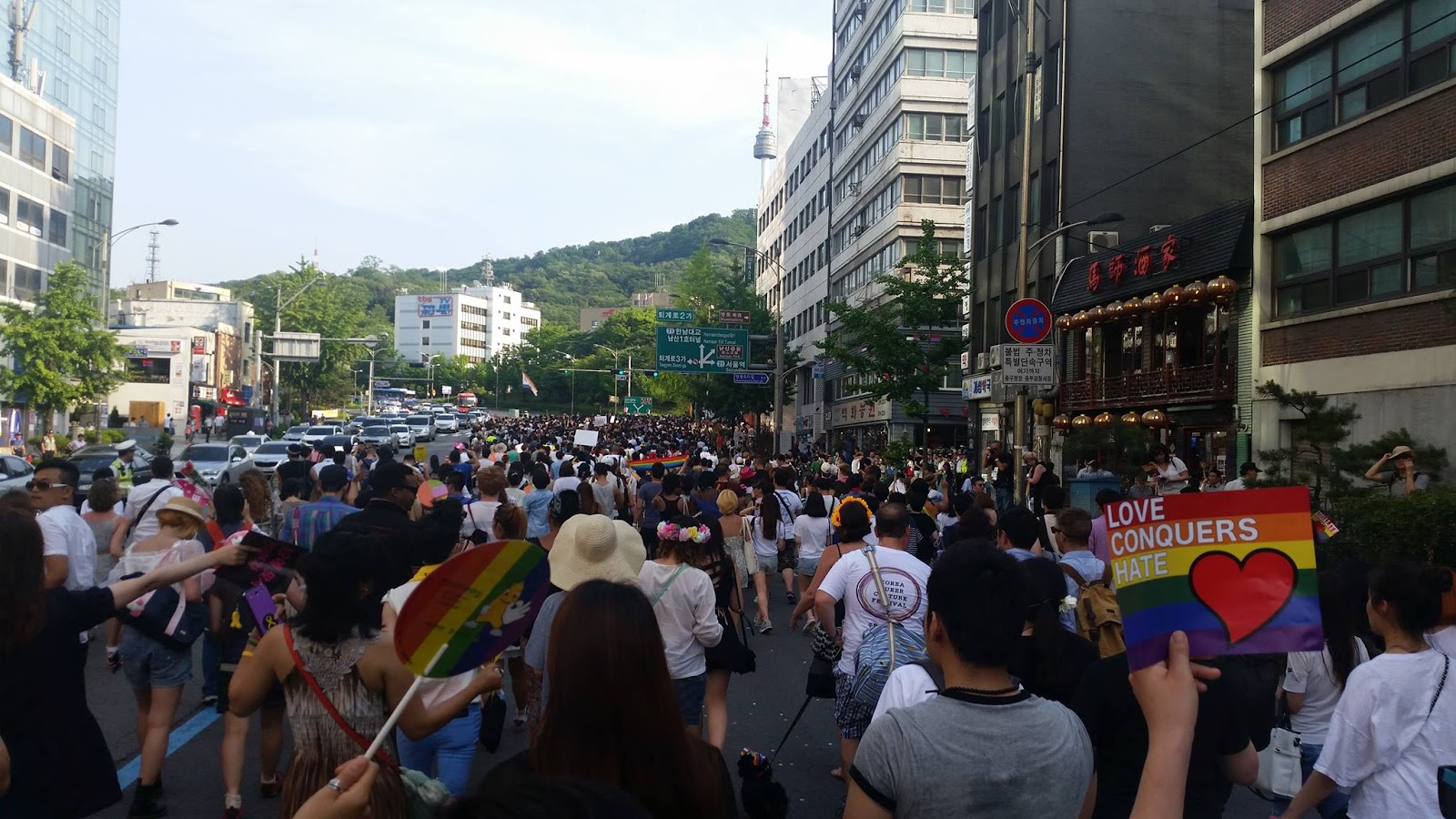
This year's Korea Queer Culture Festival had its opening ceremony on June 9th and its closing parade on June 28th. I went to both events and took photos to share with you all.

(I have translated this post into Korean. But I have not had it checked at all, so it's going to be messy. Sorry in advance for the errors!)

올해 한국의 퀴어문화축제는 6월9일에 개막식이 열리고 6월 28일 자긍심 (프라이드) 퍼레이드가 열렸다. 저는 사진을 찍어려 갔다.

(저는 한국어를 잘 못 해서 실수가 많이 있르 것이다. 미안합니다!)

To my Christian friends: a good number of you may be against events like Pride and the values that it stands for. I understand this. Years ago I also used my religion and my deeply-held beliefs about Biblical morality to fuel my disapproval of all things that had to do with LGBTQ expression.

저의 기독교인 친구들에게: 아마 너희들중에 이런 행사와 성소수자의 이상에 반대하는 사람이 많은 것 같다. 저는 너희들의 생각을 이해한다. 저도 이전에 기독교와 성경을 믿기 때문에 동성애와 다른 성소수자의 표현을 싫어했다.

My point of view has changed, however. I believe now that it is only fair that LGBTQ people have the same rights as everyone else: the right to celebrate their own culture, the right to get married, the right to create families and contribute to society without being condemned or threatened because of their differences in gender or sexuality.

하지만 이제 저는 생각을 바꿨다. 지금 성소수자들이 평등권리를 받야 한다고 생각한다. 퀴어 문화를 즐기는 권리며, 결혼 권리며, 가족을 이루는 권리며, 혐오나 협박 없이 사회에 공헌할 수 있는 권리도 필요한다.

Furthermore, I believe that the Christians who have historically opposed LGBTQ activism have done so in a largely unloving and foolish way. While Christ calls us to love even our enemies, Christians were the first to cast stones at the oppressed sexual minority communities, or else stood by and watched discrimination become entrenched in society without lifting a finger to help. Christians should have been the first to help an oppressed minority, because God's love transcends petty human ideologies.

또 한, 이전에 성소수자의 활동주의에 반대하는 기독교인들은 야박하고 어리석게 했다고 생각한다. 예수님이 우리가 원수를 사랑하라고 했지만, 억압당하는 성소수자들을 공격하는 사람들이 기독교인들이었다. 선소수자들이 사외에서 차별을 당할 때 손가락도 까딱하지 않은 사람들이 기독교인들이었다. 오히려 기독교인들은 먼저 도와줘야 했었는데요. 왜냐하면 하나님의 사랑이 인간의 이상들을 초월하기 때문이다.
Seoul Pride Parade 2015
So here I was at Seoul's Pride Month events, happy to see Korea's LGBTQ community come together in strength and solidarity, and at the same time dismayed (yet unsurprised) to see huge numbers of conservative Christian protestors loudly declaiming against homosexuality, AIDS, public indecency, and gay marriage. They flew the Korean flag and a cross flag to symbolize the ideals of faith and tradition that drove them to protest, and they countered all of the Pride events with rallies and performances of their own.

그런데 제가 퀴어문화 축제를 다녔는데, 한국 성소수자들이 같이 모이는 것 하고 그들의 공동체의 결속을 보여줘서 고무적이고 감동적이었다. 반면에 수 많은 보수적인 기독교의 시위자들이 ‘동성애 아웃’, ‘에이즈의 광란’, ‘동성결혼 싫어’, ‘외설죄 반대’라는 구호를 시끄럽게 소리치는 것도 봐서 조금 속상했다. (역시 보수적인 기독교의 시위자들…) 신앙과 전통의 상진주의 위해 태극기와 기독교의 십자가 국기를 올렸고 퀴어문화축제에 반대의 그들은 자기의 행사를 열렸다.

I just want to show you what it looked like from the perspective of a non-Korean, Christian, gay man. I went to enjoy the events, and I went with friends, and I never at any point felt unsafe. I was happy to see the joy and pride at KQCF. I hope that the Christians who support LGBTQ rights will be encouraged that even in a conservative country like Korea, a celebration like this can happen. I also hope that the Christians who do not support LGBTQ rights will see despite their opposition, the right way to win hearts is not through anger, disgust, or despair, but through love.

저는 그냥 직접 목격한 것을 좀 보여드리고 싶다. 저는 한국인 아니며, 예수님을 사랑하는 게이 남성인데 올해 퀴어문화축제에 즐겁게 지내려고 갔다. 친구들이랑 무사히 다녀왔다. 제가 KQCF에서 행복한 분위기와 모든 사람들의 자긍심이 보일 수 있어서 기뻤다. 여러분, 성소수자를 지지하는 기독교인들이 한국과 같은 보수적인 나라에서도 이런 축제가 열려도 되는것에서 위안을 찾으시면 좋겠다. 그리고 성소수자의 권리에 반대 하는 기독교인들이 다음 진상을 아시면 좋겠다: 남의 마음을 얻는 것을 위해서 가장 좋은 방식이 분노, 혐오, 절망으로 아니고 사랑으로 해야한다.
Dance performances at KQCF 2015
To my Korean friends: a good number of you may be curious about what KQCF is, even though it has been held annually in Seoul for sixteen years now. Here's my short explanation: Some people think homosexuality is something that recently came from Western societies into Korea. Actually, LGBTQ (lesbian, gay, bisexual, transgender, and queer) people have been in Korea for hundreds of years, but the recognition that sexual minorities are normal and not mentally ill or perverted is more recent. And even more recently, there have been movements around the world to show acceptance of these sexual minorities.

저의 한국친구들에게: 아마 너희들중에 ‘퀴어문화축제’가 뭣인지 궁굼할 것 같다. 한국에서 지난 16년 동안 열렸거든요… 어쨌든. 동성애가 서양 사회에서 한국에 들어온 것이라고 생각하는 사람도 있다. 사실은 LGBTQ (레즈비언, 게이, 양성애, 트랜즈젠더, 퀴어 등) 사람들이 한국에 옛날부터 있었지만, 이 성소수자들이 실제로 정신 장애가 없고 변태가 아니라는 인식이 현대까지 안 나왔다. 그리고 더 최근에 전세계에 성소수자의 승인을 구하는 운동들이 시작되었다.

Seoul's "Korea Queer Culture Festival" began in the year 2000. LGBTQ activists have had to fight to gain recognition that LGBTQ people even exist in Korea. But there are more hurdles to overcome. Discrimination against LGBTQ people is widespread: in Korea, a gay or lesbian couple cannot get married, a person can be fired from their job for being queer, and, of course, LGBTQ teenagers can be bullied to the point of wanting to commit suicide. Activists and allies in Korea want to change laws and public opinion in Korea so that Korean society will become a safer place for sexual minorities.

서울의 ‘퀴어문화축제’라는 행사는 2000년에 세웠다. 이 전에 한국의 성소수자들의 존재를 대채로 인식되지 않았다. 요즘은 퀴어 사람들이 옛잘 보다 자주 보일 수 있지만 성소수자에 관한 사회의 문제가 많이 남았다고 생각 한다. 성소수자에 대한 차별이 정말 많다. 예를 들면 한국에서 게이나 레즈비언 커플의 결혼은 불법이다. 그리고 어떤 성소수자가 성적 성향 때문에 일에서 해고될 수 있다. 또, 퀴어 청소년들이 자주 자살하도록 괴롭힘을 당하고 있다. 한국 성소수자 운동가들 하고 동맹자(친구)들은 한국이 성소수자에게 안전한 사회가 되도록 한국의 법을 개정하고 여론을 바꾸고 싶다.

Of course, KQCF is also a big party, too. LGBTQ people value freedom, love, and equality for all people regardless of who they are. The reason the celebration can be a little bit wild is probably a direct response to the intensity of the community's historical oppression. If you go to a Pride event and see crazy costumes, leftist slogans, or people behaving in a way that is surprising to you, I encourage you to remain open-minded and remember that there is a reason for all of the things people do and believe, and that it is better to try to appreciate that reason than to immediately dismiss it because you don't understand.

물론 퀴어문화축제는 축제이잖아요. 성소수자들은 사람들의 차이에 상관없이 자유, 사랑과 평등을 소중하게 생각한다. 축제가 가끔… 광란(격렬?)하는 이유는 성소수자들의 역사상의 억압에 직접 반응인 것 같다. 너희들이 프라이드 행사에 다니시고 괴짜의 의상, 좌파 구호나 이상한 사람을 보시면, 므음을 열기를 바랍니다. 인간행동과 우리의 믿음이 개인에 딸라 다른 것을 잊지 마세요. 남의 다른 자가표현을 알아듣지 않아서 싫어하지 말고 그들을 이해해보시기 바랍니다.

To my LGBTQ friends: Have courage, and happy Pride!

우리 게이, 레즈비언, 양성애의, 트랜즈젠더, 퀴어 등 친구들에게: 용기를 가지세요. 힘내. 화이팅. 해피 프라이드!

Tuesday, July 7, 2015

Half the Battle

A scene from tonight's taekgyeon class. We have just finished our warm-up.

관장님: Okay, um... now get on the floor.
[My two fellow trainees and I do as we are told.]
관장님: Now do eopdeuryeo palkuphyeo pyeogi1.
Me: ...?!?!?! What is that?
관장님 (in English): Do push-up!
Me: Oh, okay. How many?
관장님: One hundred.
Me: One hundred?!
Other guy: What?!
관장님: What's the problem? Be grateful it isn't two hundred.
[Seventy push-ups in, I notice that my fellow trainees have stopped.]
[Thirty push-ups later, I collapse to the floor.]
Me: Aigo2... So, uh, how many did you do?
Other guy: Oh, I just did fifty.
Me: Fifty? Come on! Well... at least pani sijak... ida3.
Other guy: What?
Me: Um... pani sijakida?
관장님: Pani... Oh! You mean sijaki panida4.
Me: Ah, that's right. Sijaki panida. Haha, I'm so stupid.

- - -

For those for whom this made very little sense, an explanation: I meant to encourage my fellow trainee with a proverb that I had recently learned in Korean class. The proverb is "시작이 반이다," which is basically equivalent to, "Starting is half the battle" (or the clever rhyming version I found online: "Well begun is half done"). He'd done fifty push-ups, and he was halfway through!

Unfortunately, I mixed up the two nouns in the expression and ended up telling him something more along the lines of, "Half is just the beginning." Even if it did make any sense, it probably wouldn't have been very encouraging at all! You've already done fifty eopdeuryeo palkphyeo blah blah whatever, but that's just the start of it... *cue evil laugh*

When it comes to using the new Korean words and expressions I've been learning in class, I inevitably make foolish mistakes. In the best case scenario, I bring a conversation with a Korean friend to an awkward halt because I sound like a stilted textbook example. In the worst case scenario, my friend decides to switch to English because they literally can't make sense of what I'm trying to say.

But in embarrassing times such as these, I remember another proverb, "Nothing ventured, nothing gained." Or the Korean version: 범의 굴에 들어가야 범을 잡는다5. You need to enter the tiger's den if you want to catch it. In my case, the tiger is fluency in a foreign language and the cave is an endless abyss of silly and awkward misunderstandings.

- - -

1 '엎드려 팔굽혀 펴기' is a ridiculously long word for 'push-up'. I mean, seriously?!
2 '아이고' is a common Korean expression of pain, discomfort, or dismay.
3 '반이 시작이다' does not mean anything in Korean.
4 '시작이 반이다' is a common Korean proverb.
5 In Chinese (for the heck of it): 不入虎穴,焉得虎子.

Wednesday, June 17, 2015

The Korean Taekgyeon Association(s)

Imagine a situation in which you cannot speak English but begin to learn slowly, taking lessons with an American teacher. After about a year and a half, you put your studies on hold for another year. Then, you get a great opportunity to study abroad! Unfortunately, the English language program is in Scotland. So you hop on a plane to Edinburgh and, upon arrival, wonder if anything you learned from your American teacher is even going to begin to help you understand what the heck all these ruddy Scots are saying.

Or suppose you've been learning how to swing dance, having first picked it up in Philadelphia. After some time, you go home to LA and make a beeline for the first swing dance venue you see an advertisement for. Unfortunately, none of the footwork you've just barely mastered is, well, working for you. After half an hour of utter confusion, a particularly astute dance partner identifies the problem: "You learned lindy, didn't you? This is a West Coast swing bar."

This is the kind of situation I currently find myself facing. Actually, the swing dance style mix-up literally did happen to me once, but I'm now referring to my decision to continue studying the Korean martial art taekgyeon this summer. Previously, I studied taekgyeon in Changwon for about a year and a half, and I even went as far as obtaining my first-degree black belt. So, I had been looking forward to picking up where I'd left off this summer.

However, two obstacles to this goal have surfaced. The first is that, having never practiced while I was in California this past year, I'd forgotten pretty much everything that I'd learned. Secondly, the closest taekgyeon training center in the same league as the one I'd joined in Changwon was too far away from where I live in Seoul, so I had to join a different league (or association). And the style of taekgyeon at this gym is so different that I basically have to re-learn the basics!

That's right, even in such a small country, for a traditional martial art that almost nobody practices anymore, there are still a number of different leagues or associations for taekgyeon that practice the art differently. According to my taekgyeon masters, there are three. But after doing some random and confusing Googling and Naver searching, it looks like there could be as many as half a dozen. Here's a list of some organization names that I found:

한국택견협회 - Korean Taekgyeon Association
세계택견본부 - World Taekkyon Headquarters
결련택견협회 - Kyulyun Taekyun Association
대한택견연맹 - Korean Taekkyon Federation
현함윗때태껸연구회 - World Wide Taekkyeon Organization

In Changwon, I trained at a gym associated with the first one, KTA. Now, in Seoul's Gwanak District, the gym I go to is part of the second one, WTH. Then there's the Kyulyun Taekyun Association, which is supposedly the third. And the other two... well, the WWTO is based out of Los Angeles, which makes it unique. But I'm not sure, really, how they're all related. Taekgyeon history purportedly goes back thousands of years, but its modern iterations are all about three decades old. Even so, the variations are quite striking. All three styles teach taekgyeon a little bit differently. Frankly, all they seem to have in common is how they romanize the first syllable of the name of the sport.

(For the linguists out there, regardless of spelling, the proper pronunciation is [tʰɛk̚.k͈ʲʌn]. The diacritic below the [k] represents 'strong/tense' articulation, whatever that really is...)

Anyway, the long and short of it is, I'm happy to be practicing martial arts again, but it's definitely a struggle, because I have to undo bad habits, reconsider how I think about every movement before executing it, and accept that even though I have a black belt, I'm still just a beginner. It's a humbling experience. I've had to come to terms with the fact that in order to improve, one has to admit that one is not perfect, or even the exact opposite of perfect. Or, to put it bluntly, you can't get good at it until you realize you're not good at all.

On top of that, my new gwanjangnim, or master/instructor, isn't really the most patient guy. I kick once, and he cuts in, saying, "No, no, no, no, no! Like this." I kick once more, and he cuts in... Rinse, wash, repeat. Haha. Obviously, he makes every move look as easy as eating rice cake while lying down*. But he's also lightly sarcastic and easily distracted. He can't seem to fathom how I can be strong enough to bench press him yet too uncoordinated to execute a double footsweep. The other day, right in the middle of a warmup, he stopped everything, sat on on my back, and told me to do five push-ups. Then he scolded the younger kids for not taking their training seriously. It was kind of funny.

... Yeah, anyway. Ten hours of taekgyeon a week is doing my mind and body some good, since I was pretty 정신없다 (which means something like... going stir-crazy) beforehand. Because it's a different style, though, I also have to try hard to remain patient despite my inexperience and relish the novelty and the ways my brain expands by learning, instead of getting frustrated with where I am. Flashback to my very first taekgyeon class, more than two years ago! It was always my dream to learn martial arts. When I think about it, I'm in a very lucky position indeed.

- - -

*Reference to a funny Korean idiom I learned the other day: "누워서 떡 먹기".

Saturday, June 13, 2015

More on Seoul Pride, Protests, and Human Rights

I just wanted to share this incredible photo shared on the KQCF Facebook page (courtesy Newsis). It's an aerial view of Tuesday's KQCF opening ceremony, in which you can clearly see just how many protesters attended the event.

Despite the protesters not having a permit to organize in Seoul Plaza, they showed up in droves and encircled half of the plaza. They had megaphones and posters and spent the entire evening singing, praying, and shouting at everyone on the other side of the yellow-lit barrier.

The barrier was manned by city police officers, who can also be seen in the image as the clumps of yellow who physically kept the protesters away.

On the bottom right, you can see the stage for the opening ceremony and a pretty sizable crowd of LGBTQ supporters and media. I mean, if it hadn't been for MERS, I'm willing to bet at least three-fourths of Seoul Plaza would be filled with attendees. You can also see a giant rainbow heart that was created using lighted balloons, right in the center of the field.

While we're on the subject of Seoul Pride, I'd like to share a post on Buzzfeed that shows more photos of the event and the protesters. It's rather bluntly titled "Seoul's Pride Events Are Off to a Pretty Terrible Start". And here's another article, from the Korea Observer, that describes the hate-filled atmosphere of the protests in more detail. While the situation does look bad from this point of view, I guess I want to say that a more positive outlook is both possible and necessary. Like I've said before, the LGBTQ activists in Korea have faced fierce opposition every year for over a decade, and I have faith that they will remain strong to fight the good fight for the rest of Pride Month and in the years to come.

And on a more positive note, Human Rights Watch published this open letter to the Korean president and government, urging them to take a stronger stand for LGBTQ rights and to permit the Pride Parade on the 28th (which was controversially denied a permit a few weeks ago). From the letter:

"The Seoul authorities’ failure to allow the LGBT pride parade is in stark contrast to the leadership role South Korea has taken internationally on LGBT rights. At the United Nations, South Korea voted for both the 2011 and 2014 Human Rights Council resolutions that called for an end to violence and discrimination based on sexual orientation and gender identity and that authorized development of global reports on the status of LGBT rights."

They're right. If South Korea wants to remain in good international standing in the field of human rights, it should let its actions speak louder than its words and protect the LGBTQ minority and also fight for their equality in the right to assemble, to marry, to adopt, etc. (But even if the rest of the developed, democratic world did not support LGBTQ rights, I'd hope that South Korea, a country that has experienced profound oppression in its recent history, would be able to recognize what's really happening here and rally for an end to institutional homophobia regardless.) I'm working on a translation of this short article on HuffPost Korea about how ambassadors and representatives from over a dozen countries took a stand for LGBTQ equality at last Tuesday's opening ceremony. Good on them for not caving to Korea's conservative crazies who want all LGBTQ-supporting foreigners to leave the country! And let's hope that the city government (at least) has a ready response.

Tuesday, June 9, 2015

KQCF 2015 Opening Ceremony

The LGBTQ community in Korea has recently been facing extremely strong opposition, and with this year's Korea Queer Culture Festival (퀴어문화축제, otherwise known as Seoul Pride), simmering tensions seem to have erupted into a full-scale war. I don't mean to exaggerate, but there has certainly been more controversy than ever, especially in the past week.
Tonight was the opening ceremony (개막식) for the festival. The event was meant to be a party and a celebration of LGBTQ identity, expression, solidarity, and rights. Unfortunately, the dates and locations kept shifting during the planning process because of fierce opposition from anti-LGBTQ groups (mostly made up of conservative Christians), and to top it all off, protesters numbering in the high hundreds -- perhaps even a thousand -- showed up at Seoul Plaza to try to drown out the opening ceremony with hymns and prayer.

On top of that, as most of the world may know by now, South Korea is experiencing an outbreak of MERS, a flu-like virus that has infected several dozen people and landed over a thousand more in quarantine. Although transmission has been limited to hospitals where previous patients have been treated, a rising panic over a possible epidemic has led to the temporary closure of many schools, the cancellation of some large events, and an exponential rise in sales of hygienic masks to wear in public. The organizing team of KQCF had, a few days prior to the event, announced that as a precautionary measure, they recommended that people not actually attend the opening ceremony and instead stay home to watch the live stream.

I deliberated for a while over whether or not I should go. I really wanted to support the community's efforts and use my physical presence as a display of my solidarity. Many other foreigners in Korea agreed with me (the issue was discussed extensively on Facebook), but there was the worry of jeopardizing all of Pride by risking actual MERS transmission or even physical altercations with the anti-LGBTQ protesters, neither of which would look good through the media's lens.

In the end, I told myself that I had nothing to be afraid of, so I bought myself a mask, hopped on the subway with my camera, and traveled to City Hall.

The first thing I saw were city police in their signature yellow vests. Then, I heard the music. But it wasn't the vigorous pop music I'd expected. As I exited the subway station, I saw the signs (literally) and realized that I had walked directly into the anti-LGBTQ protest. Not that there was any way to avoid it. I walked around for a bit, taking in the huge crowds of protesters, and I actually couldn't figure out where the KQCF opening ceremony was at all. Finally, I got my bearings. Seoul Plaza is a large circular field. In one small section of the field, a stage for KQCF had been set up, and people were running around taking care of last-minute details for the event. Around the stage, a police barricade had been erected, with officers standing at even intervals. And then, all around the edge of the giant field, was a long unbroken line of protesters, every one of them holding up a sign or grouped together praying and singing. Between the two camps were two lines of police officers and several yards of empty grass.

To my dismay, I saw that the protesters outnumbered the event supporters by at least five to one, and they were loud. They were prepared with posters, megaphones, and flags, and they were belting out "The Battle Hymn of the Republic" in Korean. I walked among them and took photos and videos of their posters. Most were emblazoned with slogans like "Homosexuals, OUT!", "Gay sex transmits AIDS", "Ban Ki-moon, is homosexuality a human right?", "I am against same-sex marriage", so on and so forth. I didn't know whether to laugh or cry. They were so serious.
The poster in the middle says "동성애 (homosexuality) out! out!", and the one on the left is a rant about AIDS.
The media were everywhere. Many people were filming and interviewing both the protesters and the supporters on both sides of the police line. I realized that I would probably end up in some footage broadcast somewhere or posted online... but then I also realized that with my mask and my hat, I would actually be pretty difficult to recognize. At least, nobody looking at me had any reason to suspect that I wasn't just another curious Korean citizen. I guess therein lies another aspect of the mixed blessing of being Asian. I could pretend to be an innocent bystander, but any white person at the event was assumed to be a foreigner and, by proxy, an LGBTQ person or ally. As I stood filming, a Korean clergyman carrying an anti-LGBTQ sign strode past and yelled at two white people nearby, "Jesus died for you!"

After not too long, I'd had enough of the protests and slipped into the barricaded area. I had to work my way past protesters and police, and once I arrived on the other side -- after I literally crossed a boundary (liminality, anyone?) -- I had a brief moment of, what can I call it, epiphany? It dawned on me that even though I could have been anyone, Korean or foreign, Christian or not, gay or whatever, while I was on the protesters' side, as soon as I physically arrived in the space deemed "LGBTQ", I had become the target of the protesters' hate. Honestly. Just because I was standing in a certain roped-off area in Seoul Plaza, I became an object of disgust, fear, and rejection. The Christians were yelling at me, and at everyone else at the event... and yes, it was more than a little bit unsettling.

On the Other side, though, I found the LGBTQ community and allies happily holding up supportive posters of their own, dancing with large glow sticks, or sitting on the grass waiting for the event to start. It was about ninety minutes behind schedule due to certain obstacles encountered during setup (read: protesters). But then, as my friend remarked, "Now comes the part where we just sit back and enjoy the show."

The KQCF opening ceremony, finally! There were dance performances and many, many speeches to sit through. It was formal, yet amazingly spirited, especially for the (relatively) small audience. I think that everyone who got up on the stage was extremely brave for doing so. Whenever the music stopped, we could all still hear the raucous singing and chanting of the protesters, but as time went on it got easier to tune them out. Several of the speeches addressed the protests directly. Seoul Pride has always faced opposition, and this year, while being more intense, was really no different than usual. The organizers took it in stride and responded to the haters with grace and wit. I am so proud of them.

To be honest, I couldn't understand a lot of what was going on, for two reasons. First of all, my Korean listening proficiency isn't that good yet, so I could only grasp about 50% of all the speeches. Second of all, they had Korean Sign Language interpreters! And that was distracting, because I was trying to pick up a few KSL signs while listening to Korean and having to interpret it in my head. But anyway, I think I got the gist of the night: despite oppression, opposition, and possible epidemic, we have to show our love and resist the unjust powers that be. 사랑하라, 저항하라!

By the time I left, I knew that while I and the Korean queer community have every reason to be discouraged and upset, we have strength and we have each other, and that counts for a lot. I was encouraged by tonight, and I have a good feeling that the rest of Seoul Pride will not only rise to meet future challenges, but actually transcend them altogether.
One of the opening acts for the event. The crowd was sizable, despite the MERS scare!
One of my favorite moments was when all of these ambassadors and representatives from other countries spoke in favor of human rights and equality. The one with the mic in this photo is a representative from the USA!
And I almost choked up here, too, when members of the clergy representing four religions came up on stage and spoke out in favor of equality and acceptance. The one speaking now is from a progressive Presbyterian church called Sumdol Hyanglin Church (that I would love to go visit!).
And just for good measures, more protesters I encountered as I left, around 11pm. These people were singing and waving their candles around like it was some sort of vigil.
I'll probably write more about Seoul Pride in the future, but it's been a long day and I really need to sleep now. Goodnight world; I hope I can wake up to a brighter tomorrow. :)

Tuesday, June 2, 2015

Profluentia et Imprudentia

I have to be more careful with my words. This was the realization that came hand-in-hand with a gentle reminder that I am currently living in a country where I am not fluent in the language. Wait, let me revise that: I am reminded daily that I cannot speak Korean well, and these reminders themselves are not always gentle. Like when I struggled for an hour to open up a checking account only to be told finally that without an ARC it just was not possible.

But this time, the reminder was gentle, and it came from a friend who has lived in Korea for longer than I have and knows a great deal more about it. We met up last weekend since he's currently doing his graduate studies at the same university where I'm taking language classes, and I have perhaps unceremoniously latched onto him as my go-to resource for cultural guidance and assistance with quotidian matters.

After I left Korea nine months ago, I forgot one of the basics of cultural communication, the one that is drilled into every language student's head from the very beginning: Korean culture is built on a hierarchy. In society, what this means is that the young and inexperienced always defer to their elders and superiors. Children obey their parents; younger students take orders from their seonbae (upperclassmen); the employer's word is law to their employees.

In language, this means that one's vocabulary and grammatical constructions change depending on whom you address. It's much more complex than a handful of polite terms. I would ask a favor of a friend using a wholly different grammatical form than that which I'd use to ask the same favor of my teacher or grandfather.

Of course, I didn't forget that this rule exists in Korean. What I have neglected to remain mindful of, then, is how strictly it actually applies to me.

You see, while I do I fairly a good job of blending in with the crowd here in Seoul (the expectation is that an East Asian face equals a Korean face, unless it's dressed in the outlandish garb of the Chinese tourist), as soon as I open my mouth, most people realize that I am very much American. My accent cues them off, and then my face and fashion sense fall into place with it. I guess this morning was an anomaly, when my new language instructor asked me if my parents were Korean, apparently surprised at my speaking fluency. Anyway, humblebrag aside, once I'm tagged as a foreigner, what has happened generally is that all linguistic rules are tossed and my stupid mistakes are forgiven. I can ask for a head of cabbage instead of a beer and nobody will fault me for it. I can stare dumbly at the real estate agent as he tries to explain the security deposit without him thinking that I am actually dumb. And, critically, I can use the wrong forms of address to everyone -- casual conjugations with a stranger, super-honorifics with my former student -- and I'll get a free pass because I'm still learning.

I am not saying here that I should make these kinds of mistakes. After all, as a perfectionist, I cringe when I catch myself saying something wrong or culturally inappropriate. But my point is that I do make these mistakes, yet I've been let off the hook so many times that I haven't really properly internalized the rules of what to say and when. Or at least, if I had had everything down after the first two years, I had promptly forgotten when I left.

And now I'm back and I'm making a fool of myself. Why? Because I'm here, newly determined to show that I have learned something after months upon months of intermittent language study, and along with this courage comes a fair bit of hubris, and from this hubris arises a situation in which my friend introduces me to his classmate, both of them my seonbae, and I immediately talk with him as if we've been buddies for years. So much for cultural competency.

Hence the gentle reminder: remember who you are and whom you're talking to. It may not be important to you, or any American for that matter, but it matters here.

My friend himself admitted that it took getting used to, being a graduate student in linguistics (a field generally as casual and laid-back as you can imagine; my professors at Berkeley eschew being addressed by anything other than their first names, for example), but in a country where hierarchy is deeply entrenched in the ivory bastion of cultural conservatism and academic tradition. The constant bowing, the formal pleasantries, the obligatory grad student drudgery for tenured professors: it's all here, and while my friend is just beginning to tire of it, I realize that I haven't even begun to process its reality.

If I really want to pursue Korean linguistics, then the hierarchy, ingrained as it is into both the language and the culture, is something I will have to acknowledge and accept. I don't like hierarchy; let me be clear about that if it isn't already obvious. But as an academic, I have to respect it, and step one is taking pains to use the proper honorifics in the right contexts.

Even with my Korean friends -- the ones with whom I converse freely in Korean, who only correct my many errors when I demand for them to -- I think it's time to be more disciplined about my language use. Who exactly is my nuna, my hyeong, my dongsaeng? It's admittedly a bit complex: is age the only factor? Should I ask my Korean friends for their opinion on how I should categorize them, or is that rude?

There's sure to be some discomfort as I recommence navigating this cultural landscape. I thought two years' worth of experience wasn't too bad, but it's nothing. And it's not just the hierarchy thing, either. I only have two months this time, and I wonder if tackling headfirst questions like my place in Korea as an American, the ups and downsides of rapid globalization, or the uncertain future of LGBTQ rights in this country are even worth my while. This summer, will I traipse through Seoul taking pretty pictures of food and blogging about the charmed expat life, or will I choose my words -- and thoughts and actions -- more carefully?

Thursday, May 28, 2015

The Eastern Hemisphere

As I sat at the boarding gate at SFO, Katelyn texted me: "WAHH ARE YOU EXCITED," and I, deciding to be honest, replied, "나 피곤해 ㅠㅠ," which means "I'm tired :(."

Prior to leaving for Korea, I'd spent a week in Colorado with my parents, which, while fun and worthwhile, was a specimen of rather poor timing on my part. You see, I had been busy with my final exams and papers right up until I moved out of Berkeley. Then, I found myself in the Rocky Mountains, far, far away from the banks I needed for foreign currency, the post office where my newly-purchased recording equipment had been sent, and friends who might be able to help me in my seemingly-futile search for an apartment in Seoul.

In between beautiful hikes during the day and delicious meals at night, I was actually spending most of my vacation hours in slight panic mode as my date of departure approached and nothing was falling into place. So at the airport, as I boarded my flight, I was indeed tired, and I found it hard not to worry about how many things still had the possibility of going wrong! Still, I put on my happy facade, updated a quick photo and traveling status to Facebook, and proceeded to watch four and a half movies in a row on the plane. Escapism.

This light display at SFO is one of several dozen that represents the sister cities of San Francisco. I didn't know Seoul was a sister city! The seal also depicts Seoul's city flower, Forsythia viridissima, which is called 금선개나리 (Kumson kaenari) in Korean.
Twelve hours later, I had crossed the International Date Line and was on the other side of the world! It felt very strange to be at the Incheon Airport once again. Everything was so familiar, yet I felt different. I don't know if the nine months since I last was here count as a long time or a short time.

Three hours after that, I had my own apartment, began unpacking, and went to a cafe for WiFi and a 9pm dinner of Honey Bread and a sweet potato latte. And that's when I thought, "Okay, I'm really back in Korea now."

God is good, is He not? I had prayed for a lot of things that week, number one among them being patience and serenity (to accept the things I couldn't change, which were mostly my own fault anyway). I had asked for a way to bring enough cash to pay up front for an apartment I didn't even have yet, and although all the banks had been closed on Memorial Day, the ATMs came through! I had asked for the realtor I'd been talking with (via Kakaotalk, of all things) to be an honest and not-scammy person, and he turned out to be very nice, even waiting for me at his office past its closing time to ensure that I found a place. My studio for the summer is tiny -- basically a glorified dormitory room -- but it's a cheap place to sleep in a quiet neighborhood, and it's not far from SNU's campus, so I'm satisfied.

I had prayed that I would not crash and burn on the placement test for my summer class, because I had neglected to study for it -- not a single hour. My examiner was very nice, and she seemed impressed that I had managed to find an apartment on my own using only Korean. I was placed in level 4 (out of 6). Not great, but not bad at all. I have some catching up to do.

And I had prayed that this summer, I would use my time wisely and understand my purpose for being here. It's ostensibly for study and research. But I'd like to think there's more to it than that. I don't know yet. God doesn't answer every prayer instantaneously. In ten weeks, I'll look back at this and re-evaluate.

When I last checked that goodbye-America-hello-Korea status update on Facebook, I noticed something interesting. There is a small "globe" icon on the menu bar that indicates whether you have any new notifications (and I had about a dozen comments and nearly one hundred "likes" -- were people excited to see me back in Korea or eager to see me leave America?) and it looked different. I realized that while the globe normally shows North and South America for me, suddenly it showed Asia and Africa. Facebook was welcoming me to the Eastern hemisphere.

So here I am. A new adventure awaits. So do old cliches. And who knows what else?

갑시다!

Thursday, April 23, 2015

Taekgyeon, and an exciting announcement!

My friend and fellow blogger Eleanor writes books, and as such she also reads plenty of them. The other day, she sent me a link to a blog post about a YA series called Prophecy in which the Korean martial art taekgyeon (택견*) is featured. Here's the blog post; it's a great primer on this unique and relatively unknown sport!

My taekgyeon black belt!
For about a year and a half, I studied taekgyeon in Changwon. I went to the dojang (gym) almost every weeknight and learned about roundhouse kicks and trips, poomsae, and a smattering of hapkido skills. I became very close with my gwanjangnim (master), and I think I made him proud when I achieved my first-degree black belt before I left Korea.

(Gwanjangnim mailed it overseas to me, and I received it a few months ago. That, along with my former students' Christmas cards last winter, are among the best packages I have ever received. A photo of the black belt, certificate, and special dobok (uniform) are on the left.)

About a week ago, gwanjangnim emailed me to ask if I could help him translate a few articles he needed to present on for a class. He's working on a PhD, too, in exercise psychology. As bizarre as it may sound, a lot of the instruction in Korean graduate schools is done in English, and many programs expect a certain level of fluency in English from their students, whether or not English factors at all into their future careers. Anyway, I did this favor for gwanjangnim, and then I broke the news that I'm about to tell all of you dear readers:

I received a scholarship that will allow me to spend this summer in Korea. I'm going back!

The scholarship is from Berkeley, and the funding will allow me to participate in a language program of my choice. Of course, my choice is the Language Education Institute at Seoul National University, so that's where I'll be for the duration of June and July. While I'm there, I hope to connect with some linguists at that university and conduct some of my own research on the Korean language.

Also while I'm there, I will make frequent trips to Insadong, Seoul's famous "traditional" neighborhood, where weekly taekgyeon performances and demonstrations are held. I hope to be able to find a good dojang in Seoul and show gwanjangnim what I've learned when I visit Changwon. Obviously, I've lost a lot of my skill in the nine months since I returned to the United States.

But anyway, this is good news! I will of course revive this blog to update everyone on what I'm up to in Seoul this summer. Thanks for reading; you will hear back from me again soon! (In the meantime, you can check out my grad school blog here.)

*Because of differences in romanization styles, 택견 can be written as taekkyon, taekkyeon, taekgyeon, or even t'aekkyŏn. I write it the way I do because that's how it's spelled on my uniform.

P.S. Happy Earth Day! 지구의 날 축하해!

Translate