Showing posts with label Gyeongju. Show all posts

Thursday, October 18, 2012

The Silla Legacy (Conference pt. 4)

Continuing the tour of Gyeongju from the Fulbright Fall Conference!

It is now Sunday after lunchtime, and everyone has stuffed their faces full of bulgogi, and it's warm and bright out. So when we arrive at a museum housing artifacts excavated from tombs dating back to the Silla Dynasty (57 BC to AD 935), we all just kind of casually wander through it and snap photos at pretty crowns, jewelry, and pottery. In fact, as I stroll from exhibit to exhibit with Jason, Katelyn, and Jake, all of us are actually engaged in a conversation about our favorite versions of the Pokémon games. (Mine is probably Crystal.) I also busy myself trying to read the Mandarin on the exhibit descriptions. My Mandarin is very rusty, but any chance is worthwhile! I can only recall two things, though: Gyeongju (경주) is 慶州 (Qìngzhōu), "Celebration City", and Silla (신라) is 新羅 (Xīnluó).
A crown in the unique style of the Silla period. It looks like it's made of gold leaf, and it also looks like it was made for a very large head. The little jade jelly bean ornaments make me giggle.
A lot of folks finish the museum early and are just lying on the grass outside beneath the sun. I feel like singing, or maybe napping. We board the bus to go to Anapji, a Silla palace built in the 7th century. Once there, we are given forty-five minutes to walk around the pond, but seriously? This place is gorgeous. Can we just stay here forever, etc. There is a large wooden scale model of the ancient palace complex that everyone photographs before starting the leisurely stroll around the park. The water is absurdly green, but despite the algal blooms, we see giant koi swimming comfortably around.
Katelyn and me at Anapji Pond. (Taken by Jason)
This probably doesn't help their tourism industry much, does it?
Alas, time doesn't stop for us, and we board the bus again to go to Cheomseongdae (첨성대/瞻星臺), the oldest astronomical observatory in East Asia. Popular legend says that it was built as a means for the public for learn how to read the stars on their own rather than having to depend on a corrupt shaman  class -- I can dig that. It's like the Luther Bible of ancient Korea.

But the star-gazing tower itself, despite all the boasting a guidebook can put forth regarding its numerological perfection and structural symbolism, is rather dull. It's really just a giant rook in the middle of a field that nobody is allowed to visit. See the sign?

Haha, I kid. It's actually a poor translation; the small placard reads, in Korean, "들어가지 마세요," or "Please do not enter." It's referring to the grassy area.

Even so, we walk around the entire thing and realize that there's no door, only a window. The thing must have only been accessible by ladder... Nothing else to see here.

At Cheonmachong. The balloon way in the background is from the 떡 festival.
From there, we walk past a 떡 festival and enter a quiet, secluded park with trees shading the paths and hushing the sounds of the roads. The only sounds are Fulbrighters chatting and Brittany's loud maniacal laughter as she shoots us all with the soap bubble gun she has for some unknown reason.

A path leads us past giant earthen mounds -- more like small hills -- that are all just a little bit too geometrically perfect to be natural. They are tumuli, each one a tomb for some member of the Silla royal family. They look like they would be so much fun to sled down come wintertime, but no one is allowed to step foot on them. No visitors allowed. Only lawnmowers to keep them looking pristine.

The very last one at the end of the path is Cheonmachong (천마총/天馬塚), the Heavenly Horse Tomb. It's named after a painting of a pegasus found during the tomb excavation. Now, visitors are allowed to walk inside to see some neat artifacts from the 6th century, but it's all artificial, like a small museum instead of an actual excavation site.

A lady gives a short introduction to the tomb right outside of the entrance, and asks a trivia question: "Why do you think the king's body was placed facing the east?" I answer without even thinking, "To face the sunrise". To my surprise, the tour guide herself seems surprised, and wonders how I knew that. I shrug; it seemed logical. By then, the afternoon has worn on and it's nearing dinnertime. I'm tired, but in a good way, I think, because although my feet are sore I feel like I've had a really fun, chill day.

Wednesday, October 17, 2012

Beautiful Gyeongju (Conference pt. 3)

"Beautiful Gyeongju" is the cheesy English moniker adopted by the historic city of Korea. (See related: "Colorful Daegu", "Dynamic Busan", and... "Changwon: Environmental Capital". Yeah.)

There's no denying, however, that Gyeongju lives up to this name. It's a small city but its boundaries are wide; the best word that I can think of right now to describe it is uncompressed. Unlike Seoul, Daegu, and Busan, there's so much room to breathe. And there are trees everywhere, all on the verge of changing colors -- the phenomenon known as 단풍 (dampung) in Korean. On a sunny, crisp, almost-autumn day, the tour we took around the city's historic monuments from the Silla Dynasty was more calming and relaxing than I could have imagined, thanks to our slow pace and the gorgeous sights at every stop.
A small hut selling memorial tiles; you can buy one to write an inspirational message on. I was most interested in the wooden rooftop, though; there's not only moss but small trees growing on it!
The first stop was Seokguram (석굴암/石窟庵), a Buddhist shrine located on the top of a tall mountain. Fortunately, our bus drove to the top, and we didn't have to hike for more than five minutes to arrive at our secluded, peaceful destination. Although there were tons of tourists, they didn't seem to bother the worshipers inside the shrine, who were also separated by a thick glass wall that said "No Cameras". Inside was an enormous ten-foot-tall statue of the seated Buddha, imposing yet peaceful. From the outside, you could see the beautiful farms and fields far below us in the valley, although the morning mist obscured it some. Seokguram is a UNESCO World Heritage site.
A very awake Ginger and Nina jump up in front of Seokguram Grotto (built into an artificial cave!).
Down by the parking lot, we passed by a long row of ajummas (아줌마) selling fruits and roasted chestnuts. Mmm, chestnuts. It was a nice surprise for me that chestnuts (밤, bam) are a common autumnal snack in Korea. They remind me of France (where they're called châtaigne).
This is literally a dozen sellers of the exact same product. You have to wonder what the market competition is like.
After Seokguram, we hopped back on the bus to go to Bulguksa Temple (불국사/佛國寺), Korea's "Historic and Scenic Spot No. 1" and also a UNESCO World Heritage site. Some of the historic treasures located within the temple complex included stone pagodas (탑), famous bridges, and, of course, statues of the Buddha. While we were at the temple, we were supposed to follow a tour in English, but the tour guide mysteriously never showed up (I found out later that she was just very late), so most of us just grabbed a map and wandered around the huge grounds on our own.
Me in front of Dabotap (다보탑/多寶塔), the pagoda of many treasures, built in AD 751. Its partner pagoda just a few meters away, Seokgatap, was under heavy construction at the time. (Photo taken by Susie)
For the average tourist (aka, me), it seems as if once you've seen one Korean Buddhist temple, you've seen them all. I wish I knew more about Buddhism (불교; bulgyo), though; I took only one course in college that covered Eastern traditions, and it only skimmed the surface of what there was to see and learn at Bulguksa. One neat little corner of the temple was covered with hundreds of small cairns -- piles of flat stones stacked neatly atop one another -- that made me feel like a giant in a Suessian wonderland, sans the vivid colors. I wasn't sure what their function was, having been told, when I saw similar structures at Muryeung Valley, that they were used to mark hiking trails. I found out later that they were for making prayers or wishes.
Build a cairn, make a wish! This one is about as tall as a soda can.
All around and behind me are hundreds of small cairns, carefully constructed by thousands of the faithful. (taken by Brittany)
And that's about it for Seokguram and Bulguksa! Two of Korea's most famous historical sites and tourist attractions, check! Then, it was lunchtime (맛있는 불고기!) and off to more beautiful places plus a museum, which I'll get to in a later post. Stay tuned!
The main gate of Tohamsan (토함산/吐含山), the mountain where Bulguksa is located. I spy thirteen -- no, fourteen! Fifteen? -- Fulbrighters!

Tuesday, October 16, 2012

Reunion: Fall Conference 2012 (pt. 2)

You could also call this the Group Photo Post. Last weekend's conference was a fantastic time of reuniting with all of our friends after seven weeks of being apart. Of course, I've traveled to other cities and I've seen tons of other Fulbrighters; I may be the only one in my city, but I'm not as isolated as that. Nevertheless, for everyone to get back together was really something. When we were all gathered in the main conference room, I was taken aback at our numbers. In one large room were represented dozens of cities and over one hundred and twenty different schools, families, and experiences. This amounted to thousands of stories to share.
Contacting the night away! Left to right: Ashley, Sarah, Thomas, Kelly, Sara, and Erin.
On the first evening, a bunch of folks decided to walk around the Bomun Lake (보문호수), the large reservoir central to the tourist resort area where our conference was held. We got drinks and chocolate and, braving the nighttime autumn chill, sat on a pier by the lake and talked and played games. Contact -- my favorite game ever -- was the order of the evening. I love a good two hours of Contact. I mean, not even that, I love a good two hours of speaking quickly and fluently in English with my friends. A nice break from the Korean and intermediate-level English that surrounds me in the classroom every day. And on top of that, a word game that gives your language faculty a run for its money! Kelly perhaps described it best when she said that it felt like her brain was being massaged.
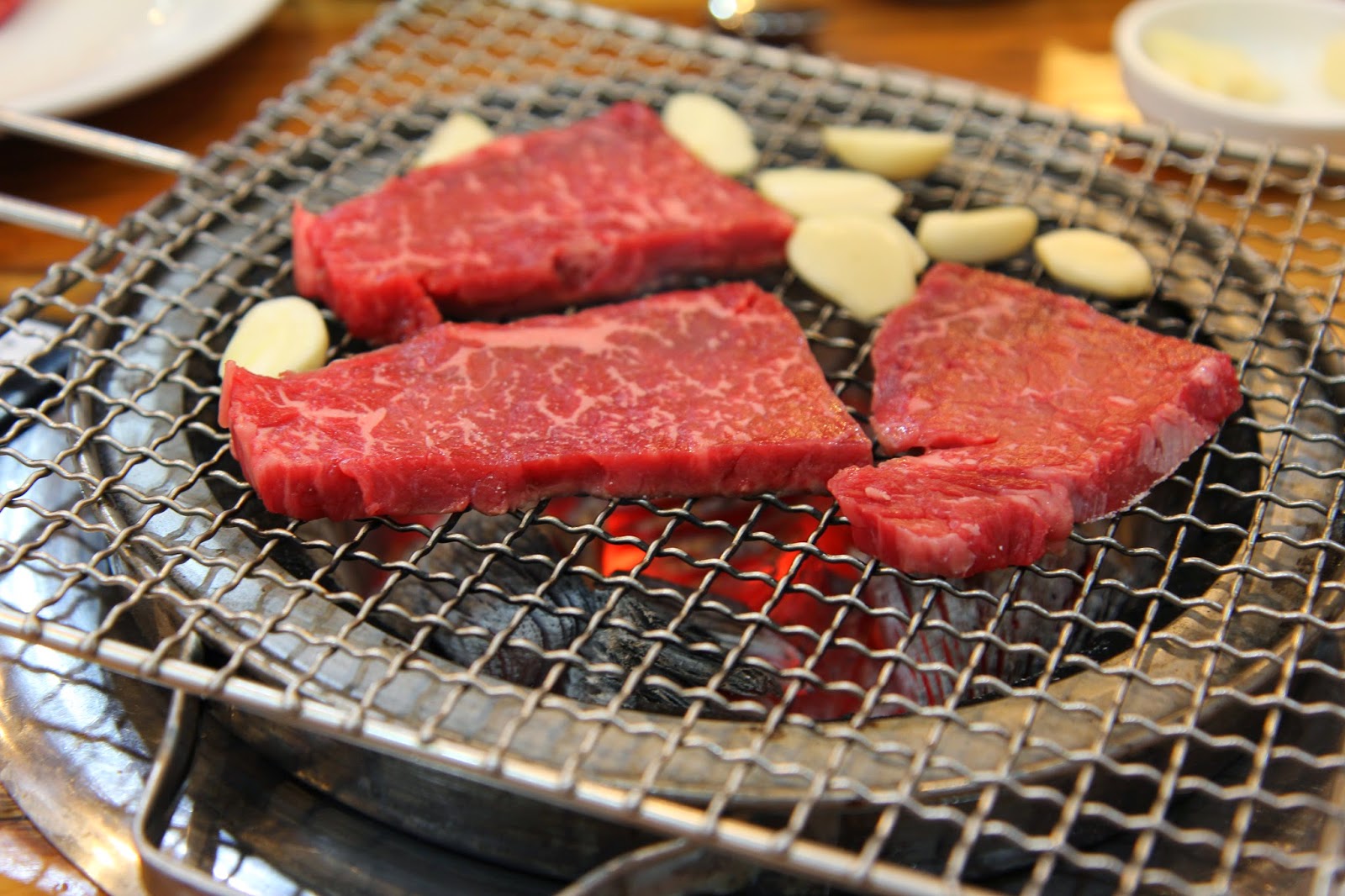
한우, Korean beef grilled over charcoal. The cuts were twice as thick as what I usually see at barbecue restaurants!
On Saturday evening, a group of us got adventurous and went out to get Korean barbecue. Fortunately -- or unfortunately, depending on how you view the situation -- we chanced across a nice-looking restaurant: 강산한우. I wasn't aware of this when we walked in, but 한우 (hanwoo) means Korean beef. Korean beef is really, really expensive. And sure enough, this restaurant turned out to be a wallet breaker. But was it worth it? The small cuts of meat that we got (10,000₩ per 100g) were delicious; juicy steak grilled over pure charcoal, along with tons of garlic, mushrooms (as much as we wanted), and a variety of 반찬. Mhm, there's no denying that it was an excellent meal, surpassing the quality of most of what I eat these days. On the other hand, I've also been stuffed to satisfaction at barbecue joints to the tune of 5,000₩, whereas this tourist trap restaurant, which charged extra for rice and even for setting up our table and grill (who does that?!), landed us with a bill of 20,000₩ per person. I'd pay $18 for that in the States, no sweat, but in Korea? Hmph. I'll say it was worth it, but I don't think I'll be treating myself to 한우 again soon...
The adventurous group that shelled out for some mad-expensive and supremely delicious Korean beef barbecue. Left to right: Kelly, Ashley, Jason, Katelyn, Ben, Tsu, Nina, Elaine, and me. (taken by Neal)
After the meal, everyone was stuffed -- almost uncomfortably so -- which called for a night-time stroll around the lake. I took photos and played with long exposure...
Katelyn, Ashley, Ben, Kelly, and Jason at Bomun Lake in Gyeongju. Jason likes his ice cream.
And that evening ended in a great Bananagrams and Pirate Scrabble marathon, during which I continued to fend off Ashley's attacks on my claim as Bananagrams Boss and Pirate Scrabble Captain and generally had a blast.

What I liked the most about this reunion was that all of us Fulbrighters could basically pick up exactly where we left off at the end of Orientation, which strangely seems like it was simultaneously very long ago and just yesterday. Only now in addition to our crazy antics and long chats about our lives back home, we have stories to tell of our students' crazy antics and long chats about our lives right now. Over all the meals, throughout all those long hours just chilling, between games of Bananagrams, the conversation continued unbroken, and, well, I guess it was telling of just how wonderful it was to be together again.
The wonderful 인터미디엇 (촣아, 촣아, 촣아!) class reunion photo. Left to right: me, Lizzie, Tracy, Jaeyeon, Susie, Amber, Soon, Monica, and Kyla. Missing: Kelly, Megan, and Ashley, who wandered off early :(

Translate