 |
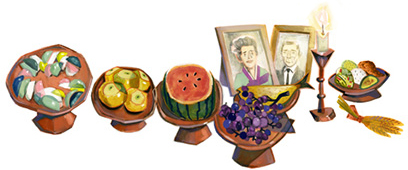
| Happy Chuseok from Google! |
Chuseok (추석) is the most important national holiday of Korea. It's billed to Americans as "Korean Thanksgiving", which is supported by both holidays' occurrence in autumn and the focus on food and family. But from what I've seen, there are more differences than similarities. Perhaps the most conspicuous difference is that the "family" focus of Chuseok is actually on deceased family.
Anyway, I was lucky enough to be able to spend Chuseok with my homestay family. They invited me to experience it, as most foreigners wouldn't get this kind of chance, and I was excited and accepted.
So I spent today in Daegu with my homestay family. (In fact, I spent most of the weekend in Daegu, and I'll have many more posts about my other adventures to write after this.) Custom dictates that a family will return to the father's hometown. So, we went to my homestay father's older brother's apartment, located in an old and quiet neighborhood where, thirty-some years ago, my homestay father grew up, biked to school, and played soccer.
 |
| Chalye jinaegi |
The morning ritual was a 차례 지내기 (
chalye jinaegi), a sort of memorial service for the family's late grandparents.
Despite the common translation of this as "ancestor worship", I would hesitate to call it that. I'm aware, of course, that not understanding the Korean language or really much at all about Korean culture, I could be totally off base. But the word "worship" has particular connotations that were absent from the scene I witnessed, with the grand exception of the prostration in front of the altar. Yet even in regards to that, well, Koreans bow a lot to many different people, and that is considered duly respectful, not idolatrous.
Anyway, the setup was really similar to the
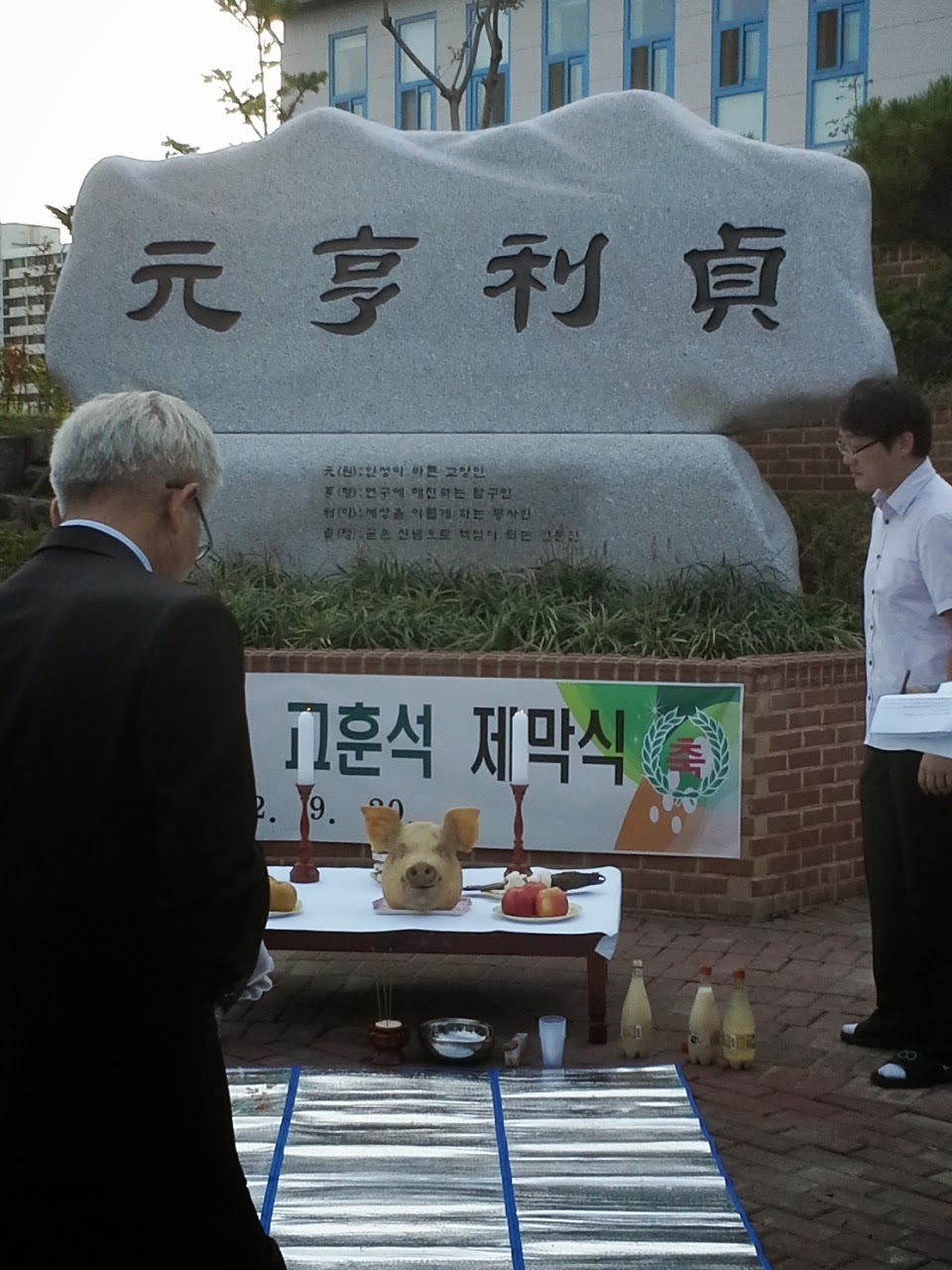
big rock unveiling ceremony that I attended last week: a table laden with food (fried sweet potatoes, fruits, dried squid and cuttlefish, a roasted chicken, rice, rice wine, rice cakes, and
songpyeon (송편), but no pig head this time), incense, and candles. There was a paper screen with
hanja on it that I couldn't decipher, and also smaller papers that represented the ancestors.
I was invited to take photos and film during the ritual, but even though I took advantage of this rare opportunity, I also felt so, incredibly awkward the entire time. "Oh, they're bowing, okay, this is a nice angle, oh, I wish the shutter weren't so freaking loud."
 |
| My homestay father burning the... well, burning something, which signaled the end of the ritual. |
 |
| Some of the dishes prepared at the altar. Rice cake, fried vegetable pancakes, and a chicken! |
After the memorial service, we ate all the food that was on the table. I'm just going to say that 송편 is delicious. It's probably the closest thing to
mochi that you'll find in Korea. And then we ate ice cream and watched TV.
Iron Man 2 was playing on a movie channel!
 |
| This is 송편 (songpyeon), rice balls filled with sweet stuff (in this case, sweet soybean paste). |
In the afternoon, we set out for a mountainous area near Gyeongsan, a city southeast of Daegu, for the purpose of performing another 차례 지내기 at the actual grave of my homestay father's parents. We were joined by thousands of other families -- I'm not exaggerating -- who created an hours-long traffic jam in the mountains where the cemetery is located. I get the sense that most cemeteries in Korea are in the mountains; this obviously has something to do with Korea's very un-flat geography, but I wonder if it is also rooted in some traditional interpretations of spirituality and high elevation?
 |
| The hillside cemetery we visited, somewhere near Gyeongsan, with many families dotting the terraces. |
 |
| Remembering 할머니 and 할아버지. |
One thing is for sure: being in the mountains meant that the cemetery was gorgeous. It was very well-kept by thousands of people coming back to tend to it at least once a year, and the view from where we were was quite nice. Overall, the atmosphere at the cemetery was in fact more jovial, thanks to beautiful weather and lunch. Yes, after performing the memorial service, every family would take the food from the tombstone, spread out a blanket, and proceed to picnic. That was unexpected, I will confess. But it was also pleasant. There was more 송편! And fruits and
bibimbap, too. We had a late lunch, and when we finished it was time to head back to Changwon.
 |
| Picnic time! The husbands drink and the wives prepare some bibimbap from this morning's leftovers. |
 |
| Beautiful bouquets at every grave. They were all synthetic flowers, though! That's why they're so bright and perfect-looking. |
On the long drive home (seriously, every highway in the country had a 교통 채증, or traffic jam, today), we passed a gorgeous sunset.
 |
| This was somewhere between Miryang and Changwon. I love Korea in the fall. Today's weather was so beautiful; I'm glad the typhoon that was slated to hit Korea today veered off course a few days ago. (It would've been the fifth!) |
I'm going to close with two questions for my readers, especially if you are Korean. First, I've heard from three separate grown Korean women that Chuseok and other 명절 (
myeongjeol), or traditional holidays, are incredibly work-intensive for the wives and mothers of a family, mostly because the food preparation takes forever and the men aren't expected to help. Because of this, they are sometimes resentful. For "progressive" Korean families, either in Korea or in the States, where gender roles are not as set in stone, is the workload ever shared among members of the family? And in the States, is the work actually less intense, in some respects, since less food is required and a cemetery visit is, in most cases, not possible?
Secondly, Chuseok obviously has deep roots in Confucianism. For Christian Korean families, how does this play out? I've noted earlier the dynamics of "ancestor worship" and harmless custom. Does Chuseok look different to a family that does not follow Confucian ideals?
And that's all! Happy Chuseok, everyone!