Showing posts with label soccer. Show all posts

Wednesday, July 9, 2014

Schadenfreude (and the World Cup)

I haven't written much about the World Cup -- nothing since the time my entire school gathered in the auditorium to watch Korea vs. Russia -- and this is because I'm not really following the games. Facebook and a few blogs I follow have kept me in the loop enough to satisfy my curiosity. This morning, though, when my news feed exploded with status updates and funny pictures related to the Brazil vs. Germany game, I thought it would be worth checking out in more detail.

That's how I found out that the gods of international soccer, Brazil, sustained a record-breaking, mind-blowing 7-1 loss to Germany in the semi-final match. This game was on their home turf, and there were tens of thousands of fans present, hundreds of thousands more watching on television, as the team failed spectacularly again and again and again.

Photos of Brazil's soccer team looking agonized and desolate, as well as photos of angry, crying, screaming fans have gone viral. In a moment of inspiration, I made a last-minute addition to my afternoon lesson and taught my third years about schadenfreude.

"It's a German word," I said, "so it's appropriate that we are learning it today."

I looked up the Korean definition; there's no translation, just an explanation. "남의 불행에 대해 갖는 쾌감": "pleasure derived from other people's misfortune."

HS was very pleased to learn this. He said that he experiences schadenfreude quite often. We then took a break to watch some "epic fail" videos.

The actual point of bringing up the World Cup game was to remind the students how to correctly talk about winning and losing. It's kind of complex in English (why "A lost to B" but not "B won to A"?), and then there's all the slang we use to refer to victory and defeat. "What happened at the World Cup today?" I asked my students. Their using-what-they'd-just-learned-replies:

"Germany kicked Brazil's butt."
"Germany schooled Brazil."
"Brazil blew it."
"Germany steamrollered Brazil."
"Germany owned Brazil."
"Brazil was a hot mess."
"Brazil got creamed."
"Germany won."

And because we all had a good laugh at this, well... schadenfreude!
This is me capitalizing on a trending topic and in-group humor to gain approval on social media. Also, I wanted to show the link to the Avenue Q song without actually linking to it, because it is rather inappropriate! I did not play it for my students. But we did listen to Sam Smith, Pentatonix, The Piano Guys, and Sam Tsui as part of a lesson on music!
P.S. I also learned a bit of Korean from discussing the game with other teachers at my school. To lose is 지다 (jida), but to lose humiliatingly, as Brazil did, is 깨지다 (ggaejida), which can also mean to break or shatter. 실패하다 (silpaehada) means to fail, but it was explained that this is a failure of something you prepared for, such as an exam. The other two verbs are for failing in a competition. And the Korean equivalent of "Brazil was crushed by Germany"? 브라질이 독일한테 떡 됬다. Brazil became rice cake against Germany. Why rice cake? Beacuse this is how it's made:

Wednesday, June 18, 2014

Watching the World Cup at school: Korea vs. Russia

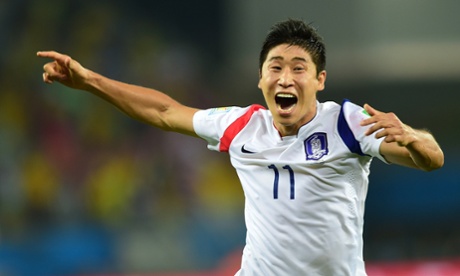
Lee Keun-ho from the South Korean soccer team. Image from the Guardian.
Although I'm not closely following this year's World Cup, I was still excited when it was announced that instead of going to zero period classes today, students and teachers would be treated to a live streaming of the Korea-versus-Russia World Cup game. Because of the time zone difference, games taking place in Brazil are shown at 1am, 4am, and 7am in Korea. This has definitely dampened enthusiasm for the World Cup in Korea this year, but really, nothing will stop them from supporting the "Red Devils" when they can.

I arrived at school a little after half-time, when the score was tied 0-0. It was exciting being in the auditorium with all my students and fellow teachers. The game was being played on a live stream on the big screen, and it was really exciting! I took some videos. The first clip is of the crowd's reaction when Korea took a shot at the goal, but it was saved by the Russian goalie. The second is just after Korea scored its goal, as the crowd responds to the slow-motion replay. It was amusing how the teachers around me hooted in laughter at the Russian goalie for screwing up. The last clip is the crowd's reaction after Russia scored: pure dismay!
Russia's goal was doubly disappointing because, in fact, we didn't see it happen! Toward the end of the game, so many people were online to watch it that the servers hosting the livestream on Naver and Daum crashed or malfunctioned in some way. Our screen began to freeze again and again, buffering, and then blanking out altogether. So when the Russian forward started toward Korea's goal, we got really excited -- and then the screen froze. Imagine the frustration! And when it started playing again, we saw that the score had changed to 1-1. 아~ 아타깝다! (What a shame!)

By that time, it was almost time to begin the first period classes, but of course nobody had any intention of leaving the auditorium. The game ended in a tie, and students were disappointed because the technical difficulties persisted (I'd have expected more from a science high school, haha) and because we didn't win. But given the low confidence Korea has in its own team, I'd say a tie with Russia is not a bad thing at all.

While I don't know any more about soccer now than I did before this morning, one good thing that comes from the World Cup is that I can use it as a springboard for conversation with my students and connect with them on another level, especially the shier students who like sports but not English.

Anyway, I probably won't watch any more World Cup games until the semifinals and finals, but I'm still hoping for the best for South Korea! 대한민국 화이팅! 

- - -

P.S. Konglish time: 화이팅 (sometimes 파이팅, romanized as hwa/pa-i-ting) is the Korean version of jia you (加油) and ganbatte (がんばって), a common sports cheer and all-around picker-upper. It comes from the English word "fighting" and is equivalent to "Let's go!" and "You can do it!" or "BEAT THEM." If I had my way with Konglish and couldn't do away with it altogether, I'd at least change 화이팅 to something that makes a bit more grammatical sense. "Korea fighting!" still sounds odd to me... even though I use it all the time now. I can say 화이팅 to a struggling student, to my taekgyeon teammates as they spar, or to my friend who's had a bad day. It's a very useful word to know!

Monday, April 14, 2014

Soccer

Before I came to Korea, I disliked playing soccer; I was no good, and games felt like running laps on muddy grass while everyone else took care of the fancy goal-scoring business. After two years in Korea, I can honestly say that I now actively hate playing soccer. Of course, "hate" is a very strong word which I don't use lightly, so before all my students gasp in horror at my admission sans context, let me explain.

Specifically, I hate the weekly games of indoor soccer that we play at my taekgyeon gym. I have been training in taekgyeon for a little over one year now, and I go five times a week. My goal is to obtain my black belt before I leave Korea, and my only chance to pass the test is in June. So, time is precious, and I want to spend every minute bettering my forms and roundhouse kicks. Instead, however, we section off one day each week, usually Friday, for casual games of indoor soccer with a small purple rubber ball and cushions stood up on end as goalposts. Our gym is small, only about twenty by forty feet, so with four to six grown men running around in this space trying to score goals on each other, the possibility of injury is high.

Yes, they're supposed to be casual games, and they always start out that way, but we're a competitive bunch. After half an hour, things can get nasty. We get tired, lose our balance, kick each other accidentally, then kick each other not-so-accidentally... A stubbed toe here, a mat burn there; the outside of my right foot is constantly sore because of soccer. My newest pair of glasses is sitting on my desk bent completely out of shape because of soccer. I have allowed outbursts of anger, pain, and every negative emotion in my arsenal because of soccer.

And tonight I was finally called out on it. Thank goodness, but also: aaargh.

I've asked my trainers several times why we play soccer when, every week, someone is injured. 관장님 (gwanjangnim, my gym director) replies that it's for building up endurance and stamina, which are required in taekgyeon matches but aren't easy to develop without holding constant scrimmages. So, I have silently endured injuring my feet in a different way every week for an entire year, but it's finally come to a point where I can't hide my frustration and anger.

관장님 and 사범님 know that I don't like playing soccer. I've complained to them several times about how I always get hurt -- 맨발로 축구를 하면 다치는 편이에요 -- but they insist on playing every week. Two weeks ago, I stubbed my toe pretty badly and yelled, "I quit!" before storming out of the gym. When I returned from my short tantrum, I played like a zombie and my team lost. Last Thursday, we played again, even though I was hoping they'd wait until Friday since I'd be out of town then and I could miss soccer with a legitimate excuse. That was not to be; I strained the outside of my right foot, which throbbed the entire weekend.

And today was the final straw -- in more ways than one. It's Monday. We never play soccer on Monday. But 관장님 cheerfully announced that today would be our very last day of soccer for a while. When I smiled and asked why, he said that we were getting a new trainee tomorrow, a woman. Since women can't really keep up with soccer the way we play, he explained, we were only going to play whenever this new trainee didn't come to the gym. Ignoring that bit of sexism, I silently prayed that our new member would come every single day.

But then we had to play soccer again. Our last game. And it started off fine -- my team quickly found itself losing 8-0, but we made up the difference eventually and held off 관장님 and the kind-of-violent ahjussi for a while. And then I just started screwing up. I kicked a sharp corner. I fell and got a mat burn on my foot. I accidentally scored on my own goal a few times. I began to get frustrated again and felt really fed up with this whole thing, even crying out, "아 축구를 싫어해요!" (Ah, I hate soccer!) once. And my demeanor changed, as it usually does near the end of the hour: I went completely silent and became more aggressive.

The good thing is that my heightened focus helped me score four or five goals in the span of ten minutes, and I brought our team to a tie. The bad thing is that I was obviously unhappy and not being a good sport. I kicked an opposing player and halfheartedly apologized. I made absolutely no eye contact, and my face probably looked like I was ready to bite someone's head off. My team lost the game.

I immediately sat down and began stretching; no high-fives, no bows, just me being letting my bitter aura fester. The thoughts continually running through my mind: "My feet hurt. I don't come to taekgyeon for this. My feet hurt."

관장님 came up to me after I had changed and gave me some straight talk. "When we play soccer," he said, "everyone gets hurt. And in taekgyeon there are some things that people like and some things that people don't like. But the rest of us know how to 참다." -- I didn't know what 참다 meant, but I assumed it meant to hide one's feelings. I was about to brush this off, but 관장님 clearly had his serious face on, so I got out my phone and looked up the word he'd used. 참다 means "to tolerate".

He went on: "Here in this gym, we understand that you don't really like soccer. But we like soccer. You need to control your feelings, otherwise other people will misunderstand you. Again, we understand you, but others might not."

I was speechless. I wanted to reply, to argue back. "But I'm in effing pain!" Obviously, I didn't say that. I wanted to explain the frustration I felt, but I realized that I didn't have the language skill to do so. And then it occured to me that I actually didn't completely understand why I felt the way I did -- even if 관장님 could understand English, I wouldn't have been able to articulate myself well enough for him to comprehend.

So I said nothing but, "I'm sorry." I was forced to admit that 관장님 was completely right. I was being a dick, and I knew it. In essence, he told me off for spoiling everyone's fun and being immature about my own inconveniences. Want to know how not to piss off your friends? Don't yuck their yum: don't be openly antagonistic toward the things you know that they enjoy. And want to know how to build character and grow despite a difficult situation? 참다. Tolerate the things that hurt you and build up a thick skin. The pain is temporary, but the extremely negative impression I've been leaving on my fellow trainees is going to last quite some time.

Yeah. I literally hung my head in shame after 관장님 talked to me. I apologized and couldn't think of anything else to say. Language barrier and acute embarrassment united to rid me of all pretension, so I tried simply to look as worn-out as possible. Everyone knows I've been busy and stressed lately... but deep down, I knew I needed to learn that lesson.

Well done, Andrew: you've done a horrendous job of representing America, as well as Christianity. Now, although I want to repair my image, I still really hate soccer! In the future, if our new trainee doesn't show up on a Friday and I walk in to find the goal posts set up, it'll take all I've got not to apologize and walk right back out. I don't want to risk blowing up again for the possibility of actually playing a decent, friendly game. But how can I prove to my teacher that I've learned and matured if I don't give myself another chance?

Tuesday, December 17, 2013

Changwon Bike Party Santa Ride!

산타할배 (Santa Claus) strikes again!
Saturday was a day full of biking. I was looking forward to my third Changwon Bike Party ride, this one being Christmas-themed. To my surprise, there was also a small cohort of Koreans doing their own Santa-themed bike ride on the same day. In years past, Changwon City has organized a huge Santa-themed bike ride, drawing hundreds and even thousands of participants in an amazing red and white parade. This year, funding for the event was cut. What a shame for a city that prides itself on its excellent bike share program. In any case, these hardcore cyclists were not to be deterred; though only a small group of about two dozen, they had their own unofficial Santa ride around town, and Coby and I joined in on the fun.
I had my camera out this time and snapped some photos while riding. Dangerous, I know. This one of Coby and some Santas was taken at a red light, though.
It was fun getting to know the members of the cycling club, called 전차데이 (Jeoncha Day, and jeoncha is a Gyeongnam dialect abbreviation of 자전거, or bicycle). They were very friendly and excited to get to know the two foreigners in their midst. They even treated us to lunch at a 오리탕 (duck soup) restaurant and then coffee at Starbucks afterward! Amazing Korean hospitality, right there. They of course invited us to their next ride. 전차데이 rides once a month, just like Changwon Bike Party. They also do more epic rides, like a tour around Jeju Island (it takes about three days) last spring. One lady was very eager to show me photos of every ride over the past year; she turned to be a kind of amateur competitor in long-distance cycling. I was impressed.
Changwon Bike Party Santa Ride! I don't have a Santa outfit, so I went with a red and green scheme with my Christmas bow tie. We're in the Changwon rotary, with its giant Christmas lights tree behind us. Photo courtesy Coby Z.
In the afternoon, it was time for the foreigner redux, Changwon Bike Party! Us 외국인 being decidedly less spirited, nobody came dressed as Santa besides our fearless leader Coby. Fortunately, some of the 전차데이 folks decided to join us for our afternoon ride, so we still had Santas in our lineup! The Changwon Bike Party route took us to the 창원의집 (House of Changwon), one of the very few cultural establishments in this city. It is the old residence of a Korean scholar that is now open to the public. It was my first time visiting the 창원의집, so I took plenty of photos. It was nothing too special, though, I must admit.
별 and me in front of the House of Changwon (창원의짐). Taken by Coby Z.
We then rode down to Changwon FC stadium, home to our city's soccer team. I actually had no idea that this stadium existed, even though it's very close to the university and the educational training center where I worked part-time last spring. Finally, we made our way back to the city center, called it a day, and moved on to evening festivities. Two of Coby's friends were visiting from Japan; they were crash-coursing Korea for about twenty-four hours, so it was fun introducing them to a bit of the culture. This included warming up in a cafe while getting covers of the same three Christmas songs blasted in our ears, dinner of 춘천닭갈비, which was spicy and delicious, and then 노래방, or karaoke! I'll be honest, I'm not the biggest fan of 노래방 usually, but if you're with the right people, it can be a darn good time.
Ended the night with 노래방 (noraebang, or karaoke room)! Coby and 별 have this Korean rap song down like nobody's business.
When the group headed to a Thursday Party bar for 3차 (the third event of the evening), I went home to get some rest, since Sunday was to be a day of grad school and grant applications. This was a great way to close out my weekend, though. Even though I haven't left my city in a month, I'm glad staying in town hasn't turned out to be a huge bore!

Saturday, November 9, 2013

Korean Words I Don't Know Why I Know

Simon from Omniglot Blog recently posted about unusual words or phrases one might learn in a foreign language. In his case, he said, "I forgot the elephant!" and realized upon later reflection that it was a somewhat odd combination of words. Yet the words were perfect for the situation.

I think it's both fun and useful to learn odd vocabulary words in a target language, even when you're first studying it. When I tutor my taekgyeon teacher in English, I often have to come up with lists of words with similar spellings for pronunciation practice. Once, I found myself dictating: "Each, teach, teacher, read, lead, meat, heat, beat... beaver." Now, I don't think 관장님 will ever encounter the word "beaver" in his Master's course, but who knows when it will come in handy for him?

In the same way, I have accumulated a few dozen truly random vocabulary words over the past two years of studying Korean. I don't always remember them, but I keep them in my Anki flashcard deck just for the heck of it. And you know what? Sometimes I find myself in a situation where I need them, and then, if I can get the timing right, the result is a Korean giving me the "Where the heck did you learn that?" look. I love it.

So here's a list of a few oddball words I've picked up in Korean. I do, of course, encourage you to add them to your flash card decks. ;)

배신자 - traitor
I first encountered the word in 광장시장 in Seoul last winter, where overwhelmed shoppers are courted by four or five intensely enthusiastic shopkeepers simultaneously, making it hard to actually buy anything. I spent a while browsing clothes in one man's stall, but eventually bought a shirt someplace else. The guy jokingly called me a 배신자, which I looked up and then stored in my back pocket for months. Last Friday at taekgyeon class, we were playing indoor soccer, and one of my teammates accidentally scored an own goal. I called him a 배신자, everyone laughed, and my inner nerd rejoiced!

쌍거풀 - double eyelids
So many of my non-Asian friends have no idea what double eyelids are. Since I grew up in a largely Asian-American community, I'm well aware that some people have single eyelids and others have double eyelids. Unfortunately, there's a pretty strongly-held standard of beauty that favors double over single. You can't be in Korea for very long without seeing advertisements for a quick and cheap plastic surgery procedure that turns a single eyelid into a double one, thus this word isn't really all that esoteric.

단풍 - leaves' changing colors in autumn
My host mother taught me this word last year, highlighting it when we went on a trip to a temple to see the beautiful foliage. I rarely encounter it nine months out of the year, but now that it's autumn once more, I'm reminded of 단풍 every day.

시루떡 - steamed rice cake
A word I learned from my taekgyeon master. He used it as a metaphor for being exhausted: "난 시구떡 됬어요!" He meant to express that his muscles had turned into jelly, or something like that. It was pretty memorable, and I stored it in my flashcards. But when I tried to use the expression in a journal entry on lang-8, another Korean remarked that he'd never heard it before and that it sounded really creative, albeit original.

초딩 - adult who behaves like a child
Another gem from my host mother; too bad I can't remember to whom she was referring when she taught me this. I haven't yet found any reason to call someone else a 초딩, but I really can't wait to do so!

외모지상주의 - lookism
I hadn't encountered the term "lookism" before seeing it as the provided translation for this phrase, but it makes sense. Like classism or racism, lookism is discrimination based on one's appearance, and it is rampant (or should I just say "standard"?) in both Korea and the US. In Korea, it is customary to attach your photo to job and university applications, which is mostly unheard of in the US; I'm afraid it gives Koreans just one more reason to worry about their appearance. Why can't skill alone be the deciding factor for hireability? I talked with my students about this in class once. We were brainstorming "problems in Korean society", and one student was trying to describe the over-emphasis on appearance. I dropped 외모지상주의 to make sure I was on the same page as him, and his reaction was, "Yeah! ... Wait, how did you know that?"

가부장제 - patriarchy
I like to throw this into conversation with my female students, who are outnumbered by the males at my school by a 3:1 ratio. Down with gender stereotypes and male domination in Korean society!, I tell them. But I think the most productive opportunity I took to put this random word to use was when I was arguing with a Korean friend about, well, "reverse sexism". He was complaining that it was really hard to be a Korean male these days, since they were all expected to make enough money to buy a house before proposing, and Korean women didn't have to worry about climbing the corporate ladder since they could just hop off and marry some rich dude whenever they wanted, and how come military service wasn't required for women, etc. I tried to summarize my counter-argument with one word: It's the 가부장제! But I ended up having to further explain how rigid gender roles aren't good for any gender, but patriarchy is inherently oppressive toward women, and, well, you should just stop complaining, dude.

비린내 - fishy smell
Picked up from my host father, either when we went fishing together or maybe when he was cooking some sort of seafood once. I really dislike 비린내, and it was unfortunate that last week's Bike Party route took us behind the famous Masan Fish Market. We rode past the docks and through a cloud of 비린내 that almost had me gagging.

등나무 - wisteria
I also learned this from my host father when we went on a walk to visit his childhood elementary school in Daegu. Months later, I identified some wisteria by the Provincial Education Office building, and my co-worker who was with me was nearly struck dumb with amazement, as if knowing the name of a somewhat obscure plant made me a linguistic genius or something. Well, I'll just admit that the wisteria is one of my favorite flowers, so it's not too surprising that I'd remember it, right?

That's all for now. These days, I have my students write daily journals, and sometimes they'll throw in a Korean word or two that they don't know how to translate. I've been adding all of these random words to my vocabulary as well, and I think I can make a part 2 for this post once I have enough! The sad part is that my Korean self-study has been going rather poorly overall since October. I blame grad school applications, which are taking up all my spare time. The first is due in just three weeks, so I'm getting kind of nervous! I'll redouble my language study efforts in January.

Tuesday, May 14, 2013

Foot Volleyball

The other day, I got to play 족구 (jokgu) for the first time ever. Well, it was less "I played jokgu" and more "I watched the other teachers play jokgu while I stood in a corner of the court and didn't even pretend to know what I was doing."

족구*, called foot volleyball** or footvolley in the Western hemisphere, is pretty popular here, especially since it seems to feature the most popular aspects of soccer (Korea's uncontested sports craze): headers and roundhouse kicks. Here is a video of what it looks like.

All the teachers already know that I'm laughably bad at soccer. We play together every other Wednesday or so, and I usually end up in defense, charging and intimidating any forwards but contributing little else. However, they also know that I love volleyball (배구/paegu). Unfortunately for me, 족구 is about 90% soccer and 10% volleyball, so I was 90% useless to my team. I'm just glad that my fellow teachers were gracious and patient as they taught me the rules and encouraged me even when my serves went out of bounds. That's right, I can't even kick a ball in a straight line across a basketball court.

Well, my school's Sports Day (체육대회, a field day where all the students play sports and other active, outdoor games) is just around the corner. While I think it'd be fun to get in on the competition, knowing myself, I'd probably better prevent my own embarrassment and just watch from the sidelines.

- - -
*literally, "football", whereas "축구" (soccer) is translates to "kickball", and kickball itself is 킥볼 (kikbol) or 발야구 (literally, "foot field ball")

**not to be confused with football tennis/futnet or sepak takraw

Wednesday, May 8, 2013

쌤

Want to know a secret?

I've always wanted to be called "쌤". Pronounced ssaem (like the first syllable of "semaphore"), it's an abbreviation of the word "선생님" (seonsaengnim), which means "teacher".

In Korea, teachers can be addressed by the simple title "Teacher", just like American college professors can be called "Professor" by their students. But if a student uses 쌤 instead of 선생님, it implies a closer relationship between the two. If a student is joking around with their teacher outside of class, or greets them excitedly upon seeing them, it's likely that they'll use the abbreviation as a term of endearment.

Now, my students have never called me 쌤. They call me "Teacher" or "Andrew Teacher", and some of my older students, who feel more comfortable with me, just call me "Andrew". That's what I told them all to call me, anyway, as I insist on their using only English. But I can't deny that I'd love for some of them to use 쌤 instead. It would mean a lot of different things, among them the affirmation that I am actually a legitimate teacher here, not just a visitor who's here to train them in practical usage of the English language. It would mean that they consider me if not a friend, then at least friendly and comfortable enough to be around to use a bit of Korean slang.

But today, it happened! Somewhat. Just like last week's basketball tournament that all my students were obsessing over, this week's lunchtime soccer tournament captures everyone's attention during that short thirty minutes before fifth period. EJ and CY, two likable students from one of my second-year classes, were watching their peers play from the window of our English classroom on the third floor. The game underway on the dirt field outside was very intense: two to one, and very little time left on the clock. As I entered the classroom to prepare for the next period, I heard a roar come from outside.

"Who scored?" I asked, although I already knew from the groans and frustrated yells from my second-years.

"Third grade!" said EJ, angrily. She was totally into the game, now tied and almost over. With the bell for fifth period about to ring, they had to go into a shootout tiebreaker. With every goal by the third-years, I gave a little cheer (full disclosure: I like my third-year students a lot). I told EJ and CY very plainly that I support all of my students, but I was secretly enjoying getting a rise out of EJ because she was going so crazy over the outcome of the game, literally pulling her hair and jumping up and down and all that.

So I kept cheering on the third-years and pleasantly clapping for the second-years, and finally, the third-years scored a goal, and I said, "Hooray!" and EJ turned to me and said "쌤!!!" with this hilarious how-could-you look on her face. As soon as that word left her mouth, she corrected herself and said, "Teacher!!!" still just as incredulously. But I was smiling inside, and not just because my third-years had won the game.

Wednesday, March 27, 2013

What is taekgyeon, exactly?

Taekgyeon Day 1: Drills, drills, and more drills. I have no idea what I'm doing at all. I leave impressed.

Taekgyeon Day 2: Weight training and stretching. My muscles feel like they are going to fall off, and I regret being a twig with toothpicks for arms. On the plus side, when we do jumping drills, I manage to impress everyone else in the dojang. I tell them I used to play volleyball. I leave tired.

Taekgyeon Day 3: A crash course in traditional wrestling and more general confusion. This time, plus lots of sweat. I leave sore.

Taekgyeon Day 4: Indoor soccer with some of the thirteen-year-old boys who are in the class before mine but stayed behind just to chill. And play soccer. I leave a bit confused.

Taekgyeon Day 5: Kick practice, plus archery. I leave really confused.

So, uh... what is taekgyeon, exactly? By the end of my first week, I think I could've been forgiven for not having the slightest idea as to what kind of martial art I was learning. It seemed like a random amalgamation of sports, like I was starting a new class every day. Archery? Wrestling? Soccer? What next, gymnastics?

Well, as it turns out, taekgyeon is comprised of at least nine different disciplines, and I've been learning bits and pieces of each every day on a steady rotation. So on Day 6 (this past Monday), I went back to wrestling, and on Day 7 (yesterday) reviewed basic footwork and kicks.

Today would have been a weight training day, but two members of the dojang received their black belts today, and we went out to celebrate with drinks instead. I enjoy the company of the dojang director and master, since they're much more cheerful and amicable than they seemed at first. The humorless sixth-degree black belt is, as it turns out, a new dad who likes to show off photos of his son and is also really into Enneagrams. I'd never have guessed. Anyway, I enjoyed this evening of 정-building, even though I could understand less than 50% of what everyone was saying. I caught bits and pieces of conversation about Hangul, the history of taekgyeon, the dangers of traveling alone in rural India (?), and foreign languages.

Another surprise for this class came in the form of the teenagers who sometimes stick around after their class to drill with us adults. The first one I met calls himself Sam. He's short and round, on the chubby side. He doesn't speak much English, but what he knows he uses loudly and enthusiastically. I had to wrestle him on the first day I learned how to wrestle, and he was sweating profusely; it was difficult to get a hold on him, let alone trip him in any way. He seemed not to mind getting tossed into the ground again and again, as long as he could do the same to me. The dojang director told us both to take off our glasses to protect them. So Sam took his glasses off, then walked right up to my face, peered into it, and declared, "Handsome." Hee.

Two of the other two kids who sit in on the class sometimes, with whom I played soccer last week, turned out to be friends of my host brother. Apparently, they told him at school that a foreigner had begun attending their taekgyeon class, and when my host brother asked them for that foreigner's name... haha, well, he got a kick out of that.

Saturday, December 8, 2012

Snow!

It snowed in Changwon yesterday, about 2-3 inches. It wasn't much, but everyone (and by everyone I mean everyone 18 and under at every school in the city) went nuts, because it was the largest December snowfall in many, many years. Usually, this far south, it won't snow at all until January, and even then just a paltry amount. But there was enough yesterday for a full-fledged snowball fight, and I recorded a bit of it (even as I participated). In fact, I like to believe that I started the whole thing, as I was the first person to throw. Being a teacher doesn't mean I can't still be a kid at heart!

The snow when it first started to fall, then when it fell harder, and then when it fell in earnest and spawned snowball fights and snow soccer. (Please excuse the bit of Korean profanity around the one minute mark.)

I'll post photos from the day, too, but not now. I'm leaving in a few minutes to spend the weekend in Gwangju, in southwest Korean. I'm counting on good food, good company, and not-too-cold weather!

Thursday, August 30, 2012

배구 - Volleyball

This one's for Tracey, a fellow Norcal-er who randomly played professional volleyball in Slovenia for one year. In Korean language classes during Orientation, Tracey was our go-to sports example person because she talked about volleyball at least once a day. Seriously, nobody in our class will ever forget that paegu means volleyball.

I also happen to really enjoy volleyball, although two years on the high school JV team and two years on the college club team have proven to me beyond a doubt that I'm perfectly mediocre at the sport. Still, when I was invited by some of the other teachers at Changwon Science High to their weekly "Sports Day" with hints that they liked to play volleyball, I was more than happy to accept. First of all, I want to get to know the other teachers at my school better. There are only around thirty total. (The English department consists of three teachers, including myself, and because I spend all day in the English department office, I basically never see anyone else at this school except for during lunch. It's maddening sometimes.) Secondly, I've been a total couch potato for the past week, sitting at my computer for six or seven hours a day, and coming home to sit on the couch to play board games with my younger host brother. I've definitely been restless, and I am sore in need of exercise.

So, yesterday was my first Wednesday sports day! I had brought along a change of casual clothes, and at 4:45pm I wandered over to the gym to see what was up. I was met by about a dozen teachers, all male, some of whom I'd never seen before and some of whom I recognized from the teachers' conversation course I threw together on Monday. All of them knew who I was already, of course, but I still felt a bit out of place. I think the youngest of these teachers is in his mid-thirties; I'm closer in age to their students than to them!

But whatever. We played three games to twenty-one, and it turned out to be tons of fun. 생각보다 재미있었어요! Much more thrilling than I'd anticipated. I don't know how long these middle-aged men have been doing their sports club together, but they mostly knew what they were doing when it comes to volleyball; some of the rules had been simplified, but I had no trouble fitting in during the match. My team recognized in the second game that I had some spike potential, and our setter gave me some great fours. The third game, our tie-breaker, was especially close and intense; the gym teacher (who runs the club and who was obviously the most competent of us all) went for a tip I sent over the net -- which was lower than usual, definitely helping my spikes -- and slightly pulled a muscle. Oops :(

In the end, my team lost, and my t-shirt was soaked through and practically dripping with sweat, but that was okay. It was all fun and games! At least, it was just fun and games for me; I gathered from what little Korean I understand that all the other teachers had placed bets on the outcome! Like, serious bets: ten bucks to each player on the winning team! Ha! And that's just the first of three stereotypically Korean additions that I witnessed to our little competition.

The second is that none of the men would ever dive for a ball -- for obvious reasons -- but if a ball did happen to go short, they would all invariably stick out their feet to kick it back up. This wasn't even done for humorous effect; it seemed as if this randomly thrown-in soccer move was just as legitimate as a normal bump or set. As far as I'm aware, "foot digs" are technically not illegal during play. It's just that while they're super-rare in American volleyball, I'm not at all surprised that soccer-obsessed Korean men made ample use of it, an often to great effect, to boot.

The third is that when we took water breaks, there was no water. Instead, there was Gatorade (normal), Pocari Sweat (normal for Asians), and... Hite (하이트), which is a rather cheap Korean beer (not normal?). Oh, and there were chips. Haha! I think that next week I'll just bring my own water bottle. And to be sure, I will be there next week. I had a fantastic time this time around, and I'm looking forward to getting my butt kicked in indoor soccer (축구, chukgu).

P.S. One thing I forgot to mention was that after Sports Day, all of those teachers go out together to eat (and probably drink themselves silly). It's known as a 회식 (hweshik), which I guess roughly translates to a dinner meeting? But it's not really a meeting at all, just a camaraderie-building hangout time. I've already been to one, but it was with my school's soon-departing principal (long story, I'll explain later) and probably isn't what a normal 회식 will look like. The point is, I wasn't aware that they were going out after the match, so I had to awkwardly and politely decline, but I'd like to go next week.

Translate