Monday, December 17, 2012

Fun Things that Happen When You Play Games in Class

My estimate is that 80% of ESL teachers in Korea know what a "Bomb Game" is. (And if you don't, ask me what it is right now.) Oh, funny you asked! Well, it's a Powerpoint-based trivia game: simple to play, easily adaptable to any class, and, most importantly, remarkably popular with students of any age. The gameplay is simple: students choose questions from a grid. Correct answers get them points. The catch is that some of the questions are special rounds during which teams can steal points from or switch points with other teams, and one or two of the questions are "bombs": choose them and everything blows up, resetting every team's score!

I threw together my own bomb game last night; it took me the better part of five hours because I was doing it from scratch. But getting less sleep was well worth it for the awesomeness that went down in my classes today.
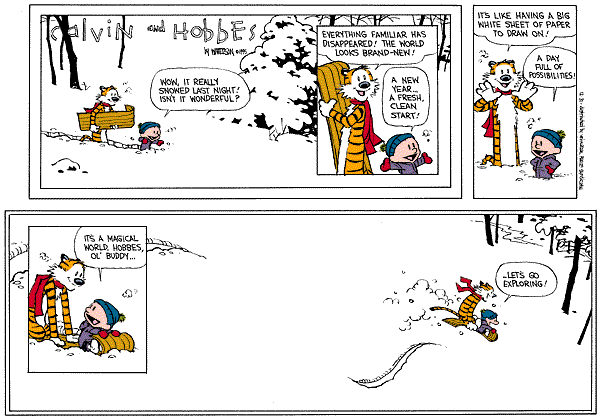
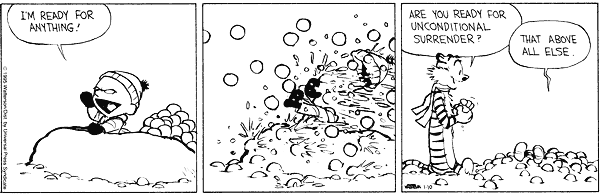
Calvin and Hobbes! All images in this post are copyright Bill Watterson and courtesy random pockets of the Internet.
Here are some things that happens when you play a bomb game with my students:

1) Song. A group of six super-serious boys who are in it to win it gets the question, "Sing one line from any English Christmas song" groans at first, and then immediately launches into a surprisingly synchronized and good rendition of "We Wish You a Merry Christmas". I wish I'd recorded it, it was that fantastic.

2) Symbolism. "Spring" becomes ironically synonymous with death, since my version of the Bomb Game, based off of the snowball fights from Calvin and Hobbes, replaces an actual bomb with Spring, which comes to melt everyone and take away their points. Students were actually chanting "spring" like some sort of jinx before rival teams chose their questions.
copyright Bill Watterson
3) Student Said What? You discover that your students have a very poor grasp of American geography. (Q: "What are the two largest cities in the United States?" Everyone gets #1 New York, but what's the other? A: "Texas! San Francisco! Las Vegas! Miami! ALASKA!!!" they shout, to no avail.)

3b) Also, they know absolutely nothing about Hanukkah, or even Judaism for that matter. (Q: "What is the name of the eight-day Jewish winter holiday?" A: "Rebirth day! Black Friday! Maria! Kill sheep and put blood on door!" ... *facepalm*)

4) Suspense. My write-up on Facebook after the first class I tried it on: "Just played this in class. Teams "HyoungraeDolph" and "Snowmen" were tied in the lead with 5 points each. It's team "Eve" (the 6 girls who banded together) up next, with only two items left. They choose ... a BOMB! Everyone's back to zero! Chaos ensues. And now, team "SingleChristmas" has the very last item: and it's a special round! Will they throw, duck, or taunt? They choose to throw... ... ... ... it's a hit! 2 points! SingleChristmas wins!"
copyright Bill Watterson
5) Singleness pathos. On that note, my students seem very fixated on the part of Christmas where they don't have a significant other to take to the Christmas lights show (as the holiday is very couples-oriented here in Korea). I had teams called "SingleChristmas", "Single Bells" (love!), and "Romantic Singles". Also, I had to change all of these names from "solo", the Konglish for "single".
copyright Bill Watterson
6) Surprise. And this is my proudest moment, as a teacher. Team "WhiteChristmas", clearly the underdogs in their class who missed almost every question thus far in the game, had the very last question: a fix-the-incorrect-grammar doozie that freaked them out as soon as they saw it. But they were also riding high on a recent spring melt that had reset the playing field. Only "Single Bells" had a single point, and everyone else was at 0. With confidence I'd never seen before, SB stood up from his seat and proclaimed the heck out of his answer, and he was absolutely correct! Here's a kid that I'd previously written off as one of the "simply uninterested" ones, proving that he knew a thing or two about English grammar. And guess what? That last question was worth three points. He won it for his team, and the entire class went ballistic. My co-teacher said she could hear the screams from our office, two doors down.

Sounds like success to me!
copyright Bill Watterson, a truly gifted cartoonist

Saturday, December 15, 2012

마창대교 - MaChang Bridge

I spent a very pleasant afternoon with my host parents today. This weekend is the last one I'll be able to spend with them this year, because next weekend I'm heading home! So, I think we all appreciated the time we had together.

First, we drove out to Masan (the ex-city that is now a district of Changwon) to go to a popular 짬뽕 restaurant. 짬뽕 (jjamppong) is often translated into English as champon, which looks French. I suppose it's an awkward loanword? According to Wikipedia -- which I fully trust to answer all my culinary inquiries, naturally -- champon is a Japanese dish based off of a Chinese dish. I mean, whatever; take one look at this and you can tell it's Asian. Order yourself a bowl of 짬뽕 and you get a spicy noodle soup with All Of The Sea Creatures, plus bean sprouts. I couldn't finish, not because it wasn't delicious, but because there was just way too much.
짬뽕/jjamppong. I spy octopus, mussels, and abalone, along with vegetables and spicy soup.
After we finished our meal, we drove out to Masan Bay (마산만), which has been nicknamed the "Dream Bay". Now, Masan has an economy that relies pretty heavily on industry. Like Changwon, there are lots of ports, shipyards, and factories. Many years ago, these took their toll on the environment, and the bay was extremely polluted. However, today you wouldn't even be able to imagine that. Masan Bay is surprisingly beautiful. It was very peaceful (평화러워요) and quiet (조용해요); I would even say serene. Cars rumble overhead on the MaChang Bridge (마창대교), which was completed in 2008 and connects Masan and Changwon (clever, eh?), but the sounds I focused on were the lapping of the water on the rocky, oyster-covered shores and the whizzing of fishermen's lines going out into the bay.
마창대교/MaChang Daegyo. It was cold and partly cloudy, but nonetheless beautiful.
My host father proudly said that MaChang Bridge and the bay were comparable to San Francisco's Golden Gate and its world-famous bridge. Sorry, host father, but I beg to differ (read: So Not True). After walking around and being sufficiently impressed by this feat of architecture, we popped into a cafe called Cordelia. It was almost impossibly cute: your typical Korean iteration of the cafe with plush seats, a hand-written menu, potted plants, random Christmas decorations, and $6 lattes. The wonderful thing about it, though, was that its enormous windows offered a perfect view of the bridge and the sun as it set behind Masan's mountains, bathing the sky in 노을.

MaChang Bridge and the Dream Bay.
As my host parents had their coffee and I sipped my hot chocolate, we chatted about many different things, including how my host mother thinks the bridge is pretty but the fact that it's lit up prettily at night is probably a waste of electricity (전력 낭비). Most importantly, I think there was a solid moment of connection when my host mother asked me what my motivations were for studying hard when I was in high school. (Currently, my host parents are having trouble with my puberty-stricken host brother, who isn't very focused in school.) This led to a relatively long conversation, due mostly to slow, belabored communication.

I told them that I studied hard mostly out of the spirit of competition (경쟁); "I wanna be/The very best," etc. I also wanted to get into a good college, as I set very high standards for myself, and lastly, I wanted to make my parents happy. I left out the part about my parents having pushed me really, really hard to succeed at everything, because I figured my host mother is already doing that with my host brother and doesn't need reinforcement.

I also tried to explain, in my broken Korean, that although I studied really hard, the competition was severe and I was sometimes too competitive to have close friends, or too focused on my studies to have a social life. I said that while competition is important (중요해요) for school, after graduation, it becomes much less so. Now... I have to admit that I don't really know how strictly I believe this. I'm competitive by nature, and I will always be. And in the workplace -- in the Korean workplace, especially -- having a competitive edge on top of intrinsic motivation and a good work ethic are absolutely necessary. But really, I was just trying to explore the possibility that studying hard and getting good grades isn't the Most Important Thing for a teenager. This is because I feel bad for my host brother, who just wants to play Minecraft and watch Running Man and build model airplanes. This isn't likely to get him anywhere in life, but for goodness' sake, he was in elementary school last year! I don't want to see his childhood get sucked into the black hole of hagwons and self-study so soon. Then again, he's not my son, and the burden of raising him in Korea's education-obsessed society isn't mine to bear.

All things considered, I don't think that I could have eloquently articulated my ideas even in English, but nevertheless, I am touched that my host mother even thought to ask me for my opinion. As my host brother navigates the rough waters of adolescence (사춘기), here's to hoping he ends up happy and not as awkward as I am! In the end, I really treasure today's small bit of bonding time. It's a rare occasion for my host parents and me to connect on a level that's anything more than superficial, and today was one of them.
Host parents with me in front of the MaChang Bridge as it begins to light up in the evening. Low-quality photos are the fault of the smartphone camera, but it's better than nothing, as I'm glad I now have something to remember the evening by.

Friday, December 14, 2012

College-bound

There are at least two sides to every situation.

My college prep kids. My poor college prep kids. They are suffering from an intense collective Senioritis. They don't have to study anymore, and even though they have final exams next week, their grades no longer matter, so they're not trying. And unfortunately, this week, all of the second-year students had their speaking tests: three-minute speeches on their opinion on one of a number of social, political, or philosophical issues. When I administered the speaking tests for the first-years, I basically held their hands through the entire month we spent perfecting the drafts before the dreaded test day. With the second-years, I was less of a "helicopter teacher", because I figured they didn't need as much guidance.

As it turns out, dozens of students failed to memorize their speeches and instead read sheepishly from their scripts, still riddled with grammatical mistakes, in front of the entire class, with only the slightest hint of remorse. These students all got terrible scores. Even worse, three students didn't even prepare anything at all. They got zeros. It hurt me to give one out the first time, but by the third, I was so over it.

I become pretty upset at one of my two college prep classes after one too many students started their speech with, "I'm sorry, Teacher, I didn't remember [memorize] my speech." I made it very clear that I was disappointed in them and that I expected the rest of the speeches (later on in the week) to be better.

Two students from this class came to me personally to apologize and explain the situation. One claimed that the college-bound students wanted to help out their peers who will move on to the third grade by doing poorly on their tests, the idea being that the two third-year-bound classes would get relatively better scores.

No, kids, that's not how it works. If you don't prepare for your test, the only person it affects is you. You're only shooting yourself in the foot, and nobody else will benefit from it, because I don't curve. I told YG, who was very sweet in her attempt to justify her classmates' mindset, that I knew the grades didn't matter, but that the inevitable low scores weren't what bothered me. What bothered me was their attitude, the irresponsible notion that when the goal (college) has been met and the stakes (grades) no longer exist, effort can also just be tossed out the window with no repercussions. It's the transgression of resting on one's laurels -- well-earned, but, well, they're being worn on the wrong end.

I thought I made it so easy for them to do well. I gave them an outline and twenty topics to choose from. I told them I'd correct a hundred additional drafts if they gave me a hundred additional drafts, but only a handful of students took advantage of my office hours, and many didn't write a single draft at all. Remember that my college prep students have no classes besides English and haven't had anything to do besides self-study for the past three weeks. But their work ethic has simply vanished. And they're sleeping in class. And it's discouraging.

But... But!

But on the other hand, as I've realized, these lamentable students are, in fact, the students who are going to college. And that, my friends, is awesome! They have slaved away in the grueling high-test-scores machine that is the Korean Educational System for their entire lives, and now, finally, they're free (basically). I'm very happy for them.

I'd have to say that it really hit me today, when I realized two things: depending on my schedule, which has changed about every other week for the past six weeks, today may have been the last time I see my graduating second-years. And they are really not high schoolers anymore; they're college students. College students. Heck, I was a college student six months ago. This is ridiculous.

I saw WJ after lunch today in a hallway by the lockers. She was jumping up and down, looking like she'd just won a Golden Ticket. It turns out that she had just found out that she had been accepted off the waitlist into Ewha Womans University (not a typo) for their biology program. Score! Up until today, WJ thought that she was going to have to go into her third year of high school, another poor "leftover" student that everyone involved in Korean secondary science education seems to pity. But now, she gets to graduate and go to Seoul.

Upon hearing WJ's wonderful news, I gave her many high-fives. What I really wanted to do was give her a huge, congratulatory bear hug, but I don't think that it would have been appropriate. I just wanted to express how incredibly happy I was for her. I'm so happy for and proud of my students -- all of them, but especially the ones who have been accepted into college early -- and I almost forgive them for having lost their work ethic completely in my class and driving me nuts.

I tried to make it up to the college prep class I had scolded earlier in the week by teaching them a lighthearted lesson about Senioritis after they had finished their speech tests today. I am happy to report that they understood the concept instantly and that they laughed when I told them that when I was in high school, I also suffered from acute Senioritis. (AP Calculus was a hot mess.) Then, we watched YouTube videos on the theme of Christmas and mistletoe.

Yet there are still more sides to this. I remember telling WJ, "I'm really happy for you! But this means that I will not teach you next year, or ever again." I can say without reservation that WJ is one of my favorite students. (She works hard and it shows: her essay was probably the best in her class of nearly ninety.) Many of my favorite students -- the friendly, inspiring, and hardworking ones -- are the ones who are leaving. Cue the big sigh...

This afternoon, I ran into another student, MC, and made him stop to talk to me.

"What's up?" I asked.
"So-so," he replied.
"What's wrong," I asked.
"Oh, uh... it's garbage day..." (In an instant I remembered that this is the student that I embarrassed a few weeks ago when I misheard his heavily-accented English as Korean during a game.) "... My friend is cleaning."

I thought for a moment. Right, today is cleaning day, when the entire student body is split up into groups and assigned different classrooms and areas of the school to sweep and tidy up. In addition, I had also seen some second-year students cleaning out their lockers. And then I made the connection: the students who have been accepted into university are cleaning their lockers of all their books and work from the past two years. A lot of it will be taken home. The rest will be gal-bi-ji: thrown away or perhaps given to the underclassmen. They're cleaning things out because their time at Changwon Science High School is very nearly over.

"Your friend is going to university, then?" I asked.
"Yes," MC replied. MC is not in my college-prep class.
"Well, you can be happy for him! Are you sad?" I asked.
"A little," he replied.

Hey, buddy... me too. 섭섭해...
Thursday, December 13, 2012

518 Memorial (Gwangju pt. 5)

A bit of history for today, courtesy Wikipedia. In December 1979, ROK Army General Chun Doo-hwan staged a coup-d'état and gained control over South Korea. He quickly became a dictator, backed by Reagan's Washington, who established martial law throughout a nation struggling with social instability due to economic woes and the ongoing threat of its northern neighbor. South Koreans at that time found themselves rid of one dictator (Park Chung-hee, whose daughter Park Geun-hye is currently running for president) only to be given another, whose harsh policies were immediately unpopular. These included the closing of universities, military presence in cities, and restrictions on free speech. Korea's southwestern Jeolla Provinces, of which Gwangju was a capital at the time, were especially hard hit by the new measures and political discrimination.

It wasn't long before citizens organized in protest. In May of 1980, several large demonstrations took place around the country. General Chun responded by sending in the troops to quell anti-government activity. Everything came to a head on May 17th, when a hundreds-strong student protest at Gwangju's Chonnam University clashed with a platoon of paratroopers. From the first morning skirmish throughout the day, both the number of protesters and the number of troops escalated dramatically, along with the number of casualties. The citizens numbered in the thousands by the end of the day, and by May 20th, they were more than ten thousand.

On May 21st, the protests went haywire and turned into a battle: civilians broke into armories and police stations and opened fire on the army; the army in turn used tear gas, bullets, and, by some accounts, bayonets on protesters, on-lookers, and anybody caught in the crossfire. Cars and taxis were used as weapons and barricades.

From May 22nd to the 25th, the army retreated and waited for reinforcements. The Democratization Movement had successfully taken control over Gwangju. However, on the 27th, the army reinforcements arrived, re-entered the city, and completely quashed the defenders in less than two hours.

In total, there may have been between one and two thousand deaths, but it is unclear what the exact total is.

In the years following the Gwangju Democratization Movement, many more movements were born and eventually brought democracy to South Korea in the late 1980's. South Korea's government and the city of Gwangju have done quite a lot to memorialize the sacrificial efforts of the protesters, support the families of the victims, and establish "518" as a means of remembering the cost of freedom. To that end, the 518 Memorial Park in Gwangju is an amazing monument to this milestone in Korean history.

On Sunday afternoon, I visited the 518 (오일팔/o-il-pal, not five-eighteen) Memorial with Adam, Katelyn, and Julia. It was a peaceful park where families were playing in what little snow was left, couples were exercising together, and tourists were seemingly absent.
The main sculpture in the park, in front of the underground memorial chamber (beneath all of those poles in the background). (taken by Adam)
We were able to walk among the poles, which were really shiny and mesmerizing in the way they glowed in the late afternoon sun.
The three awe-inspiring things in the underground chamber were this sculpture of a woman holding a dead protester, the wall of the names of the victims of the massacre, and the relief sculpture (not pictured, as it was behind me) that depicted the events of May 18th.
This was at another part of the park, another striking sculpture that commemorates the struggle for democracy.
Dwarfed by the 518 Memorial. (taken by Katelyn)
My friends and I had very little grasp of the historical context of the memorial, only going because we knew it was one of the must-sees of Gwangju. But after doing our research, the whole park became so much more meaningful, and not just pretty. What boggles my mind the most is that all of these incredible, horrible, yet transformational events took place only thirty years ago. The generation of students who clashed against their country's army is still alive and well, which stands in stark contrast to my own country's democratic revolution, which occurred nearly 250 years ago. It doesn't seem possible, when you look at Korea today, that only one generation has passed since 518.

With that on our minds, we were fairly quiet as we walked around the park and explored the other things of note. Besides memorials and sculptures, there was a small temple at the top of a hill and a very tall pagoda-like tower. After climbing to the third story, we had a spectacular view of the entire city of Gwangju, and we could even spot snow-capped mountains in the distance on all sides. It was lovely.

And that was the last part of my Gwangju weekend! My friends and I all went to the bus terminal directly from the park, got a quick dinner, and boarded our separate buses headed for our separate cities. I remember sitting in front of a group of very loud American girls who, when the bus stopped by my neighborhood in Changwon, called it "this city's red light district". 헐. That is so untrue. Whatever, okay, that's all! Wow, I'm sorry for taking five posts to talk about less than two days' worth of travel. And I didn't even cover everything. I hope you enjoyed the photos and stories, though!

Wednesday, December 12, 2012

Poutine (Gwangju pt. 4)

First of all, happy 12/12/12! Nine days until the world ends, eleven days until I go home, and thirteen until Christmas.

Okay, so regarding The First Alleyway, the foreigner haven that blew my mind when I visited for a short half hour on Saturday: there is most certainly a reason why people who love Western-style food flock to this restaurant and bar. Several reasons, actually. And one of them is that its breakfast/brunch menu is fantastic.

I had poutine, for what I think is the first time ever, at The First Alleyway. Adam encouraged me to try it, and my couchsurfing host Jordan, who is Canadian, also recommended it. Oh, let me backtrack: on Saturday night, Adam and I spent the night with a couchsurfing host. We got to his place pretty late, but stayed up for a bit talking about travel, fiction, writing, and life in Korea. In the morning, he went to church while Adam and I wandered around the downtown and the deserted Art Street on another quiet Sunday. Then, we met up again for lunch.
Katelyn, Adam, my couchsurfing host Jordan, and his girlfriend, at The First Alleyway in Gwangju. Look, French toast!
Coincidentally, we ran into Jessica and Taxi again, whom we had just seen the evening prior. Anyway, I ordered poutine, which is French fries with gravy and cheese (mozarella, in this restaurant's iteration). Hm... I smell a heart attack. Oh, and as a brunch meal, this also came with French toast and bacon. Dang. Well, it was good. And slow going. But I made it through, and I probably could have eaten more! As I've mentioned before, my wintertime eat-all-of-the-fatty/delicious-foods mode is kicking in. I am so going to Black Bear Diner when I get home.
So this is what poutine looks like. Nom nom nom! How many calories do you think it packs? My guess is somewhere around 1,000?
Pretty much every brunch meal on the menu (French toast, huevos rancheros, biscuits and gravy, and more) was 10,000₩, which is not terribly priced. The service was a little wonky, but my couchsurfing host and his girlfriend happened to be very frequent patrons of this restaurant (as in, they go almost every other day) and helped speed things along.

My third (or second official) couchsurfing experience was another great one! One note to self: I need to be more careful about cat dander, because, as I like to conveniently forget sometimes, I'm allergic. But otherwise, the company was good, and the food was good, and I tried something new.

I'm going to leave you now with a photo of my travel buddy Adam prancing on some snow-covered stepping stones that we used to cross the Gwangju River.
Prance, Adam, prance!

Tuesday, December 11, 2012

And then we ate a lot of food. (Gwangju pt. 3)

It was one of those three-restaurant kinds of evenings, know what I mean? No? Okay, I don't really know myself. But Fulbright 친구 and I did end up getting pre-dinner, dinner, and dessert at three different places around Gwangju on Saturday evening, and I had a fantastic time of it.

The first place was a "foreigner bar" and restaurant called The First Alleyway which I will talk about in further detail tomorrow, since I didn't actually stay for long on Saturday but ended up eating there for Sunday brunch. The only thing of note was that the sheer number of non-Koreans at the restaurant in the evening took me completely by surprise. I'm not even kidding; when I walked in the door and saw, essentially, a room full of white people, I was simply shocked. I felt like I'd somehow stepped through the door and back into America. It was bizarre and slightly disconcerting.

It's not like I've been completely surrounded by Koreans; even in Korea, I see a non-Asian foreigner every few days. Heck, I even came to Gwangju for the express purpose of seeing my foreigner friends. But the atmosphere in this foreigner-owned-and-promoted establishment was really... like nothing else I've experienced so far here. All of my Fulbright friends expressed the same sentiment, to varying degrees. It was kind of funny!

After a light snack at the bar, we did some shopping and wandering around the streets of Gwangju's labyrinthine downtown. Then, when we were hungry again, we went to 민속촌갈비 (Minsokchon Galbi), a fantastic barbecue place. There was only floor seating, but the floors were heated! How awesome. The restaurant's interior was very warm and rustic. It gave me good vibes. And the food was just as excellent as I could have imagined. A barbecue meal (with tons of 반찬, including salad, and taking into account some people who ordered different dishes) came out to about 9,000₩ per person for seven people, if I remember correctly.
Look at how excited Adam is about his galbi! And he had an entire table to himself... before Jessica and Taxi joined us.
Our group in front of the restaurant (minus Julia, who snapped the photo). Left to right: Adam, Taxi, Jessica, Jason, Katelyn, and me.
After dinner, we decided on dessert at a stealthily hidden-away wine and cheese (cheese!) bar that some of the Gwangju locals (Taxi, Jessica, and Julia) had gone to just the day before. It turns out that they've frequented this particular bar quite often in the past semester, and have earned the rights to some on-the-house desserts...! Not that we knew this for sure upon setting out. In the cold, we got lost in the maze of streets and tossed little snowballs at each other, and then we found it, tucked away on a quieter street: Big Apple.
Big Apple, in downtown Gwangju. A coffee and wine bar THAT SERVES CHEESE TOO DON'T FORGET.
Cheese platter: Pesto Parmesan! Brie(?)! Raisins! (Raisins?)
We ordered the "wine and cheese platter" set that made us feel like classy, urban adults instead of young expats fresh out of college, told stories, cracked jokes, and took photos. I loved it.

I've said this a hundred times before but I'll say it again now: the company of other Fulbright teachers is really special, because it's not just the connection of being American or being English teachers in Korea, it's the connection of friendship and of having been through a long and adventurous experience together (i.e. that six-week Orientation) and thus of understanding each other on a deeper level.

And seriously? There was wine and cheese. This always helps.

Although I sometimes feel isolated from most of the other hundred twenty-something Fulbright ETAs (because I am), this makes it all the more worthwhile when I do get a chance to see them and catch up on life. Although this involves making the trip to another city on the opposite side of the country, on the bright side, it also means I can turn "I want to see you!" into an excuse for a full-blown weekend excursion. Sadly, Gwangju was the last one of the year for me. This coming weekend, I'll spend time with my host family, and the weekend after that, well, I'll be flying home for the holidays! Cheonan, Chungju, Jeju, Mokpo, Naju, and Hwacheon, you're still on my list. 2013 is going to be jam-packed with adventure.
Classy Fulbrighters at Big Apple in Gwangju.
Aw, they wrote "welcom ㅂig [apple]" with chocolate. Cute!
Oh, and one last thing:

There.

Was.

Cheesecake.

New York cheesecake (very dense), organic cheesecake (miraculously creamy), and an on-the-house tiramisu (what a pleasant surprise!), five slices shared by eight.

Total bill came out to 12,000₩ per person. Expensive? Yes, but still worth every won. Highly recommend this place.

Monday, December 10, 2012

Volunteering with North Korean Defectors (Gwangju pt. 2)

On Saturday afternoon of my weekend in Gwangju, I accompanied Katelyn and Jason to the "HaNa Center" where free English tutoring sessions, among other events and services, are provided for North Korean defectors.

While leaving the communist nation is a severe crime for its oppressed citizens, many still risk their lives to cross the dangerous borders, and some (over 2,000 a year, now totaling over 20,000) eventually find their way to South Korea, where they begin the lifelong task of assimilation. Because so many of these people have left their families behind and are almost completely unable to maintain communication with them, it certainly isn't easy.

Along with seeking gainful employment or trying to fit in at school, defectors also take on learning English, still considered the key to a more prosperous life. This is where the HaNa centers come in. ("Hana" (하나) is the Korean word for "one", and it represents the desire for the eventual reunification of the two Koreas.) Some Fulbright ETAs volunteer weekly or bi-weekly at HaNa centers to teach and tutor defectors who range from children learning the alphabet to adults preparing for job interviews.

I am not allowed to say much more about these centers, where they are, or who is involved, etc. (and I didn't even take any photos at the center itself), but my short experience there was memorable.

The three of us were the first to arrive, and my first priority was to sit by the space heater and dry my socks and shoes. One student came, an older woman, and the other two ETAs went over her learning materials with her for a bit, until she started asking more complex questions in Korean, and I was summoned to translate (granted, my Korean is only marginally better than theirs, so I don't know how helpful I really was. Honestly, how do you explain what the meaning of "the" is, even in English, let alone in broken Korean?).

I proceeded to spend the next hour and a half going over verb tenses, some random everyday vocabulary, and some trickier aspects of English pronunciation with her. It was a bit repetitive, but she was a really energetic personality and the time flew by. As it did, four more students arrived, all of them school-aged, plus one toddler who spent an hour being chased around the classroom by another ETA who came later. So, all in all, there were four ETAs and six students, which amounted to what Jason and Katelyn called the largest turnout they'd had in a while. It's a good thing I was there to help out!

But... I guess what struck me most about volunteering at the HaNa center was that it was so ordinary. Really, it's no different from the volunteer-based Korean class I attend weekly, only there I'm the student and not the teacher. There wasn't anything particularly special or different that I noticed about the Koreans there. I didn't have any expectations going in, but I came out having enjoyed my afternoon, and if proximity weren't such a huge issue, it's something I would definitely do regularly. My student seemed disappointed when I told her I was only visiting for the weekend and wouldn't be back next week.

Here is a short news piece from the Gwangju News on the HaNa center in Gwangju, with quotes from Fulbright ETAs.

And here is an interesting short news segment from BBC on North Korean defectors who will be able to vote, for the first time, in South Korea's upcoming election. Looks like they tend to swing conservative!

Sunday, December 9, 2012

Snow can't stop us (Gwangju pt. 1)

It must have snowed sideways!
So, remember when I said I was hoping for good food, good company, and not-so-cold weather for a weekend in Gwangju? I got my first two wishes, but dang, was it cold! In fact, as my bus entered the city, I looked out the window and was shocked to see  that it was snowing heavily. That was something I definitely did not expect, having left Changwon on a sunny, clear day. I guess I should have looked at the weather report and also brought some shoes to Korea that are actually suitable for winter.

Anyway, after the 2.5-hour bus ride, I found myself in Gwangju (광주), the city famed for having the best food in all of Korea, thanks to its proximity to the highest quality agriculture in the peninsula. I immediately met up with Jason and Katelyn, two other Fulbright ETAs (neither of whom teach in Gwangju, but live nearby), and first on our to-do list was to get lunch!

We dined at a Japanese hot pot (shabu shabu) restaurant called... (Katelyn, help me out). The hot pot was delicious, and I especially liked how the Korean iteration of this pan-Asian dish included a second course that re-used the hot pot broth to make dumpling noodle soup, followed by a third course that re-re-used the broth to make porridge (죽). It was a delicious meal for about 12,000₩ each. A great start to a rather food-centric weekend!
Jason noms on the starter while our hot pot warms up.
Koroke! These deep-fried balls of deliciousness were filled with sweet potato (고구마/koguma) and cheese (치즈).
After lunch, we wandered along the river that runs through Gwangju and marveled at the snow (it was still falling even though the sky had mostly cleared up... Is the wintry equivalent to a sunshower a sunsnowfall?). We crossed the river and threw snow and talked about life and Pokémon and made our way over to the center where Jason and Katelyn volunteer. More on that in the next post, though!
Katelyn crosses the river, taking a moment to practice her aegyo (애교).
The Pokémon masters!

Saturday, December 8, 2012

Snow!

It snowed in Changwon yesterday, about 2-3 inches. It wasn't much, but everyone (and by everyone I mean everyone 18 and under at every school in the city) went nuts, because it was the largest December snowfall in many, many years. Usually, this far south, it won't snow at all until January, and even then just a paltry amount. But there was enough yesterday for a full-fledged snowball fight, and I recorded a bit of it (even as I participated). In fact, I like to believe that I started the whole thing, as I was the first person to throw. Being a teacher doesn't mean I can't still be a kid at heart!

The snow when it first started to fall, then when it fell harder, and then when it fell in earnest and spawned snowball fights and snow soccer. (Please excuse the bit of Korean profanity around the one minute mark.)

I'll post photos from the day, too, but not now. I'm leaving in a few minutes to spend the weekend in Gwangju, in southwest Korean. I'm counting on good food, good company, and not-too-cold weather!

Friday, December 7, 2012

Why I Got Angry Today, and How the Problem Fixed Itself (Kind Of)

It was supposed to be a mini-lesson on the slang prefix "super-" and its use in modifying adjectives. While compiling my list of American slang to teach in class, I'd noticed that "super-" is used more often in front of positive adjectives than in front of negative ones. (Compare super-cool, super-smart, super-cute, and super-close to super-lame, super-dumb, super-ugly, and super-far.) It's not a hard and fast rule, but I figured that most people tended to associate the prefix with ideas of greatness and attractiveness.

With that in mind, I combined the lesson on this bit of slang with an exercise in compliments. I told my classes that "super-" is most often use with positive adjectives, describing people that one likes, such as friends or family. So, my classes brainstormed as many positive adjectives as they could: brilliant, glamorous, sexy, tall, warm-hearted, awesome, nice. A few jokesters called out adjectives that wouldn't necessarily be considered positive, at least in my opinion. And that's where the problem arose.

When I had my students read their compliments out loud to each other, the "MJ is super-pretty!" and "YH is super-good at math!" were just fine, but then DR -- of all people, the class captain -- had to get up and, with a smirk on his face, read out three compliments he had written. "US is super-short, because he is only 1.5 meters. KI is super-gay, because he likes men. UH is super-dark, because..." and by that time I was so angry that I didn't even hear how that one ended.

"DR. Are those compliments?" I tried to ask it neutrally, but I bet whatever expression I was wearing made it really obvious that I was nowhere near neutral.

He looked at me guiltily, said no, and sat down again.

I tried to continue the exercise and had more people give their compliments, but inside I felt like I'd just been completely deflated. Hindsight told me to make DR apologize in front of the class, or to explain why I was upset, anything but just go on and pretend that nothing had happened. But as I was scrambling to think about what I should've done as well as what I was going to do in the last three minutes of class, it happened again. A female student said another female student was "super-cute", and some boys in the back of the classroom called out, "Gayyy."

I stopped everything and addressed the class, two minutes before the bell was to ring.

"Okay, maybe this isn't the best time to talk about this, but... I will. Please do not use the word 'gay' as an insult. It's very, very offensive." Damn, that didn't come out the way I had intended to. I could've said more, but the class laughed when I wrote 'gay' on the board to make it clear what I was referring to. Screw this, I thought. Just end class already.

Convinced I'd just botched that moral lesson, I figured I'd just save the real lecture for another day, even though I only have one class left with the first-years. I went back to my office, pretty dejected. When my co-teacher asked what was wrong, I explained that I was offended by the students who tried to be funny in class by putting down other students: short, gay, and dark-skinned are all negative stereotypes in Korea, and the "complimented" students could have been hurt by the comments.

Co-teacher responded by saying that the students were just in the habit of making fun of each other by insulting each other in a way that actually showed their solidarity and friendship. "Not that it makes it okay," she added, "but I don't think they had bad intentions."

I told her that I think it's important that students learn about how words can harm others even if they don't intend them to and about how jokes cracked at the expense of someone's feelings can be dangerous. I mused about whether I'd administer some sort of retroactive punishment or just find DR later to talk to him in person. I was scolding myself for not having a better plan of action ready, because let's be serious: this is high school, and my students are still kids. I should have expected this to happen sooner or later.

Fortunately, I didn't actually have to do anything. In the last few minutes of passing period, DR himself stepped into my office, looking meek. He came to apologize. He said, "Teacher, I'm sorry." I had him sit down, and then I explained that his words could have hurt and that while it is usually good to be funny, it is not good to be funny by making fun of other people. I told him to apologize to the three students he had insulted and also to give them real "super" compliments this time. Lastly, I asked him if he understood everything I said and if we would need my co-teacher to translate. He said no, and then I let him go.

Now, I don't know if DR actually did do what I told him to. I hope he did apologize to his peers. But if he didn't, I can at least be sure that he actually did feel remorse for his actions. How? I didn't ever tell him to come to my office or stay after class, but he came on his own initiative. I guess it was a bit of his feeling of responsibility as class captain coupled with my extremely visible disappointment in him and the rest of the class that got to him. And I was super-impressed.

In any case, after DR left, I felt significantly better about the situation. But if (when) it happens again, I'm going to be better prepared. There's no reason I can't teach respect and citizenship on top of English grammar and slang.

Translate