Showing posts with label language class. Show all posts

Sunday, August 9, 2015

Until Next Time

I was tempted to make a list of the things I regret not having had time to do during this summer that I've spent in South Korea. But I thought better of it. A more positive use of my time would be to count all my blessings from the past ten weeks, short as they were.
저는 이번 여름을 한국에서 지냈는데 시간이 없어서 못 했던 것에 대해 생각 하고 싶었지만 하지 않기로 했다. 대신, 이 10주간 축복들을 회상하는 건 할 가치 더 있다고 생각한다.


I lived on my own and I learned so much. My understanding of the Korean language and culture have progressed as much as I had anticipated, if not more.
저는 혼자서 살았고 많이 배웠다. 제가 한국말과 한국문화를 이해하기가 생각 만큼 (아니면 생각 보다) 나았다.


I had reunions both planned and unexpected; all brought me joy. I made many new friends from many different countries and reconnected with old ones, too.
친구를 만나는 건 예상한 것도 있고, 우연히 만나는 것도 있고, 다 좋아했다. 여러 나라에서 온 새로운 친구들을 많이 사귀었고 예전의 친구들을 다시 만났다.


I watched a lot of really good movies (and one musical)!
아주 좋은 영화들과 뮤지컬 하나를 봤다!


I explored forests; I climbed mountains; I ran around in rainstorms.
숲을 탐험하고, 산을 올라가고, 소나기에서 뛰어다녔다.


I discovered new and exciting areas of a city I thought I was fairly familiar with.
서울은 제가 잘 알다고 생각 하는데 새롭고 재미있는 지방을 찾았다.


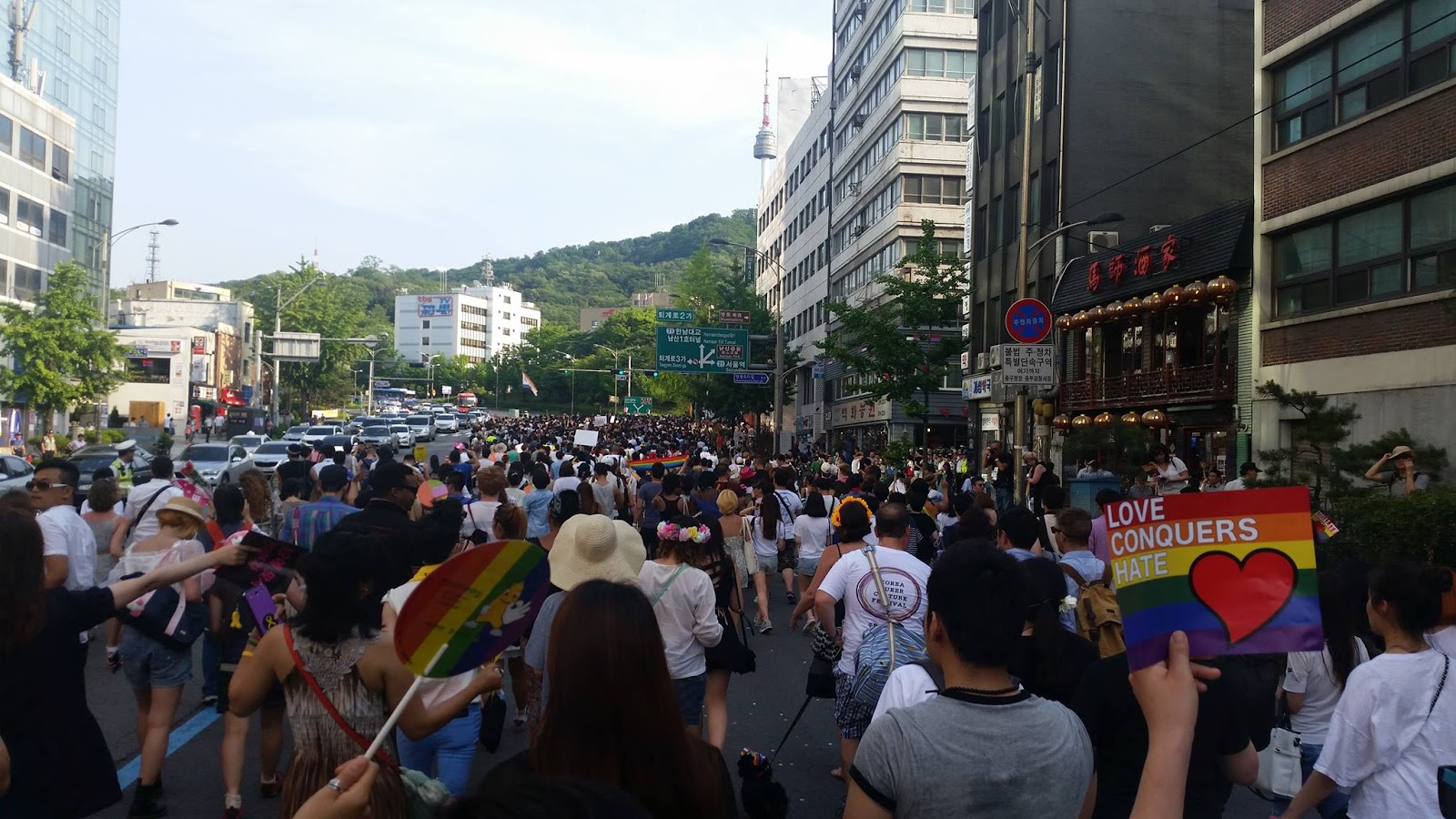
I marched in a parade; I showed my pride; I fell in love.
행진을 하고, 자기 자존심을 표시하고, 사랑에 빠졌다.


I read a lot and wrote a lot (not all of it in this blog).
많이 읽고  많이 썼다.

And for all of these amazing opportunities I think the scholarship I got from school and I thank God from whom all blessings flow.
이렇게 굉장히 좋은 기회에 대해서, 저에게 장학금을 주셔서 대학원을 감사하고, 하나님이 저를 사라해서 축복 너무 많이 주셔서 감사합니다.

Tomorrow, I go back to California for grad school, year two. I don't know when I will come back to Korea. But that's what I said last time, and as it turned out, I was back within a year. So we'll just leave it at that.
내일 저는 캘리포니아에 돌아간다. 언제 다시 한국에 올지 완전히 모른다. 하지만 지난번에 똑 같은 말을 했는데, 결과는 1년만에 다시 왔는 거... 그러면 그냥 기다려 봅시다.

다시 만날 날이 있겠다!

Tuesday, July 7, 2015

Half the Battle

A scene from tonight's taekgyeon class. We have just finished our warm-up.

관장님: Okay, um... now get on the floor.
[My two fellow trainees and I do as we are told.]
관장님: Now do eopdeuryeo palkuphyeo pyeogi1.
Me: ...?!?!?! What is that?
관장님 (in English): Do push-up!
Me: Oh, okay. How many?
관장님: One hundred.
Me: One hundred?!
Other guy: What?!
관장님: What's the problem? Be grateful it isn't two hundred.
[Seventy push-ups in, I notice that my fellow trainees have stopped.]
[Thirty push-ups later, I collapse to the floor.]
Me: Aigo2... So, uh, how many did you do?
Other guy: Oh, I just did fifty.
Me: Fifty? Come on! Well... at least pani sijak... ida3.
Other guy: What?
Me: Um... pani sijakida?
관장님: Pani... Oh! You mean sijaki panida4.
Me: Ah, that's right. Sijaki panida. Haha, I'm so stupid.

- - -

For those for whom this made very little sense, an explanation: I meant to encourage my fellow trainee with a proverb that I had recently learned in Korean class. The proverb is "시작이 반이다," which is basically equivalent to, "Starting is half the battle" (or the clever rhyming version I found online: "Well begun is half done"). He'd done fifty push-ups, and he was halfway through!

Unfortunately, I mixed up the two nouns in the expression and ended up telling him something more along the lines of, "Half is just the beginning." Even if it did make any sense, it probably wouldn't have been very encouraging at all! You've already done fifty eopdeuryeo palkphyeo blah blah whatever, but that's just the start of it... *cue evil laugh*

When it comes to using the new Korean words and expressions I've been learning in class, I inevitably make foolish mistakes. In the best case scenario, I bring a conversation with a Korean friend to an awkward halt because I sound like a stilted textbook example. In the worst case scenario, my friend decides to switch to English because they literally can't make sense of what I'm trying to say.

But in embarrassing times such as these, I remember another proverb, "Nothing ventured, nothing gained." Or the Korean version: 범의 굴에 들어가야 범을 잡는다5. You need to enter the tiger's den if you want to catch it. In my case, the tiger is fluency in a foreign language and the cave is an endless abyss of silly and awkward misunderstandings.

- - -

1 '엎드려 팔굽혀 펴기' is a ridiculously long word for 'push-up'. I mean, seriously?!
2 '아이고' is a common Korean expression of pain, discomfort, or dismay.
3 '반이 시작이다' does not mean anything in Korean.
4 '시작이 반이다' is a common Korean proverb.
5 In Chinese (for the heck of it): 不入虎穴,焉得虎子.

Tuesday, June 2, 2015

Profluentia et Imprudentia

I have to be more careful with my words. This was the realization that came hand-in-hand with a gentle reminder that I am currently living in a country where I am not fluent in the language. Wait, let me revise that: I am reminded daily that I cannot speak Korean well, and these reminders themselves are not always gentle. Like when I struggled for an hour to open up a checking account only to be told finally that without an ARC it just was not possible.

But this time, the reminder was gentle, and it came from a friend who has lived in Korea for longer than I have and knows a great deal more about it. We met up last weekend since he's currently doing his graduate studies at the same university where I'm taking language classes, and I have perhaps unceremoniously latched onto him as my go-to resource for cultural guidance and assistance with quotidian matters.

After I left Korea nine months ago, I forgot one of the basics of cultural communication, the one that is drilled into every language student's head from the very beginning: Korean culture is built on a hierarchy. In society, what this means is that the young and inexperienced always defer to their elders and superiors. Children obey their parents; younger students take orders from their seonbae (upperclassmen); the employer's word is law to their employees.

In language, this means that one's vocabulary and grammatical constructions change depending on whom you address. It's much more complex than a handful of polite terms. I would ask a favor of a friend using a wholly different grammatical form than that which I'd use to ask the same favor of my teacher or grandfather.

Of course, I didn't forget that this rule exists in Korean. What I have neglected to remain mindful of, then, is how strictly it actually applies to me.

You see, while I do I fairly a good job of blending in with the crowd here in Seoul (the expectation is that an East Asian face equals a Korean face, unless it's dressed in the outlandish garb of the Chinese tourist), as soon as I open my mouth, most people realize that I am very much American. My accent cues them off, and then my face and fashion sense fall into place with it. I guess this morning was an anomaly, when my new language instructor asked me if my parents were Korean, apparently surprised at my speaking fluency. Anyway, humblebrag aside, once I'm tagged as a foreigner, what has happened generally is that all linguistic rules are tossed and my stupid mistakes are forgiven. I can ask for a head of cabbage instead of a beer and nobody will fault me for it. I can stare dumbly at the real estate agent as he tries to explain the security deposit without him thinking that I am actually dumb. And, critically, I can use the wrong forms of address to everyone -- casual conjugations with a stranger, super-honorifics with my former student -- and I'll get a free pass because I'm still learning.

I am not saying here that I should make these kinds of mistakes. After all, as a perfectionist, I cringe when I catch myself saying something wrong or culturally inappropriate. But my point is that I do make these mistakes, yet I've been let off the hook so many times that I haven't really properly internalized the rules of what to say and when. Or at least, if I had had everything down after the first two years, I had promptly forgotten when I left.

And now I'm back and I'm making a fool of myself. Why? Because I'm here, newly determined to show that I have learned something after months upon months of intermittent language study, and along with this courage comes a fair bit of hubris, and from this hubris arises a situation in which my friend introduces me to his classmate, both of them my seonbae, and I immediately talk with him as if we've been buddies for years. So much for cultural competency.

Hence the gentle reminder: remember who you are and whom you're talking to. It may not be important to you, or any American for that matter, but it matters here.

My friend himself admitted that it took getting used to, being a graduate student in linguistics (a field generally as casual and laid-back as you can imagine; my professors at Berkeley eschew being addressed by anything other than their first names, for example), but in a country where hierarchy is deeply entrenched in the ivory bastion of cultural conservatism and academic tradition. The constant bowing, the formal pleasantries, the obligatory grad student drudgery for tenured professors: it's all here, and while my friend is just beginning to tire of it, I realize that I haven't even begun to process its reality.

If I really want to pursue Korean linguistics, then the hierarchy, ingrained as it is into both the language and the culture, is something I will have to acknowledge and accept. I don't like hierarchy; let me be clear about that if it isn't already obvious. But as an academic, I have to respect it, and step one is taking pains to use the proper honorifics in the right contexts.

Even with my Korean friends -- the ones with whom I converse freely in Korean, who only correct my many errors when I demand for them to -- I think it's time to be more disciplined about my language use. Who exactly is my nuna, my hyeong, my dongsaeng? It's admittedly a bit complex: is age the only factor? Should I ask my Korean friends for their opinion on how I should categorize them, or is that rude?

There's sure to be some discomfort as I recommence navigating this cultural landscape. I thought two years' worth of experience wasn't too bad, but it's nothing. And it's not just the hierarchy thing, either. I only have two months this time, and I wonder if tackling headfirst questions like my place in Korea as an American, the ups and downsides of rapid globalization, or the uncertain future of LGBTQ rights in this country are even worth my while. This summer, will I traipse through Seoul taking pretty pictures of food and blogging about the charmed expat life, or will I choose my words -- and thoughts and actions -- more carefully?

Thursday, April 23, 2015

Taekgyeon, and an exciting announcement!

My friend and fellow blogger Eleanor writes books, and as such she also reads plenty of them. The other day, she sent me a link to a blog post about a YA series called Prophecy in which the Korean martial art taekgyeon (택견*) is featured. Here's the blog post; it's a great primer on this unique and relatively unknown sport!

My taekgyeon black belt!
For about a year and a half, I studied taekgyeon in Changwon. I went to the dojang (gym) almost every weeknight and learned about roundhouse kicks and trips, poomsae, and a smattering of hapkido skills. I became very close with my gwanjangnim (master), and I think I made him proud when I achieved my first-degree black belt before I left Korea.

(Gwanjangnim mailed it overseas to me, and I received it a few months ago. That, along with my former students' Christmas cards last winter, are among the best packages I have ever received. A photo of the black belt, certificate, and special dobok (uniform) are on the left.)

About a week ago, gwanjangnim emailed me to ask if I could help him translate a few articles he needed to present on for a class. He's working on a PhD, too, in exercise psychology. As bizarre as it may sound, a lot of the instruction in Korean graduate schools is done in English, and many programs expect a certain level of fluency in English from their students, whether or not English factors at all into their future careers. Anyway, I did this favor for gwanjangnim, and then I broke the news that I'm about to tell all of you dear readers:

I received a scholarship that will allow me to spend this summer in Korea. I'm going back!

The scholarship is from Berkeley, and the funding will allow me to participate in a language program of my choice. Of course, my choice is the Language Education Institute at Seoul National University, so that's where I'll be for the duration of June and July. While I'm there, I hope to connect with some linguists at that university and conduct some of my own research on the Korean language.

Also while I'm there, I will make frequent trips to Insadong, Seoul's famous "traditional" neighborhood, where weekly taekgyeon performances and demonstrations are held. I hope to be able to find a good dojang in Seoul and show gwanjangnim what I've learned when I visit Changwon. Obviously, I've lost a lot of my skill in the nine months since I returned to the United States.

But anyway, this is good news! I will of course revive this blog to update everyone on what I'm up to in Seoul this summer. Thanks for reading; you will hear back from me again soon! (In the meantime, you can check out my grad school blog here.)

*Because of differences in romanization styles, 택견 can be written as taekkyon, taekkyeon, taekgyeon, or even t'aekkyŏn. I write it the way I do because that's how it's spelled on my uniform.

P.S. Happy Earth Day! 지구의 날 축하해!

Tuesday, July 15, 2014

작별 인사 스피치 - Farewell Speech

Today, I went to the community center Korean class for the last time, sat down to write a short essay for the last time, asked the Korean tutors to check my work for the last time... and gave a speech for the last time. I haven't been going to the class regularly this semester due to busyness, but it was an integral part of my life in Changwon for my first year and a half. I'm very thankful for the 창원한글학당 (Changwon Korean Class) because it helped keep me motivated to study Korean. Anyway, here's the speech I wrote, with the translations beneath.

시간이 너무 빨리 지나갔죠? 다음 주 월요일에 저는 창원을 떠날겁니다. 그 때 이 주일 반 후에 한국을 떠날겁니다. 저는 달력을 보다가 걱정하거나 멘붕 와야 한다고 생각하는데, 실제로는 아주 침착합니다. 대개 저는 감정적인 성격이 아니거든요. 제 친구들중에도 한국을 떠나는 선생님들이 많습니다. 그들은 마지막 수업 할 때 많이 웁니다. 그러나 저는 오늘 학교에서 작별 인사 스피치를 했을 때도 눈물 하나도 없었습니다.

Time's really flown, hasn't it? Next Monday, I'm going to leave Changwon. Two and a half weeks after that, I'm going to leave Korea. I ought to be looking at my calendar and worrying or freaking out, but actually, I'm calm. I'm usually not a very emotional person, you see. Many of my friends are also teachers who are about to leave Korea. They've been doing a lot of crying in their last classes lately. But as for me, even though I gave a farewell speech at school* today, I didn't shed a tear.

제가 안 울고 있는데, 그 이유가 떠나는게 안 섭섭해서가 아닙니다. 저는 진짜 아쉽습니다. 약간 가고 싶지 않습니다. 그렇지만, 이제 저는 앞으로 나가기 위해 준비되었습니다. 이년 동안 한국에서 굉장히 즐거웠습니다. 매우 축복받은 사람이라고 생각합니다.

So I'm not crying. But it's not because I'm not sad about leaving. In fact, I feel really sorry to go! I kind of don't want to leave. But I think I'm ready to move on now. I have really, really enjoyed my two years in Korea. I feel very blessed.

저는 미국에 돌아가서 캘리포니아 버클리 대학교에서 언어학 박사학위를 시작합니다. 저는 진짜 신나고 여기서 받은 경험이 저를 도와 줄 것 같습니다. 특히 여기 창원 한글학당의 선생님들에게 감사 드립니다. 선생님들은 저를 격려하셨고 한국어를 잘 가르쳐주셨고... 창원에서 살고 있는 외국인들에게 매우 귀중한 단체입니다. 써니 쌤 열심히 지도하셔서, 또 나미 쌤 참을성있게 가르쳐주셔거, 그리고 여러분 모두 사심없이 도와주셔서 감사 드립니다.

When I go back to the United States, I'm going to start working on a PhD in Linguistics at UC Berkeley. I'm really excited, and I think my experiences here will help me. I especially want to thank the teachers at the Changwon Korean Class. You teachers have encouraged me and taught me well. The foreigners who live in Changwon have such a valuable resource in you. Sunny, thanks for enthusiastically leading the class; Nami, thanks for patiently teaching me, and to everyone, thank you for all of your self-sacrificial help.

미래에 한국에 돌아오면 다시 뵐 수 있기를 바랍니다.

In the future, I hope that I can come back to Korea and that we can see each other again.
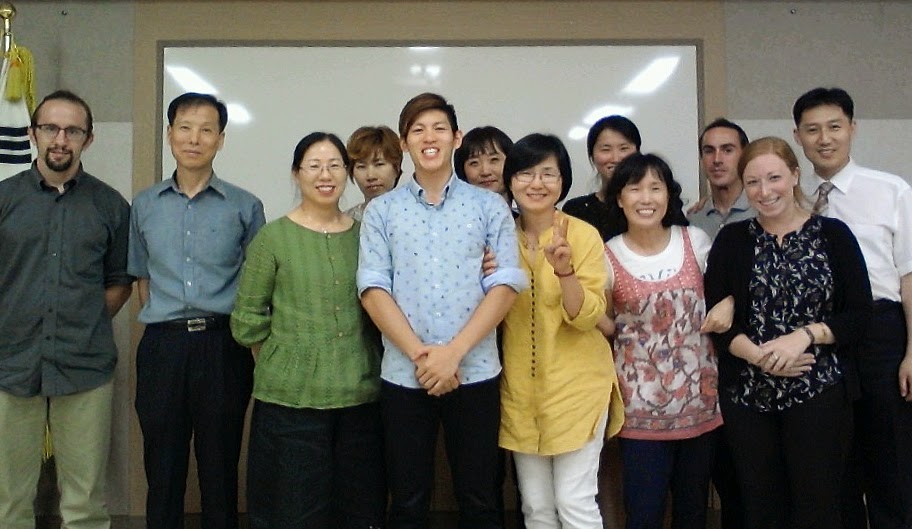
창원한글학당 - Changwon Korean Class. Nami is in yellow, and Sunny is in white on the far right.
- - -
There were not too many people at Korean class today, but the few that I really wanted to thank were there, so that was enough. Nami gave me a small farewell gift, a beautiful keychain. Man, I really am sorry to go!

*Yes, I also gave a goodbye speech at school today. It was before the end-of-the-year teachers' sports competition, which took the form of a ring-toss tournament this time. Anyway, the speech I wrote (and my co-teacher expertly translated) was a heck of a lot longer than this one. I awkwardly stumbled through it for like five minutes because the level of Korean that I was reading was way beyond me. But my principal really appreciated it, I guess. He kept saying, "아쉽다! 아쉽다!" That means, "It's too bad! It's too bad [that you're leaving]!" Perhaps I will post that speech in its entirety later.

Tuesday, July 8, 2014

Let the Countdown Begin

Actually, I meant to start my countdown a while ago, but I never got around to it. Today, however, is special. From today, I have only thirty days left in Korea! In just one month, on August 7th, I will board a plane at Incheon Airport and fly home to California.

Here's an even smaller and scarier number: I have eight days left with my students, and on two of those days, they will be taking exams! I was surprised by quirks in the schedule (although after two years of this nonsense, you'd think I'd stop getting blindsided) that left me with just one more meeting with some of my favorite classes.

So today, I had to rush my goodbyes. I passed back tests, gave out class awards, and then played one last game with the second-years. This game was an elaborate puzzle that I put together from bits and pieces of things they've learned (or should have learned) over the past year, like Greek and Latin roots, high school cliques, and US geography. There were eight parts to the puzzle, and each part, when unscrambled and put together, spelled out the answer to the Big Question: Where is Andrew going?

The answer: "University of California at Berkeley."

My nerdy students had a lot of fun with the riddles, but I underestimated the difficulty of some parts, unfortunately. The classes thus took so long to figure out the puzzle that by the time I actually gave my announcement, breaking the news -- just a week before the end of the semester -- that I would not be returning in the fall, the bell was already ringing. So there actually wasn't much time at all for goodbyes.

I think it would have been more difficult to prolong it, anyway.

Fortunately, I've already had some students promise to visit me!

- - -
Unrelated: tonight, I went to 한글학당 (hangeul hakdang), the weekly Korean tutoring sessions offered for free at a local community center, for the first time in months. I felt bad because I have only two more opportunities to go, and I made a promise to the Korean teachers there that I'd be more diligent about going this year. Well, I totally broke that promise (약속을 지키지 못했다). Actually, it turns out they'd all assumed that I'd gone home to the US already. Nope! I just went to chat with the teachers and learn a thing or two. A lot of my time was unexpectedly taken up by a local reporter who was doing a news story on the Korean class. So, instead of studying Korean, I got to practice Korean by being interviewed for a newspaper! That's pretty exciting. If I get ahold of the article (기사/kisa) when it comes out, I will certainly share it here.

Also unrelated: there was a crazy thunder-and-lightning storm (뇌우/nwe-u) today! A lot of people assumed that it was Typhoon Racoon*, which has sliced through Okinawa and is about to travel up Korea's east coast, but it was actually just a typical monsoon season (장마/jangma) storm. The typhoon is supposed to arrive tomorrow, which will mean high winds and heavy rain, but there's no real danger, at least where I'm living.

*Neoguri (pronounced nuh-goo-ree), means "racoon" in Korean. I don't know why they named a typhoon thus.

- - -
Lastly, watch this. It is, in fact, thematically appropriate.

You're welcome.

Thursday, February 28, 2013

Goodbye Seoul

Beneath Mapo Bridge (마포교) on the Han River. Taken by Ashley.
Today could have been a typical day, not unlike any other of the past month: language class, shopping, hanging out with friends at a bar. But it was special because it was the last typical day.

This morning, I went to my last Korean class at Ganada; I think normally the class period runs a full four weeks, so the last class should have been Friday, but tomorrow is Korean Independence Day, also known as Samil Day (삼일절), so everyone is on holiday. Between Samil Day, Seollal, and every Wednesday off, I feel like I haven't actually attended much class at all this month. But the final three hours were today. We went over 제30과 and also got our final exams (학기말시험, which we took on Tuesday) back. I suppose I scored all right... if you take into account my having studied for only a few hours and also coming down with a cold the day before the test. Eh, who am I kidding, I got an Asian F. Regardless, I know that I've learned a lot, and I'm ready to go back to Changwon and to my host family and use everything I've added to my Korean language arsenal.

In the afternoon, I went to 광장시장 (Gwangjang Market), which has fast become one of my favorite places in Seoul. It has tons of great Korean street food on the ground floor and a labyrinth of vintage clothes shops on the second and third floors. I promise I'll write more substantially about it in the near future, but suffice it to say that even though I primarily intended to wander around Dongdaemun and purposefully get lost in a different part of the city than I normally frequent, my feet somehow led me back to Gwangjang Market and I spent hours there browsing through racks of clothes and chatting with the shopkeepers in Korean.

And to top it all off, my friends and I all went to AcousticHolic again in the evening. It was partially a celebration of Jason's birthday (we surprised him with an ice cream cake from Baskin Robbins) and partially a celebration of our last night in Seoul. Most of us will be leaving to go back to our respective placement cities tomorrow morning or afternoon, so this was the last chance for us to hear the amazing guitarists (and Guitar Jedi) and hang out. Toward the end of the evening, well past midnight, one of the co-owners of the bar was playing through a set mostly consisting of American pop songs, and everyone sang along to Marley's No Woman No Cry, Coldplay's Viva La Vida, Jason Mraz's I'm Yours, and many more. I even joined in on the djembe when he needed a beat for some song that kept getting faster and faster. It was tons of fun, reminding me why I love this place so much. I did promise everyone that I'd be back soon, maybe in April...

(As an aside, I bumped into two Swatties at AcousticHolic! They are my 동문, or fellow alumni of a different graduating year. I recognized Aejin vaguely; I believe we worked together on The Phoenix at some point. Her friend Austin was with her - another Swattie, but one I didn't recognize. They're both class of '10 and are working in Seoul at the moment. I was so surprised to see Swatties at this tiny bar. The world isn't small; it's tiny. This brings my total of Swatties I've met in Korea since last July to... eighteen! And that's not counting all the Swatties with whom I'm not acquainted that I met at President Chopp's event in Seoul. The actual count must be over four dozen... We're everywhere, folks.)

So that's that: my last full day in Seoul. Winter vacation is over! I've had an amazing time. This has without a doubt been one of the best winter vacations I've ever had, and that's mostly thanks to it being two months long and paid, to boot. But as soon as I get back to Changwon tomorrow evening, I have my work cut out for me. Classes begin on Monday and I haven't prepared a single lesson. (I mean, I technically only need to prepare two, but that's a lame justification.) 자... Spring semester, 시작!

Thursday, February 7, 2013

February in Seoul

I'm spending my February in Seoul, and it's been a blast so far!

The first order of business is to take Korean classes, which I am doing at a well-known hagwon, or academic institute, called Ganada. (The name comes from the first three letters of the Korean alphabet: ㄱ, ㄴ, and ㄷ, which, when reciting the alphabet, are read as ga na da.)

It's interesting to be back in the classroom setting as a student (instead of as a teacher). After my 분반시험 (placement test), I was put into an intermediate class. So far, I've been able to keep up with the class; it's not too difficult, but it's not below my level, either. I think this is pretty fair; I studied at an intermediate level during Orientation, and it's not like I've been improving much in the months since due to limited practice. My Ganada class is small and the pace is quick and intense, just like at Orientation -- we speed through one chapter a day, three hours a day, four mornings a week. Re-experiencing the confusion that comes with total immersion in a language class is good for me, and it will help me better understand what my own students feel in my English class.

Another interesting thing about Ganada, specifically for this month, is that there are a lot of other Fulbrighters taking classes there. There are five in my class alone! Instead of choosing from dozens of other hagwons or university programs (like at Yonsei or Korea University), about thirty Fulbrighters have settled for Ganada, presumably on account of its cheap price (a little over 400 bucks for each month-long program, including the textbook and workbook) and the freedom it allows us. Less class time means more time spent exploring this awesome city!

What I know I'll especially love exploring is the neighborhood where I'm living. It's called Hongdae, which is an abbreviation for the local university (학교 becomes 홍대). I wouldn't call this place a "college town" so much as a hub of all the young people in Seoul. At night the streets are filled with people shopping, going to bars and clubs, and watching street performances. The narrow alleys are practically lined with cute cafes and specialty boutiques. And the people who live and work here are described as "ultra-hip". It's exciting to be in such a vibrant atmosphere.

My friends and I got an apartment through Airbnb. It's a tiny, cute, and cozy place on a quieter street. The location is perfect: out of the way, but a quick walk from the subway station, a local grocery store, and all of the fun parts of Hongdae. My apartment mates and I, all Fulbright teachers, have had a great time already, cooking on our own (American food! Pasta!) and looking for good cafes to hang out at. I love this arrangement, and I'm really looking forward to the coming weeks.

Monday, February 4, 2013

번데기! Scrumptious Silkworms and Swatties

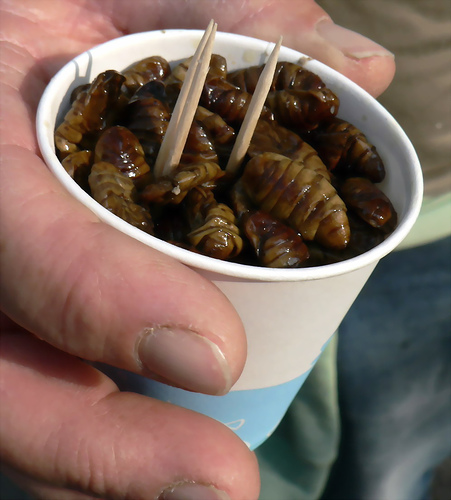
There isn't much to say here. 번데기 (beondegi) is a popular Korean street food that is quite literally boiled silkworm chrysalises. Not something an American is used to eating. I ate one.

I only did it on a dare, and it wouldn't have happened if I hadn't met some friendly and lively French people at the hostel where I was staying the night before. We and I mostly lazed around the hostel and chatted all day, and then we decided to maybe go out and sightsee something before the sun set, so we set off for Changdeokgung, an ancient Joseon Dynasty palace. I've been before, in the summer, but in January after a recent snowfall, the place seemed quite different. It was tranquil, with fewer people around, and snow crunching beneath our feet.
In front of Changdeokgung in the winter with friends from France and Korea.
The linguistic situation was quite interesting with our group. Julie, Aurelie, and another Julie were traveling together, and Ludovic was joining them from China, where he'd been studying Chinese. Ludovic also asked his Korean friend to join us; she had been in the same program as him in China. She then brought along her cousin. (They were both very generous and treated us a lot that afternoon.)

So, there were four French people, two Koreans, and myself wandering around the ancient palace, switching continually between French, Chinese, and Korean. We caved to English when the other three languages didn't work. As someone who enjoys studying languages, I felt like all those years spent in classrooms and cramming vocabulary and grammar actually paid off. For once, I got to communicate with other people in their own primary language rather than mine, and I really enjoyed it, even though it was hard work.

Beondegi in a cup. From the Korea Blog.
After wandering around the palace, Julie said that she wanted to try silkworms. It was part of her carpe diem attitude while in Korea. So, she got a cupful of them from a street vendor and spent a good five minutes psyching herself up to spear one on a toothpick and pop it in her mouth. As soon as she did, she spit it out! But since there was still a lot left, I told Ludovic, "J'en mangerai un si tu fais le même!" (I'll eat one if you do, too!) We got little beondegi on toothpicks and counted to three, and then ate them!

Well, to my surprise, the little brown thing was juicy. Warm silkworm juice squirted out as soon as I bit into it, and it was a supremely unpleasant feeling. It didn't actually taste bad at first, kind of like some sort of roasted meat. But after I swallowed it, a bitter and nasty aftertaste was left on my tongue. I washed it down with some candy that Aurelie had. Ludovic also spit his out. And... that was that! I ate bugs, you guys. In Korea. With French people. Who speak Chinese. The things you can do while you're abroad...
Julie with her cup of silkworms. Ludovic looks on in interest...
Cathy and me. She interpreted the entire evening's program!
Some last things of note: that evening (the 19th), I attended an event for Swarthmore alumni held at the Lotte Hotel. Our college president was touring Asia and stopped by to talk to alumni, some prospective students, and mostly parents of students about the college's vision and some plans for the future. The event was nice because I saw a few old faces and also because the food was excellent! There were about a hundred people present, and I think I might have been the only non-Korean under 30. Ha! But it really was nice to see a bunch of Swatties together again, especially Cathy, a current Senior from whom I hadn't heard for several months. It reminded me that yes, I do miss college. Quite a bit sometimes. But it's also time for me to move on, stop the pining, and get to work on making a future for myself.

J Kwon and me.
Speaking of seeing Swatties, I forgot to mention earlier that I saw another friend, J Kwon, whom I hadn't seen in two years because he had to do his mandatory military service. We watched Cloud Atlas together (which was mind-blowingly good) and caught up on old times.

Now that I'm back in Seoul after all of that traveling, I look forward to reconnecting with other people! There are lots of old friends and peers in the city, and actually, four weeks is starting to look like not enough time to see them all!

Tuesday, December 18, 2012

Let's Talk About Issues

Tonight was the final community center Korean class of the year, and there were much fewer students and teachers than usual. I suppose most people were busy with travel or end-of-the-year preparations, or maybe they were partying it up since, hey, no work tomorrow! Most of the country will have the day off on the 19th because it's election day. (What a great way to encourage people to vote! Why can't we do that in the U.S.?)

In class, I decided to chat with my conversation partner about the election. It seems to be either illegal or very frowned upon to share who you've decided to vote for in a public forum, so I didn't press the question. I did, however, pick up tons of election-related vocabulary. Here we go:

선거 (seongeo) is election, and 대선거 (daeseongeo) refers to the Presidential election. The two main 후보 (hubo), or candidates, are Park Geun-hye (박근혜) and Moon Jae-in (문재인). There was a somewhat substantial third-party candidate, Lee Chung-hee (이충희), but she declared right from the beginning of her campaign that she was only running in order to get a national platform upon which to attack Park as much as possible, then proceeded to do so, and finally withdrew from the election yesterday. Sneaky woman. But that's a pretty baller way to use politics (정치/jeongchi). Anyway, now Park and Moon are 서로 경쟁하고 있다: competing with each other, and the polls right now show a 박빙, or a very close race.
Park Geun-hye of the Saenuri Party and Moon Jae-in of the Democratic Party. Courtesy Yonhap News.
Park's party is called the 새누리당 (Saenuri Dang), which means the "New World Party". They are politically conservative (보수적), wary of North Korea, and well supported by the older generations and the nation's elite (including chaebols, or business conglomerates like Samsung and Hyundai). They are the party of Korea's troubled string of dictators, who controversially led the country to miraculous economic prosperity despite horrific human rights abuses, as well as the current President Lee Myoung-bak (이명박). Park herself is the daughter of Park Chung-hee, an important figure in modern Korean history. She has been involved in politics essentially as long as her father has, which means she already has strong ties to the government (정부) over which she is trying to gain control.

Moon's party is the 민주당 (Minju Dang), which simply means the Democratic Party. More progressive (진보적), more tolerant, and younger: altogether unsurprising. Moon himself is a lawyer 변호사/pyeonhosa) with less political experience, but he did serve as chief of staff for Roh Moo-hyun, the President of Korea prior to Lee.

I am admittedly not too well informed of the candidates' actual 정치철학 (jeongchicheolhak/political philosophies), knowing little more than what I hear from my Korean friends and read on Koreabang, but since I personally lean somewhat left of center, I think it would be good if the more liberal candidate become President (대통령/daetongryeong). My host family asked me not to write on this blog who they would voting for, despite their having already told me, perhaps due to the public nature of this blog and the aforementioned "keep your vote secret" thing. I can't vote, so my opinion doesn't matter much... but on the plus side, my host parents have promised to take me with them to the polling place tomorrow morning so that I can watch and take photos! This event only takes place once every five years, so I'm excited for the opportunity.
A vigil in NYC for the victims of the Sandy Hook shootings in Newton, Connecticut. Courtesy TIME Newsfeed.
And now for a much sadder 이야기 주제 (topic of conversation)... the Sandy Hook shootings. Like most 소식 (news) from the US, I first grabbed bits and pieces of information from Facebook, and then I went to Buzzfeed and TIME. The story was shocking and awful, but I honestly haven't stopped to mourn or even really think about it. Of course, it was on the news in Korea, but since I'm not surrounded by Americans and because I'm not in America, the issue was never shoved in my face. I actually avoided most of the dozens of articles being written on every corner of the Internet with updates to the story regarding the shooter's background, or more tales of heroism and survival. I just didn't want to confront it.

But tonight at class, and also afterward, I had to confront it. A lull in the conversation with my speaking partner led to the question, "What are your opinions on gun control in the United States?" My Korean tutor was extremely curious. In Korea, personal firearms are illegal, so you can imagine that the number of gun-related deaths in the country is extremely low. Compared to my trigger-happy country, well...

What struck me, however, was that as soon as I thought about the question for a moment, I realized that I actually really did not want to talk about this, least of all in Korean. Not only is gun control a hideously complex issue, it also requires grammar that I don't have yet to explain in a language I still can only barely grasp. But I tried, because that's what this class is for.

이사건에서 문제는 총이 않은데 정신병이었다라고 생각해요. 그 남자 정신병이 앓고 있었어요; 총이없으면 다른 사람을 아직 다치게 할수 있어요. 미국 사회는 총이 너무 좋아하는데 제일 중요한 문제는 정신 건강이예요. 몇 사람의 생각에는 더 많은 총은 더 많은 문제가 있다. 하지만 완전히 금하면 안되요. 이왕 불법총이 이젠껏 많아서 보통 사람들이 총이 받을수없으면 범인은 오직 총을 있을거예요. 그리고 으리 사회 보다 위험해져요. 그런데 이 주제 굉장히 복잡하네요.

Okay, that was probably all over the place in terms of grammar, but here's what I meant to say: "In my opinion, in [the Sandy Hook] incident, the problem was not guns but mental illness. That man was suffering from mental illness; without a gun he still could (have) hurt other people. American society likes guns too much, but the most important problem is mental health. Some people think that more guns means more problems. However, guns should not be completely banned. Up until now, the number of illegal firearms is already so high that if normal citizens are not able to procure guns, then it is only the criminals who will have them. Thus our society will become more dangerous. Anyway, this issue really is extremely complex."

So that is the gist of what I was talking about, reluctantly, with my Korean tutor. I tried to steer the conversation back to the election, but in the end I just announced that I was really sad now and couldn't think of anything else to say.

Late at night, when I returned from Korean class, I chatted with my host parents about the election. But inevitably, just as it had in class, the conversation switched to Sandy Hook and my thoughts on gun control. By this time, I really did not want to talk about it, but I tried my best to rehash the opinions I'd developed earlier. My host parents are fiercely anti-gun, and I could tell that they really didn't understand why "everyone in America has guns". ("Do you have a gun?" my host father asked me. I was too tired to mask my horror at the question.)

I also perceived their utter sorrow at the fact that the shootings took place at a school -- my host parents are both teachers -- and when I mentioned the argument some people have given for equipping teachers with guns, my host mother completed the thought: so that the teachers could have protected the children... There was so much conflict in her eyes. It was really telling.

Wednesday, November 14, 2012

서예 - Korean Calligraphy

Six "fonts" for Hangul calligraphy; the phrase is: 창원한글학당: Changwon Hangul Hakdang (School). Plus, some hanja on the very left. I can read about half of the characters... pity.
Our calligraphy teachers demonstrating their skills!
Korean calligraphy, called 서예 (seoye), is an art that has been practiced in the country for hundreds, even thousands of years. The calligraphy that uses Chinese characters, which were introduced to the peninsula in the 2nd or 3rd century, is called 한자 (hanja). In 1443, King Sejong and his court invented a script for Korean that wasn't based in Chinese characters; this new writing system is called 한글 (hangeul), or Hangul. Currently, Korean calligraphy includes character writing in hanja and Hangul, as well as minimalist still life paintings of things like trees and flowers.

Yesterday was "Korean Culture Day" at the Korean class in Jungang-dong. I was only vaguely aware that there would be some food provided at the class, but what I didn't realize was that we were going to have a husband-and-wife pair of calligraphers come to show us their art and teach us the art itself. That, plus the 귤 (kyul/tangerines), 김밥 (kimbap/rice rolls), and 떡 (tteok/rice cakes) made it a party.

There was also a lottery at the end of the class/party, where winners received a calligraphy painting done by one of our teachers. I was the first one called! That's unusual... I almost never win lotteries of any kind. But I took home a nice painting of some reeds, as well as a painting of a hanja character: 忍 (Mandarin: rěn; Korean: in), which means "longsuffering", that the teacher did for me just on a whim.

It was fun to chat with the Korean teachers about hanja and how much they did or did not know. I also had a casual conversation with one of them about his Mandarin studies in college. A feeble attempt to retain my rapidly declining Mandarin...

Well, I didn't learn much Korean yesterday, but I got a taste of Korean culture, plus some souvenirs, so I guess that's good enough!
They also helped some of us make our own paintings! According to the teacher, traditional Korean painting is much simpler and minimalist than what you'll find in most Chinese paintings. There's a lot of white space left on the canvas.

Tuesday, October 16, 2012

Reunion: Fall Conference 2012 (pt. 2)

You could also call this the Group Photo Post. Last weekend's conference was a fantastic time of reuniting with all of our friends after seven weeks of being apart. Of course, I've traveled to other cities and I've seen tons of other Fulbrighters; I may be the only one in my city, but I'm not as isolated as that. Nevertheless, for everyone to get back together was really something. When we were all gathered in the main conference room, I was taken aback at our numbers. In one large room were represented dozens of cities and over one hundred and twenty different schools, families, and experiences. This amounted to thousands of stories to share.
Contacting the night away! Left to right: Ashley, Sarah, Thomas, Kelly, Sara, and Erin.
On the first evening, a bunch of folks decided to walk around the Bomun Lake (보문호수), the large reservoir central to the tourist resort area where our conference was held. We got drinks and chocolate and, braving the nighttime autumn chill, sat on a pier by the lake and talked and played games. Contact -- my favorite game ever -- was the order of the evening. I love a good two hours of Contact. I mean, not even that, I love a good two hours of speaking quickly and fluently in English with my friends. A nice break from the Korean and intermediate-level English that surrounds me in the classroom every day. And on top of that, a word game that gives your language faculty a run for its money! Kelly perhaps described it best when she said that it felt like her brain was being massaged.
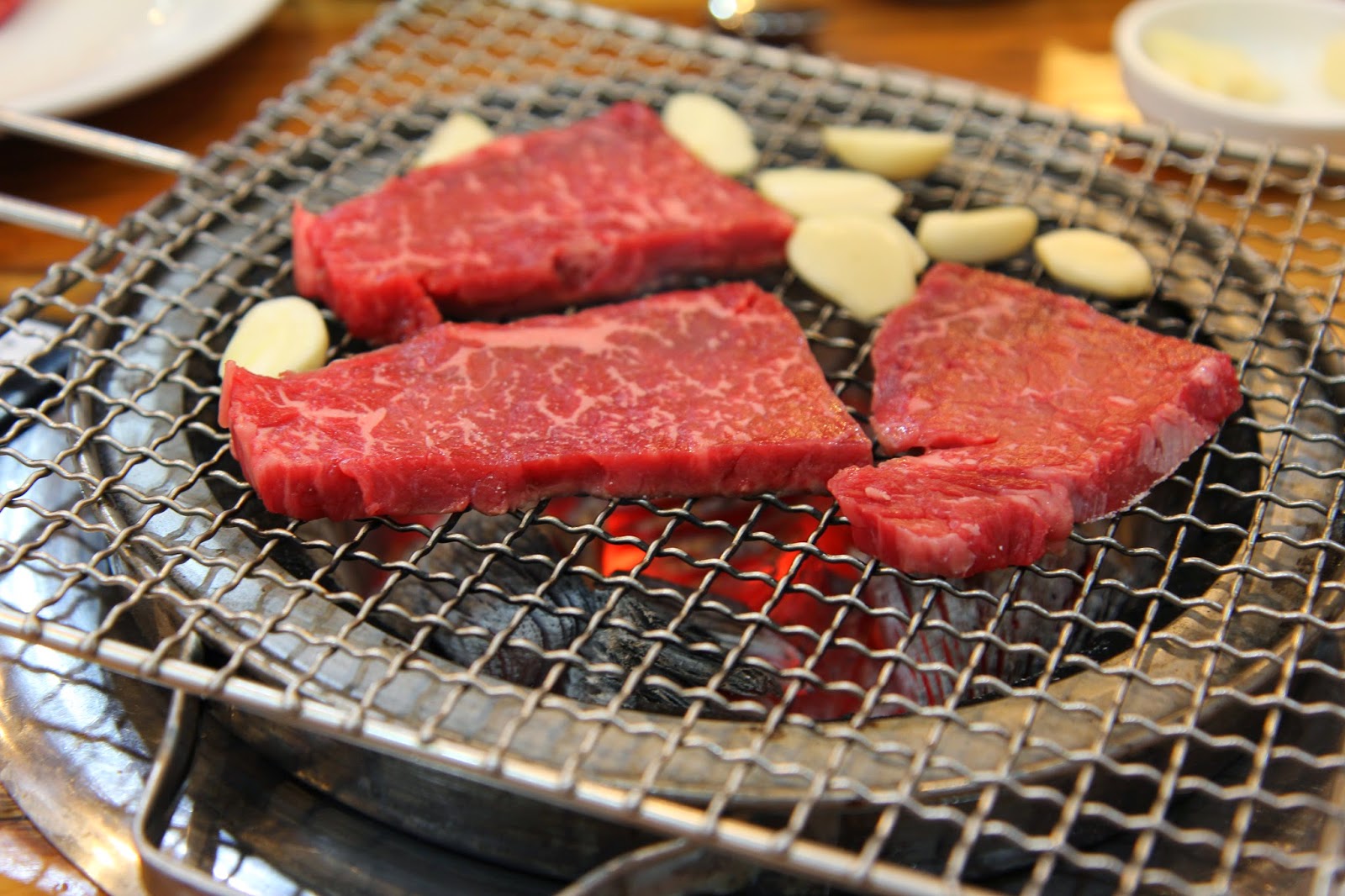
한우, Korean beef grilled over charcoal. The cuts were twice as thick as what I usually see at barbecue restaurants!
On Saturday evening, a group of us got adventurous and went out to get Korean barbecue. Fortunately -- or unfortunately, depending on how you view the situation -- we chanced across a nice-looking restaurant: 강산한우. I wasn't aware of this when we walked in, but 한우 (hanwoo) means Korean beef. Korean beef is really, really expensive. And sure enough, this restaurant turned out to be a wallet breaker. But was it worth it? The small cuts of meat that we got (10,000₩ per 100g) were delicious; juicy steak grilled over pure charcoal, along with tons of garlic, mushrooms (as much as we wanted), and a variety of 반찬. Mhm, there's no denying that it was an excellent meal, surpassing the quality of most of what I eat these days. On the other hand, I've also been stuffed to satisfaction at barbecue joints to the tune of 5,000₩, whereas this tourist trap restaurant, which charged extra for rice and even for setting up our table and grill (who does that?!), landed us with a bill of 20,000₩ per person. I'd pay $18 for that in the States, no sweat, but in Korea? Hmph. I'll say it was worth it, but I don't think I'll be treating myself to 한우 again soon...
The adventurous group that shelled out for some mad-expensive and supremely delicious Korean beef barbecue. Left to right: Kelly, Ashley, Jason, Katelyn, Ben, Tsu, Nina, Elaine, and me. (taken by Neal)
After the meal, everyone was stuffed -- almost uncomfortably so -- which called for a night-time stroll around the lake. I took photos and played with long exposure...
Katelyn, Ashley, Ben, Kelly, and Jason at Bomun Lake in Gyeongju. Jason likes his ice cream.
And that evening ended in a great Bananagrams and Pirate Scrabble marathon, during which I continued to fend off Ashley's attacks on my claim as Bananagrams Boss and Pirate Scrabble Captain and generally had a blast.

What I liked the most about this reunion was that all of us Fulbrighters could basically pick up exactly where we left off at the end of Orientation, which strangely seems like it was simultaneously very long ago and just yesterday. Only now in addition to our crazy antics and long chats about our lives back home, we have stories to tell of our students' crazy antics and long chats about our lives right now. Over all the meals, throughout all those long hours just chilling, between games of Bananagrams, the conversation continued unbroken, and, well, I guess it was telling of just how wonderful it was to be together again.
The wonderful 인터미디엇 (촣아, 촣아, 촣아!) class reunion photo. Left to right: me, Lizzie, Tracy, Jaeyeon, Susie, Amber, Soon, Monica, and Kyla. Missing: Kelly, Megan, and Ashley, who wandered off early :(

Tuesday, September 4, 2012

무료 - Free!

무료 (muryo) means "free". I've found free weekly Korean classes in downtown Changwon, and the prospects are encouraging.

Personally, I require structure and a schedule to learn best. If you just gave me a book and told me to self-study, I'd end up leaving the book on a dusty shelf somewhere and forgetting about it. (Facebook Scrabble is just so much more fun!) But I also prefer to spend as little of my salary as possible. So, when Elani from church told me about a free Korean class offered at the community center, I jumped at the opportunity.

Braving the Changwon buses once more to go to the Jungang district (중앙동) this evening, I gave myself time to explore that area more. I did check out the local cheap clothes store, called Auckland, which I might describe as the closest thing to a hipster fashion joint in Changwon. It's been surprisingly difficult to find clothes in my size here (I thought Koreans were generally... small... like me), but this place had lots of clothes that fit and that caught the eye -- in multiple ways. Polka-dot jeans? Check. Paisley ascots? Check. Engrish tees? Check. I even found a sweater with mustache styles on it, as well as a shelf full of bowties! (And yes, I bought one, for just 5,000 won (<$5) !)

After resolving to come back in the near future, I made my way to the Jungang 주민센터 (community center), where the Korean classes are held. The class has been run by a Korean named Sunny since 1998, and as far as I'm aware it's always been free of charge, just his way of contributing to the community. Isn't that awesome? The class has maybe half a dozen foreigners in it, and just as many native Korean speakers. The format of the class is a one-on-one pairing, somewhat like a language exchange. On the downside, it's also geared for beginners, so I breezed through the level evaluation given by Sunny.

In the end, I just chatted in a mix of Korean and English with him and another Korean, Eva, and decided that I could come back weekly, if not for actual grammar lessons, then at least for solid conversational practice and 정-building. (My host parents are good, but there's much more Konglish involved in our communication than I'd like.)

Everyone was very pleasant and enthusiastic! They invited me to hang out at a coffee shop after class (it began at 7:30pm, ended at 9pm) and we stayed until 10pm. I met folks from Russia, England, Canada, and South Africa (South Africans are everywhere, what?); the international crowd is really awesome! I'm pleased that I found this place and I'm looking forward to my new Tuesday evening engagement.

Friday, August 17, 2012

Last Day of Class

The Intermediate class has had a lot of fun the past few days. To celebrate our last day of class, we made a big poster for our homeroom teacher, 김 선생닙. It was shaped like a giant cupcake (컵케익), and we wrote individual notes to her shaped like sprinkles!
Our awesome cupcake poster! The green stem of the cherry was actually a piece of trash we found on the ground.
We also got her this amazing green tea cake (녹차 케이크) from Tous Les Jours (뚜레쥬르), the nice bakery chain that also has 팥빙수. It was absolutely delicious, and also very pretty!
녹차 (nokcha), green tea, is one of my favorite dessert flavors. :3
During the first two periods of our last day, we learned a Korean song called "Americano", by 10cm. Here is a fan-made lip-sync video of the song. It's simple and really catchy, so I think it'll be stuck in my head for a while! Anyway, our assignment was to rewrite the lyrics so that we loved something besides Americano.
Our class decided to write an ode to... ourselves. ("인터, 인터, 인터, 인터... 인터미디엇!) We also *kind of* put down the Beginner classes... not my idea! But it was really funny anyway, and during the class battle (B-1 through B-6 versus Intermediate, all presenting their versions of the song), we had a great time. I love a little rivalry, and it's funny how it's only just come out! The competition to make the best poster, buy the best gift, and impress our teachers the most at the end of the semester has been a fantastic motivator. Also, I'm glad we finally had a chance to have a fun class. 인터미디엇, 사랑해!
"We love Intermediate, no need for Beginner!" Teehee. (If you're wondering, we're making hearts with our hands.)
Speaking of class gifts, our gifts to 김 선생님 and 홍 선생님 were photographs of our class in really nice frames. (Thanks to Kelly and Ashley for getting the cake and gifts!) After giving her the gift, we ate snacks and cake and wrote little "yearbook" autographs to each other. I was pleased at how much I knew how to say to my classmates in Korean, although I still used a little bit of English in my autograph to get some more complex points across. But I can now tell people that they are going to be a good English teacher in Korean!
김 선생님 with our class photo, which was taken in this same room in front of the same whiteboard. 파이팅!
I guess I'm pretty sad that language class is over! It wasn't always loads of fun -- in fact, having four hours of language class a day was never very exciting -- but it was a really important part of Orientation, and now that we've passed this milestone, the reality of our approaching Departure Day and the real beginning of the grant year is starting to sink in. I'll miss my classmates and our teachers!

(We still have one thing left, though: the graduation ceremony! It'll take place in Seoul on Monday. During the ceremony, every class will give a presentation in the form of a skit and speeches. So, our class still has to meet to rehearse once or twice. Fortunately, our skit is hilarious and I enjoy rehearsing it. You'll see photos of it soon!)

(Oh, and yeah, I'm going to Seoul! It's 1:30am as of this writing, and everyone will be boarding the buses in two hours. Am I going to have an awesome weekend? Yes.)
Intermediate class, posing with our awesome cupcake poster! From left to right: me, Susie, Monica, Jaeyeon, Kelly, Ashley, Megan, 김 선생님, Amber, Tracey, Lizzie, Kyla, and Soon.

Wednesday, August 15, 2012

The Final

The final exam is over! It wasn't too difficult (쉬운 편였어요), so I wasn't nervous (긴장 안되었어요), and I felt pretty good about my performance all the way through. The exam was broken up into three sections: reading comprehension, writing, and speaking.

The reading section was straightforward, but on one section, we were given four sentences and had to figure out which one of them had no grammatical mistakes. I didn't think it would be difficult, but as soon as I read through the choices, I had to make sure that I was choosing the one correct sentence, not the one incorrect sentence, because I couldn't find any mistakes in most of them. I ended up guessing on those questions, and probably got them wrong.

In the writing section, the biggest portion was a short essay on a hobby. I've written about enjoying photography and working out, but I decided to go for something new and wrote about liking music (음악) and playing the guitar and the piano whenever I have time. It was an awkward essay, because I had to use specific grammatical points and wrote clumsy sentences such as, "Because I get good feelings when I am playing guitar, if I can't play guitar then I'm a bit sad." ...Yeah. Here it is in Korean: "기타를 치고 있을데 기분이 좋아 졌기 떼문에 연주 할 수 없으면 슬픈 것 같아요."

Unfortunately, I'd misspelled "guitar" (기타) throughout the entire essay: I wrote about how much I liked to play the "kuitar" for a whole page. Oops!

Lastly, there were two oral examinations. One was with a dialogue partner; we chose a scenario and had to role play. I was paired with Soon, which was a bad idea from the start because whenever Soon and I sit next to each other in class, we end up in hysterics. She's very funny, but has a knack for putting me into embarrassing situations during which I can't stop laughing. Anyway, Soon was a fun partner to work with, and it probably didn't surprise anyone that our role play ended ridiculously. I was looking for a suit to buy for teaching attire, and Soon the shopkeeper kept insisting that I buy a pink or orange suit, because those were in style.

After that, I had my one-on-one interview with my teacher. I admit I was more nervous coming into this one, but it was all right. I was asked to describe my parents ("저는 어머니를 닮았어서 눈이 큰 편이에요." I take after my mother, so my eyes are on the bigger side.) and talk about what kinds of situations made me happy, sad, or nervous. The interview didn't take as long as I thought, or maybe time passed quickly.

All in all, I think I did fine. I wanted to do well not really because my over-achiever drive was kicking in, but because I wanted to show my Korean teachers that I've indeed come a long, long way since my arrival in Korea. I mean, in all seriousness, I am so much more competent in the language now, and I'm kind of amazed at how much my class has managed to cover in five short weeks. Actually, my teacher who did my final exam oral interview was the same teacher who interviewed me during the placement test on Day 2. During that interview, I could only talk about when I arrived in Korea, tell the time, say that I like Korean food... really basic stuff. Now, I can write an essay about myself and my hobbies; I can describe peoples' appearances and personalities; I can make travel plans for winter break. No, fluency is still a long, long way off, and I still am not sure if I can successfully direct a taxi driver to a new destination, but hey, little steps!

A lot of the other students (future teachers!) were very anxious about this exam, because not passing our Korean crash course actually results in termination of the grant. But, in reality, I don't think anyone is going to fail the course. Even if someone technically receives a failing grade on the final, it's the effort that counts, and our Korean language teachers are aware of that. (And at this point, now that we've gotten our placements, the program would do anything to prevent a grantee from going home!) So, success really does depend on the amount of effort you put in.

In a more abstract way, this will apply to my year as a teacher, as well. For one, I will have to instill in my students the mindset that getting a low grade doesn't mean you're a failure (at least not in my class). It will also become apparent to them quickly enough that if you don't try to learn a language, you simply won't. For me personally, I'm also going to make plans to continue Korean classes regularly during my grant year or find a language partner to practice conversational skills. I've got to be held accountable, though, because if I don't make the effort, I won't get the results I want.

Here's to successful language learning! 아자자 화이팅!

Monday, August 13, 2012

Stressing vs. Seeking

Life has been quite busy and stressful these past few days... the final exam for our Korean classes is this Wednesday, so I've been studying for that in earnest. But I've also been finding ways to procrastinate for it, including Facebook Scrabble and jamming on the guitar as a study break. On the plus side, I was able to turn playing the guitar randomly with friends into a performance for the 2012 ETA Talent Show, which is this Thursday. But I'm also doing a swing dance routine with another friend, so rehearsals for that have been taking up time, as well. All in all, I think I can look at each day of this week consisting of 4 hours of class, 3 hours of studying, 2 hours of cultural workshops, 1 hour of gym, 1 hour of swing rehearsal, half an hour of music rehearsal, and half an hour of Facebook Scrabble.

This Friday, the end of Orientation will be marked by a weekend trip to Seoul! I'm really excited for this, but it's hard to think about the weekend when I'm so busy at the moment. On Saturday and Sunday, I'll be hanging out with friends (including some Swatties! Yay!). However, next Monday, we are going to have our "graduation ceremony" from KLCC; that is, we'll officially be promoted from the Korean classes we've been taking and obtain the right to become Fulbright English teachers. For this graduation ceremony, each class has to prepare a special skit or movie demonstrating what we've learned. My class, the Intermediate level, is going to perform a skit based on The Bachelor (but I'm not the Bachelor, haha...). So let's add on extra skit rehearsals to my already hectic schedule!

The thing is, although I have a lot on my plate, I need to keep reminding myself not to complain or to be an ass about it. People in general have a way of finding ways to gripe about anything, and as someone who is easily annoyed by it, I should check myself for hypocrisy. I must constantly remember that I've been blessed beyond comparison just by having the opportunity to be in Korea (and take Korean classes and get teaching training and do all the great things I've already done for free!).

So: yes, I'm busy. But am I, at the same time, grateful for having a job and for having friends? Do I have good health and food to eat (even if it's not delicious food), goals to work toward, and daily physical, mental, and spiritual satisfaction? Yes. 예! Swarthmore has taught me a lot about handling stress in healthful ways, and one of those methods is to remember to frame everything in context.

Tonight's Bible study was focused on Matthew 6, the passage where Jesus commands us not to worry. As Tracey pointed out, it's not just a "Oh, don't worry about it, things are going to be okay"-type message but an actual command not to worry. Anxiety (and stress, by extension, I'd suggest) is useless because, unlike concern, it is self-centered and doesn't manifest itself outwardly in love. Worry is almost idolatrous in nature, whereas true faith means seeking God in all situations ("Seek first the kingdom of God..." Matthew 6:33). Instead of worrying, stressing out, or complaining, in all things I can trust in God to pull me through. Including the big, scary four-hour test on Wednesday.
Mickey Mouse and me. Even though I'm in Korea, I know I'm in good company! :)

Friday, August 10, 2012

Dinner with the 선생님s

I don't know if I've mentioned this in earlier posts, but one thing that's been making Korean classes a bit more awkward than they already are (picture a class of eleven females and one male, and two female teachers) is the fact that I am my class' 반장 (banjang). This roughly translates to "class captain", and it means that I have some classroom responsibilities (erase the chalkboard, for example). I also was in charge of planning an evening outing with our two teachers. Let me add that I didn't volunteer to be captain... I was nominated against my will and won an election in which I didn't want to run. Oh well, that's what I get for being an awkward minority!

Anyway, yesterday the Intermediate class skipped mediocre Jungwon University dinner and went into town to find a good 냉면 (naengmyeon, Korean cold noodles) place. Tracey suggested a good restaurant, but when we arrived there it was unexpectedly closed. Luckily, Kim SSN (short for seon-saeng-nim, which means "teacher") knew of another cold noodle restaurant just around the corner, so there we went.

Goesan is a tiny city with hardly anything in it, but one essential that it does not lack is restaurants. I think my favorite is still the Chinese restaurant called Shanghai that has 자장면. But until yesterday, I'd never tried 냉면 before, so I was excited.

My first 냉면!
The photo on the left is of my huge bowl of Korean cold noodles, 냉면. It was... not what I expected, to be honest. The beige-ish stuff in the bowl is ice and slush, and the noodles are in the dark brown pile beneath radishes, peppers, a boiled egg, and assorted green things. Cold noodles are vegetarian, and mildly spicy.

I was eager to try the bowl -- it was fairly large --but the slimy texture and slight tang from vinegar surprised me. I think I had envisioned something more like Japanese chilled soba noodles. But it wasn't bad at all! I finished my bowl (except for the slush) and even tried a bit from my friend's 비빔 냉면 (bibim naengmyeon), which is just cold noodles without the slush and with a lot more spicy sauce.

During the meal, I didn't have much to say. This is mostly due to the fact that my Korean is still conversationally poor. I did, however, ask about the other section that our SSNs teach -- the Advanced class. I'd heard that when the other class took our SSNs out to dinner earlier this week, the most lively topic of conversation was my own class. So I intended to return the favor and get all the latest juicy gossip about them... alas, I didn't receive very much for my efforts. Besides other students, we talked about Kim SSN's love life, Chinese, the upcoming ETA talent show, and aegyo (I'll explain that one later).

After dinner, we went for dessert at Tous Les Jours. "뚜레쥬르" is a Korean bakery and cafe chain that has arguably the best 팥빙수 (patbingsu, or shaved ice dessert) in Goesan. We got three flavors: blueberry (블루베리), green tea (녹차), and original red bean (with 떡!)
Tous Les Jours 팥빙수! Blueberry, green tea, and original red bean.
They were absolutely delicious, and incredibly 달아요, or sweet. I finished all the slush from every bowl! However, I'm going to have to say that Taiwanese 剉冰 and 雪花冰 (shaved ice and shaved snow) beat patbingsu by leagues. I was really craving some 玉井-style mango shaved ice, but really, sweet dessert and good laughs with friends and my Korean teachers made it a great evening nonetheless.
Not everyone in our class could even fit inside the tiny cafe seating section of Tous Les Jours. From left to right: myself, Kelly, Tracey, Lizzie, Kim SSN, Amber, Hong SSN, and Monica. (photo taken by Jaeyeon)
P.S. While walking back to campus, we were playing Contact, but I felt bad because our teachers weren't able to play with us. So, we learned a Korean word game instead! I was instantly hooked, of course, because I love word games more than any other kind of game. It turned out to be a word-chain game that I've played in Chinese class before: one person starts by saying a two-syllable word, the next person comes up with a second word that starts with the final syllable of the previous word, etc. In English, this might be like playing the last-letter game, but in languages like Korean and Chinese, syllables (or morphemes) are easier to work with than "letters". Here's an example of one of our word chains: 기사 --> 사과 --> 과일 --> 일요일 --> 일번. (Translation: article, apple, fruit, Sunday, Japan) It was tons of fun!

Thursday, August 2, 2012

On Identity - Homosexuality (동성애)

This is part two of a series of posts I'm writing on several aspects of my personal identity and how they might intersect with the Korean culture in which I will live for the next year. Part 1 can be read here, and Part 3, here.

I think Korea is beating me up! Almost literally. I can actually feel myself getting more and more physically exhausted each day I'm here. Trying to wake up at 7am each morning is becoming an uphill battle. I hardly had any energy to teach this afternoon; thank goodness I was co-teaching with Brittany, who pulled tons of enthusiasm out of the blue to get our students pumped. And lastly, taekwondo. It's kicking my butt. I have trouble climbing stairs these days because my legs are so sore. Not to mention that today, we practiced sparring for the first time, and our taekwondo master (who is a fifth-degree black belt) accidentally roundhouse kicked me in the eye. Yup.

That aside... at night, when I'm not stretching or trying to fall asleep as fast as possible, I think about identity. Yesterday, I attended two cultural workshops that resonated with me deeply. These Fulbright cultural workshops are run by past ETAs who want to share advice and encouragement with the "new guard", and they cover a multitude of topics. One of these workshops was on LGBTQ+ (Lesbian, Gay, Bisexual, Transgender, Queer, and more) attitudes in South Korea and resources for queer ETAs.

Surprisingly for me, the awkward turtle of my sexual orientation has already poked its head out of the shell, although most people are unaware of it. In Korean language class, one of our teachers constantly singles me out, when giving examples of grammar or vocabulary, to be the token male relation, because I'm the only guy in a class of twelve. I'm always the boyfriend or the husband, and once I was even a creepy stalker chasing a beautiful girl. It's heteronormativity at its finest. Even worse, our teacher once made a culturally naive joke about 한국 게이인 (Korean gays). She was teaching us what the verb 같다 (to be similar to something) meant, and stereotyped them all as being "similar to girls". Her "Korean gay" act was essentially an 애교 (aegyo, Korean cute-girl charm) act. I was a bit slow to understand what she was talking about at first, but once I figured it out, it struck me as fairly disturbing to borderline inappropriate. In the words of my peer who was sitting next to me, "Sooooo un-pc..."

Homosexuality in Korea
So back to the workshop I attended yesterday. The two facilitators, whom I'll call Jen and Jon, were great, enthusiastic people who were very open with us about how they were involved with the LGBT community in Korea (it's fairly underground) and what it was like to be queer -- out or closeted -- during all professional hours of their grant year.

Among the ETAs who attended, some were queer and some were straight allies. But the majority of the talk was geared toward queer ETAs who had concerns about how to live out and proud in this fairly conservative, traditional country. Jon's first word of encouragement was that homestay families would more likely than not not try to delve into our personal affairs. His homestay parents recognized that their role was to be hospitable, not to bother him constantly about why he didn't have a girlfriend, or whatever. Some of his colleagues at school, and most of his Korean friends, were also in the know about his sexuality, and had no problem with it whatsoever.

From there, Jon generalized that Korean society, while not traditionally accepting of homosexuality, at least has very little to none of the anti-gay vitriol that is so prevalent in the United States. The overall attitude of most of the population seems to be, "It's not my problem" and/or "That's a Western thing." (My guess is that it won't be long before it does become a "problem" for a growing percentage. But the issue and its corollaries, such as the fight over gay marriage, are never discussed publicly or in the Korean political sphere.)

With that in mind, the queer community is very much underground, and only in Seoul is there any significant manifestation of gay pride or any strides toward gay rights. And, as Jen noted, "underground" in Korea really means "online". Internet communities and chat rooms are big here (for everyone), and the queer community that she was involved in interacted much more through the Internet than in person. However, she did become marginally involved in some human rights groups and gave us a run-through of the biggest ones.

Both Jon and Jen dated Koreans during their grant year, and the discussion eventually moved toward those experiences. Jen was the one who remained closeted in her professional life: none of her colleagues and very few of her Korean friends ever knew that she is a lesbian. At the same time, she presented herself as a strong ally at her school, showing support for LGBT rights her classroom and building enough trust with some of her students that they were able to come out to her in private. Jen's "advice" was to keep the personal and the Professional separate. But I put that in scare quotes because she also readily admitted that being closeted at her school was a tough identity choice to make that had its consequences on her self-perception. I mean, what is gay pride worth if you choose to remain in the closet in an environment where you have the opportunity to positively share your cultural identity?

I now wish that I had talked to Jen more after the workshop, but I had had to run off. For me personally, I would have no problem staying closeted, especially if I had to because I felt that the environment were unsafe. It's fairly easy for me to pass as straight, and I've never made more than a little splash about my sexuality. In college, I guess I officially came out sometime during sophomore year, but I was not very active in the queer community at Swat. Also, some people at home still don't know, and I don't announce it to the world whenever or wherever I change scenes (for example, when I began Fulbright). Thus, I can see how separating the personal and the Professional could be how I choose to live for one year. Kind of like Anderson Cooper!

On that note, while I'd like to teach my more advanced students (if I have any) about American culture wars and current issues such as the gay marriage debate, both Jen and Jon emphasized that as cultural ambassadors (or cultural "share-ers"), even if we think the progressive opinion is the correct one, we should refrain from teaching any opinions. Teach objectively; teach only facts (that is, provide arguments from both sides of the debate), and let students decide for themselves what they believe.

Another really interesting point that they brought up in the discussion was the idea of privilege. (Oh hey, Swarthmorean discourse, welcome back!) As an out gay man in the States, although I may not be able to marry whom I want in California, my orientation is not a crime and I am protected by law against discrimination. The same does not apply for queer folks in Korea. If I am fortunate enough to meet people from an LGBT community, they will (unfortunately) have every reason to be envious of my status as a foreigner -- and an American, at that. Because even if I end up hating staying closeted in Korea, at least I can always leave after one year. They can't leave. Gay Korean men dream of moving to New York or Los Angeles, but how many ways do they have of moving to a big American city? Compared to how easy it is for me to drive to SoCal? Or how long it takes to BART to SF?

Privilege is a set of social benefits that I have but did not choose to receive. Being male, coming from a comfortably middle-class socio-economic background, and having been able to reach my current level of education are all privileges. Being a Fulbright grantee this year is also a privilege! (Being gay and a person of color are not, but that's another story.) I get one more privilege while I'm in Korea: the foreigner card. I have no idea what this will actually mean for me... yet. But I'm really curious as to how I might use it in the year to come.

The rest of the workshop was centered around describing the gay districts of Seoul and some interesting slang (일반, ilban = straight; 이반, iban = queer). When it ended, I had a lot on my mind, but didn't really talk to anyone about it. So... I talked to my blog. Ha! Dear blog (dear readers), any thoughts?

Translate