Showing posts with label Fall Conference. Show all posts

Wednesday, October 23, 2013

The Kid They Call 게이, Part 2

Part 1 can be found here.

"Hey JS, can I talk to you after class?"
"Me?" said JS.

I waited until all the other students had left and talked to JS as I cleaned the whiteboard and gathered my things.

"Good job today, by the way," I began. "Um, I just wanted to ask you about your nickname."
"Oh, yeah," said JS, as if he guessed what was coming.
"Why do the other students call you that?"

JS began a rambling story. "Well, it started with JM. He saw my namecard one day, with (my initials) AJS, and the words were a little faded, so you couldn't read it... So he wrote in "gay" (게이) as my name. It's because I'm in the Mathematics Club at our school. People joke that the Mathematics Club is gay. Apparently the leaders of the club a few years ago went crazy. During the event when students introduce their clubs, they said, 'We welcome girls, but we welcome boys even more.'"

"Oh, I see." After listening to all that, well, I couldn't say that I was surprised. "That's... funny."
"Yeah," JS said.
"So you don't mind people calling you that?" I asked.
"No, not really," he replied. "It's just... people being funny."

I walked toward the back of the room to turn off the light, thinking very hard. Then I went for it. "Do you want to know why I don't like it when people use the word 'gay', though?" Not waiting for an answer, I went on. "In the United States, students cannot say that word -- I'm sure you know..." I recalled that JS had lived in New Jersey for three years. "...Because they use it to insult and bully others. Know what I mean?"

JS was quick to catch on. "Yeah. I guess, in Korea, gay people are rare... or hidden..."
"Right," I replied. "Does that make it okay to make fun of them?"
"I guess not," he said.

"Right." I breathed a small sigh. "I'm just glad to know that you aren't offended by it. But I want you to know something." By this time we were both walking toward the door. "If you ever, ever don't like it when someone calls you that, you can tell them to stop. It's that easy. Just say, 'Please don't call me that.' You understand?" I looked at him closely.

"Yeah."
"Okay."

As he stepped out the door, I said, half to myself, "Wow, I guess it's about time I taught a lesson on the power of words, huh?"
"That might be interesting," he said. "Bye, teacher!"
"See ya."

- - -

This conversation took place last week, after a class where everything went smoothly except for one moment in a game, when JM, the same student who gave JS his nickname, called a girl gay, and the entire class erupted in laughter. I was so angry. I paused the game and sternly told them not to use "gay" as an insult. But what use is that? How could my students know they're using it as an insult? It's just a joke to most of them.

On the bright side, the incident reminded me that I wanted to talk to JS, and the opportunity opened itself right up after class.

But... sigh. How many times is this going to happen?

At last weekend's Fulbright Conference, my friend Sara and I led a small group discussion centered on LGBTQ issues as expats and teachers in Korea. We talked about various issues, including straight-washing relationships, encountering students who may be LGBTQ, how to challenge locals' notions of Korea's queer community, and handling homophobia in the classroom and workplace. I wish I could say I had all the answers, but I definitely don't. Fortunately, having the support of my friends and colleagues is encouragement enough for now.

Tuesday, October 22, 2013

베이킹을 사랑해! I Love Baking!

Fulbright Fall Conference was last weekend, and one of the events was a bake sale as part of a fundraising effort for various Fulbrighter-led initiatives. My contribution was a batch of persimmon cupcakes (with persimmon frosting!) and Oreo brownies! My friend Katelyn, who baked peanut butter-chocolate chip cookies, and I together raised about $70 for the North Korea Defector tutoring program in Daegu.

I documented my uber-baking process, which began at 6am the morning before I was to leave for Gyeongju. I got up before sunrise, baked for three hours straight, cleaned for one hour, packed, and was out the door by 10:30am.
The set-up: some new baking pans, a new muffin tin! And all the ingredients up top: peanut butter, persimmons, Oreos, chocolate... Dang, seeing this makes me excited to bake again.
Oreo brownies: one layer of cookie dough, one layer of Oreos, and one layer of brownies. Recipe from here.
The finished product! It was very sweet, but not as melty or moist as I'd have liked. Still, not bad for the first try.
Persimmon cupcakes, just out of the oven! I mostly followed this recipe from the Cupcake Project, but used cinnamon instead of pumpkin pie spice and also added crushed walnuts per a recipe I got from my aunt. (The idea was inspired by her own persimmon cake, so thanks, A-koh!)
Here's the first batch! Persimmon cupcakes, with persimmon. :) Cute, but a bit flat. Perhaps more baking powder next time to help them rise. Also, more flour to counteract too much juice from the fruit.
I also made persimmon frosting! Without powdered sugar (confectioner's sugar), I had to go with a recipe that used granulated sugar, but it turned out better than I could have imagined, anyway. Butter, sugar, milk, flour (?!), and one persimmon, whipped together like mad and refrigerated for a few hours. I frosted them just before the bake sale, so that it wouldn't melt. They were a hit. I even sold cups of extra frosting for a buck each; I'm not kidding.
Oh and here's another thing I did a few weeks ago: cinnamon sugar sweet potato fries. Yum!
I love baking and I will try to get better at it throughout the year. Fall is definitely here. How do I know? The weather is chillier and I've caught a cold. Time to try recipes with pumpkins (Korean pumpkins, 호박, are quite different from American ones) and Korean pears!

Monday, April 15, 2013

The Researchers (+ an announcement!)

The Spring Conference was not only a chance for Fulbright English Teaching Assistants (ETAs) to get together and share what new and exciting things they were doing, but it was also a major gathering for the Fulbright researchers, affectionately known by us ETAs as "our other half". These two dozen-or-so independent academics, some fresh out of college and others working on their Masters or Doctoral degrees, have been in the country since last fall. Their research spans a wide variety of topics all related to South Korean history, culture, economics, health, or politics, and it was all quite well done.

During the last day and a half of our weekend in Jeju, the Fulbright researchers presented their research -- mostly background and updates, since they have not been here for too long yet -- to the entire Fulbright community. I actually expected it to be tough to sit through tons of these presentations at a time, since I knew that I'd be tired from the island tour and also probably not very interested in their subject matter. Boy, was I wrong. I was completely engrossed by more than half of the presentations, and I didn't doze off once. I think the doodle-notes helped a bit; during the presentations that didn't engage me as much, I took to "enhancing" the notes I'd taken on other segments and ended up with a pretty page of tons of information about South Korea. Here are some notes! Browse at your leisure and leave a comment or question!

Suicide
Joanne Cho is researching suicide in the country whose suicide rate is the greatest among all OECD countries. Suicide (자살) is the leadingcause of death for Koreans aged 10-40 (age 10?!), although a higher proportion of older men and women commit suicide, which makes this a social issue on all fronts, for all people. The reason behind this is often cited as stress, social pressure, and inadequate mental health care, but Ms. Cho thinks it's not so simple. She is investigating not only the mental health care system and its purported deficiencies, but also the stigma and the paradoxical influence of high-profile suicides on public perceptions of how to deal with shame.

Obesity
Emerson Song is researching the effects of 한식 (hanshik, or Korean cuisine) on obesity. Koreans have a significantly lower average BMI than residents of all Western countries, but the number of overweight and obese adults is rising. Also, did you know that Asians and Caucasians gain weight in different ways/places in the body? Due to this, it might be necessary to reevaluate the way Western medicine defines "obese". The more you know!

Korean-American Return Migration
Stephen Suh has been interviewing Koreans who have lived abroad (read: in the US) for extended periods of time but have since returned to Korea and are living stably and comfortably here. Why would Korean-Americans want to come back to Korea? For one, the economics prospects in the US still suck, and native-like fluency in English can get you a long way in any job in Korea, not just as an English teacher. But the typical locations of Korean return migrants are indeed English education and international businesses, as well as in the US military, which might indicate a propensity toward vocations that accentuate a return migrant's American identity. Does the US exert a strong cultural influence on Korea without using military force? Yes. (Mr. Suh calls this neo-imperialism.) Do 재미교포 who come to Korea have a role to play in all of this? Perhaps.

Chaebol Urbanism
The 재벌 (chaebol) is a unique type of business conglomerate that has flourished in South Korea and, arguably, been at the root of its meteoric economic rise in the past fifty years. Justin Stern did a unique economic and architectural study of the effect of these conglomerates on the visual landscape of Seoul. There was a lot of fascinating history included in this presentation: did you know that in the 1960's, the South Korean government extended huge benefits to Lotte, then a small confectionery company, so that they could finance the building of a grand hotel, and then an amusement park, and then an apartment complex? These business depended on the government for their big breaks, but once the construction began, it took off and hasn't stopped since.

These days, the mark of the conglomerates is huge. Names like Samsung, Kia, Hyundai, GS, and LG are everywhere: on gas stations, cafes, department stores, office buildings, theaters, phones, and even life insurance. They have spread their influence so far that even the government now wouldn't dare funnel any money into any project without first getting the okay from a chaebol. Anyway, how has this affected the urbanization of Seoul? Well, aside from having everything that makes a city a city owned by one conglomerate or another, each chaebol's headquarters appears to have staked out a geographic portion of the city to call its own, which, when you consider how every chaebol wants its own skyscraper and beautiful, futuristic office complex in its own neighborhood, will give us a strange, scattered skyline in twenty years or so.

Cosmetic Surgery
Kayleigh Nauman is heading up an interesting project investigating attitudes of foreigners in Korea toward cosmetic (plastic) surgery (성형수술). This is informed by the fact that there are between 400-600 cosmetic surgery businesses in the Gangnam neighborhood of Seoul alone -- and yes, they are regulated as businesses, not as medical practice. Loads of foreigners travel to Korea for "medical tourism" (150,000 in 2012), but why do they choose Korea?

Ms. Nauman wanted to dispel the stereotypes that cosmetic surgery in Korea was the cheapest in this region of the world (because it isn't), or that Asians wanted to look like K-pop stars, or, heaven forbid, that Asians want to look more "Western". (I mean, I've realized by now that suggesting that the Korean or Asian beauty ideal is just Hollywood glamour transplanted onto the other side of the Pacific is, in fact, a misguided opinion at best and a white- or American-centric microagression at worst. And it still wouldn't really answer why Korea is such a hot spot for people who want to cut up and realign their legs and boobs and faces. (By the way, I acknowledge that I did write about this very idea a month or so ago. And +1 for embedded parenthetical statements.)) Anyway, this was interesting research that was definitely on my mind as I planned a lesson on beauty standards for my second-years for this week.
Doodle-notes! (Clicking on the photo will make it bigger, but it will not fix my handwriting.)
Miscellany
There was a quintet of Fulbright researchers whose topics involved North Korea and North Korean refugees. They were so informative and intriguing that I took copious notes, and I will write them all up as a separate post later.

Overall, I felt really fortunate to be able to hear the presentations given by the researchers. It was academically fulfilling to tackle these issues and get some dialogue going with my fellow Fulbrighters. It was also very refreshing to see Korea through the lenses of people who have not been dealing with students and principals and lesson plans and classroom management for six months. I'll say, teaching can really swallow you whole; after a while you begin to forget that anything else exists outside of your various classrooms.

In addition to the Fulbright researchers, some other parts of conference were given to Fulbright ETAs who were doing their own side projects, independent research or community events, things like that. As I heard from my colleagues who are compiling cookbooks, editing our annual literary magazine, or developing education-based NGOs, I obviously felt like I've been absolutely unproductive with my time here. I'm so lazy and not driven compared to everyone else! But hearing about everyone's projects was great nevertheless.

This is all such a far cry from Fall Conference in Gyeongju last October. Our last conference was themed around solving the myriad problems that had cropped up in the first-year ETAs' experiences thus far in the grant year. We're all a long way from that now: small group discussions were no longer "how to address school issue X and homestay issue Y" but more for living in Korea (dating advice, dealing with sexual harassment, exploiting every feature of your smartphone) or preparing for life after Fulbright (resume building, pursuing teacher certification). And, as I've noted, all of the large group talks were presentations on amazing projects we've accomplished since last August.

Most importantly, while I was anxious about my future around the time of Fall Conference, I can proudly and excitedly declare that during Spring Conference, I decided to renew my grant. This means that I will stay in Korea for one more year! I get a month-long break in July/August, and then it's straight back to teaching. I'll get to watch my second- and third-years graduate again, and I'll gain so much more experience in teaching and living in Korea.
Hooray!

Saturday, October 20, 2012

Deepest Darkest Fears (Conference pt. 5)

Part 5 of 5 from last week's Fulbright Fall Conference.
The problem boarding wall. Write out your problems, write out advice for others.
A neat portion of Fall Conference that ran continuously throughout last weekend was the problem boarding wall. All of the ETAs were asked to respond to two questions on a folded sheet of paper. On the outside, "What do you wish you knew about teaching?" On the inside, "What is one unresolved fear or worry you have about being in Korea?" Our questions and problems were then posted on a literal wall, and during any free moment we could write an answer on a Post-It to help one another out. As you can tell from the photo, we had a lot of problems.

Anthony, our Program Coordinator and conference MC, tried to lighten the mood a bit by joking about how we should be writing our "deepest, darkest fears" on the insides of our problem boarding sheets. Regardless, I took it seriously. Some things have been weighing on my mind a bit more heavily than I'd like to admit. They're not really fears, to be fair, but simply vague clouds of dissatisfaction. And they don't actually have anything to do with my placement or how life has been for me these few months. It's hard to explain, but I'll try my best.

On my "I wish I knew..." section, I wrote that I wish I knew how to engage the students in my classes who are at a lower level of English than all the rest. I can tell they don't understand sometimes, but what student is willing to raise his hand and ask the teacher (read: announce to the entire class) that they're confused? As a result, they keep quiet and zone out. I wish I knew exactly what my students want or need out of my class, too. Most of them will need English to attend the top science universities, but if they're not aiming that high, or if they fall short of their goal, what then? What's the point of my class? Can I offer them a different motivation? And I wish I knew all of my students' names and their stories. As for this last one, I think I'm getting there. It just takes time and patience.

Those were my teaching questions. My fears, on the other hand, are much more broad and substantial. The first (of two) was a fear that I've already fallen too far behind in my goal to reach basic conversational fluency by the end of the year.

One optimistic stranger wrote to me on a Post-It: "It's really not too late!! Take advantage of winter break and take a class! Ask a co-teacher or faculty member to do a language exchange. Go to a university area -- or ask around -- and find a college student who wants a language exchange. NOT TOO LATE!"

The rational part of me already knows all of these things. It's not that I don't know what I should be doing -- in fact, I am taking a class, sort of. But the worry is an ambiguous projection into the future. The goal I set was not concrete enough, so I won't really know if I've reached it. That is to say, what is "basic conversational fluency", anyway? From one perspective, I've already reached basic conversational fluency, because I can hold a conversation with my host parents completely in Korean about my weekend plans or what I did today. I've also had lots of practice at the Korean class held at the community center. But because I still run into communication problems on occasion, I get frustrated about the simple things that I don't know, and that's why I am doubtful of my progress. In fact, it's pretty irrational, when you think about it.

The second fear I wrote is that I'm having trouble figuring out what to do after year one. Should I renew my grant and stay for one more year? Should I apply to graduate school? If so, in what field? If I don't apply now and I don't renew, should I just go home and become a sad sack?

The Post-It reply I got read, "Sounds cheesy, but where is your heart calling you? I'm going home at the end of the year."

It's not cheesy, Post-It peer. I understand exactly what you mean, and then some. It's the same irrationality that has brought about my lack of confidence in Korean. See, I know that I should be following my heart -- or to put it in spiritual terms, placing my trust in God and trying to discern His will -- but actually doing so is a different matter entirely.

And this is where things get depressing. I have no idea what God wants me to do after my grant year. I'm still trying to determine if coming to Korea in the first place was a part of His will, or if my coming here was really just me running away from something else, like Jonah trying to go to Joppa in order to avoid Nineveh. The analogy isn't perfect, of course. If Korea were truly my Joppa then God would never have actually let me come, and I'm sure Megashark would have leapt out of the Pacific to swallow my plane before I'd arrived.
Joking aside, I'm starting to feel the creeping pressure to get myself a concrete plan. For starters, although I'm fairly comfortable and happy in Korea, I don't want to give off the impression that I'm drifting. Deadlines for graduate school applications are coming up... and I don't even know what I want to study in graduate school. Linguistics? Religion? Education? Should I switch to law? Do a post-bac in medicine? I had so many ideas before graduation but never settled on any of them. I never sat down and considered any of them seriously; now I'm afraid that if I choose one, I'll second-guess the decision and spend the next five to seven years wondering if I should have done something else.

Thus, in the meantime, it's like I'm just stalling for time by teaching during the week and exploring Korea on weekends. Not that teaching is just a meaningless method of killing time -- far from it! I love teaching (see yesterday's post for proof); it's been nothing but a pleasure so far. And anyone would agree that traveling is a neat way to spend a year after college. But like my dad says, I can't do this forever.

And that's the next source of pressure: parents. My future is nowhere near the path that they envisioned for it. I was supposed to go to Berkeley, study medicine, and become a doctor like my two older brothers. Instead, I went to Swarthmore, studied Linguistics (what is Linguistics, anyway?), and didn't even take a single course in organic chemistry. But that was okay, they reasoned, because with my quarter-of-a-million-dollar education, I could do something else just as amazing, right? Right.

Then, I became an English teacher in Korea. Nope, that was definitely not on their radar.

These days, our Skype dates have become a weekly episode of Where in the World is Your Future Headed? and it's just as disappointing for myself to have to answer that I don't have a clue as I feel it must be for them. Dear Swatties, remember The Graduate?

Mr. Braddock: Ben, what are you doing?
Benjamin: Well, I would say that I'm just drifting. Here in the pool.
Mr. Braddock: Why?
Benjamin: Well, it's very comfortable just to drift here.
Mr. Braddock: Have you thought about graduate school?
Benjamin: No.
Mr. Braddock: Would you mind telling me then what those four years of college were for? What was the point of all that hard work?
Benjamin: You got me.
Sigh...

Its not all bad, though. I've registered for the GRE; I'll be taking it in late November. I'll study hard so that I only have to take it once, and then the scores will last for five years. That should be enough time to figure out what I want to do. One doesn't decide overnight that they want to commit to years in some graduate program or other. I can still patiently think and pray and discern.

I'm not drifting. It's not that I don't have any plans; I just have many options on the table, and I'm being non-committal. Oh, and you know what? One of my main goals for the Fulbright grant from the very beginning was to see if I had what it takes to be a good teacher. So this is a year of prospective job training, isn't it?

Well, there's a fine line between looking on the bright side of things and sugarcoating the truth.

"Don't settle. You can do better. You're smart, you have a good education. You should aim to be the best in your field. Don't you think your skills are being wasted if you spend more than one year in Korea? Hey Andrew, didn't you once say you wanted to be a doctor, a professor, a missionary? You need to wait for God to tell you what to do -- oh, and also, you need to decide now. Dear Andrew, I hope South Korea's treating you well. What are you planning to do afterward?"

Mr. Braddock: What is it, Ben?
Benjamin: I'm just...
Mr. Braddock: Worried?
Benjamin: Well...
Mr. Braddock: About what?
Benjamin: I guess about my future.
Let That Be Enough (Model Behavior) - Switchfoot by Jars of Clay on Grooveshark

Thursday, October 18, 2012

The Silla Legacy (Conference pt. 4)

Continuing the tour of Gyeongju from the Fulbright Fall Conference!

It is now Sunday after lunchtime, and everyone has stuffed their faces full of bulgogi, and it's warm and bright out. So when we arrive at a museum housing artifacts excavated from tombs dating back to the Silla Dynasty (57 BC to AD 935), we all just kind of casually wander through it and snap photos at pretty crowns, jewelry, and pottery. In fact, as I stroll from exhibit to exhibit with Jason, Katelyn, and Jake, all of us are actually engaged in a conversation about our favorite versions of the Pokémon games. (Mine is probably Crystal.) I also busy myself trying to read the Mandarin on the exhibit descriptions. My Mandarin is very rusty, but any chance is worthwhile! I can only recall two things, though: Gyeongju (경주) is 慶州 (Qìngzhōu), "Celebration City", and Silla (신라) is 新羅 (Xīnluó).
A crown in the unique style of the Silla period. It looks like it's made of gold leaf, and it also looks like it was made for a very large head. The little jade jelly bean ornaments make me giggle.
A lot of folks finish the museum early and are just lying on the grass outside beneath the sun. I feel like singing, or maybe napping. We board the bus to go to Anapji, a Silla palace built in the 7th century. Once there, we are given forty-five minutes to walk around the pond, but seriously? This place is gorgeous. Can we just stay here forever, etc. There is a large wooden scale model of the ancient palace complex that everyone photographs before starting the leisurely stroll around the park. The water is absurdly green, but despite the algal blooms, we see giant koi swimming comfortably around.
Katelyn and me at Anapji Pond. (Taken by Jason)
This probably doesn't help their tourism industry much, does it?
Alas, time doesn't stop for us, and we board the bus again to go to Cheomseongdae (첨성대/瞻星臺), the oldest astronomical observatory in East Asia. Popular legend says that it was built as a means for the public for learn how to read the stars on their own rather than having to depend on a corrupt shaman  class -- I can dig that. It's like the Luther Bible of ancient Korea.

But the star-gazing tower itself, despite all the boasting a guidebook can put forth regarding its numerological perfection and structural symbolism, is rather dull. It's really just a giant rook in the middle of a field that nobody is allowed to visit. See the sign?

Haha, I kid. It's actually a poor translation; the small placard reads, in Korean, "들어가지 마세요," or "Please do not enter." It's referring to the grassy area.

Even so, we walk around the entire thing and realize that there's no door, only a window. The thing must have only been accessible by ladder... Nothing else to see here.

At Cheonmachong. The balloon way in the background is from the 떡 festival.
From there, we walk past a 떡 festival and enter a quiet, secluded park with trees shading the paths and hushing the sounds of the roads. The only sounds are Fulbrighters chatting and Brittany's loud maniacal laughter as she shoots us all with the soap bubble gun she has for some unknown reason.

A path leads us past giant earthen mounds -- more like small hills -- that are all just a little bit too geometrically perfect to be natural. They are tumuli, each one a tomb for some member of the Silla royal family. They look like they would be so much fun to sled down come wintertime, but no one is allowed to step foot on them. No visitors allowed. Only lawnmowers to keep them looking pristine.

The very last one at the end of the path is Cheonmachong (천마총/天馬塚), the Heavenly Horse Tomb. It's named after a painting of a pegasus found during the tomb excavation. Now, visitors are allowed to walk inside to see some neat artifacts from the 6th century, but it's all artificial, like a small museum instead of an actual excavation site.

A lady gives a short introduction to the tomb right outside of the entrance, and asks a trivia question: "Why do you think the king's body was placed facing the east?" I answer without even thinking, "To face the sunrise". To my surprise, the tour guide herself seems surprised, and wonders how I knew that. I shrug; it seemed logical. By then, the afternoon has worn on and it's nearing dinnertime. I'm tired, but in a good way, I think, because although my feet are sore I feel like I've had a really fun, chill day.

Wednesday, October 17, 2012

Beautiful Gyeongju (Conference pt. 3)

"Beautiful Gyeongju" is the cheesy English moniker adopted by the historic city of Korea. (See related: "Colorful Daegu", "Dynamic Busan", and... "Changwon: Environmental Capital". Yeah.)

There's no denying, however, that Gyeongju lives up to this name. It's a small city but its boundaries are wide; the best word that I can think of right now to describe it is uncompressed. Unlike Seoul, Daegu, and Busan, there's so much room to breathe. And there are trees everywhere, all on the verge of changing colors -- the phenomenon known as 단풍 (dampung) in Korean. On a sunny, crisp, almost-autumn day, the tour we took around the city's historic monuments from the Silla Dynasty was more calming and relaxing than I could have imagined, thanks to our slow pace and the gorgeous sights at every stop.
A small hut selling memorial tiles; you can buy one to write an inspirational message on. I was most interested in the wooden rooftop, though; there's not only moss but small trees growing on it!
The first stop was Seokguram (석굴암/石窟庵), a Buddhist shrine located on the top of a tall mountain. Fortunately, our bus drove to the top, and we didn't have to hike for more than five minutes to arrive at our secluded, peaceful destination. Although there were tons of tourists, they didn't seem to bother the worshipers inside the shrine, who were also separated by a thick glass wall that said "No Cameras". Inside was an enormous ten-foot-tall statue of the seated Buddha, imposing yet peaceful. From the outside, you could see the beautiful farms and fields far below us in the valley, although the morning mist obscured it some. Seokguram is a UNESCO World Heritage site.
A very awake Ginger and Nina jump up in front of Seokguram Grotto (built into an artificial cave!).
Down by the parking lot, we passed by a long row of ajummas (아줌마) selling fruits and roasted chestnuts. Mmm, chestnuts. It was a nice surprise for me that chestnuts (밤, bam) are a common autumnal snack in Korea. They remind me of France (where they're called châtaigne).
This is literally a dozen sellers of the exact same product. You have to wonder what the market competition is like.
After Seokguram, we hopped back on the bus to go to Bulguksa Temple (불국사/佛國寺), Korea's "Historic and Scenic Spot No. 1" and also a UNESCO World Heritage site. Some of the historic treasures located within the temple complex included stone pagodas (탑), famous bridges, and, of course, statues of the Buddha. While we were at the temple, we were supposed to follow a tour in English, but the tour guide mysteriously never showed up (I found out later that she was just very late), so most of us just grabbed a map and wandered around the huge grounds on our own.
Me in front of Dabotap (다보탑/多寶塔), the pagoda of many treasures, built in AD 751. Its partner pagoda just a few meters away, Seokgatap, was under heavy construction at the time. (Photo taken by Susie)
For the average tourist (aka, me), it seems as if once you've seen one Korean Buddhist temple, you've seen them all. I wish I knew more about Buddhism (불교; bulgyo), though; I took only one course in college that covered Eastern traditions, and it only skimmed the surface of what there was to see and learn at Bulguksa. One neat little corner of the temple was covered with hundreds of small cairns -- piles of flat stones stacked neatly atop one another -- that made me feel like a giant in a Suessian wonderland, sans the vivid colors. I wasn't sure what their function was, having been told, when I saw similar structures at Muryeung Valley, that they were used to mark hiking trails. I found out later that they were for making prayers or wishes.
Build a cairn, make a wish! This one is about as tall as a soda can.
All around and behind me are hundreds of small cairns, carefully constructed by thousands of the faithful. (taken by Brittany)
And that's about it for Seokguram and Bulguksa! Two of Korea's most famous historical sites and tourist attractions, check! Then, it was lunchtime (맛있는 불고기!) and off to more beautiful places plus a museum, which I'll get to in a later post. Stay tuned!
The main gate of Tohamsan (토함산/吐含山), the mountain where Bulguksa is located. I spy thirteen -- no, fourteen! Fifteen? -- Fulbrighters!

Tuesday, October 16, 2012

Reunion: Fall Conference 2012 (pt. 2)

You could also call this the Group Photo Post. Last weekend's conference was a fantastic time of reuniting with all of our friends after seven weeks of being apart. Of course, I've traveled to other cities and I've seen tons of other Fulbrighters; I may be the only one in my city, but I'm not as isolated as that. Nevertheless, for everyone to get back together was really something. When we were all gathered in the main conference room, I was taken aback at our numbers. In one large room were represented dozens of cities and over one hundred and twenty different schools, families, and experiences. This amounted to thousands of stories to share.
Contacting the night away! Left to right: Ashley, Sarah, Thomas, Kelly, Sara, and Erin.
On the first evening, a bunch of folks decided to walk around the Bomun Lake (보문호수), the large reservoir central to the tourist resort area where our conference was held. We got drinks and chocolate and, braving the nighttime autumn chill, sat on a pier by the lake and talked and played games. Contact -- my favorite game ever -- was the order of the evening. I love a good two hours of Contact. I mean, not even that, I love a good two hours of speaking quickly and fluently in English with my friends. A nice break from the Korean and intermediate-level English that surrounds me in the classroom every day. And on top of that, a word game that gives your language faculty a run for its money! Kelly perhaps described it best when she said that it felt like her brain was being massaged.
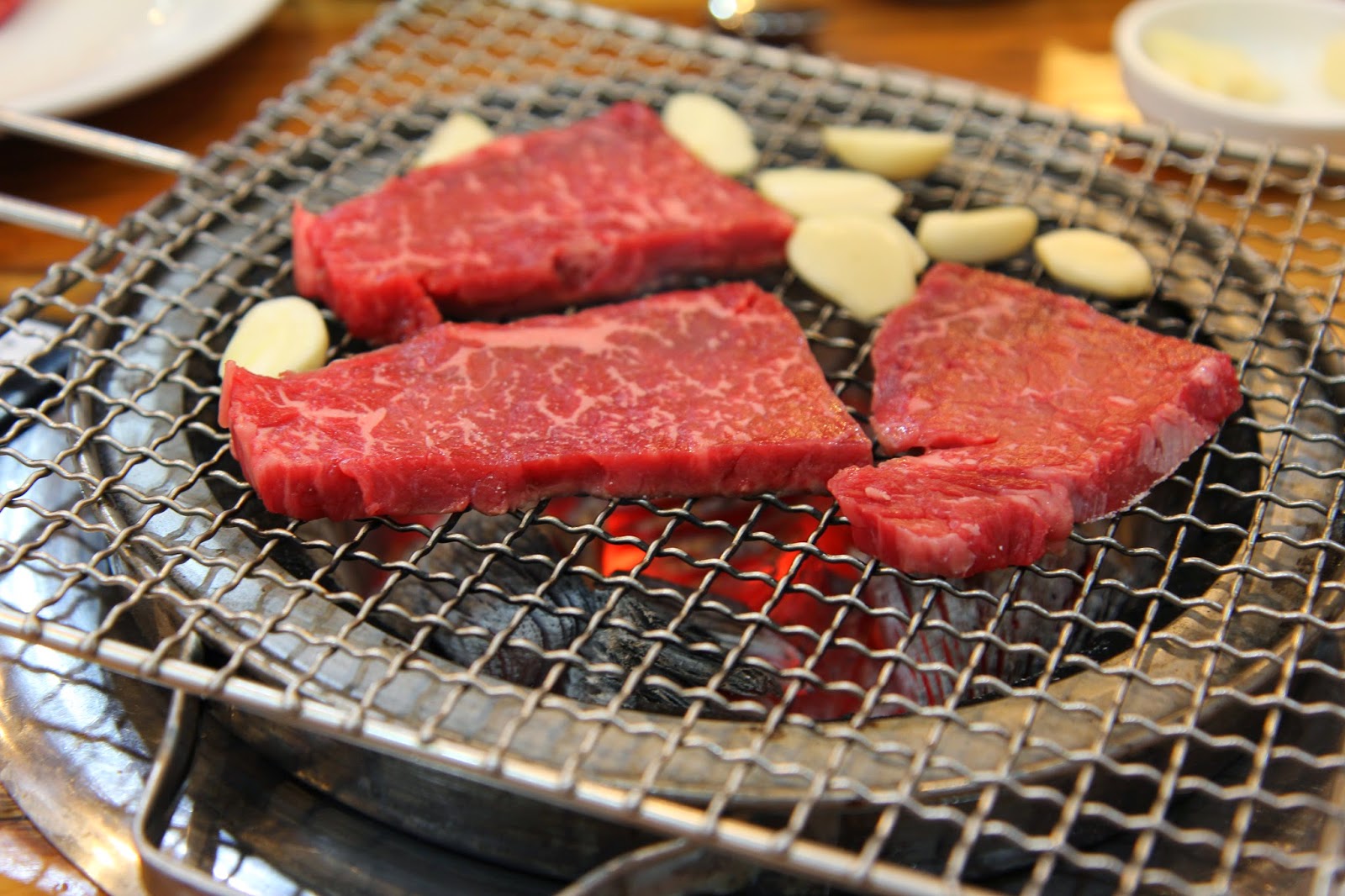
한우, Korean beef grilled over charcoal. The cuts were twice as thick as what I usually see at barbecue restaurants!
On Saturday evening, a group of us got adventurous and went out to get Korean barbecue. Fortunately -- or unfortunately, depending on how you view the situation -- we chanced across a nice-looking restaurant: 강산한우. I wasn't aware of this when we walked in, but 한우 (hanwoo) means Korean beef. Korean beef is really, really expensive. And sure enough, this restaurant turned out to be a wallet breaker. But was it worth it? The small cuts of meat that we got (10,000₩ per 100g) were delicious; juicy steak grilled over pure charcoal, along with tons of garlic, mushrooms (as much as we wanted), and a variety of 반찬. Mhm, there's no denying that it was an excellent meal, surpassing the quality of most of what I eat these days. On the other hand, I've also been stuffed to satisfaction at barbecue joints to the tune of 5,000₩, whereas this tourist trap restaurant, which charged extra for rice and even for setting up our table and grill (who does that?!), landed us with a bill of 20,000₩ per person. I'd pay $18 for that in the States, no sweat, but in Korea? Hmph. I'll say it was worth it, but I don't think I'll be treating myself to 한우 again soon...
The adventurous group that shelled out for some mad-expensive and supremely delicious Korean beef barbecue. Left to right: Kelly, Ashley, Jason, Katelyn, Ben, Tsu, Nina, Elaine, and me. (taken by Neal)
After the meal, everyone was stuffed -- almost uncomfortably so -- which called for a night-time stroll around the lake. I took photos and played with long exposure...
Katelyn, Ashley, Ben, Kelly, and Jason at Bomun Lake in Gyeongju. Jason likes his ice cream.
And that evening ended in a great Bananagrams and Pirate Scrabble marathon, during which I continued to fend off Ashley's attacks on my claim as Bananagrams Boss and Pirate Scrabble Captain and generally had a blast.

What I liked the most about this reunion was that all of us Fulbrighters could basically pick up exactly where we left off at the end of Orientation, which strangely seems like it was simultaneously very long ago and just yesterday. Only now in addition to our crazy antics and long chats about our lives back home, we have stories to tell of our students' crazy antics and long chats about our lives right now. Over all the meals, throughout all those long hours just chilling, between games of Bananagrams, the conversation continued unbroken, and, well, I guess it was telling of just how wonderful it was to be together again.
The wonderful 인터미디엇 (촣아, 촣아, 촣아!) class reunion photo. Left to right: me, Lizzie, Tracy, Jaeyeon, Susie, Amber, Soon, Monica, and Kyla. Missing: Kelly, Megan, and Ashley, who wandered off early :(

Monday, October 15, 2012

Fall Conference 2012 (pt. 1)

Part 1 of 5 from the Fulbright Fall Conference.
Just an arbitrary Korea-themed photo I took in Gyeongju.
I'm back from Fulbright Fall Conference, or the "workshop" (워크샵) that I attended last weekend in Gyeongju (경주). It's hard to explain the nuances between workshops, conferences, conventions, and things of this nature in Korean, but the abovementioned Konglish loanword seems to suffice.

The weekend was definitely a throwback to Orientation, and this not simply on account of all one hundred-and-twenty-something Fulbright ETAs being together in one place for the first time in seven weeks. In true Fulbright fashion, the hours were packed with panels, discussions, small groups, large groups, and presentations that covered every issue under the sun. The main focus overall, though, was on improving our teaching skills, classroom management strategies, and getting along in the homestay (for the first-year ETAs). It was a day and a half full of talking, listening, talking, listening, reflecting, and listening some more.

Here are some stray notes I jotted down. (I wasn't as assiduous as I normally am, due in part to being slightly overwhelmed by all the information pouring in.) Yes, I guess this is the boring part of my updates on the conference, but I think they're necessary -- helpful for me, at least -- and maybe you'll find them interesting. Here goes:

3rd-Year ETA Panel:
- In the classroom, content is important, but Korean students get tons of content already from their other English classes. If you want to change things up and/or burden your students less, focus on caring for them. It's arguably more important to show them that you care than to perfect their English.
- A tip for reaching out to introverted students: don't rely on speed and volume (such as using games like Speed Quiz). Use critical thinking problems, which require time to think and to focus on accuracy, to let the quiet students shine.
- Think, Pair, Share is an excellent Independent Practice model that will have every student speaking at one point and reduces the embarrassment factor when it comes to speaking in front of the the whole class.

SG Discussion on Building with the School Community (Sam & Dan):
- CoolMessenger is a good computer program that connects faculty and relays important information. Get connected with it to stay up-to-date and avoid pitfalls such as having a class canceled without your knowledge.
- Give food! Share generously. You can always connect over food.
- Offer to help with anything and everything -- especially if, like me, you have not been asked to do much at all in the past two months.
- On a free weekend, be so bold as to ask some co-teachers if they'd like to hang out -- go hiking, fishing, whatever. Folks at my school are insanely busy at this time of year, but it's worth trying!
- Find out the PE class schedule and make the gym your new haunt. Often, students are totally willing to chat with you while they're not testing or even include you on their dodgeball team.
- Memorizing names is like memorizing vocabulary; make your own mugshot flashcards (camera phone apps) and flip through them in between classes.
- Giving your students your KakaoTalk (Korea's ubiquitous instant messaging app) ID is an option. I think I may do this for my second-years after they graduate.

SG Discussion on Drama Activities (Vinnie):
- Keep your goals simple at each meeting/class. For example, in one day choose to focus on just the vocal projection, just tone or enunciation, just making good eye contact, just gesturing, etc. Don't overwhelm students with everything all at once. My first-years have a speech test coming up, and I have to train them on how to properly give a speech. I hope I have enough time to address all the important aspects individually.
- Some random fun ideas for class warmups, skits, etc.: acting like old people, Zip Zap Zop, 1- to 5-word sentences, "Sausage", Magic Doctor Chair... I should also browse Whose Line Is It, Anyway? for some more skit ideas.
Another photo that doesn't really have anything to do with the post. This was also taken in Gyeongju, which is home to a billion beautiful and interesting things to photograph.
SG Discussion on Teaching for Introverts (Anne):
- Yeah, I went to a small group for introverts. If you know me well, you'll know that I'm an introvert. I love hanging out with my friends, but being around large groups for too long is draining, and I cherish my alone time. So a group of Fulbrighters similar to myself gathered (ironically, there was a rather large group of us) to discuss how this affects our performances as second language teachers.
- One issue that introverts may face is the utter exhaustion that follows a day of "performing" in class and being around people -- strangers, really -- without a break for down-time. On one hand, you can remedy this by making your own down-time, finding the teachers' lounge and napping, or going to the gym. I go to the gym, and I also read in my office. I'm fortunate enough that my 교무실 (gyomushil) is tiny -- just my co-teacher and me -- that it's generally very quiet already. On the other hand, as you become accustomed to teaching, gradually the exhaustion will lesson, and your stamina will build, and soon you will become SuperTeacher and tackle all those classes like a boss.
- Stay natural in your teaching persona; whether or not you "perform", don't stray too far from who you are normally. Your students will soon stop comparing you to last year's teacher, Ms. Always-Played-Games-And-Sang, and learn to appreciate you for being you.
- Try to relate to your quieter students. If you're an introvert and they're an introvert, you have a connection there. Don't surprise them with anything that you yourself would be terrified of doing -- dancing in front of the class, for example. Exercise your compassion.
- Repetitive conversations with students ("Hi, how was your day? Oh, busy? Tired? Again?") are... repetitive. But they lay the groundwork for future gains in relationships with students. So don't write them off.

SG Discussion on Reward Systems (Bryce):
- To encourage individual participation in addition to classroom participation (I'm having my classes compete against other classes, but some students aren't buying into it and thus don't ever raise their hands), you could have a raffle system where individual participation is rewarded with a raffle ticket for an occasional drawing. It's cheaper than most prizes, more suspenseful than stickers, and healthier than candy.
- Also opt for verbal encouragement whenever possible. It is, after all, more English. I'm also entertaining the idea of teaching my entire classes stock phrases ("You rock!") that we can all use together to praise an individual who does well, although it smacks of an elementary school classroom...

Spare Ideas:
- Hangman tip: don't just have students guess letters, but challenge them a bit to say, "A, as in apple", for example.
- The Kid Should See This
- Incorporating the arts into education is important... not just mental education, but physical, emotional, civic, and artistic education are also important. This is actually a huge topic, and I'd like to write some more about it in a later post.
- Many of my second-years are graduating soon. It'd be nice to have them write advice letters to new students, who will arrive on campus next February.
- Including common classroom expressions ("Could you repeat that, please?" and "How do you spell..." are the ones I find myself constantly reminding my students) on name cards is a great idea.
- Seat students in a circle and have a discussion by throwing a ball to one another. I even got an awesome Switch Ball for this purpose! It's good at keeping students engaged, maybe even motivating them to speak up in class.
This is a Switch Ball. When you toss it, it flips itself inside out and changes colors. 헐! (Wow!)
Okay, that's it! I promise more beautiful things (photos, etc.) in the next post.
exempli gratia pretty leaves, as Korea slowly turns toward autumn.

Translate