Showing posts with label ferry. Show all posts

Thursday, May 29, 2014

Windy Hill and Camellia Island (바람의 언덕과 지심도)

Continued adventures on Geoje Island! The first half of my weekend wasn't so smooth (see previous post about transportation fails), but I had a blast spending Saturday night eating good barbecue, playing Cards Against Humanity -- the most hilarious and inappropriate card game -- and falling asleep to the sound of waves crashing on the beach.

On Sunday morning, my friends and I headed out onto the peninsula to visit Windy Hill (바람의 언덕). Supposedly it's very windy there, but I didn't feel so much as a breeze. Jeju Island is infinitely windier, that's for sure. But Windy Hill has an adorable little windmill at the top of it. Actually, it's not very little at all. But it sure is picturesque. The seven of us took photos, just like the hundreds of other tourists there, but we also turned a few heads as we filmed a few short segments for a music video we're making...
From left to right: Carly, Anna, Amy, Neal, Rachel, and another Andrew, at Windy Hill in Geoje.
After Windy Hill, we taxied up to Jangseungpo and got tickets for a ferry to go to Camellia Island (지심도). A few scenes of a recent mega-hit Korean drama called My Love from the Star (별에서 온 그데) were filmed on this island while its camellia flowers were in full bloom. Of course, my K-drama obsessed friends Amy and Anna were beyond thrilled to be setting foot on the island that Kim Soo-hyun pretended was his own alien planet.

Well, 지심도 really is quite pretty! And although the skies were threatening to rain, it was cool enough that a brisk walk along the secluded and forested paths was more refreshing than exertive. I believe that nobody actually lives on the island; some people run shops and restaurants for daily tourists, but today it seemed almost deserted. All the better for us to film some extra scenes for our music video with nobody around to accidentally walk into a beautiful backdrop!
Our small ferry to Camellia Island. Side note: there are no trash cans on the island at all! All trash must be carried down to the boat each evening to be taken back to the mainland.
Well, there isn't much else to do on 지심도 than 산책 and look at the ocean or the camellia trees (동백나무), which weren't in bloom, so after a few hours, we headed back down to the pier to wait for our boat. The round-trip fare is ₩12,000 and boats leave about every hour until around 3pm. And that's all for Camellia Island!
Fulbright friends on Camellia Island!
It was nearing 5pm by the time we returned to Jangseungpo, so I decided it was about time to head back to Changwon. After grabbing a quick snack at Lotteria (and realizing to my amusement that it was my first time eating at a Lotteria since Fulbright Orientation... way back in August 2012!), I hopped on a bus home.

To my great surprise, I ran into two students on the bus when it stopped at Tongyeong! YJ, who lives in Geoje, and HY, a first-year who lives in Tongyeong. I was very happy to see YJ, who never shies away from talking with me and also asks me really interesting questions about life in the US. "Teacher, in Korea, the curriculum at Seoul National University and Geoje University are actually the same; they use the same textbooks and the professors aren't necessary better teachers at SNU. So it's only the reputation of the school that makes a difference. Is this so in the United States?" ... What a conversation starter, huh?

When we arrived in Changwon at 7:30, the three of us took a taxi back to school. Students have to return to their dorms by Sunday evenings at 9pm. Since we had some time to kill, I invited them both to dinner. HY had already eaten, but YJ accepted, and we got chicken at the local chicken joint, cleverly named ChiKing (치킹). Fried chicken fit for royalty. I am sure that this is the place my students call when they break the school rules against ordering takeout from their dorm rooms at night.

Anyway, I'm very pleased with the trajectory of my mood this weekend. Yes, it started off kind of low, but the steady increase went exponential by Sunday evening. Treating one of my favorite students to dinner ended it on a high note. I wish I could do this every weekend!
A view of the ocean from Camellia Island.

Thursday, April 17, 2014

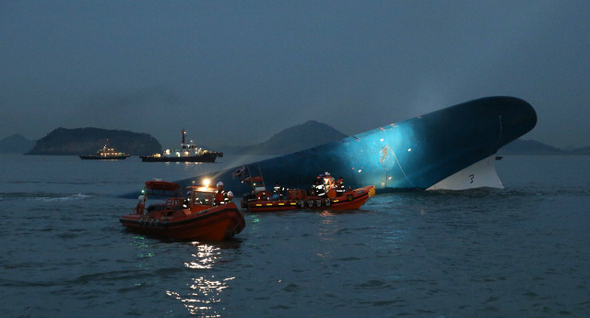
Sewol Ferry Sinking Accident

Search and rescue efforts for the sunken Sewol off the southwestern coast of South Korea (from the Hankyoreh)
침몰사고 -- A Korean ferry bound for Jeju Island sank off the southwestern coast of the peninsula on Wednesday; 14 confirmed dead and 282 missing*. Many of the passengers were high school students from Ansan on a school field trip.

All day today, footage of the rescue operations and some videos taken by the trapped passengers on their mobile phones played over and over again on the news. I kept my eyes trained on the TV screen in my school's cafeteria all throughout lunch and dinner, barely able to understand what was being said but knowing that something awful was transpiring.

It's such an overwhelming tragedy; I can't imagine what it must be like for the friends and families of those lost. I don't even know what to say to my own students. I just keep repeating, "It's so sad, it's so sad." And I ask them to translate the news reports for me. Every teacher in the country is thinking, "It could have been us."

I can't think about this any more. 뭐라지 위로에 말을 해야할지 모르겠어요. Thoughts and prayers to the victims and their families, and to an entire country in mourning. 편히 잠들기 바란다.

P.S. Some more news articles: Reuters, TIME (with video), BBC (with photos), and CNN (with video). The news reports about the "final text messages" are the most harrowing. But there's slim hope left yet: the story is not completely over.

- - -

*Update as of May 11th, 2014: After one month, out of 476 passengers, 172 were rescued, 275 are confirmed dead, and 29 are still missing. One civilian diver has died during the rescue attempt.

*President Park Geun-hye and her office are coming under increasing fire for their perceived responsibility for the disastrous emergency response and general incompetence. Meanwhile, Chonghaejin Marine, the company that owned the ferry, has been revealed to have, simply put, done a lot of dangerous and illegal things for years; their CEO has been arrested and their owner is under intense investigation. The captain and crew of the ship at the time of the sinking have all been arrested, as well.

*People are wondering whether Korean culture is to blame for the tragedy, and one analyst offers a perhaps-unexpected perspective. And Children's Day this year was a somber affair, as families and children remember the children lost one month ago with yellow ribbons in public spaces across the country.

Sunday, January 19, 2014

Glover Garden and Gunkanjima (軍艦島)

Heart-shaped charms at Glover Garden in Nagasaki.
I left the Nagasaki Atomic Bomb Museum subdued and pensive, but there was still much to do on our itinerary, so I shelved my thoughts for later. Erik and I walked over to Nagasaki's Chinatown and munched on the Japanese version of gua bao, then headed up into the hills to tour Glover Garden, a cute little neighborhood of lavish Western-style houses built by merchants and businessmen in the late nineteenth century. The higher we went, the more magnificent the view of the harbor city became. At the top, I took a panorama photo with my cell phone; excuse the lazy stitching job and poor quality, but you can sort of get the idea.
All the hills have Nagasaki reminding me of San Francisco.
Christian martyrs' fountain in Glover Garden, Nagasaki.
The gardens themselves are nice enough to walk around, but what Erik and I noticed the most was the eerie lack of other tourists. Erik blamed the winter and the cold weather; in all other seasons, he said, these gardens were packed with people. This continued to be a theme on our travels. I chose a remarkably low-traffic time of the year to visit Kyushu!

The photo at left is of a fountain that was built to commemorate Christian martyrs in Japan. The history of Christianity in this country is very interesting. It was introduced by Francis Xavier, a Basque Jesuit missionary, when he landed in Kagoshima in 1549. Thanks to early missionary work, northern Kyushu is where "all the churches are" in Japan. But in the 17th century, Christianity was forced underground, and many believers were martyred. Japan opened up to the West again in 1853 at the start of the Meiji period, and in 1871, freedom of religion was restored in the country. Christian communities that had been in hiding for hundreds of years have been slowly growing ever since.
Glover House of Glover Garden in Nagasaki.
A model of the 1.2-meter sundae.
As evening approached, Erik and I met up with a friend of his from the area named Fumi, and we had dinner at an izakaya (居酒屋), which is essentially a pub, but the one we went to was very classy. We had a feast that included sashimi, tempura, delicious grilled meats of some sort, and Japanese beer.

For dessert, we went to a diner called Cafe Olympic, which is famous for... how else can I say it? American-sized portions of everything. You can get a steak as big as your head here. But for our dessert, we ordered a super-tall sundae. The largest ice cream sundae offered at the cafe is a ridiculous 1.2 meters tall. It's a glass as long as your arm filled with four or five different flavors, topped with several more cones and various other random items. I mean, ice cream is ice cream, but you really come here for the novelty of eating your way through a four-foot tower of deliciousness. Fumi said he wanted us to experience a "funny dessert", and sure enough, we had our laughs.

The next morning, Erik and I set out for Gunkanjima (軍艦島), or Battleship Island. Its actual name is Hashima, but when you see it you can easily understand why it was given the militaresque moniker. It took half an hour for our ferry to reach the island; it's not that far out to sea, and from it you can easily see the mainland's coast. From the mainland, though, I don't think it's possible to see this:
Gunkanjima, Battleship Island.
So, yeah, holy cow, what is that? Hashima was a coal mining facility operated by Mitsubishi from 1887 to 1974. The miners and their families lived on the rock itself, having expanded it over the years to become a nearly self-sustained community. At its peak, over five thousand people lived on the island of 0.025 square miles. When Japan began to shift toward petroleum instead of coal, Hashima was abandoned, and it has fallen into extreme disrepair in just forty years.

Ruins on an island in the middle of the sea.
The island used to have dozens of high-rise apartment buildings up to seven stories tall, as well as a large school, a shrine, a hospital, a saltwater swimming pool, and of course, a large mining facility and its offices. Many of these buildings have already crumbled into nothing, but our tour took us around a corner of the island to see what was left. As Erik translated our guides' words, I began to get the picture of a small but lively and tight-knit community that worked extremely hard to make their lives livable. They brought soil in from the mainland and carried it to their rooftops to make rooftop gardens. They faced rough waves from typhoons with nothing protecting them besides the concrete seawall. They made do with very little fresh water and limited electricity. Obviously, the men employed in the mine risked their lives every day to dig coal out from beneath the ocean. But after just a few generations, they left. And all that remains is concrete and brick rubble that the waves continue to erode.

A documentary was screened on the ferry on the way back; I was captivated by the "then and now" photos that were shown: a barbershop busy with customers then, a row of rusting barber chairs now; an alley filled with women and children then, an alley overgrown with weeds and vines now.

Gunkanjima was the inspiration for the island where Javier Bardem's psychopath villain in Skyfall gambles with James Bond for the life of Severine. I remember the scene quite clearly, but Silva's island is much larger and apparently more structurally sound than the real island; it's actually just an elaborate set. I doubt any film can be filmed here now, although, amazingly, you can Google Street View a tour of the island. Anyway, visiting Battleship Island was still a great experience; it definitely stirred a bit of the thirst for haikyo, or urban exploration, in me. I wonder what abandoned marvels I can find in Korea?
First glimpses of Battleship Island.
Remains of the brick wall of the mine office, and a recently constructed lighthouse up on the hill.
Erik and me on the boat by Gunkanjima. It was extremely cold.
After returning from the island and lunch, Erik and I chilled around the shopping area by Nagasaki Station, killed some time at an arcade, and then boarded a train for our next stop: Kumamoto!

Thursday, January 16, 2014

The Ferry to Fukuoka (and Back)

This is going to be a long, boring post about taking a high-speed ferry, the Kobee Beetle, across the East Sea/Sea of Japan from Busan to Fukuoka (and back). The rides themselves weren't very interesting, but I think sharing my experience would be helpful for anyone who wants to take the trip in the future. In the words of a friend, "I mean, Japan's right there. It'd be a shame not to visit while we're in Korea."

My ferry was to depart from Busan on Thursday morning. I had booked my ticket weeks in advance with help from my co-teacher through a travel agency called Joy Road (조이로드). They emailed me my confirmation number and detailed instructions (in Korean) on what to do when I got to the ferry terminal.
View of Busan from my window seat on the ferry; you can see the shopping centers of Nampodong and Busan Tower.
Busan --> Fukuoka
Take the subway line 1 (orange) to Jungang Station (중앙역), get out at exit 10, and walk across the street and through the large gate to the Busan Port International Passenger Terminal (부산국제여겍터미널). Go up to the second floor to the counter for Kobee/Miraejet (they appear to be the same company; both run the same high-speed ferries, as opposed to the slower "cruises"). Check-in ends about forty-five minutse prior to departure. For both trips, you must pay a "terminal tax" (which is BS, but there's no way around it) as well as a "fuel surcharge" for your ticket. The latter of these is actually part of your ticket price, only it changes periodically depending on the price of oil, so it's not calculated until you arrive. For me, the additional fees were about 23,000KRW.

After going through super-fast security and being stamped out of Korea, I boarded the boat! To my surprise, the interior was set up like an airplane cabin, with neat rows of seats and narrow aisles. The TV was showing Running Man before and after the safety instructional videos. There was supposed to be wifi, but it didn't work for me. It wasn't a boat you could walk around in, so I stayed in my seat and looked outside. The view of the coastline of Busan was nice, and then the view of the open water was a thrill, but due to high winds, the waters were rough; several times the boat ran straight into a wave and all I could see outside my window was the white spray of water. I didn't become completely seasick, but I found it more comfortable to close my eyes and drift off. The trip took 3 hours.

Upon arrival in Japan, immigration was an awkward affair. I hadn't put down the telephone number of my friend (an American who lives in Japan) with whom I'd be traveling, so the immigration officer tried to ask me what the number was, or why I didn't have it, or something. He didn't speak more than a few words of English, and I couldn't get anything across to him. The officer next to us was speaking fluently in Korean to another passenger, so I wondered if I should try Korean. But eventually the officer gave up and let me through. Customs was also awkward; the officer searched my bag very thoroughly while asking me extremely rehearsed questions (in English) about my travel plans and past experiences and if I was bringing any illegal drugs into the country.

And then I was in Japan! Hakata Port International Terminal. (The ancient city of Hakata (博多) was merged with Fukuoka (福岡) hundreds of years ago, but it is now the name of the ward where Fukuoka's port and train station are located.) You have to take a bus to get to the actual city: routes 11, 19, or 50 to Hakata train station. Fortunately, my friend had prepared very detailed instructions on how to take the buses (enter from the middle and grab a ticket; you can get change for a 1,000 yen note on any bus, pay the fare with exact change only, depending on the number on your ticket (from the port to Hakata Station is 220 yen)) and where to go from there.

The Kobee Beetle, high-speed ferry
Fukuoka --> Busan
After a wonderful weekend traveling around northern Kyushu, I found myself back in Fukuoka on Monday afternoon for the ferry ride back to Korea. From the new and beautiful Hakata train station, bus stop E, I took bus 88 to the Hakata Port International Terminal (博多港国際ターミナル), last stop on the line. (There was tons of traffic due to a large Seijin-shiki taking place nearby.)

The Kobee/Miraejet counter is on the first floor. The fuel surcharge was 2,000 yen and the terminal tax was 500 yen, the latter payable via a small vending machine by the entrance (because Japan). I had to use my Korean with the clerk, and I really wonder if my American accent was stronger than her Japanese one.

A few funny comparisons between the Busan terminal and the Fukuoka one: at the latter, there was no security prior to boarding. I just showed my boarding pass and terminal ticket and then went to town at the duty-free shop before getting on the boat. At Busan, the security had been quick, but it was at least there. Also, photographs of the boat and pier were not allowed, but at Fukuoka, I snapped a shot of the Beetle. And upon entering Korea again, customs was almost a joke. I breezed through the line (there were 10 lines for Koreans and 1 for non-Koreans) and then walked through a security scanner with all layers of clothes on. It even beeped, but I was let through, and no one checked my bags. I think due to the heavy traffic of returning Korean vacationers, customs and immigration didn't give a hoot about who or what was coming through.

Oh, and thanks to great weather, the trip back to Korea was very comfortable. I took a three hour nap.

So that's that! If you're interested to know more about the ferries between Japan and Korea, leave a comment. Or just go with Google; there's a ton of good information out there.

Translate