Showing posts with label Daegu. Show all posts

Saturday, June 21, 2014

North Korean Defector Conference in Daegu

I'm writing this from Daegu, where I attended a conference for English teachers who volunteer with North Korean defectors around the country. The weekend-long camp, the first of its kind, I believe, was an opportunity for the teachers as well as their students to connect and have fun together. Since none of my students attended the camp (we had our own fun activity yesterday at the movies: Edge of Tomorrow in IMAX 3D!), I came just for the workshop programs today.

Besides getting to hang out with some of my Fulbright friends, which I always appreciate, I was able to get a refresher on teaching tips and tricks and learn more about the background and organization of South Korea's Hana Centers. I was surprised to learn that the centers are a relatively recent government initiative (most having been established within the past decade) and that they are all somewhat independently managed. Changwon's Hana Center is hosted in (and maybe by) the city's branch of the Korean Red Cross. Daegu's is in the care of the Empathy for a Better World Foundation, which actually runs tons of other defector- or reunification-related programs, too. The Empathy Foundation does a lot of stellar work with defectors; if you're interested in NK defector issues and in Daegu, go check them out.

Anyway, I had a great day, but unfortunately I can't stay the night or attend Sunday's programming. My black belt test for taekgyeon is tomorrow morning! I have to get a good night's sleep at home.

P.S. Completely unrelated: in downtown Daegu, my friend and I espied an older Korean man wearing a UCLA t-shirt! I pointed at him quite unabashedly, having forgotten for a moment that not being Korean doesnt make you invisible in this country-- in fact, quite the opposite. To hide my embarrassment, I went all in and called out, "UCLA!" The man stared for a moment, then laughed when he realized that I had only been reading his shirt. And he called back, "Ooklah!" My friend, who happened to be a UCLA graduate, turned to me and remarked, "I guess that about sums up how much he knows about his wardrobe choice. Funniest thing I've seen in Daegu today!"

Thursday, April 24, 2014

5-Day Weekend in Seoul and Daegu!

I took some time off during midterms, which meant that I did not have to attend school on Monday, Tuesday, or Wednesday this past week. That may seem excessive, but I really needed the break.

Sung Min, seafood pad thai
Snow beer -- like a beer slushie!
On Saturday, I went to Seoul to visit my friend Monica, who is recovering from an accident. She was discharged from the hospital that day and moved in to a new apartment, with the help of her parents. I really enjoyed getting to know her mother and father and tried to be as helpful as I could. Over the weekend I actually visited several times, and we listened to music, played Settlers of Catan (finally!) -- which Monica won her first time playing, naturally, and dreamed of all of the world's most delicious smoothies.

That evening, I visited Sung Min, who is currently in med school in Seoul. It was great to catch up with him again. I haven't seen any fellow Swatties recently, though I know a few are around. Sung Min's just the easiest to get in touch with, because he's not ensconced in the library all day. ;)

We went to a Thai grill restaurant in Wangsimni whose name I forget and won't bother to remember, because the service was crappy and I don't intend to go back. To its credit, the food was good, but in the end, not worth it.

Better, then, was the snow beer and fries at a small bar near the school called Pommes Frites (French for "French fries"). I've never had snow beer before. The head of the bear is actually frozen, like a beer slushie. That's how it gets its ice cream shape. It's really good! And at this particular bar, it was also really cheap.

Sunday morning was Easter. My sixth Easter away from home. I've gone to services in Swarthmore, Philadelphia, Grenoble, Daegu, and now Seoul. A rather large group of Fulbrighters ended up at Jubilee Church in Sinsa-dong, Seoul. This is the church I attended regularly during the month I lived in this city last year.

I was glad to see that it hadn't changed much. Still a very young, hip, fairly diverse congregation, a great worship band, and a very passionate pastor. His message about focusing on death in order to understand the importance of resurrection was on point. To follow the cross, die to yourself and your desires. A lesson I can never hear too often.

Laura and me by the Han River
Galumph about the grass
After church, five of us had an excellent lunch at Deli Heinzburg in Sinsa-dong. This is a neighborhood I've never had a chance to explore. It's near Seoul's 가로수길, which usually means expensive, trendy cafes and such. But dang, there looked to be a feast waiting just inside every door on these streets. Deli Heinzburg lived up to this expectation: delicious paninis and sandwiches, plus a shared pitcher of fruity iced tea. I'll be back.

Lunch was followed by a nice walk in the park. Seoul's famous Han River park system is the real miracle on the Han, in my opinion. The parks are so beautiful and full of activity on a perfect spring day like this. I just wanted to frolic. Cameron and Connor went ahead and frolicked. All the afternoon needed to be perfect was a picnic blanket and a good book. Or a guitar.

Janet and me with delicious Street Churros
On Sunday evening, I met up with a friend from high school, Janet, whom I have not seen in six years. I'm serious; the last time we saw each other was probably the summer of 2008. The funny thing is that though we had both grown up a lot since then, I didn't get the impression that much had changed. We were comfortable friends in high school and went right back to being comfortable, six years and 5000 miles later.

Janet's teaching at a hagwon in Seoul, so we could relate to each other about teaching. I'm about to close this chapter of my life, but she's just begun. I'm glad that she already enjoys it so much ad excited about the opportunities she'll have with her students in the months to come.

We had dinner at Don Charly Taco in Itaewon, which was good for Mexican in Korea, but pretty pricey. I even miss Costco horchata at this point... Oh, and dinner was followed by excellent churros from a streetside stand called Street Churros. Also, chocolate truffle shots. Enough said.

Ashley and me in Daegu

At night, I hung out with Liam, Jake, and Monica and also gave myself a haircut, though you might not be able to tell from the following photos. It was fun -- I've gone to hair salons more times in the past two years than I have in my entire life prior to Korea, but that doesn't mean I'll still have my friends cut my hair any chance I get. I did the sides -- "two-block" is the most trendy style in Korea these days -- and Jake helped with the back.

And that was the weekend proper! I slept well on Sunday night, knowing that I wouldn't have to go to school on Monday morning. Instead, on Monday morning, I made pancakes. Then, I went to Daegu to visit Ashley at her elementary school.

Her school is so colorful and cute! And her students are kind of cute too, I guess. Sixth graders. Some are nearly as tall as me, and others still look like babies. Puberty is a weird thing. Every one of them assumed that I was Ashley's 남친 (boyfriend), which I cheerfully denied. Then, I got to help out with the lesson on giving directions, which was pretty chaotic, but in a good way. I definitely could never be an elementary school teacher. I don't think I have the requisite energy. My students are always half asleep, which makes them easier to control. :)
Lolomiel ice cream sundaes! Honeycomb, chocolate Oreo, and strawberry
After school, we made dinner and then I tagged along as Ashley went downtown to her various hagwon classes, including a dance class where I watched my friend blend into the group of high schoolers doing some pretty awesome jazz dance in a very dark studio. I wish I could dance like that! The treat for an hour and a half of sweating was a big bowl of green tea bingsu from Nunpat, which we will return to soon because it was so darned delicious. 연유 (condensed milk) with green tea ice cream and 떡? Yes, please. The evening ended, of course, with Pirate Scrabble.

Tuesday dawned bright and early, and since I didn't have to go to school (again!), I made it a lazy morning, prepared lunch, Skyped with a friend, and simply enjoyed having nothing to do (while knowing that in
reality, I was merely putting off everything that I had to do). Ashley's school was having its Science Day, which meant a lot of 2nd graders ran around blowing bubbles, the 5th graders launched water bottle rockets, and general chaos reigned, as is the custom at an elementary school.

Sophia and our amazing 팥빙수!
A little after noon, I met up with Sophia, another Daegu ETA, for dessert at a cute cafe called Mary Poppins. Although I didn't know Sophia too well before today, we clicked well and talked about blogging, writing, travel, grad school, and lots of other things. It was pleasant, and our bingsu and melon cream puff were wonderful.

One of my regrets this year is not having taken the time to get to know the batch of ETAs who arrived a year after I did -- the "class of 2013", so to speak. Since I'm the only ETA in my city and I am already very close with other second-year ETAs, I never had many opportunities to get close with the first-years. But through conferences, trips to North Korea, and various meet-ups around the country, I've made many new and close friends out of the "betas", as we affectionately call them, and Sophia is no exception. A pity there's so little time left in the year now...

Ashley got out of school around 3pm, and we went downtown to look for a pie shop we'd wanted to check out. Unfortunately, and strangely, the pie shop was open but closed. Windows open, lights on, music playing, delicious smells emanating... but the door was locked and nobody was inside. Though the owner might have just stepped out for a minute, the situation was off-putting enough that we left and got ice cream at Lolomiel instead. Honeycomb ice cream is the biggest trend in Korean desserts right now, I think, so Ashley got some for the first time, while I settled for chocolate Oreo, and Sophia got strawberry. We filmed ourselves a bit for Sophia's vlog.

I had to leave shortly after that to catch a bus back to Changwon. (Note to future self: West Daegu Bus Terminal has the buses that go to Changwon. East goes only to Masan. Actually, depending on timing, the train might be a better option.) So that was the end of my long weekend travels. I felt refreshed, well-rested, well-fed, and just happy to be where I was at each moment. Just what I needed... before spending all of Wednesday reading, writing, and working from home. Yup, I can only hold off the torrent of to-do's for so long. As pathetic as this sounds, I'm glad the weekend's almost here again!
Sophia, Ashley, and me in the 2.28 memorial park in downtown Daegu.

Wednesday, April 3, 2013

Yaenoeul Choir Concert and Easter

Yaenoeul Choir (얘노을 합창단) at their 12th annual concert. Can you spot the white guy?
My friend and fellow Fulbrighter Adam has busied himself this past year with teaching at a large middle school, studying taekwondo, and singing in a choir. I thought that that alone was cool. But then I learned that this choir was, like, seriously legit: directed by a famous Korean maestro and everything. And I learned that Adam was the first foreigner to sing with them in their illustrious twelve year history. Dang! All of this made me even more excited that I was going to their annual concert!

The choir rehearses all year for just one performance. (One large performance, for an audience of thousands.) Their repertoire was incredibly vast: one set of traditional choral pieces, one set of arranged Korean songs, one set of gospel music and spirituals, and one set of modern pop music done in glamorous show choir fashion. Ten of us Fulbrighters came to support Adam, watched him rock the bass parts like a boss, and squealed in delight when he stepped out to deliver solo lines as Javert in the final piece, "One Day More" from Les Mis.

The whole thing really was wonderful. As Cecile put it, if there were anything that really epitomized the notion of "cultural exchange" that we Fulbrighters are supposed to promote, it's this talented white guy from the States taking part in a first-rate performance that itself represented a hodgepodge of cultures and musical styles. Good feels all around, not least due to the quality of the music that night.
Adam's in the center, with the black bag. On his right is his conductor, a nice man with a magnificent perm. Surrounded by friends!
Videos will come soon, I promise.

Well, after the concert, we all went out for dinner and drinks (extremely late, just like the day before). I had "scoop pizza", a ridiculous concoction of dough, cheese, bacon, and French fries, that was heavenly and quite sinful at the same time. So much cheese... We stayed at the restaurant until after midnight, and back at the hostel, I chatted with Adam, Julia, and Alanna until four in the morning. Ridiculous. No wonder I've been so drained this week...

On Sunday afternoon (Easter!), I went to church at Dongshin's English service. There, I met up with Jaeyeon and Bridget, and we also ran into Megan, whom I did not expect to see there! The Easter service was really nice, like a breath of fresh air. It felt great to sing and worship and feel a bit of joy again, after so many weeks of going through the motions, in a sense. I think Megan is very lucky to have a large and vibrant church community in her city. I do have a church community in Changwon, but it's not quite the tight-knit family that Megan seems to have found. Well, I'm not going to complain. The visit was really nice, anyhow.
Me, Jaeyeon, Bridget, and Megan at Dongshin. If we look a bit tired... you know why.
Then, it was time for goodbyes! I'd already parted ways with most of the dozens of friends I'd met over the weekend, but for all of us it was only a brief valediction, since this weekend we will all gather again for spring conference on Jeju Island! Woohoo! It's going to be great.

Tuesday, April 2, 2013

fly to you: Secondhand clothing in Daegu

It was a Saturday afternoon in Daegu, bright and sunny. I hadn't been awake long, having trudged off to bed around three in the morning and proceeding to sleep for my requisite eight hours. Alanna and I had French toast and some of the leftover wine-poached apples for brunch. Then, when she went to get some work done, I decided to head into the downtown area to do some shopping, knowing that Daegu has a reputation for being a fashionable city.

I'd been in Daegu once before, but I was in the downtown in the evening, and I didn't see much of it anyway. So, walking around the wide, pedestrian-friendly streets was still like walking around in a maze, as I honestly had no idea which direction I was going, or even what I was looking for. Luckily, it didn't take me long to come upon a vintage (빈티지) and secondhand clothing store (중고품 가게), which reminded me of how much I'd enjoyed vintage shopping in Hongdae. The store was called "fly to you".

I went straight in, and was met with an awesome sight: lots of clothes. Lots and lots and lots of clothes. Racks of 'em. Neatly organized, but certainly not in the antiseptic way a brand retail store has its clothing. I wandered through the large first floor before realizing that men's clothing was on the second floor. Then, it was like I entered jeans paradise. Lots of jeans. And jean shirts. And cardigans, sweaters, shirts, jackets, and lots of odds and ends, like colorful suspenders, backpacks, and really dirty shoes. Not all of it was vintage, but all of it was secondhand. I asked a worker where all the clothes had come from, and he told me they were mostly from Japan.
Racks upon racks upon racks of secondhand jeans (at fly to you #2).
I found a pair of skinny jeans and dark green corduroy pants, both from Uniqlo, for ₩30,000 each (about $27 each). Although that's not "cheap" -- by my standards, anyway -- it's still easily half off the original price. I checked before buying. And hey, on top of all that, the jeans were too long for my short little legs, so a staff member  hemmed them to the right length for free. That's awesome.
Here's the man who will hem your ill-fitting purchases for you! What a great and unique service for a place like this.
When I returned to the hostel with my finds, Alanna instantly decided she wanted to go to that store. I wasn't sure if I could remember where it was, but I knew from chatting with the store owner that there are actually two branches. I figured that if we couldn't find one, we could look for the other.

So, later in the afternoon, Alanna and I set off to find "fly to you" again. I must confess that I got lost in the downtown labyrinth within ten minutes. I had absolutely no idea where I was going, and the GPS on my phone wasn't working very well, and I couldn't seem to find the correct address... Almost an hour had passed, and we were still lost, and I was just about ready to go (because we had to return to the hostel soon to get ready to attend Adam's concert that evening). But! Literally as soon as I had said, "Okay, I think I'm ready to give up," we turned a corner and saw "fly to you"! Except it was the second branch of the store, embarrassingly far away from the first branch, which I had been looking for.

I guess it didn't matter, though, since this second branch was very similar to the first. A bit smaller, but brighter, and still very organized. In this store, a staff member was very eager to help me find a shirt that fit and even tried to style an outfit for me that made me laugh when I saw myself in the mirror. Alanna went on a spree and bought a jacket, a cardigan, and a pair of pants. She also chatted with some of the staff members; they were definitely friendlier here. Branch #2 also had a man who altered and hemmed clothes.
Alanna and me at fly to you #2. The resident stylist tied my ascot for me. Just so you know, I did not buy any of these clothes (except for the jeans and shoes I'm wearing).
I took my camera along this time, so all of the photos in this entry are from fly to you #2, the second branch (or smaller branch, or southern branch).
fly to you #2 (플라이투유 2호점). I'm not exactly sure what "fly to you" is supposed to mean...
Just inside the entrance, there are clothes and shoes and... a motorcycle.
Lots of clothes and accessories, very neatly organized (for a secondhand store, that is).
So, Alanna and I had a great time thrift(ish) shopping in Daegu. It was a chore for us to find the stores, so I'll try to make it easier for you if you ever want to visit.

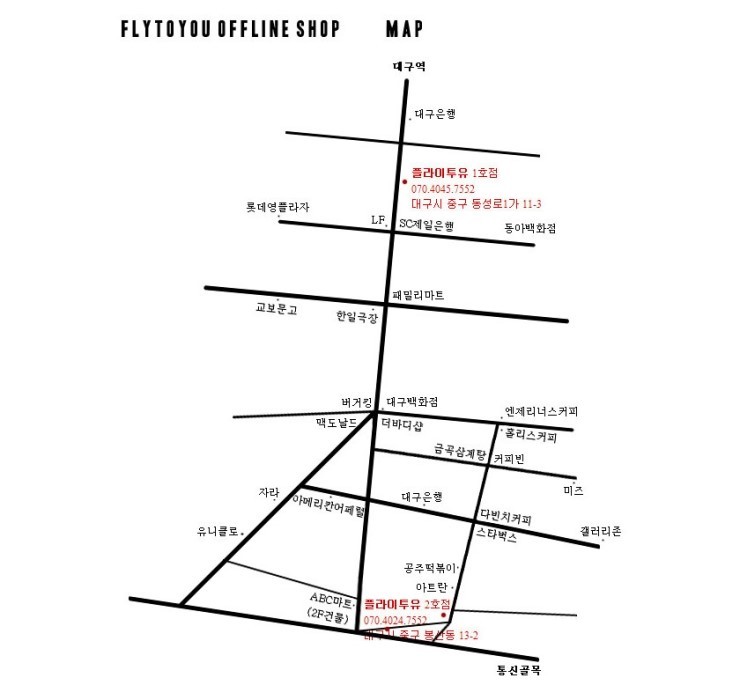
Address of fly to you #1: 대구시 중구 동성로1가 11-3. (Daegu City, Jung-gu, Dongseongno 1-ga 11-3)
Address of fly to you #2: 대구시 중구 봉산동 13-2. (Daegu City, Jung-gu, Bongsandong 13-2)

(There was a third branch that used to be located in between these two, but it closed recently. Also, if I heard correctly, they are planning to open a special store for the company's own clothing brand. I do not know where that is, however.)
Here is a map from the store's website. fly to you #1 is north, not far from Daegu (Subway) Station, and fly to you #2 is south, close to Banwoldang Station (the intersection of the red and green lines). You can click on the map to enlarge it.
Here is their website (in Korean). Here is their online store (in Korean and some random English). Lastly, I added both branches to my thrift shop Google map. Enjoy!

View Thrifty in Korea in a larger map

Monday, April 1, 2013

The Story of Passover

Passover (유월절/Yuwol-jeol) is the week-long Jewish holiday that commemorates the escape of the ancient Israelites from slavery in Egypt. For my entire life, cognizance and even a basic understanding of what this holiday is all about has been prevented due to the timing overlap between Passover and Good Friday, the day when Christians remember the crucifixion of Christ. I have studied Judaism and I have many Jewish friends, but even I don't know much more than the average Christian about Passover. This year, however, I had planned -- long before I knew when Easter would be -- to go out of town to visit a Fulbright friend for a concert, and when I heard that he was going to celebrate Passover with other Fulbrighters, I invited myself along. I wanted to see what a Passover Seder was like, and I enjoy opportunities to embrace all things interfaith.

As it turns out, the small cohort of Jewish Fulbrighters had been planning a Passover get-together for quite a while. Although it would have been impossible to get together during the week, Friday night was open as an ideal time for us all. In the weeks and days beforehand, several of my friends had been preparing a menu, a haggadah, and making huge batches of food in advance. All I had to do was show up the evening of (it was a ninety-minute bus ride from Masan for me, and I left right after my last class of the day) and pitch in in the kitchen before we began the seder. (Due to long commutes and schedules running late, this was not until 11pm.)
Preparing chocolate-covered matzoh. (taken by Kaley)
This was my first seder, so I did not know how long it would take, but I got the feeling when we began that we were going to up for a while. We used a modern haggadah that emphasized peace and social justice and was distinctly pro-American and secular Humanist. One line from the invitation really struck me: "We remember together tonight because we are Jews and friends of Jews, and feel connected to the historic roots of Judaism." Because of this, I -- and the other several non-Jews present -- felt instantly welcomed into the traditional celebration.

Then, there was singing in Hebrew that I didn't know or understand, and there were lots of symbolic gestures involving different foods that I don't quite remember, but I still enjoyed it. One of the nicest things about the seder was that it was definitely one for friends: friends getting together in a foreign country who came from very different traditions (Ashkenazi, Sephardic, Reformed, Christian, atheist, whatever). It was very exemplary of the diaspora.

Another part that was quite interesting -- to me as well as to the other Jews there who had not used this kind of haggadah before -- was the Spilling of the Wine. Traditionally, the ten plagues of Egypt are recounted in this section of the seder. In addition to these, this haggadah added ten "modern plagues" that still afflict humanity today, including hunger, war, crime, racism, homophobia, pollution, and indifference to human suffering. Yeah -- very humanist. But also humbling and a good reminder of the hope and change that religions are meant to bring to the world.

In between the solemn moments and rituals, there was a lot of laughter and joking, which I thought was great. More traditional seders are exceedingly somber, as I've been told, and I'm glad the one I attended was very chill. I think the wine helped. As it were, we did not begin eating the actual meal until sometime around one in the morning, and the night petered out around three. (How European of us.)
Our amazing Passover feast! 맛있다!
Did I mention that the food was delicious? Adam is an excellent cook; he made potato pancakes and some excellent sauces for the meat dishes. Alanna took care of the matzoh ball soup, and there was also Israeli salad and a spinach and mango sautée. Not to forget dessert, we had dark chocolate-covered matzoh with salt and chopped almonds, charoset (which is not supposed to be a dessert per se, but...), and a charoset-inspired ice cream with wine-poached apples.

In short, I'm not going to forget this meal for a long, long time. It was that good.
Fulbright 친구, 유대인 and otherwise, at the hostel where we celebrated Passover.
Vocabulary
유월절 (Yuwol-jeol): Passover
유대교 (Yudaegyo): Judaism
유대인 (Yudae-in): Jew
성금요일 (Seong Geumyo-il): Good Friday (Holy Friday)

P.S. I studied a bit of Ancient Hebrew in college, and attending this Passover Seder motivated me to practice my very rusty transliteration skills by re-writing the Hebrew portions in my haggadah using the Hebrew alphabet -- or, at least, trying to. It made me miss my Hebrew class very much.

Hebrew Vocabulary
Seder (סֵדֶר‎): a Jewish ceremonial dinner, held on Passover, from the word which means "order".
Haggadah (הַגָּדָה): the liturgy for Passover which explains the origin of the holiday.
Charoset (חֲרֽוֹסֶת): chopped nuts, apples, spices, and wine. A dish that represents the mortar used by the Hebrew slaves.
Yayin (יין): wine! P'ri ha'gafen!
Pesach (פֶּסַח): the Hebrew word for Passover, from the word which means "skip".
Afikoman (אפיקומן): the larger of two pieces of matzoh ritually broken, set aside to be eaten at the end of the meal. Until that time, it is hidden and then looked for by the children of a household for a prize. From either a Greek word meaning "dessert" or a different Greek word that refers to the coming Messiah.

Sunday, March 31, 2013

Happy Easter!

Christ is risen!

Happy Easter, everyone. I have not been able to find an equivalent for that English, phrase. However, 부활절 (Buhwal-jeol), or Resurrection Day, is the Korean word for Easter.

I just returned from a fantastic weekend in Daegu, where I celebrated Passover with some Jewish friends, attended the annual concert of a Korean choir featuring a fellow Fulbrighter, made new friends, went shopping, and celebrated Easter at an international church.

It's late now, and while I'd like to write about the entire weekend, I actually have a bit of lesson planning to do. So, I'll be updating with photos and stories over the next few days.

In the meantime, please enjoy this photo of some cherry blossoms (벚꽃/beotggot). Easter is a celebration of resurrection and of life being renewed. All over Korea, the flowers are now in full bloom and spring is definitely here.
Cherry blossoms (벚꽃) in Changwon.

Friday, March 15, 2013

The Brain

A human brain and a half. 우웩! (oowek/yuck!)
I poked a human brain! That's something I never thought I'd do, especially after I finally decided that I wasn't going to pursue a career in medicine. But yesterday I had the good fortune of viewing a brain specimen in all its wrinkly, formaldehyde-y glory and touching its slimy gray matter (with a gloved finger, of course).

This brain (뇌/nwe) was put on display for the science high school students who visited the Daegu Gyeongbuk Institute for Science and Technology yesterday for their open house-slash-lecture series for Brain Awareness Week. Second- and third-year students at CSHS went on an afternoon field trip to attend three lectures by professors at DGIST and also get some information about applying to the school, which will be opening its doors to undergraduate applications starting this year.

I accompanied my students on their field trip, although in retrospect I'm not really sure what reason I had to be there. The lectures were in Korean, so while their content seemed interesting from what I could understand on the slides and videos, I hardly took anything from them. I guess I made for good company for my students. (I had actually assumed that my first-year students would also be going on the field trip, which was why I was willing to forego my afternoon classes with them yesterday; as it turns out, they stayed at school and I accidentally gave my co-teacher two extra classes to teach. Oops.)

In fact, I really enjoyed the company of my students. They seem to have warmed to me; I don't have to corner any of them to start a conversation anymore, because most of them will willingly speak to me about whatever is on their minds, or at least say hello, and we can go from there.

For example, a funny exchange between YJ, a third-year, and me:
Me: YJ, what did you think of the lecture?
YJ: Oh, so tired.
Me: Yeah, I was tired, too. Also, I couldn't understand the lecture because it was in Korean.
YJ: Yes, Teacher, you were sleeping.
Me: Oh no, did you see me fall asleep?
YJ: I was watching you.
Me: ಠ_ಠ

Anyway, YJ used to be very shy, but now, even if she doesn't know how to put what she wants to say into words, she'll try anyway. I can see that my students overall have gained a lot of confidence in their spoken English, and that's very important. I just have to nurture that, make sure they keep it up when they speak with strangers, and teach them interesting things to say.
학생들은 뇌를 궁금하게 검사해요. Some of my students examine the brain in curiosity.
That said, I got some interesting responses when I asked my students how they liked feeling the brain or what they thought of DGIST. Some of the female students I was waiting with were pretty ecstatic about touching the brain (they kept saying 재미있겠다! "This'll be fun!" over and over again), yet they also couldn't hide their disgust. When I jokingly suggested poking their finger deep between the lobes, they squealed and squirmed but grinned all the more. One student said the brain felt like those pre-packaged soup noodles you can get at the grocery store; just throw them in broth for some good 국수 (guksu).

As for this school, unfortunately, it seemed as if very few of my students intend to apply here. Although the D in DGIST stands for Daegu (대구), the campus is actually located in a rural area way outside of the city. It's pretty isolated, and also currently has no undergraduate student body, only graduate students. I think when my students envision finally going off to college, they see themselves somewhere a bit livelier than here.

I found it a bit strange that I was even talking to my students about college, though. They've been in high school for one year, yet they'll start applying to schools in just a few months. I've been teaching lessons based on the future and following one's 꿈 (ggum), or dreams, and invariably a topic that always comes up is one's 꿈 꾸던 학교 (ggum ggudeon hakgyo), or dream school. POSTECH, SNU, Yonsei, KAIST... my students are dreaming big. 화이팅!

Thursday, October 4, 2012

찜질방 - Sauna Overnighter (Daegu pt. 4)

A 찜질방 (jjimjilbang) is a public sauna or bathhouse. This type of establishment is very common in Korea and, as far as I've experienced, in China, Taiwan, and Japan, too (think hot springs). What was new to me about Korean saunas, however, was that many of them operate twenty-four hours a day, which means that people can and do spend the night there. Quite literally, you can check into a sauna in the evening and just sleep on a mat in a warm room, then leave the next morning. It's cheaper than a motel!

Last Saturday night, while I was in Daegu, I gave myself the option of sleeping at a youth hostel or at a public sauna. Pros of the hostel: It would be more comfortable (that is to say, I would have a bed), it would be safer, and I knew for sure that there was one in the downtown area where I was at the time. Cons of the hostel: It would be more expensive, and because it was very late, I wasn't sure if I could even check in. Pros of the sauna: It would be a completely new experience, and as long as I could find one, I could check in at any time. Cons of the sauna: I wasn't sure if I could find one.

But as I wrote before, a new friend I met at the swing dance club drove me to the nearest 24-hour sauna, which was located right next to the Daegu train station. It's called 태평 사우나 (Taepyeong Sauna), and it turned out to be a spacious and simple bathhouse. Exactly what I was looking for! I checked in, the lady handed me my sauna "uniform" (ugly shorts and a large, baggy t-shirt that everyone must wear). In the next room, I put my shoes in a small locker in order to obtain a key for a larger locker for the rest of my stuff. Once I changed into my uniform, I was free to walk barefoot around the entire facility and check it out.

There were many rooms along a long hallway. At one end were the lockers and the baths. People were still bathing at midnight, but I was exhausted, so I decided to brush my teeth and go to bed. The actual baths could wait for the morning. As I made my way down to the other end of the hall, I passed a billiards room, a noraebang, a massage room, arcade games, and a weight room, all closed. At the far end of the hall was the giant sleeping room and a convenience store, still open.
A low-quality photo of the sleeping room I surreptitiously took on my phone.
The sleeping room was such a bizarre sight: in an area about the size of a small school gymnasium, dozens of people were silently sprawled out on red mats with pink blankets while a TV in the far corner quietly played some Bollywood film. To the right were what looked like catacombs... they were small compartments lined with colored stones, each one supplied with a mat and a blanket, presumably for sleeping -- if you aren't claustrophobic.

Not wanting to sleep in a quasi-tomb, I located a (surprisingly comfortable) mat in the large room, but all the blankets were already taken. The floors weren't heated, as I'd heard they might be, but it was warm enough in the room that I didn't need a blanket anyway.

I did not sleep very well. At 1am, I woke up due to discomfort and quickly feel back asleep. At 2am, I woke up when tons of people walked in to the large sleeping area and were being rather loud. At 3am, I woke up again because it was a bit cold. At 4am, I woke up because suddenly, everyone around me had begun to snore very loudly. I took a video.
At 5am, I probably woke up again, but I don't remember. And at 6am, other people started to wake up and walk around and make noise, so I decided to just give myself another hour and then call it quits for the night. I got up at 7:30am. It had been a very fitful seven hours...

On the plus side, it was now morning, and I decided to treat myself to the actual sauna part of the sauna. This required me being absolutely naked in a large room with dozens of other absolutely naked men. Awkward much? Yeah, at first. But you know what? I realized that a Korean public sauna, rampant nudity notwithstanding, is a decidedly unsexy place. It was just about taking a really nice bath, nothing else. All the other men were just minding their own business, chillaxing. And that being the case, being completely naked amongst strangers was actually very liberating. I enjoyed the hot tub, the "medicine" tub with some kinds of perfumes and stuff in it (it reminded me of Spirited Away...), and a few lengths in a cold water swimming pool. Then, I finished off with a super shower, scrubbing away every square inch of dead skin that I could reach. I felt raw and quite refreshed afterward, and much more awake than I would have expected after a not-so-restful night. The last thing I did was grab breakfast, and then I left and walked out into a beautiful, sunny Sunday morning.

All of that for 7,000₩! In hindsight, this was a great experience, one of those things I'll probably never do in another country, so why not here and now? Thus, I will probably do another sauna overnighter while in Korea, though now that I've dipped my toe in the water, so to speak, I'd like to try a fancier one. I will probably also visit Busan's insanely large SpaLand. This small, quaint place by the train station was as simple as you can get, and even then I enjoyed it. Three cheers for public baths!

Wednesday, October 3, 2012

Club Ann.A: Swing Dancing in Korea! (Daegu pt. 3)

At around 8:30pm on Saturday evening in Daegu, I was simultaneously searching for something to do and somewhere to sleep. I couldn't decide which was more the more pressing matter; if I could find hospitable folks at a club, maybe they could help me find a place for the night, but if I had to go looking for a hostel, then I might not end up doing anything fun for the evening. Either way, I was very thankful that I have a smartphone. The Internet told me that there was a swing club and a 찜질방 (jjimjilbang) within walking distance of the downtown area, so I opted to find them, even though the directions given on the multiple websites and blogs I browsed were vague at best.

Jet took me to a salsa club called Babalu before he had to leave for other business. The salsa club is a pretty hot spot and the expats there were quite friendly. I explained that I was trying to find a swing club that I'd heard about, and several people tried to help me figure out where to go. I was grateful for their kindness! The American who was leading a beginner salsa class, Katherine, even gave me an impromptu lesson in bachata while I was vacillating over my plans for the evening. In the end, around 9:30pm, I decided to try my luck at finding the swing club, knowing that if I couldn't find it, then I could always come back to Babalu and hang out there.

Long story short, after twenty minutes, I was lost, and the GPS function on my phone was not working properly, and my phone itself was quickly running out of batteries... I was standing on a dark and silent street corner where the club was supposed to be, almost ready to give up when I took about five steps to the right and suddenly heard music! Swing music! Coming from a building almost hidden from view!

It was Club Ann.A! 드디어, I found it! You have no idea how happy I was when I walked in and saw people dancing -- swing dancing -- in a dimly lit room to music from the '40s. I tried to explain how happy I was, and why, in Korean to the lady at the welcome counter (who turned out to be the club owner), but just settled for saying that the place was hard to find. And then I danced!
Swing dancing at Club Ann.A in Daegu!
It was perfect. Just imagine any lindy club you've ever been to, and then replace all the Americans with Koreans, and you have the scene I was in. As I watched for the first few minutes, I realized that most of the people there were at an intermediate or advanced level, and they would have fit in seamlessly with the style and atmosphere that I've seen at Philly's LaB. It was actually a bit intimidating, but I thought, "Well, if this is just like being at LaB, then I have to work up my own courage and ask someone to dance." And when I did, I asked in English, and peoples' heads turned.

That's all it took. As soon as the ladies in the room registered that I was American, not Korean, suddenly everyone wanted to dance with me. For probably the first time since coming to Korea, I felt the "rock star treatment" that many foreigners get -- albeit usually for being tall, white, and beautiful. I am, for obvious reasons, often mistaken for being Korean. But just this once, rather than blending in, I was the one who stood out the most, and the reception was warm, flattering, and kind of funny!

Here's a compilation of some short videos I took while they did some cute line dances. (My camera was running out of memory, so the videos are short and choppy; my apologies.)
Anyway, this was probably the highlight of my weekend. I had a fantastic time, and I enjoyed meeting all of the Koreans. They were an energetic, young group, although I was by far the youngest. Many of the follows I danced with spoke English well, but I also had a great opportunity to practice my Korean, since I was quite literally the only foreigner there, and lots of people wanted to ask me some questions (Why are you here? How'd you find us? Where are you from? How long have you been dancing?). At the end of the evening, I promised to be back soon, got some numbers, and then was blessed enough to be given a ride to the nearest 찜질방 to crash overnight.

Favorite song from the night: The Idea of North's a cappella cover of Stevie Wonder's Isn't She Lovely.
Odd cultural difference of the night: Koreans sometimes bow to each other (insa) after a dance.

Here's some info about Club Babalu and Club Ann.A:
Club Babalu: Salsa, bachata, and tango. From Exit 10 of Banwoldang Station (반월당역), walk east (away from all the other exits), turn left after the pharmacy onto a narrow road with noodle shops on both sides. Walk for about two blocks; you'll pass a CNS on the right, then Babalu should a door or two down on the left. Take the elevator to the 4th floor. 8,000₩ entry for the Saturday night dances, beginning 9pm. They also offer various leveled classes all week.

Club Ann.A: Lindy and blues, as well as a smattering of other styles, from what I could tell. From Jungangno Station (중앙로역), Exit 3, walk east for five blocks until you get to City Hall (대구 시청). From Gyeongdae Hospital Station (경대병원역), Exit 1 or 4, walk north for four blocks (you'll pass a park on your left; cross the intersection and go for one more block), turn left after the galbi (갈비) restaurant and walk two more blocks until you get to City Hall. By bus or taxi, look/ask for Daegu City Hall (대구광역시청). Here is a map.

The club is located in the basement floor of Building 276, right by the pharmacy on the corner across from City Hall. The neighborhood is deceptively quiet, so don't be alarmed if you think you're walking away from all the downtown nightlife (because you are). 8,000₩ entry for the Saturday night dances, 8-11:30pm.

Ann.A was begun in 2007 by a lady named Anna who still runs the place. According to some outdated information floating around the Internet, Babalu used to be located in the same building; but several years ago, Babalu relocated to its current home at the heart of the downtown area.

- - -
On a side note, I got my first haircut at a Korean salon today! The first five minutes were incredibly awkward, since I realized that I know absolutely no haircut vocabulary in Korean apart from "long", "short", and "Please give me a haircut." After the prolonged silence, the hairdresser whipped out her phone and started looking for photos online; she also made me have some sponge cake and instant coffee while she searched. It was nice, I guess. In the end, my hair looks completely normal, but the sides are now at an appropriate length. My host father says I look like a high school student. 8,000₩ for a haircut and complimentary shampooing! Not bad.

Tuesday, October 2, 2012

Disco pang-pang (Daegu pt. 2)

I'm going to have to do some research into the origin of this name. Disco pang-pang (디스코 팡팡; perhaps officially known as a tagada ride?) is a thrill ride designed, as it would seem, purely for disorientation, discomfort, and disbelief. It is a large, circular disc with a single padded bench all along the circumference, seats facing inward. It spins, wobbles, and bounces, and there are no restraints (literally or figuratively). I'm not kidding; there are no seat belts or harnesses. The thing just goes nuts as people hang on for dear life and strobe lights flash and heavy K-pop blasts and you know what? It's absolutely fun.

So part two of my Daegu adventure involved meeting up with my Fulbright Orientation roommate Jet, who's teaching at Daegu boys' high school, grabbing dinner, and then discovering this hellish torture-cum-entertainment device, fittingly located underground next to a video game arcade.

For a mere 4,000₩, one gets to ride the disco pang-pang for a whopping twenty minutes, including a two-minute breather for people who have forgotten to breathe. The ride operator had a hilarious mean streak; while he did give everyone the opportunity to be mercilessly bounced on the higher end of the ride, rotating everyone around so that we'd all end up in the hot seat at least once, he happened to pick on foreigners a lot more. Jet and I were the token Americans, and we were seated next to a group of Vietnamese girls who looked like they regretted their decision to ride the pang-pang. Guess which side of the circle got the longest and most insane bouncing? Yup. ("WHERE ARE YOU FROM?" he asked us over a loudspeaker. "OH, Miguk? YEAH," *insert unintelligible Korean that's probably something like "Take that, foreigners! Bounce bounce bounce!"*)

I managed to take a few videos with my phone... I apologize for the brief profanity! I was kind of on an adrenaline rush.
And here is video #2. This is the part of the ride where the operator would pick on people to bounce just for the lulz. He was definitely trying to make them tumble out of their seats. It was hilarious! (Watch for the end, when Jet nearly falls out of his seat!)
When our ride was over, I wasn't dizzy but just kind of in disbelief at what I had just spent the past twenty minutes doing. Thanks, Jet, for showing me around Daegu, treating me to my very first disco pang-pang, and being awesome! Thanks, Korea, for being crazy enough to have this ridiculous thing and leaving an impression that I won't soon forget!
Jet 씨 at the over-priced Italian restaurant we went to, smiling because risotto for dinner is much better than spam.

Monday, October 1, 2012

롤러 코스터 - Rollercoasters (Daegu pt. 1)

A native Korean speaker might have a hard time saying that...
A view of Daegu from E-World.
Last Saturday, I traveled to Daegu with my host family. The plan was to spend the afternoon at E-World (previously known as Woobang Land), and then my host family would take off to meet their extended family, and I would be left to my own devices. Although I was kind of anxious about the latter half of these plans (you know, like, not having a place to sleep), my mind was completely worry-free for the few wonderful hours we spent at E-World. Why? Because there were ROLLERCOASTERS.
Rollercoaster yayyyyyyyyyyyyy
Dear friends, I love rollercoasters. I have ever since I became tall enough to ride The Demon at Paramount's Great America. One of the best birthday presents I ever received was the computer game RollerCoaster Tycoon. I used to spend hours surfing through the rollercoaster database, memorizing types and records and locations, making a list of every amusement park I'd visit before I got too old to ride the tallest, fastest, and most vomit-inducing terrors out there.

So when my host father tells me that there's a 놀이 공원 (noli gongwon, or amusement park) in Daegu? Before you can say "No hands!", I say, "I'm in."

Well, we arrived at E-World at about 3pm, due to traffic, and that left us only about two and a half hours to do everything, since I was going to meet friends for dinner later. Fortunately, that was actually plenty of time for us. E-World is quite a small park, with only three coasters and a dozen or so other attractions ranging from awesome carnival-type thrill rides (a Top Spin, an inverted pirate ship) to typical kids' fare (merry-go-round, haunted house).

My host brother and sister got passes that would allow them to ride anything they wanted. My host parents bought me an adult ticket, which meant that I needed to buy individual tickets for each ride. I decided to save my money for just the coasters: Hurricane, Camelback, and Boomerang. (They were $3.50 to $4.00 each.) The best of these by far was Boomerang, which is a standard boomerang coaster but also was, curiously enough, the first of its kind that I've been on. (Great America's Invertigo is the wicked older sister of this type of coaster, and I guess having been on that one many times spoiled me for the original ride, such that I never bothered to ride it anywhere else.) But the other two had their perks, too: Hurricane was like what The Demon would be if it were forced to exist in an space only half as large, which was neat, and riding on Camelback gave me an absolutely gorgeous view of Daegu.
A daring photo I took with my phone while on Hurricane with my host siblings!
Besides the coasters, I also enjoyed just looking around and trying to figure out what it was that made this amusement park Korean. One aspect was how overtly the whole place was catered to couples. Every few feet there was something cute and romantic and neatly positioned at a photo spot. Then there was the influence of American culture in a not-so-American way. I mean, yes, there is a KFC in the park, but I'm talking about more... subtle indicators. Like the Philly Love Park sculpture, re-appropriated only as one would expect for the lovey-dovey theme. And the fun house attraction named "Aladin".
Hi, Philly, I've missed you. Because I LOVE YOU. (Also of note: the Ghost Adventure in the background.)
Somebody call Disney. Something horrible has happened to Genie.
And one thing I'll briefly mention: over Chuseok weekend, the park was doing some kind of promotion for foreigners ("Foriegner Invitation Weekend" or something like that), which included an international food fair and a singing contest for foreigners. They were trying to appeal to the growing population of immigrants from west and southeast Asia, and I think it was a nice initiative. As a foreigner myself, I took a "Where Are You From?" survey at the entrance of the park, but there wasn't a spot for 미국 (USA), interestingly enough.

I definitely enjoyed my first Korean amusement park. A trip to Everland or Lotte World in Seoul is on my bucket list, though, so this only whetted my appetite a bit. Also, I'm happy that I got to spend more time with my host family, since I'm going to be out of town for a few consecutive weekends.
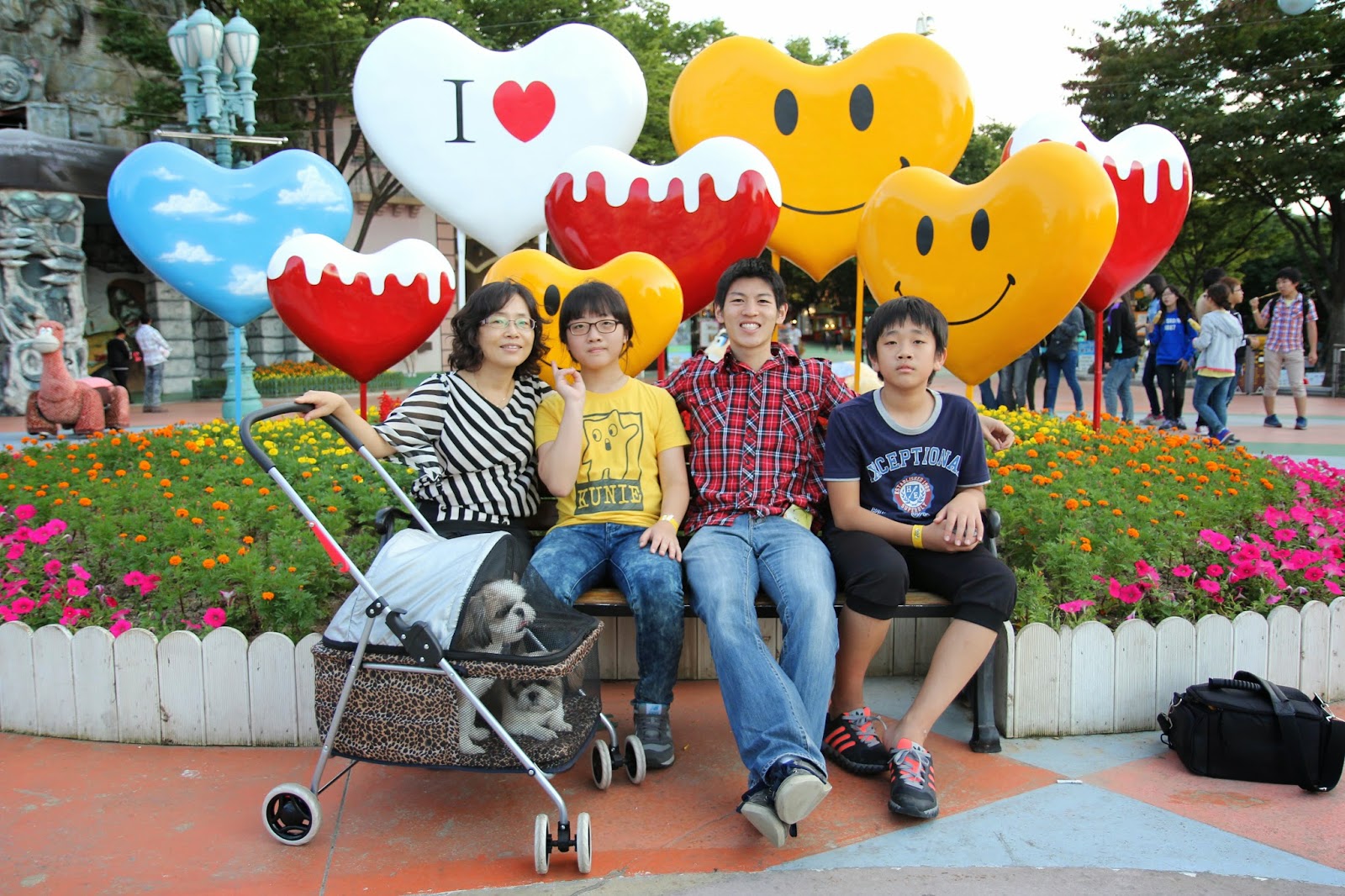
My host family and me at E-World! (Minus my host father, who took the photo.) Please note the two derpy dogs in a stroller.
Okay, and here is a photo of my host siblings tumbling around a pool inside giant inflatable balloons, just because. 그냥.
Hahaha!

Sunday, September 30, 2012

Happy Chuseok!

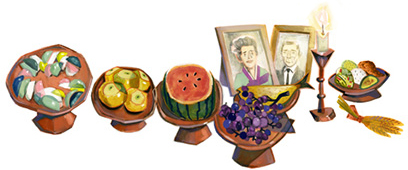
Happy Chuseok from Google!
Chuseok (추석) is the most important national holiday of Korea. It's billed to Americans as "Korean Thanksgiving", which is supported by both holidays' occurrence in autumn and the focus on food and family. But from what I've seen, there are more differences than similarities. Perhaps the most conspicuous difference is that the "family" focus of Chuseok is actually on deceased family.

Anyway, I was lucky enough to be able to spend Chuseok with my homestay family. They invited me to experience it, as most foreigners wouldn't get this kind of chance, and I was excited and accepted.

So I spent today in Daegu with my homestay family. (In fact, I spent most of the weekend in Daegu, and I'll have many more posts about my other adventures to write after this.) Custom dictates that a family will return to the father's hometown. So, we went to my homestay father's older brother's apartment, located in an old and quiet neighborhood where, thirty-some years ago, my homestay father grew up, biked to school, and played soccer.

Chalye jinaegi
The morning ritual was a 차례 지내기 (chalye jinaegi), a sort of memorial service for the family's late grandparents.

Despite the common translation of this as "ancestor worship", I would hesitate to call it that. I'm aware, of course, that not understanding the Korean language or really much at all about Korean culture, I could be totally off base. But the word "worship" has particular connotations that were absent from the scene I witnessed, with the grand exception of the prostration in front of the altar. Yet even in regards to that, well, Koreans bow a lot to many different people, and that is considered duly respectful, not idolatrous.

Anyway, the setup was really similar to the big rock unveiling ceremony that I attended last week: a table laden with food (fried sweet potatoes, fruits, dried squid and cuttlefish, a roasted chicken, rice, rice wine, rice cakes, and songpyeon (송편), but no pig head this time), incense, and candles. There was a paper screen with hanja on it that I couldn't decipher, and also smaller papers that represented the ancestors.

I was invited to take photos and film during the ritual, but even though I took advantage of this rare opportunity, I also felt so, incredibly awkward the entire time. "Oh, they're bowing, okay, this is a nice angle, oh, I wish the shutter weren't so freaking loud."
My homestay father burning the... well, burning something, which signaled the end of the ritual.
Some of the dishes prepared at the altar. Rice cake, fried vegetable pancakes, and a chicken!
After the memorial service, we ate all the food that was on the table. I'm just going to say that 송편 is delicious. It's probably the closest thing to mochi that you'll find in Korea. And then we ate ice cream and watched TV. Iron Man 2 was playing on a movie channel!
This is 송편 (songpyeon), rice balls filled with sweet stuff (in this case, sweet soybean paste).
In the afternoon, we set out for a mountainous area near Gyeongsan, a city southeast of Daegu, for the purpose of performing another 차례 지내기 at the actual grave of my homestay father's parents. We were joined by thousands of other families -- I'm not exaggerating -- who created an hours-long traffic jam in the mountains where the cemetery is located. I get the sense that most cemeteries in Korea are in the mountains; this obviously has something to do with Korea's very un-flat geography, but I wonder if it is also rooted in some traditional interpretations of spirituality and high elevation?
The hillside cemetery we visited, somewhere near Gyeongsan, with many families dotting the terraces.
Remembering 할머니 and 할아버지.
One thing is for sure: being in the mountains meant that the cemetery was gorgeous. It was very well-kept by thousands of people coming back to tend to it at least once a year, and the view from where we were was quite nice. Overall, the atmosphere at the cemetery was in fact more jovial, thanks to beautiful weather and lunch. Yes, after performing the memorial service, every family would take the food from the tombstone, spread out a blanket, and proceed to picnic. That was unexpected, I will confess. But it was also pleasant. There was more 송편! And fruits and bibimbap, too. We had a late lunch, and when we finished it was time to head back to Changwon.
Picnic time! The husbands drink and the wives prepare some bibimbap from this morning's leftovers.
Beautiful bouquets at every grave. They were all synthetic flowers, though! That's why they're so bright and perfect-looking.
On the long drive home (seriously, every highway in the country had a 교통 채증, or traffic jam, today), we passed a gorgeous sunset.
This was somewhere between Miryang and Changwon. I love Korea in the fall. Today's weather was so beautiful; I'm glad the typhoon that was slated to hit Korea today veered off course a few days ago. (It would've been the fifth!)
I'm going to close with two questions for my readers, especially if you are Korean. First, I've heard from three separate grown Korean women that Chuseok and other 명절 (myeongjeol), or traditional holidays, are incredibly work-intensive for the wives and mothers of a family, mostly because the food preparation takes forever and the men aren't expected to help. Because of this, they are sometimes resentful. For "progressive" Korean families, either in Korea or in the States, where gender roles are not as set in stone, is the workload ever shared among members of the family? And in the States, is the work actually less intense, in some respects, since less food is required and a cemetery visit is, in most cases, not possible?

Secondly, Chuseok obviously has deep roots in Confucianism. For Christian Korean families, how does this play out? I've noted earlier the dynamics of "ancestor worship" and harmless custom. Does Chuseok look different to a family that does not follow Confucian ideals?

And that's all! Happy Chuseok, everyone!

Translate