Showing posts with label UNESCO World Heritage Site. Show all posts

Sunday, May 11, 2014

Suwon's Hwaseong Fortress

When I hear the name of Korea's eighth largest city, Suwon, the first thing that comes to mind is the fact that a Korean-American friend of mine has family who lives there. An odd bit of trivia. Unlike me, the rest of the country thinks, "Oh, that big fortress wall." They are referring to an ancient fortress that is Suwon's most famous historical site and tourist attraction, and, yes, it has a wall. I visited about one week ago, on Children's Day. (It was one day before Buddha's Birthday, or, as I like to call it as of right now, Buddha's Eve.)
One of the gates to Hwaseong Fortress, seen from atop the wall itself.
The Hwaseong Fortress (華城/화성 -- I should point out that 성 itself means "castle" or "fotress", so this is really the Hwa Fortress) was built in the end of the 18th century, during the Joseon Dynasty, and it is a designated UNESCO World Heritage Site. The wall of the fortress is astoundingly long: 3.5 miles (5.7 kilometers) in length and running over two hills. It is also impressively well-maintained; you can walk or jog along the length of the entire wall and enjoy beautiful views of the surrounding city the entire time.
Paldalmun (팔달문), the southern gate of Hwaseong Fortress. It's quite beautiful to look at, but because it is detached from the rest of the wall and stuck in a giant rotary amidst traffic and ugly modern buildings, some of the charm is admittedly lost.
In my opinion, walled cities that have survived from antiquity to the present day have a very distinct charm. I'm thinking Avignon and Chiang Mai, both of which I really enjoyed visiting. But in those two cities, despite their historical flavor, the old walls not only preserve a bit of the culture but also give off a somewhat claustrophobic air. Avignon is, to put it bluntly, cramped. And Chiang Mai's old city is small enough that you can never walk too far before you hit the wall, quite literally.

Suwon's wall is different. It's as wide as a jogging path in a park, and as I said before, it's a very pretty and well-maintained space in such a big, busy city. Nothing about this wall actually seems belligerently imposing; it's grand, but it's peaceful. All the gates, turrets, and sentry points feel like they were constructed less for war than for sightseeing. Of course, Hwaseong Fortress has hundreds of years of history that I know nothing about, so this could be my ignorance talking.
Walking up the first hill of the fortress wall from the Paldalmun entrance; quite a steep climb, but worth it.
Anyway, I visited the wall with friends on a beautiful spring day. The entrance fee is usually 1,000KRW, but thanks to a certain golden holiday, we got in for free. All we did was walk around the wall, take photos, and watch tourists ring a giant bell to grant wishes as we munched on snacks. It was a nice way to spend an afternoon. Of course, there were tons of other things to do in the fortress complex itself: performances, culture centers, maybe a museum or two? I don't really know. But I was content to hang out with my friends with nothing planned and very little on my mind.
Hwahongmun (화홍문), the north water gate of the Hwaseong Fortress, through which the Suwon River flows. It's a beautiful spot that I would like to come back to one day. But there are so few days left...
In addition to hiking the fortress wall, my friends and I explored the enormous shopping complex that sprung out of the loins of Suwon's main train station. Tip for future reference: its food court is amazing. I also met up with Greg, whom I first met in Laos, for dinner (in said food court), and it was nice to catch up with him and get an update on his plans to move to Southeast Asia permanently.

So that was Suwon, in a nutshell. I was happy to strike another Korean city off my map (I've now been to nine of the ten largest cities), especially now that my days here are numbered and the opportunity to travel freely won't come again for a while. It's been strange, thinking about what I should do with the three months I have left. Even planning this trip to Suwon took that into consideration: I literally asked my friend, "So, where have you not been yet?"

And the question now is, "Where will I go, before I go?"
Many flags wave proudly along the top of the fotress wall. This one reads 巡視 (xúnshì/순시, which means to patrol or inspect). "Keep your eyes peeled," I think, "for the impending future."

Saturday, May 3, 2014

Luang Prabang

A shiny mosaic at Wat Xieng Thong.
Day 9 (Feb.1): Wat Xieng Thong, Phou Si, and Dyen Sabai
It's difficult to get lost in the old town of Luang Prabang: it's just one big loop on the top of a hill. I wandered around for a day with no real plans in mind, but it was nice to run into old friends and make new ones.

I met a guy from Chengdu whose English name is Flame. He was very friendly and eager to talk about everything from politics to Taiwanese food. Even though he was from China, he loved Taiwan (and really disliked Chinese communism). We walked to Wat Xieng Thong, the city's most famous temple, where we ran into Corine and Ian! It was hot, but the temples were cool inside, so it was nice to explore and take photos. Overall, it wasn't very interesting, though. I was getting temple fatigue -- they all look the same after a while.
Small Buddha sculptures at Wat Xieng Thong.
Later in the afternoon, Flame got a massage while I got a smoothie and played with free WiFi. Internet access is advertised all over the city, but it's very rarely reliable. In fact, Flame and I actually met at the guesthouse because he asked me how to access its WiFi. It wasn't easy -- I had to go out onto the balcony to get just a few bars.

Anyway, as the afternoon wore on, we decided to hike to the very top of the local hill, Phou Si, to watch the sunset. This wasn't the best of ideas, since it ended up being so overwhelmingly crowded that any enjoyment of the natural beauty was inevitably spoiled by hordes of people taking photos and being loud. It was so ridiculous that it became funny, actually. But I'd paid the price of 20,000kip and a hike to see this, so I joined the crowd and tried to take some photos, too.
The sunset was still gorgeous. It was just hard to appreciate it with all the people around.
Me, Green, and Flame at Phou Si.
At the top of the hill, Flame and I ran into Green, a guy from Taiwan whom I met briefly in between the border crossing into Laos and the slow boat pier at Huay Xai. Green had taken a bus up north to Luang Namtha and had finally found his way back down to Luang Prabang. Realizing that they could have a lot of interesting things to talk about, I introduced them to each other and then tuned out as they talked about their respective countries in Mandarin too fast for me to really follow along.

That evening, I met up with Greg and P, Corine and Ian, and their friend Chrissie at the nice restaurant across the bamboo bridge* from the old city. It's called Dyen Sabai, and I highly recommend it. Their specialty is Lao fondue, which is similar to Cambodian barbecue. Essentially, it's meat grilled on coals like a barbecue, plus a heated broth for cooking other things hot-pot style. There was buffalo meat, Lao sausage, and delicious dishes with eggplant including fried eggplant and baba ganoush. Everything was to die for and also served with class.

The restaurant's atmosphere is also great -- instead of four walls, patrons dine in large open-air huts and sit on the floor with bamboo mats and cushions. It was wonderful. It was also cheap -- we ordered several of the dinner sets and lots of happy hour drinks and ate until we were beyond stuffed, but our total bill came out to less than 100USD. My share of the bill came out to 116,000kip, or $14.50. And this was my splurge meal of the week. Easily four times the amount I'd been paying for meals up until then, but compared to South Korea or the US, it was an unbelievable deal. So, if you are ever in Luang Prabang, be sure to try Dyen Sabai.
Lao fondue: a grill plus a hot pot. That there is buffalo meat! It's basically beef.
Greg, Ian, Chrissie, Corinne, and P, having a wonderful dinner in an open-air hut.
Of course, now that the city is booming with tourism, there are undoubtedly many other high-end restaurants that can provide the same level of class and fine dining, but this place really was something special. I think the good company added to it.

I ended the night at a bar owned by a French man, chilling with the three funny and friendly Brits I'd befriended over the past few days. After just one day in Luang Prabang, I already loved it.

- - -

*If you are ever in Luang Prabang, beware the evening bridge toll scammer! During daylight hours, tourists who cross the bridge must pay toll; this contributes to the maintenance of the bridge, which is washed away every rainy season and rebuilt. But after sunset, the crossing is supposed to be free. That didn't stop a clever swindler from installing himself in the toll booth to collect fees from unsuspecting tourists. I was lucky to be crossing with P, who marched right past the toll booth without even giving the guy a second glance. And the guy was gone when we crossed back after dinner...
The bamboo bridge in Luang Prabang

Wednesday, April 17, 2013

Photos from Jeju

Well, it's been a rather gloomy and dismal day, and that's not just on account of the weather. It's gotten cold in Changwon lately, and there have been scattered rains. Also, awful things are happening in the United States and around the world. So it's time to go to my happy place and relive memories from Jeju Island (where I attended the Fulbright Spring Conference two weekends ago).
This was the view from my hotel room! It was in Seogwipo, on the southern coast of the island, looking south at nothing but ocean.
First stop on the one-day tour of the island: famous volcanic rock columns making interesting formations at the water's edge.
The peak of Sunrise Peak! (일출봉정상/Ilchulbong jeongsang) (taken by Adam)
It took about 20 minutes to get to the top, and the wind was blasting us the entire time. Here's another shot at the peak, facing east.
Looking west, back toward the island... it was gorgeous! 아름답네요! I love the colors of the water and the rooftops.
Down by the beach, Jeju's famous female divers were looking for shellfish. When they found their catch, they'd discard the beautiful shells. But this one I picked up in a tide pool. (Seems like I also got photobombed by Ashley.) (taken by Katelyn)
Cuttlefish/squid (오징어/ojingeo) drying on a line on the coast. Nom nom nom...
"I hope the Pacific is as blue as it has been in my dreams."
A Jeju pony! Riding one is on my Korea bucket list.
Have I mentioned yet that it was super windy and cold all day? Jeju is famous for its women (the divers), rocks, and WIND!
Super-windy. 바람이 불었어요.
But then we went somewhat inland to chill by a beautiful river and take a short hike to see a waterfall.
And here is the aforementioned waterfall, called Cheonjiyeon Waterfall (천지연폭포), or Sky-Land Waterfall. The hollowed-out bottom portion is made up of softer, porous volcanic rock, which has been worn away by the splashback of the waterfall, while the upper granite portions remain.
Since my departing flight was on Monday evening, I had time to hike up a hill in Jeju City with some Fulbright friends at sunset.
We also visited an arboretum. Ginger is standing in a sculpture of the hanja (Chinese character) that reads 木 (목), or tree. Adam is doing Gangnam Style because he is silly. We also got dinner, and I had 제주 육개장, and it was delicious.

Monday, February 4, 2013

번데기! Scrumptious Silkworms and Swatties

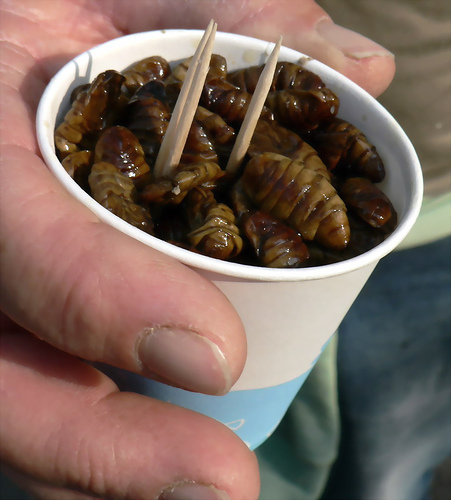
There isn't much to say here. 번데기 (beondegi) is a popular Korean street food that is quite literally boiled silkworm chrysalises. Not something an American is used to eating. I ate one.

I only did it on a dare, and it wouldn't have happened if I hadn't met some friendly and lively French people at the hostel where I was staying the night before. We and I mostly lazed around the hostel and chatted all day, and then we decided to maybe go out and sightsee something before the sun set, so we set off for Changdeokgung, an ancient Joseon Dynasty palace. I've been before, in the summer, but in January after a recent snowfall, the place seemed quite different. It was tranquil, with fewer people around, and snow crunching beneath our feet.
In front of Changdeokgung in the winter with friends from France and Korea.
The linguistic situation was quite interesting with our group. Julie, Aurelie, and another Julie were traveling together, and Ludovic was joining them from China, where he'd been studying Chinese. Ludovic also asked his Korean friend to join us; she had been in the same program as him in China. She then brought along her cousin. (They were both very generous and treated us a lot that afternoon.)

So, there were four French people, two Koreans, and myself wandering around the ancient palace, switching continually between French, Chinese, and Korean. We caved to English when the other three languages didn't work. As someone who enjoys studying languages, I felt like all those years spent in classrooms and cramming vocabulary and grammar actually paid off. For once, I got to communicate with other people in their own primary language rather than mine, and I really enjoyed it, even though it was hard work.

Beondegi in a cup. From the Korea Blog.
After wandering around the palace, Julie said that she wanted to try silkworms. It was part of her carpe diem attitude while in Korea. So, she got a cupful of them from a street vendor and spent a good five minutes psyching herself up to spear one on a toothpick and pop it in her mouth. As soon as she did, she spit it out! But since there was still a lot left, I told Ludovic, "J'en mangerai un si tu fais le même!" (I'll eat one if you do, too!) We got little beondegi on toothpicks and counted to three, and then ate them!

Well, to my surprise, the little brown thing was juicy. Warm silkworm juice squirted out as soon as I bit into it, and it was a supremely unpleasant feeling. It didn't actually taste bad at first, kind of like some sort of roasted meat. But after I swallowed it, a bitter and nasty aftertaste was left on my tongue. I washed it down with some candy that Aurelie had. Ludovic also spit his out. And... that was that! I ate bugs, you guys. In Korea. With French people. Who speak Chinese. The things you can do while you're abroad...
Julie with her cup of silkworms. Ludovic looks on in interest...
Cathy and me. She interpreted the entire evening's program!
Some last things of note: that evening (the 19th), I attended an event for Swarthmore alumni held at the Lotte Hotel. Our college president was touring Asia and stopped by to talk to alumni, some prospective students, and mostly parents of students about the college's vision and some plans for the future. The event was nice because I saw a few old faces and also because the food was excellent! There were about a hundred people present, and I think I might have been the only non-Korean under 30. Ha! But it really was nice to see a bunch of Swatties together again, especially Cathy, a current Senior from whom I hadn't heard for several months. It reminded me that yes, I do miss college. Quite a bit sometimes. But it's also time for me to move on, stop the pining, and get to work on making a future for myself.

J Kwon and me.
Speaking of seeing Swatties, I forgot to mention earlier that I saw another friend, J Kwon, whom I hadn't seen in two years because he had to do his mandatory military service. We watched Cloud Atlas together (which was mind-blowingly good) and caught up on old times.

Now that I'm back in Seoul after all of that traveling, I look forward to reconnecting with other people! There are lots of old friends and peers in the city, and actually, four weeks is starting to look like not enough time to see them all!

Wednesday, October 17, 2012

Beautiful Gyeongju (Conference pt. 3)

"Beautiful Gyeongju" is the cheesy English moniker adopted by the historic city of Korea. (See related: "Colorful Daegu", "Dynamic Busan", and... "Changwon: Environmental Capital". Yeah.)

There's no denying, however, that Gyeongju lives up to this name. It's a small city but its boundaries are wide; the best word that I can think of right now to describe it is uncompressed. Unlike Seoul, Daegu, and Busan, there's so much room to breathe. And there are trees everywhere, all on the verge of changing colors -- the phenomenon known as 단풍 (dampung) in Korean. On a sunny, crisp, almost-autumn day, the tour we took around the city's historic monuments from the Silla Dynasty was more calming and relaxing than I could have imagined, thanks to our slow pace and the gorgeous sights at every stop.
A small hut selling memorial tiles; you can buy one to write an inspirational message on. I was most interested in the wooden rooftop, though; there's not only moss but small trees growing on it!
The first stop was Seokguram (석굴암/石窟庵), a Buddhist shrine located on the top of a tall mountain. Fortunately, our bus drove to the top, and we didn't have to hike for more than five minutes to arrive at our secluded, peaceful destination. Although there were tons of tourists, they didn't seem to bother the worshipers inside the shrine, who were also separated by a thick glass wall that said "No Cameras". Inside was an enormous ten-foot-tall statue of the seated Buddha, imposing yet peaceful. From the outside, you could see the beautiful farms and fields far below us in the valley, although the morning mist obscured it some. Seokguram is a UNESCO World Heritage site.
A very awake Ginger and Nina jump up in front of Seokguram Grotto (built into an artificial cave!).
Down by the parking lot, we passed by a long row of ajummas (아줌마) selling fruits and roasted chestnuts. Mmm, chestnuts. It was a nice surprise for me that chestnuts (밤, bam) are a common autumnal snack in Korea. They remind me of France (where they're called châtaigne).
This is literally a dozen sellers of the exact same product. You have to wonder what the market competition is like.
After Seokguram, we hopped back on the bus to go to Bulguksa Temple (불국사/佛國寺), Korea's "Historic and Scenic Spot No. 1" and also a UNESCO World Heritage site. Some of the historic treasures located within the temple complex included stone pagodas (탑), famous bridges, and, of course, statues of the Buddha. While we were at the temple, we were supposed to follow a tour in English, but the tour guide mysteriously never showed up (I found out later that she was just very late), so most of us just grabbed a map and wandered around the huge grounds on our own.
Me in front of Dabotap (다보탑/多寶塔), the pagoda of many treasures, built in AD 751. Its partner pagoda just a few meters away, Seokgatap, was under heavy construction at the time. (Photo taken by Susie)
For the average tourist (aka, me), it seems as if once you've seen one Korean Buddhist temple, you've seen them all. I wish I knew more about Buddhism (불교; bulgyo), though; I took only one course in college that covered Eastern traditions, and it only skimmed the surface of what there was to see and learn at Bulguksa. One neat little corner of the temple was covered with hundreds of small cairns -- piles of flat stones stacked neatly atop one another -- that made me feel like a giant in a Suessian wonderland, sans the vivid colors. I wasn't sure what their function was, having been told, when I saw similar structures at Muryeung Valley, that they were used to mark hiking trails. I found out later that they were for making prayers or wishes.
Build a cairn, make a wish! This one is about as tall as a soda can.
All around and behind me are hundreds of small cairns, carefully constructed by thousands of the faithful. (taken by Brittany)
And that's about it for Seokguram and Bulguksa! Two of Korea's most famous historical sites and tourist attractions, check! Then, it was lunchtime (맛있는 불고기!) and off to more beautiful places plus a museum, which I'll get to in a later post. Stay tuned!
The main gate of Tohamsan (토함산/吐含山), the mountain where Bulguksa is located. I spy thirteen -- no, fourteen! Fifteen? -- Fulbrighters!

Saturday, August 25, 2012

Walking Around Seoul (Seoul Weekend pt. 5)

In front of Gwanghwamun (광화문), the largest gate of Gyeongbokgung (경복궁). Left to right: Katelyn, Christina, Cody, Jason, Adam, and Lauren. The fans some of us are holding were freebies we got from high school students for taking a brief survey about the environmental impact of eating meat. It was really humid, so the fans were an awesome surprise.
Saturday was a drizzly and rainy day, but fortunately the showers came in spurts, so my friends and I could walk from one historic site to another without much problem. Our first stop was Gyeongbokgung (경복궁), the largest of Seoul's Five Grand Palaces of the Joseon Dynasty (조선). It was first built in the 14th century and has been destroyed and restored several times since.

We actually didn't do much there except take photos on the outside. We didn't go in because we were planning on visiting another palace later that day, and one is enough, I think. On the way to the next palace, we briefly dropped by the National Folk Museum. There were some interesting outdoor displays to look at, but it seemed kind of small. I discovered later that we never even found the museum and had only wandered around the grounds beside it. Oh well!
Funny imitations of stone statues (spirit posts?) on the grounds of the National Folk Museum.
It took us a while to find the next palace; it was only a few blocks down the road, but we made some wrong turns and had to ask for directions at an information booth. On the plus side, our path took us around the edge of Bukchon/Samcheong-dong, which was a cute and fascinating neighborhood to walk around. It kind of felt like walking around hilly Berkeley, and I'd like to go back to explore it more.

Eventually, we made it to Changdeokgung (창덕궁; 궁/gung means "palace") and went inside. We got our timing wrong and missed the English tour and the tour of the Secret Garden in the back, but I figured that walking around it would still be worth it, so we did just that. And played Contact when it began to rain heavily and we were stuck under a gate.
Changdeokgung is famed for having been built into the topography of the land around it, rather than "imposing on nature". The result is a very pretty palace grounds that nevertheless got old quick. Next time I visit, I'll be sure to join the Secret Garden tour. After taking the inevitable tourist photo and the inevitable self-serious band shot, some of us split off to visit Gwangjang Market (광장 시장), South Korea's oldest traditional market.
My kiwi smoothie (키위 스무디)! With photobombers Jason and Katelyn in the background.

When we arrived at "Gwangjang Market", we were confused because we had actually gone to Sewoon Plaza instead, and that turned out to be arcade after arcade of fan stores, stereo stores, lamp stores... nothing but electric appliances! We found a cafe to sit and re-orient ourselves while downing delicious smoothies... and then walked one block over to find the real deal. Gwangjang Market: food, traditional clothes, convenience stores, and random touristy stuff all barely organized along covered streets, or arcades, and tons of loud Koreans everywhere! Although this market is on the tourist maps, it didn't seem like many foreigners were there. Maybe these dried fish scared them away, or the ahjummas making enormous bowls of kimchi, or incredibly dense crowds.


My friends and I quickly found the "street food" section, which was two short streets crammed with food stalls like mini open-air restaurants. It was insane; it smelled amazing; it was also really, really hot. We walked down the entire length of both streets -- it was actually much smaller than your typical Taiwanese night market (夜市) -- and grabbed some ddeokbokki (떡볶이), kimbap (김밥), and all types of fried savory pancakes (부침개), like pajeon (파전)!
Gwangjang Market's street food section! It smelled so good. So good.
I love street food, especially in Asian countries where it's fried, greasy, totally unhealthy, and has mysterious meat in it. This is something I'll take advantage of while I'm here, I think! So far, Taiwan still has the best in my opinion, but we'll see if that changes after a few months!

So that was Saturday morning and afternoon. After the street food smorgasbord, we went back to our hotel and chilled, meeting up later to visit one of Seoul's famous animal cafes! Reader be warned: you are about to see lots and lots of photos of the cutest dogs ever.
Buchimgae feast! It was about ten bucks per plate; we barely finished it, but Adam on the right definitely helped us power through.

Translate