Showing posts with label linguistics. Show all posts

Wednesday, July 22, 2015

North Korean - South Korean translator app


It should surprise nobody by now that the languages spoken in North Korea and South Korea are not the same. The two countries have been geographically separated for decades, with no free communication allowed across the border between them. In addition to that, North Korea's government initiated purges of the language long ago to get rid of foreign words or borrowings (from English, Chinese, or Japanese) and replace them with pure Korean translations. As a result, while South Koreans might want to eat 아이스크림 ("ice cream", transliterated) on a hot summer day, a North Korean will dream instead of 얼음과자 ("ice snack").

When I visited North Korea last year, I found myself unable to understand much of the Korean that I heard being spoken. Of course, my Korean listening comprehension level is fairly low, but it wasn't just me -- even the Korean-Americans in my tour group who were fluent in (South) Korean had some difficulties. Most of it was due to the differences in vocabulary, but there was also the intonation of North Korean, which would have been considered a mere dialectal difference back when Korea was unified, but is now one of the markers of the two languages' divergence. (The line between "language" and "dialect" is a fairly blurry one, even for linguists.)

Anyway, when I came across this advertisement/PSA for a new app called 글동무 ("classmate"). I like the name -- the whole phrase means "classmate", which directly references the app's usefulness for North Korean students struggling to keep up in South Korean classrooms, and encourages a camaraderie among youth. Also, the first word (글) on its own means "writing" or "knowledge". The second part (동무) on its own can also mean "comrade", but I don't think that was intentional.

I have taught camps and tutored students from North Korea in South Korea before, and I can say that an app like this would be very helpful for most of them. (For others, especially younger students who basically grew up in China while their families were in hiding, it would perhaps be less useful than a Chinese-Korean dictionary, but those already exist.)

And in addition to the app's usefulness, its beautiful, simple design and hi-tech programming (it can use the phone's camera to identify unknown words automatically and offer translations immediately) are really compelling. This amazing app is the brainchild of linguists, computer programmers, and sociologists who saw a need in South Korea and came up with an elegant solution. I hope that the work I will do in the future can be as beneficial as this!

Tuesday, June 2, 2015

Profluentia et Imprudentia

I have to be more careful with my words. This was the realization that came hand-in-hand with a gentle reminder that I am currently living in a country where I am not fluent in the language. Wait, let me revise that: I am reminded daily that I cannot speak Korean well, and these reminders themselves are not always gentle. Like when I struggled for an hour to open up a checking account only to be told finally that without an ARC it just was not possible.

But this time, the reminder was gentle, and it came from a friend who has lived in Korea for longer than I have and knows a great deal more about it. We met up last weekend since he's currently doing his graduate studies at the same university where I'm taking language classes, and I have perhaps unceremoniously latched onto him as my go-to resource for cultural guidance and assistance with quotidian matters.

After I left Korea nine months ago, I forgot one of the basics of cultural communication, the one that is drilled into every language student's head from the very beginning: Korean culture is built on a hierarchy. In society, what this means is that the young and inexperienced always defer to their elders and superiors. Children obey their parents; younger students take orders from their seonbae (upperclassmen); the employer's word is law to their employees.

In language, this means that one's vocabulary and grammatical constructions change depending on whom you address. It's much more complex than a handful of polite terms. I would ask a favor of a friend using a wholly different grammatical form than that which I'd use to ask the same favor of my teacher or grandfather.

Of course, I didn't forget that this rule exists in Korean. What I have neglected to remain mindful of, then, is how strictly it actually applies to me.

You see, while I do I fairly a good job of blending in with the crowd here in Seoul (the expectation is that an East Asian face equals a Korean face, unless it's dressed in the outlandish garb of the Chinese tourist), as soon as I open my mouth, most people realize that I am very much American. My accent cues them off, and then my face and fashion sense fall into place with it. I guess this morning was an anomaly, when my new language instructor asked me if my parents were Korean, apparently surprised at my speaking fluency. Anyway, humblebrag aside, once I'm tagged as a foreigner, what has happened generally is that all linguistic rules are tossed and my stupid mistakes are forgiven. I can ask for a head of cabbage instead of a beer and nobody will fault me for it. I can stare dumbly at the real estate agent as he tries to explain the security deposit without him thinking that I am actually dumb. And, critically, I can use the wrong forms of address to everyone -- casual conjugations with a stranger, super-honorifics with my former student -- and I'll get a free pass because I'm still learning.

I am not saying here that I should make these kinds of mistakes. After all, as a perfectionist, I cringe when I catch myself saying something wrong or culturally inappropriate. But my point is that I do make these mistakes, yet I've been let off the hook so many times that I haven't really properly internalized the rules of what to say and when. Or at least, if I had had everything down after the first two years, I had promptly forgotten when I left.

And now I'm back and I'm making a fool of myself. Why? Because I'm here, newly determined to show that I have learned something after months upon months of intermittent language study, and along with this courage comes a fair bit of hubris, and from this hubris arises a situation in which my friend introduces me to his classmate, both of them my seonbae, and I immediately talk with him as if we've been buddies for years. So much for cultural competency.

Hence the gentle reminder: remember who you are and whom you're talking to. It may not be important to you, or any American for that matter, but it matters here.

My friend himself admitted that it took getting used to, being a graduate student in linguistics (a field generally as casual and laid-back as you can imagine; my professors at Berkeley eschew being addressed by anything other than their first names, for example), but in a country where hierarchy is deeply entrenched in the ivory bastion of cultural conservatism and academic tradition. The constant bowing, the formal pleasantries, the obligatory grad student drudgery for tenured professors: it's all here, and while my friend is just beginning to tire of it, I realize that I haven't even begun to process its reality.

If I really want to pursue Korean linguistics, then the hierarchy, ingrained as it is into both the language and the culture, is something I will have to acknowledge and accept. I don't like hierarchy; let me be clear about that if it isn't already obvious. But as an academic, I have to respect it, and step one is taking pains to use the proper honorifics in the right contexts.

Even with my Korean friends -- the ones with whom I converse freely in Korean, who only correct my many errors when I demand for them to -- I think it's time to be more disciplined about my language use. Who exactly is my nuna, my hyeong, my dongsaeng? It's admittedly a bit complex: is age the only factor? Should I ask my Korean friends for their opinion on how I should categorize them, or is that rude?

There's sure to be some discomfort as I recommence navigating this cultural landscape. I thought two years' worth of experience wasn't too bad, but it's nothing. And it's not just the hierarchy thing, either. I only have two months this time, and I wonder if tackling headfirst questions like my place in Korea as an American, the ups and downsides of rapid globalization, or the uncertain future of LGBTQ rights in this country are even worth my while. This summer, will I traipse through Seoul taking pretty pictures of food and blogging about the charmed expat life, or will I choose my words -- and thoughts and actions -- more carefully?

Saturday, August 16, 2014

Disappearing Languages and Other Things

Interesting stats about the language imbalance in the world and current efforts to translate the Bible into indigenous languages, shared with me by a friend who did two years of missions in western Afria.

About four years ago, my dream was to become a linguist for Wycliffe who would go to remote areas of the world to translate the Bible into indigenous languages. That's changed, and a part of me regrets that my life has taken a different direction. Of course, I say that I will do whatever and go wherever God calls me, but I wonder if I backed down from the idea of working with Wycliffe because I was intimidated by the notion of actually being a missionary?

When people from my Christian community back home learn that I've been in Korea teaching English, their first assumption is that I went abroad to do missions work and taught on the side. Actually, I went abroad to teach English, and didn't do any missions work on the side. To reiterate: not a finger did I lift to contribute to this great cause for which I purport to live. And when I clarify this, well, it becomes a bit awkward. I wonder if I've let them down in some sense.

Now, my time in Korea is over. Memories are starting to be replaced by photos and blog entries, people are losing reasons to stay in touch. I've been home for one week, and in two more, classes will begin: my first steps toward obtaining a PhD in linguistics. Five years down the road, I'll be a "doctor"... and then what? What will I do after that? Where will I go? God only knows. (And does anything I'd ever had planned even matter to Him?)

A new chapter begins... But the book of life metaphor isn't perfect, I must admit. In a book, I can always turn back to an earlier page, read it again, maybe add an annotation. Seems more like I'm reading a message I'd scratched in wet sand at the beach, only to have the water wash it away.

It's hard to remember things.

- - -

P.S. Unrelated: I found out recently that a friend and fellow Fulbrighter in my year is the granddaughter of WC Townsend, the founder of Wycliffe Bible Translators and SIL International! Wow! Also, one of the Fulbright Korea grantees this year is the grandson of Noam Chomsky. It's like the heirs of linguistic royalty are partying up in Seoul right now. Haha.

Monday, July 7, 2014

Jeju-eo Project Update

About six months ago, I introduced my self-directed research project about Jeju-eo, the endangered variety of Korean spoken on Jeju Island. Since then, I've been happily busy with the linguistic documentation work which I received a small Fulbright grant to do.

In January, I met with a professor of Jeju National University to get his insight and some inside information on what language activism looks like on the autonomous island province of Korea. Then, nothing happened for a while.
This is me giving my presentation on Jeju-eo at the Fulbright Spring Conference 2014. Even without anything concrete to show, I went way over time! But people gave me very positive feedback, at least! Photo taken by Katelyn.
It was not until April, during the Fulbright Spring Conference, that I actually had the opportunity to do any fieldwork! After giving a presentation of my research at the conference itself (which was a bit lacking, in my opinion, since I didn't have any actual data to show yet), I spent an entire afternoon with five native Jeju Islanders who helped me make recordings.

The fieldwork was fun but a bit nerve-wracking, at least for the first part. Through a friend of a friend, I met an elderly couple who live in a rural area outside of Jeju City. They are known to be very involved in the local language activism community, so fortunately, they were very willing to talk about Jeju-eo with a complete stranger, and told me many stories. For example, they explained why Jeju-eo sounded so clipped (shortened words make communication across long distances easier when wind is constantly blowing over the island) and highlighted the main differences between Standard Korean and Jeju-eo.

The nerve-wracking part was that I felt way out of my depth in terms of language ability. These people spoke no English, so all of our communication was done in Korean. It was tough for me to explain exactly how I needed them to elicit the words I wanted to record. Also, there was a lot of ambient noise in the recordings, because we were meeting in their house, which meant that they offered snacks and were busy eating them the entire time. Also, the background noise of refrigerators, clocks, and a farm have probably ended up in these recordings.
The friendly and hospitable first group of consultants. They welcomed me to come back any time in the future!
My second group of consultants were much easier to work with, since they were a mother and a daughter, and the daughter happened to be an English teacher. Again, I was connected through a friend of a friend, and again, even though I was just this random kid with a microphone, they were enthusiastic about helping and showed a great deal of generosity.

Because the linguistic barriers were no longer an issue, the second recording session went much more smoothly, and we worked for over an hour to collect over one hundred words, including many that are unique to Jeju-eo. These are the recordings that I have been putting into the Jeju-eo Online Talking Dictionary.

Ah, yes, the dictionary. The big project. I can freely admit that the lexicographical process is much more of a mountain than the molehill I expected it to be. Although I returned from Jeju Island happy and ready to dive right into the splicing, transcribing, annotating, and uploading work required to build up the dictionary from nothing, well, all of that work took a lot more time than I'd planned for. Weeks went by, and then months, and still I never got close to finishing. Then the semester got busy, and I had to put my project on hold.

Back when I did online lexicography in college, it was as part of a team. Despite my experience -- or perhaps beacuse of it? -- I underestimated my ability to do all the work on my own!

Finally, in early June, the deadline for my final report drew nearer, and I realized that it was now or never. I spent hours upon hours one weekend churning out data, giving myself just enough to work with for a few key observations in my report, and finished the eight thousand-word paper just before the deadline! This wasn't the worst I've ever procrastinated, but -- whew! -- It certainly was a wake-up call to the kind of work I might be doing in grad school. Note to self: no full-time jobs when you're doing full-time research, too. :)

Anyway, what I have to show for my work now is a modest online dictionary of Jeju-eo that you can browse at your leisure here. It's not complete by any means, and it's also imperfect. (This is mostly due to my imperfect translations and transcriptions. I do need help with the Korean, so if you know anyone who's willing to lend a hand or an ear, let me know!) But, as my friend Coby put it, "Something now exists that didn't exist before because of your work. That's awesome!"

In other news, I learned that a Fulbright Junior Researcher for the 2014-2015 grant year is going to be doing a similar project! Actually, let's be real here: her project is essentially exactly the same as mine. But she will have full funding for a year's worth of research and dictionary-making, and she will also be based on Jeju Island, so she can develop better connections and do more in-depth fieldwork. I've already been in touch with her, and I'm excited about the prospect of collaborating.

Wednesday, July 2, 2014

Haeinsa Cafe / Wordplay

A bit of cute wordplay at the Haein Cafe: 해맑게 인사하는 사람들...
A multi-orthographic linguistic puzzle! What does "海맑게 印寺하는 사람들" mean?

If you look carefully, you can see that this phrase uses two scripts: hanja, or Chinese characters, and hangul, the Korean writing system invented in the mid-fifteenth century. In ancient times, Korean was written entirely in hanja, but after Hangul was promulgated, it began to replace hanja. Today, few hanja are used, and then only in specific contexts; you might come across a few characters in newspaper headlines and official documents, but it's slowly falling out of common use.

Now let's examine these hanja. First, you have 海, which means "sea". It is pronounced 해 (hae). Then, you have 印 and 寺, which mean "stamp" or "mudra, a symbolic Buddhist gesture" and "temple", respectively. They are pronounced 인 (in) and 사 (sa).

Anyone familiar with Korean Buddhism will recognize these three hanja as the name of one of Korea's famous temples, 海印寺 (해인사/Haeinsa). What do they mean in the context of this phrase, however?

In fact, there's a bit of wordplay involved. As the Chinese characters are read with the Korean pronunciation, they are not intended to retain their written meaning. Instead of meaning "sea", 海 (hae) is simply part of the word 해맑게 (haemalkge), which means "brightly, purely". This 해 (hae) actually means "sun" in native Korean.

As for 印寺 (insa), the two words are essentially a homophone of 人事, or 인사 (insa). 인사하는 (insahaneun) means "greeting, bowing politely". And 사람들 (salamdeul) means "people", so...

Altogether, the phrase means something like, "People who greet brightly and purely." Maybe it makes more sense like this: "People who say hello with a warm smile (and a bow, because Korea)."

So as it turns out, the phrase has nothing to do with the sea or temples, but the clever part is that this was found printed on the menu for the cafe at Haeinsa. Thus, the cafe used the name of the temple as homophones to welcome its patrons. I love the ingenuity!

- - -
Stray observations:
1. The menu is printed on beautiful hanji (한지/韓紙), a thick, coarse paper that has dried leaves and flowers embedded in it.

2. The spelling of "cafe" in Korean (까페/ggape), is a little unusual. Usually, it's 카페 (kape), with an aspirated [k] from the American English pronunciation. Instead of that, ㄲ represents a tense, unaspirated [g]. Perhaps this came from an attempt to transliterate the French pronunciation instead of the English one.

3. More hanja (한자/漢字) in the top right corner: 茶來軒, or 다래헌 (daraeheon). I've never encountered this word before, but it means a traditional teahouse. Literally, "a house or high pavilion where you can order tea." NB: don't think Korean words written with hanja are just borrowed from Chinese. 茶來軒 means nothing in Mandarin, as far as I'm aware. Also, the more common words for "teahouse" are 찻집 (chatjip) and 다방 (dabang/茶房).

4. Unrelated to linguistics: why does Haeinsa have its own cafe, anyway? Is it so that after you worship and commune with nature, you can get an iced caramel macchiato to keep you tethered to modern society? I enjoyed my seven-dollar (?!) iced 유자차 (citron tea), but the very existence of the cafe seemed incongruous to me, like the Starbucks located inside the Louvre or the stuffed animals sold in the 9/11 museum gift shop. I guess cafes are now just as integral to Korean culture as thousand-year-old temples, so this is an unsurprising mix of new and old.

Friday, June 27, 2014

Hangulish T-Shirt

Warning: weird hodgepodge of esoteric linguistic terminology and dumbed-down descriptions of said terminology, as well as smatterings of Korean, straight ahead!

But look left first, before you cross. See the t-shirt? I spotted it while walking around downtown Changwon the other day, and I found it so clever that I just had to take a photo. Why? Look at the writing closely. At first glance, it looks like a list of city names: Seoul, New York, Tokyo... but wait. That's not an "S" at the beginning of Seoul. And the "W" in New York is... pi? What is "Tofyo"? Hm... is this Konglish?

Well, it is, but it's not nonsense "Engrish"-type typography, exactly. What look like mistakes are actually a simple linguistic puzzle. The character that has been subbed in for the "S" in Seoul is a Hangul (1) letter, ㅅ (pronounced she-ut). It makes the "s" sound in Korean, an aspirated alveolar fricative [s]. So, that word still reads "Seoul", but more accurately, in a sense, than the romanized spelling does.

Next, you've got the "you" sound in "New York", represented by the Hangul ㅠ [ju], which has replaced "W". Tokyo's "K" has been replaced with ㅋ [k], the aspirated velar stop.

The next three are an interesting set, because they illustrate the versatility of the Korean liquid /l/ quite well. The letter ㄹ (pronounced ree-ul... or lee-ur... or, actually, let's forget trying to use English for this) is an alveolar liquid, but it changes its expression depending on where in a word it's located. Between vowels, as in the word "Paris", it turns into an alveolar flap [ɾ], like the sound Americans make in the middle of "butter". Same for Milano. Word-initially, however, ㄹ can sound like a flap or like a typical English [l]. So the first letter of "London" has been replaced with the ㄹ, too.

A word to the wise: ㄹ is never a purely rhotic sound; that is, it is never like the American "arrr"! But it is certainly the closest approximation that Korean has for the American [r/ɹ], the American [l], or even the French [χ/ʁ], which is the guttural sound in Paris, which is why one letter is used to transcribe all three foreign sounds (which is why some Koreans are confused about r and l in English).

Here are those city names again, in complete Hangul and in IPA according to the Korean pronunciation:
Seoul = 서울 = [sʰʌ.ul] = SUH-ool
New York = 뉴욕 = [njuː.jok̚] = nyoo-YOHK
Tokyo = 도쿄 = [to.kʰjo] = doe-KYO
London = 런던 = [lʌn.dʌn] = LUN-dun
Milano = 밀라노 = [miːl.la.no] = MEEL-lah-no

Anyway... hope you found this bit of phonetics/phonology interesting. If I ever see that shirt for sale, I'm probably going to buy it.

- - -
(1) Hangul is the name for the Korean writing system. It literally means "Korean writing": 한글.

Monday, June 16, 2014

June's a Circus

Hello, world. Would you look at that, we're halfway through 2014. Whew. Just a few updates for today!

1. My 3rd-year students' writing portion of their final exam includes a post on our class blog. They will get a few extra credit points if their post gets a lot of views, likes, and comments! So please take some time to look at the nine most recent entries (all made in June) and comment on anything that interests you. Thanks in advance! Here's the blog.

2. I submitted my Castleberry project report on Jeju-eo yesterday. At nearly eight thousand words, I'm actually kind of impressed with my work, especially since this is the first paper I've written in two years (since I graduated from college, reeling from Honors exams). It's far from perfect, and in fact, my research isn't even finished yet, but I'm definitely glad to have finally crossed that hurdle. I'll post a more substantial update on my research soon.

3. This week, as I predicted about a month ago, is the week from hell. It began when I listened to thirty three-minute speeches in my classes today. Only 130 left to go in the next four days! But that's not all: my hardworking students took my offer to correct extra drafts of their speeches seriously, and as a result, the door to my office opened countless times today as students came in shyly, holding out papers and hopes for last-minute favors: "Teacher, can you please check this draft until [sic] tomorrow?" Even though I already corrected 160 drafts -- twice -- in the beginning of June, well... I relish a challenge. Bring it.

4. In one week, I will take my blackbelt test for taekgyeon. Another source of stress, I suppose.

Basically, the month of June has been very, very busy so far, and the end is just coming into view. After next week, it'll be downhill coasting all the way to the end. I'm a bit excited and a bit nervous. In addition, it seems as if grad school stuff is picking up, too. The other day, I received an email that included the names of Cal Linguistics' entering class of 2014: my six soon-to-be classmates! Although I resisted the urge to Facebook stalk them all, I did Google myself really quick, just to see what would come up. And, well, you don't have to scroll for very long to find this blog.

I of course welcome friends and strangers alike to read about my life on my little corner of the Internet, but it sure is strange to think that people I am going to work very closely with for the next five years could know a lot more about me than I know about them before we even meet.

And now, apropos nothing, here is a photo I took at my favorite local bakery the other day.
Profound and mysterious bread. The best part is that this isn't even a mistranslation. 오묘하다 means profound and mysterious. I should have bought this to find out what exactly makes it so!
P.S. Happy Father's Day (back in the States) to my one and only Babi! I think he reads this.

Tuesday, May 20, 2014

Wishy-Washy Korean Onomatopoeia (의성어) and Mimetic Words (의태어)

I'm no expert in Korean linguistics, but I have noticed something strange about Korean onomatopoeia (의성어) that I'd like to share with you. Aside from being astoundingly creative and multifarious, Korean onomatopoeia is intriguing because it takes the linguistic idea of iconicity and runs far, far away with it. There are thousands of ideophones in the language: onomatopoetic words that describe not just sounds but also certain kinds of sensory perceptions that don't necessarily make a sound.

nomz. Hi, Pusheen!
To begin with, common Korean onomatopoeia include: 냠냠 (nyam-nyam), which is how they write the nomz (eating), 음 (eum), which is their "hm", and 똑똑똑 (ddok-ddok-ddok), for when somebody knocks on the door.

Of course, linguists argue that not all onomatopoeia are iconic. How exactly does 쩌렁쩌렁 (jjeoleong-jjeoleong) sound like a shrill voice? Which sounds more like a heartbeat, lub-dub or 두근두근 (dugeun-dugeun)?

In any case, where Korean (and Japanese, as well) excels at onomatopoeia is their wealth of words that describe sounds that aren't actually sounds. For example, 따끈따끈 (ddaggeun-ddaggeun) is the "sound" of warm, fuzzy feelings. 빤짝빤짝 (bbanjjak-bbanjjak) is their version of twinkle. In Korean, these ideophones are called 의태어 (mimetic words), and their definitions always include the word 모양 (moyang), which means "shape" or "form".

Well, this is where things get confusing, because Korean 의태어 tend to be quite fickle. It seems that not everybody has been able to agree on just how to say -- or, more accurately, write -- the sound of a shimmering star, for example. This particular onomatopoeia is cited equally often as 빤짝 (bbanjjak) and 반짝 (banjjak), the difference contained in the first letter: ㅂ or ㅃ. The sounds are very similar, of course, as the second is simply a tense version of the first, but they are still considered separate phonemes.

As for meaning, some say that 빤짝 is a stronger shininess than regular old 반짝, due in part to the tensed phoneme. But what I see is a simple lack of standardization in these onomatopoeia. As in English, we may wonder if the sound of a train is really "choo-choo" or "toot-toot". Does a dog say, "woof," "ruff," or "arf"?

Another Korean example can be found in the aforementioned heartbeat: not only 두근두근 (dugeun-dugeun) but also 두글두글 (dugeul-dugeul).

When I first began noticing these rather murky boundaries surrounding onomatopoeia, it reminded me of a Korean adage my co-teacher taught me. It goes like this: "아 다르고 어 다르다." It roughly translates to "ah is different from oh," meaning that you must pay careful attention to how you say things. You wouldn't want to meet a cool guy (멋있다/meoshitda) and tell him you think it's he's tasty (맛있다/mashitda).

But how this figures into the difficulty I have in learning Korean onomatopoeia is that it seems that the rules for altering them are quite arbitrary: sometimes the vowels can be shifted, sometimes not. Sometimes it's unclear if the way someone pronounces a word is due to their regional dialect or if they're just saying it wrong.

Take a look at the sound of drizzle, which I learned as 보슬보슬 (boseul-boseul). I must take care not to accidently say 버슬버슬 (beoseul-beoseul), because according to the dictionary, that's the texture of crumbly pastries. So is 바슬바슬 (baseul-baseul). What I can say, though, is 부슬부슬 (buseul-buseul); it appears to be acceptable even though I have literally never heard it before.

For good measure, I just checked out the remaining possible vowels to insert into the first syllable and found that 비슬비슬 (biseul-biseul) means to take tottering steps, 배슬배슬 (baeseul-baeseul) and 베슬베슬 (beseul-beseul) mean to do something weakly and passively, or to shirk, and 뱌슬뱌슬 (byaseul-byaseul) is yet another variant of this. 브슬브슬 (beuseul-beuseul) was not in the dictionary, but I can't help but wonder, "Well, why couldn't this just be another way to describe mizzle or goldbricking?"

(One more: 벼슬하다 (byeoseul) is, in fact, not one of these 의태어, but it means to take up a public office.)

At lunch the other day, a teacher was trying to describe a former student whose face I was having trouble bringing up. "He was short and skinny, didn't wear glasses..." he struggled to use a descriptor that didn't apply to roughly half of our school's population. Finally, he said, "Well, he was 반질반질 (banjil-banjil)," and at that the teachers around us laughed and nodded in agreement.

My co-teacher tried her best to explain. 반질반질 is a word (an 의태어, in fact) used to describe the smooth or slick surface of a stone, but when applied to people, it paints a picture of someone who never wants to work and can think of a hundred ways to avoid responsibility without taking the blame. They're shirkers, charmers, and, well, now that I think about it, they're also 배슬배슬. That can't be a coincidence, can it?

반질 as a baby's bottom.
I offered the translation of "slippery" or "cunning", and also mentioned Ferris Bueller.

Anyway, as my co-teacher went on, another teacher offered that 반질반질 was the same as 밴질밴질 (baenjil-baenjil). When I looked this up in the dictionary, I discovered that 빤질빤질 (bbanjil-bbanjil) was also an option. So were 번질번질 (beonjil-beonjil) and 뻔질뻔질 (bbeonjil-bbeonjil). All of these words mean greasy, glossy, sleek, or smooth. And at that point, my search history on Naver dictionary looked ridiculous.

The common definition among all of these words happened to include another word unfamiliar to me: 빤빤하다 (bban-bban), which means "brazen". Unsurprisingly, 뻔뻔하다 (bbeon-bbeon) and 뺀뺀하다 (bbaen-bbaen) are acceptable variants. But don't get too far ahead of yourself: 반반하다 (ban-ban) means to be good-looking, and 번번하다 (beon-beon) means to have a fair complexion or to be... smooth.

Sometimes I feel like the dictionary is taunting me by sending me in circles.

It played one last trick on my co-teacher and me by telling me that "brazen" meant someone who had no 염치 (yeom-chi). When I asked my co-teacher what that was, she told me that there must have been a mistake: the word they should have used was 얌치 (yam-chi). As it turns out, 염치 and 얌치 have the same meaning, only my co-teacher had never heard of the former.

아 다르고 어 다르다! Does a small difference in pronunciation actually matter? If you look at Korean onomatopoeia, you might think that it's not important at all!

- - -

P.S. I found this fun list of cross-linguistic onomatopoeia during my "research".
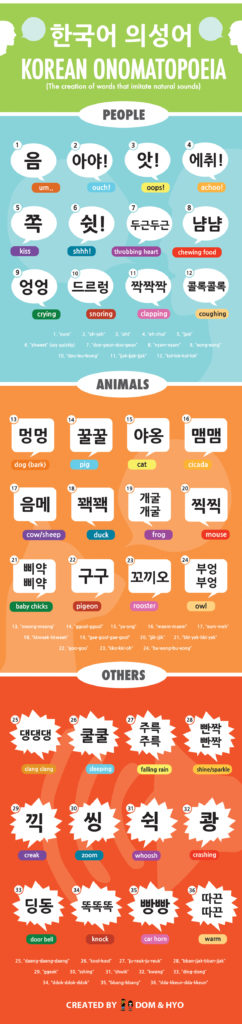
P.P.S. Talented graphic designers Dom and Hyo made a infographic of some common Korean onomatopoeia, which I've reproduced below. Have fun studying!

Monday, April 7, 2014

What are you doing next year?

The Question.
I've been mulling this over for a few months now and still have trouble answering.

I haven't talked about my future plans on this blog very much. In the past, this was because I didn't have any future plans. But I decided last year that I wanted to obtain a PhD in Linguistics, so I applied to graduate school programs in the fall. At this point, I've heard back from the six schools I applied to, and now, well, the silence about my decision stems not from the absence of plans but from simple reluctance to think about it.

You see, I do a lot of my thinking by writing. Without this blog, a lot of the thoughts I have day to day would never be processed. I like to get these thoughts out somehow, and making them public on this platform encourages me to be honest and straightforward about them. Does that sound counterintuitive? Surely a private journal would allow for more truth and less self-censorship. But what I mean is, I like to imagine that I have an audience, reading what I type here as if I'm telling them in person, so for their sake I can't write anything that I wouldn't say in a casual conversation... and for their sake I can and do write everything that I usually want to say in those situations.

The point is, I am at a moment in my life where I need to make a very big decision, and I feel unprepared to do so because I haven't thought about it enough. (And I haven't thought about it enough because I haven't blogged about it yet, see?)

The last two weeks have been busy and exhausting for various reasons. Right before I left for conference, I was feeling considerably 답답해, a unique sentiment to Korean culture that refers to the inability to say what one wants to say, the mentally suffocating discomfort that stems from not expressing one's true thoughts satisfactorily, or even just the confusion of not knowing what to say or think in a difficult situation. Due to my stress and uncharacteristic lack of sleep -- topping off a week of 4-to-5-hour nights with an all-night baking party of one -- I resolved to spend my time at the Fulbright Spring Conference getting as much rest as possible. In between napping and enjoying the wind and sun of Jeju Island, I thought that I'd also have the opportunity to ponder and pray about my future.

Fortunately, I did have time to do this over the weekend. Actually, I did not end up getting much sleep. There was also very little time in the schedule for personal introspection; I guess it was assumed that we ETAs would use our odd free hours for that... but I spent my free day conducting fieldwork. That's another story for another post. The important thing is that during the conference, I finally got to talk about my future plans with my friends, and that was when I finally began to get a clearer picture of what they might look like. So, I'm very thankful that going to the conference allowed me to process the ideas bouncing around in my head in a different, albeit obvious way: seeking my friends' input. Rather than writing things down and clicking a button to send them into the void, I simply sat and talked. I don't often just sit and talk anymore; isn't that a bit sad?

Anyway, now that I have returned from the conference, I figure it couldn't hurt to, once again, write things down and send them into the void. If you're interested in where I may possibly end up going for graduate school, read on.

The Applications.
My dream is to be a linguist. I want to work with endangered language communities and teach them how to use the tools they need to preserve and revitalize their language and culture. I don't know exactly how feasible this dream is, but it's where I began when I applied to various top Linguistics programs around the country. I set my bar particularly high: Stanford, Yale, MIT, UC Berkeley, UCLA, and UC Santa Cruz. All six of these programs are very good and very difficult to get into, though not all necessarily focus on language documentation.

What I also found was important -- a bit to my own surprise -- was location. I felt like if I was going to spend another five to six years in school, I'd only be willing to do it in a city or region that I could thrive in. Hence the many schools in California. I'll admit it: as the winter chill set in and I wrote those neverending personal statements, I was pining for my home state and its perfect climate and food.

Almost absurdly soon, I heard back from Berkeley and SC! An offer of admission from the former in late January and an interview with the latter, which soon became a second offer of admission in early February. This was a fantastic way to begin my decision-making process, and I was optimistic. Alas, this y turned out to be a negative x, and in the week that followed, I bombed an interview with Yale and received two rather impersonal rejection letters from MIT and Stanford.

In mid-March, I learned that I'd been waitlisted at Yale (while a fellow Swarthmore linguist had been accepted, which likely slims my chances of getting in) and also received news of my funding packages for Berkeley and SC. Berkeley's is better, no question about it. Also, they somehow secured me an extra scholarship on top of the standard five years of full funding. UCLA remained oddly silent, and the suspense would have been unbearable had I not already learned from a friend there that my name was not to be found on the list of admited students. I found out just prior to leaving for the Fulbright Conference that I was waitlisted at UCLA.

The Dilemma.
So, that's where I was before my weekend retreat: 2 Yes, 2 No, 2 Maybe. Now, the question you'd think I'd be asking is, "Which will you choose, Berkeley or SC?" Actually, the question I began to ask myself -- weeks ago, even, after my late-February screwups and before I got any news on the funding front -- was, "Which will I choose, grad school or another year (1) in Korea?"

As soon as the semester began in early March and I resumed teaching, I realized that there are so many wonderful aspects of my life in Korea that I couldn't imagine giving up in a matter of months. I had just begun volunteering with North Korean defector students. I was beginning to get more involved in the expat community in Changwon, after a year and a half of being a quasi-hermit. I was really enjoying the work I was doing for the Fulbright Infusion, our literary magazine. All of these things I felt considerably more enthusiasm for than the distant prospect of furthering my own education. Also, I realized that my Castleberry research project on Jeju-eo was turning out to be a much bigger project than I'd imagined at first. Although I had to scale it down, I began to wonder why I couldn't just stay in Korea a bit longer -- maybe a year longer -- to continue my research uninterrupted. After all, the dictionary project is very much in the same line of work I dream of doing for a career.

Most importantly, when I went back to school and saw my students -- my old second- and third-years and a new crop of fresh-faced first-years -- I knew that leaving them in July would break my heart. When I mentioned to JH that I speak French and could teach her in her spare time, she excitedly said that it would have to wait until after she is finished with college applications in the fall. I didn't tell her that I might be gone by then.

And it's kind of a silly thing, but after my very first semester of teaching, back in 2012, one of my favorite students, truly a standout in her class, wrote me a note asking me to stay at their school until she graduated. This is an odd request, since normally, native English teachers at public schools don't stay longer than one year. Students get used to them cycling in and out in the middle of their school year. But I'm not quite normal; I've stayed for two years. And DH isn't quite normal, either, for a science high school student; while 90% of her classmates were awarded early admission to college last fall, she was not and is now completing the final months of her educational prison sentence. If I leave, I'll have to break the silent promise I made to her one year ago when I read her special note.

I'll admit it: I'm jealous for my students. I love them. I feel like I know them pretty well, and I like to think that I've had a positive impact on their lives, even if some of them still sleep in my class and write in their journals that they hate journaling. I couldn't bear leaving them, especially leaving them in the hands of another NET I don't know. But since I'll have to leave them eventually, what exactly is the difference between leaving this July and leaving next July?

Here's an analogous question: what exactly is the difference between entering graduate school this August and entering next August? As I considered my graduate school options and weighed them against renewing my Fulbright contract for the second and final time, I asked the graduate departments about my options for deferment. I am allowed to defer matriculation: that is, I can wait one year and enter without having to re-apply in 2015. However, I am not allowed to defer the funding I've been given, especially not the additional scholarship I received from Berkeley. Deferring for a year puts me back into limbo regarding money; I could get the same amount next year, or more, or less. It's a gamble.

Is it any surprise that in spite of all my feelings, my goals, and my desires -- or rather, in spite of all the careful consideration I'm putting into these abstractions -- it really is just going to boil down to the issue of money?

Who can walk away from such an amazing opportunity? I'm looking at you, Berkeley. The best public university in the country is willing to throw thousands of dollars at me so that I can become educated within its hallowed hipster halls. What fool chooses a low-paying, non-career-advancing, intellectually dissatisfying job any twenty-something with a bachelor's can do over that?

... But what fool willingly gives up living more freely and comfortably than he ever has before, yet growing, learning, and being stretched in many wonderful ways, developing precious and unforgettable relationships, and helping people's lives directly and tangibly every day... for an excuse to scurry back home and bury himself deep in books for five years?

The Discussion.
So here is where talking with my friends came in. I asked friends back home what they thought; I asked my old professors for advice; I talked to a lot of people here in Korea, too. More people than I expected to, since I was initially unwilling to divulge a lot of information to anyone who might inform my students that my time with them was now possibly limited.

It seemed that a lot of people from back home (2) were very supportive of my desire to stay in Korea, to continue doing what I love. After all, you're only young once. There's no hurry to move on to something different or more "adult" if where you are now is where you most strongly feel you should be. Even my Linguistics professor advised asking about deferment, along with the note that I'd spend my extra year continuing my self-directed research project.

On the other hand, most people I spoke to in Korea, including my fellow ETAs, other expat friends, and my Korean friends, took the opposite stance: why turn down all that money? An American education is expensive, and if you risk losing the scholarship, Korea might not be worth it. You may enjoy what you're doing now, but you shouldn't get too comfortable. (3) And at the very least, Korea isn't going anywhere: you can finish your studies and then come back.

"Why did you apply to graduate school in the first place," my Korean friend asked me, "if you didn't actually want to go?"

I do want to go, but the strength of that desire can wane, can't it? It's a little scary to consider how easy it is to make huge, life-changing decisions depending on an arbitrary lingering mood. If I had just had a string of crummy experiences in Korea, I'd probably be counting down the days until the end of my contract. But that mindset could just as easily be reversed by a classroom miracle, a completed bucket list item, or simply a day spent counting my blessings. Thus, it's all about the timing: when it comes time to make my decision by the deadline in mid-April next week, how much will I love Korea? How excited will I be about beginning graduate school? Which future will prevail in that moment?

The Decision.
I don't know. But I'm learning toward Berkeley.

Good night!

- - -
(1) Fulbright Korea uniquely allows its ETAs to renew their contracts two times. Most Fulbright commissions in other countries cap the grant duration at one year, maybe two. Three is the limit for us ETAs at Korean schools.
(2) The exception, of course, being that my family wants me home as soon as possible, especially my parents. They are extremely uncomfortable with how far away from them I've been for the past six years.
(3) Other factors that may take the luster out of a third year in Korea: our ETA contract is slated for some drastic and potentially unpleasant changes. Pretty much all of my Fulbright friends are leaving the country in July. Also, I miss going to a real church.

Monday, January 6, 2014

제주어 (Jeju-eo)

Map of Korea, Jeju Island in pink.
My friend Jessica recently brought to my attention the extremely interesting fact that there is an endangered language spoken in Korea! I used to think that Korean was essentially the only language spoken in this country. Then, I learned about 방언/사투리, the fairly dissimilar regional dialects that make it possible for a Korean to tell where you are from after a minute of conversation.

As it turns out, the local dialect spoken on the island province of Jeju (제주) is even more unique than the dialects of the peninsula. It is so different, in fact, that it is nearly mutually unintelligible with standard Korean. For example, Jeju-eo has retained a low-back vowel that standard Korean no longer uses, and its lexicon includes hundreds of words borrowed from Mongolian, Chinese, and Japanese that don't all appear in standard Korean. In addition, standard verb endings, which are critical to Korean morphology, are completely different: compare Jeju-eo's 알앗수다 alassuda to standard Korean's 알았습니다 alasseumnida, both of which mean "I understand." Thus, a person from Seoul would not be able to understand most of what a Jeju Islander is saying if the latter is using Jeju-eo*.

Unfortunately, common use of Jeju-eo is slowly diminishing. Between 5,000-10,000 Jeju Islanders can speak it natively today, but the grand majority of them are senior citizens. Children are not being taught Jeju-eo at a rate fast enough to keep the language alive for the next generation. Consequently, a few years ago, Jeju-eo was classified as an endangered language by UNESCO.

This is exciting for me, because I want to become a linguistics researcher, and my passion is for endangered languages. Thanks to Jessica, I got a great idea for an independent research project for this upcoming semester. I will travel to Jeju Island, meet a professor at Jeju National University, and work on compiling an English-to-Jeju-eo online dictionary similar to the ones I worked on at Swarthmore. I received funding for my project from the Fulbright Korea Alumni Fund (also called the Castleberry Grant), and I'm thrilled that I can begin right away!

Here are some links to informative articles related to Jeju-eo:
- A professor at the University of Hawaii calls for the preservation and revitalization of Jeju-eo.
- A Jeju Islander reflects on the ongoing loss of Jeju-eo.
- A feature on a Jeju poet who writes only in Jeju-eo.

- - -

*The "eo" (어/語) in Jeju-eo means "speech", which is normally translated as "language", as in 영어 ("English language"). It is also called 제주방언 ("Jeju dialect"), but it seems that native speakers prefer to consider it a language, as do I. This is more an issue of politics/semantics than linguistics, however.

Friday, January 3, 2014

This Syntax Needs Studied

A few weeks ago, my co-teacher asked me a question about English grammar. This happens several times a week, but around final exam period the questions came more frequently. This time, she asked if "The car needs being washed" was an acceptable grammatical construction (as a variant of the standard "needs to be washed").

As far as I'm aware, no native speaker of American English will say that, but her question did bring up the issue of the interesting "needs washed" construction that has some syntacticians scratching their heads. In some parts of the Midwestern United States, notably western Pennsylvania, the infinitive "to be" will be left out of an utterance following the modal verb "need" and sometimes "like" or "want", and only the passive particle ("washed") is said. Thus, you may sometimes hear, "The car needs washed."

Here is an article from Grammar Girl about the construction, and here is one from the Yale Grammatical Diversity Project. According to their research, the "needs washed" construction is apparently derived from patterns in Scottish and/or Irish. The basic conclusion is that it is part of the regional dialect, and furthermore, it is used widely enough that many people actually aren't aware that it is considered incorrect by standard grammars.

My co-teacher was intrigued by the idea that a small population would be oblivious to what to her was clearly a gross syntactic error in their everyday speech. She asked me, "So is it wrong?" I hesitated. If there's anything I've learned from my linguistics courses, it's that we are not to pass judgment on the way humans communicate. A linguist's job is to study language and try to understand the reason why something is said a certain way, not impose any rules determining what is or is not correct. So I told her, "No, I wouldn't say it's wrong. It's merely uncommon. It's not something I would ever say or even teach, but... it's not wrong." There are, I added, many Englishes.

She chuckled and told me about how when she was being trained as an English teacher, there was a large reference book of English grammar that all teachers were expected to consider the final authority on issues such as this. "It's like our Bible for English grammar," she said. But this tome never mentioned anything about "needs washed". "It seems," she continued, "that Americans are very lenient about grammar and don't like to say that something is wrong."

Is that an appropriate generalization? Well, it's true that there's no Academy of English (either in the US or the UK), nothing on par with the illustrious (and/or stuffy) Académie française to dictate what does or does not fly in our language. But there are plenty of American language enthusiasts who find it perfectly acceptable -- if not necessary -- to point out and fix every grammatical error they spot. They are the ones who endeavor to overhaul and improve grammar education in English classrooms and lament the ever-quickening changes to English such as "I wish you would've told me" (gah!) and "a historical event" and "it was funner last time" and "let's dialogue about it" and "the reason is because" and "ain't" (gah!).

You can probably tell that some of these things still bother me. The grammar nut in me -- the linguistic prescriptivist who used to correct my friends' utterances mid-sentence (so rude!) -- has refused to go quietly. It's especially difficult for me as an English teacher to efficiently triage my students' mistakes: which ones do I correct and reinforce? What do I let slide? What do I praise as linguistic creativity and what is just plain wrong?

At least in one sense, I feel fortunate that my co-teacher has me pegged as a grammatically lax American (if this is a thing), because it means that the descriptive linguist in me is finally starting to show his stripes. My hope is that the two sides will work together in my classroom, not against each other, so that my students will be allowed complete freedom of expression while still learning the traditional rules.

Monday, February 18, 2013

LanguageCast Hongdae

클로리스 티 & 커피에는 언어 교환. Photo by Katelyn
Language exchange! Echange linguistique! 언어 교환! Tonight, I discovered something amazing that happens every week -- multiple times a week, actually -- in Seoul: LanguageCast.

The gist of it is that dozens of people descend upon a sponsoring cafe solely to converse with other people in many different languages. There are tables designated for French, Spanish, Japanese, Italian, Korean, English, Chinese, and probably more. The crowds were huge at the Hongdae location, which I attended tonight; other exchanges take place throughout the week in Gangnam and near Korea University (mostly, I gather, for English-Korean exchanges).

I was overwhelmed when I walked into Chloris Tea & Coffee and heard the babble of so much conversation in so many languages. I could tell that some Koreans, unaware that a special event was going on, were also overwhelmed and also confused. But there were also many Koreans purposefully there, helping foreigners practice Korean or practicing other languages with foreigners. I ordered a latte and headed straight for the French table, and I basically stayed there all night, reviving my rusty French with folks from Paris and Marseille (I met some French-born Koreans for the first time!) and other francophones from Korea and the US.

There was also the opportunity to practice Korean, of course, which I did. And I tried a little bit of Mandarin with a Taiwanese woman but only managed to disappoint her and severely embarrass myself.  Too many languages in my brain results in 언어를 헷갈랴요 (mixing them all up)! Yet the lingua franca seemed to be English here; the event organizers were English-speaking Koreans, anyhow. Oh! I have to mention that the organizers are the people who run TalktomeinKorean.com, the website where I self-studied Korean for a month before even arriving here. I was so surprised to see Hyunwoo, the podcast host whose photos and videos are all over the site, in person for the first time.

Overall, it's hard to describe the general 분위기 (atmosphere) of the place. It's frenetic, like a busy marketplace, but also very fun. There were so many interesting people to meet, from impressive polyglots to total beginners. Time simply flew by from 7:30-11:30 pm. For the last hour, it was very quiet and only the French table remained (even after all the actual French people had left), but I was still hooked, and I was thinking, "If only I could do this every evening!" Alas, the Hongdae meetup occurs only on Mondays, which means next Monday is actually the last chance I have to attend! 어떻게? :(

In conclusion... 오늘 레인귀즈카스트 다녔으니까 기분이 종말 좋네요! 다음 번에 다시 갈거예요. 그 때 한국말을 연습할것 같아요... 아니면 프랑스어를 또 이야기를 나눌거예요! 몹시 바라다!

(Translation: I feel great from having gone to the LanguageCast today! I'm going to go again next time. Then I'll maybe practice Korean... or converse in French again! I can't wait!)

Monday, February 11, 2013

Happy Lunar New Year!

Yesterday was Seollal, the Korean Lunar New Year! This differs only from "Chinese" New Year in that it is celebrated differently by a different culture; the date, however, is the same.

The word Seollal is 설날 in Korean. If you can read Hangul, the Korean alphabet, then you might notice that the individual syllables are seol (설) and nal (날). Seol refers to the new year, and nal means "day". Hence, New Year's Day. However, in Korean phonology, an syllable-initial "n" that follows a syllable-final "l" becomes elided or assimilated into the "l". Thus, instead of Seolnal, we celebrate Seollal.

To wish someone a Happy New Year in Korean, however, you don't even have to worry about linguistics. The traditional New Year's greeting is 새해 복 많이 받으세요. Let's break this down: 새해 (saehae) is another way to refer to the new year, using the native Korean words for "new" (새/sae) and "year" (해/hae). Next, 복 (bok) means "happiness", and 많이 (man-hee) means "much". Lastly, 받으세요 (padeuseyo) is a respectable way to ask someone to receive something. So, 새해 복 많이 받으세요, or Saehae bok manhee padeuseyo, means, "May you receive lots of new year's happiness (or blessings)!"

So, what did I do for Seollal? Well, the Korean tradition is to travel to see your family, make and eats lots of food, and perform some ancestral rights. In fact, it's very similar to the customs of Chuseok, only with different food and a different vibe. Chuseok is the most important Korean holiday, and pretty much everything shuts down invariably. Seollal is probably holiday number two. It's a bit more festive, less solemn, and also observed less. Maybe this is because I was in Seoul this time, but a lot more businesses and restaurants were open than I'd expected, and the city in general seemed no less empty than on any other Sunday morning.

On Sunday morning, my apartmentmates and I all woke up rather late and straggled to a lunch date at The Flying Pan Blue. This place is arguably one of the most famous restaurants (for tourists) in Seoul. It's located in Itaewon, the international district of the city, and specializes in European-style breakfast and brunch. By European-style breakfast, I mean eggs, pancakes, French toast, and delicious lattes. Although the meal was pricey, I think it was well worth it. Every time one of our dishes was brought out, everyone gasped, oohed, and aahed at how pretty it was, and how wonderful it would feel to have that deliciousness soon in our stomachs. And yes, it was delicious.

Mandu-making. Photo courtesy Jessica.
For dinner that night, we went to a fellow Fulbrighter's apartment for a mandu-making party. Mandu (만두) are Korean dumplings. Well, they're just dumplings. I guess what makes them Korean is that they're made in Korea, and they have kimchi in them.

Anyway, this little New Year's get-together was so much fun! Jessica and Connor got a ton of ingredients (dumpling skins, ground beef, mushrooms, rice noodles, veggies, kimchi, peppers, and more), gave us the low-down on how to properly fold a dumpling, and we all sat down on the ground to make them together. I've only made dumplings once before in my life, so mine weren't great.

They say that if your dumplings are ugly, then your future daughters are doomed to the same fate. We had a lot of fun predicting the various levels of misery we were all going to inflict on our progeny.

In the end, our company produced over six dozen lumpy, floury, misshapen, and delicious dumplings that we then cooked with 딱국 (rice cake soup) or pan-fried to crispy perfection. Then, we ate them all. And we also had wine and cake. Now if that doesn't make for a great dinner party, I don't know what does.
Our first batch of mandu!
And that was New Year's Day. But as is typical for Korean holidays, it stretches out over some time. My host family actually traveled from Changwon to Seoul for the new year, and this morning (Monday), they were still around. So, they invited me over to my host mother's mother's apartment in the northern part of the city for lunch. We had 만두떡국 (manu ddeokguk/dumpling rice cake soup), which is a traditional new year dish and other stuff. It was nice to see them on the holiday again. And now, I've met the extended family of my homestay family on both sides!

Happy New Year! 운수대통합니다! It's the year of the snake on the Chinese zodiac. So hiss a bit when you greet your Korean friends: ㅆ~새해 복 많이 받으ㅆ~세요! Okay, that was lame, I know.

Thursday, January 24, 2013

Andrew goes to Taiwan (and does Linguistic-y stuff!)

We interrupt the jealousy-inducing saga of Andrew's winter travels around Korea for a brief update on what he's actually doing in Taiwan right now...

Every so often I get upset at myself for having left academia. Now, of course I haven't really left; this year is only a temporary hiatus caused primarily by my having graduated. But in choosing to go abroad after college instead of going straight to graduate school, I also chose to leave my studies behind for a while, and I miss them.

It doesn't help, either, that while I know I will eventually go back to school, I'm not sure exactly when, or for what, and I always feel the pressure to figure these things out as soon as possible. This was all very quarter-life crisis-inducing for me toward the end of last semester.

Now, however, perhaps it's safe to say that I've almost decided on pursuing graduate studies in Linguistics. I don't mean to be too certain of anything. But today, I ventured out to see what this field could possibly lead me to in the far future by visiting a linguistics professor and endangered languages specialist at National Taiwan University (台大).

Professor Sung Li-may was recently featured in an Associated Press article that my dad sent to me. As well as being a great read, it made me realize that I had the opportunity to see what the world of endangered language preservation and activism was like in Taiwan. For those who don't know, I majored in Linguistics at Swarthmore and was very involved in Professor K. David Harrison's Endangered Languages Laboratory, where he contributed to the growing field of endangered languages research.

I was excited to hear that there were linguists in Taiwan doing the same kind of work, so I arranged a meeting with Professor Sung and visited her today. I learned some very useful things from the meeting and came away from it feeling pretty positive, although I wouldn't say all my future doubts have been assuaged.

For example, Professor Sung was very clear from the start that in order to do endangered language research in Taiwan, you need to speak Mandarin Chinese. I am considered an "ABC" in Taiwan: American-born Chinese. Increasingly, ABCs are known to speak broken to poor (or even no) Mandarin, due to having grown up in the US and given an English education. I admitted to her that I was not fluent in Mandarin (although my Taiwanese isn't half bad) and that I studied it in college but didn't have enough practice. I definitely wouldn't be able to conduct graduate-level research in Mandarin at my current level, at any rate.

Why is this a problem? While American linguists have a habit of traveling all over the world and using interpreters -- often several layers of them -- in order to do their field work (i.e. English --> Oriya --> Remo --> Oriya --> English), Taiwanese researchers don't allow anything to be lost in translation if they can help it (i.e. Mandarin --> Kanakanavu --> Mandarin). The time and resources are too limited to have someone come along and try to conduct all the fieldwork in English; instead, they'd rather everyone speak this country's lingua franca. I think that a lot of the people interested in Taiwanese aboriginal languages (also called Formosan languages) also have a more personal investment in the welfare of the languages and the tribes that speak them; after all, they are all cohabitants of the same small, tropical island.

In the same way, I'm drawn to studying the Formosan languages because I view it as a part of my own Taiwanese heritage. Professor Sung seemed genuinely pleased at my interest; in Taiwan just as in the rest of the world, there really aren't enough people interested in linguistics! She said that we should keep in touch, introduced me to some of her graduate students, and even invited me to join their group on a fieldwork expedition in April! The invitation came after we switched from English to Mandarin for a bit, and she apparently judged my 國語 as "還可以". That made me feel marginally better about myself. Of course, with the Fulbright, it's impossible for me to make the trip, but the gesture was amazing, and I was quite happy.

Tomorrow afternoon, at least, I'll return to 台大's campus to meet some of the other graduate students and take a quick look at the kind of work they're doing. Mostly, at the moment, it's data segmentation and analysis using Praat. Boy, am I familiar with that program... I hope it'll be interesting, though. I hope that graduate students in linguistics don't turn out to just be zombies hooked to computers listening to unintelligible recordings of human speech. Because that's what I fear I'll be doing for three years if I do go into this field... Ha! I kid.

Did I mention yet that I'd be applying to graduate programs in the fall? NTU's own GIL is out of the question, but I think I ought to start looking for other programs to apply to. I guess I can say that I've been inspired to get this grad school thing on the road. In the end, it only took one hour this morning for me to completely reinvigorate my search for a career. How about that?

Friday, November 9, 2012

Konglish and Cold Weather

Female Student 1: Wowwwww!
Me: What!
Female Student 1: You are wearing short sleeves.
Me: Oh, yeah.
Female Student 2: It's cold!
Me: I'm not that cold. I have lots of body heat.
Female Student 2: Can you give me some?
Me: UH... no, haha.

That funny little lunchtime conversation happened on the last day I wore a polo shirt to school. Since then, it's been noticeably colder, and I've taken out the scarves from where they were hiding in the back of my dresser drawer. The day I first wore my favorite scarf, a long gray knit thing that can wrap around my neck at least four times, to school, the other teachers noticed. (They all drive to school, while I walk, so they don't have to bundle up like I do.)

One of them made a point to ask me if I was wearing a scarf, and then chuckled when I replied in the affirmative. Why? Because of Konglish -- English words borrowed into Korean, often resulting in arbitrary changes in meaning. Some examples include:

fighting (화이팅/hwa-i-ting) for "You can do it!"
cider (사이더/sa-i-duh) for plain soda, like Sprite
meeting (미팅/mi-ting) for "blind date"
service (서비스/suh-bi-seu) to mean "on the house"
hand phone (핸드폰/haen-deu-pone) for cell phone

So there are two Konglish words you must understand. The first is muffler (머플러/muh-peul-luh), which we in the US know as the thing motorcyclists take off their motorcycles so they can annoy the heck out of everyone in the neighborhood. In the UK, however, a muffler is a scarf.

Speaking of which, scarf has also been reappropriated by Konglish (스카프/seu-ka-peu), but it has changed in meaning, from any piece of cloth you wrap around your neck, to specifically small silk scarves, the kind that women tend to wear more often than men.

That said, when I told the other teacher that what I was wearing was a big scarf, he laughed and said no, no, it's a muh-peul-luh. But my English co-teacher knew that there was some Konglish at play there, so she had me explain the differences between the English understanding of words and the altered meanings they sometimes acquired on their way into general usage in Korea.

There's another word for scarf in Korean, one that isn't borrowed: 목도리 (mokdoli), which to me sounds like "neck girder/support". A quick Google Images search indicates that 목도리 and 머플러 are basically the same, although the results page for the Konglish word appears to have more white people on it.

Here is a link to an "Ultimate Konglish List", very extensive but probably incomplete, as language change happens more quickly than you can say "sociolinguistic phenomena". Fun to browse!

Saturday, October 20, 2012

Deepest Darkest Fears (Conference pt. 5)

Part 5 of 5 from last week's Fulbright Fall Conference.
The problem boarding wall. Write out your problems, write out advice for others.
A neat portion of Fall Conference that ran continuously throughout last weekend was the problem boarding wall. All of the ETAs were asked to respond to two questions on a folded sheet of paper. On the outside, "What do you wish you knew about teaching?" On the inside, "What is one unresolved fear or worry you have about being in Korea?" Our questions and problems were then posted on a literal wall, and during any free moment we could write an answer on a Post-It to help one another out. As you can tell from the photo, we had a lot of problems.

Anthony, our Program Coordinator and conference MC, tried to lighten the mood a bit by joking about how we should be writing our "deepest, darkest fears" on the insides of our problem boarding sheets. Regardless, I took it seriously. Some things have been weighing on my mind a bit more heavily than I'd like to admit. They're not really fears, to be fair, but simply vague clouds of dissatisfaction. And they don't actually have anything to do with my placement or how life has been for me these few months. It's hard to explain, but I'll try my best.

On my "I wish I knew..." section, I wrote that I wish I knew how to engage the students in my classes who are at a lower level of English than all the rest. I can tell they don't understand sometimes, but what student is willing to raise his hand and ask the teacher (read: announce to the entire class) that they're confused? As a result, they keep quiet and zone out. I wish I knew exactly what my students want or need out of my class, too. Most of them will need English to attend the top science universities, but if they're not aiming that high, or if they fall short of their goal, what then? What's the point of my class? Can I offer them a different motivation? And I wish I knew all of my students' names and their stories. As for this last one, I think I'm getting there. It just takes time and patience.

Those were my teaching questions. My fears, on the other hand, are much more broad and substantial. The first (of two) was a fear that I've already fallen too far behind in my goal to reach basic conversational fluency by the end of the year.

One optimistic stranger wrote to me on a Post-It: "It's really not too late!! Take advantage of winter break and take a class! Ask a co-teacher or faculty member to do a language exchange. Go to a university area -- or ask around -- and find a college student who wants a language exchange. NOT TOO LATE!"

The rational part of me already knows all of these things. It's not that I don't know what I should be doing -- in fact, I am taking a class, sort of. But the worry is an ambiguous projection into the future. The goal I set was not concrete enough, so I won't really know if I've reached it. That is to say, what is "basic conversational fluency", anyway? From one perspective, I've already reached basic conversational fluency, because I can hold a conversation with my host parents completely in Korean about my weekend plans or what I did today. I've also had lots of practice at the Korean class held at the community center. But because I still run into communication problems on occasion, I get frustrated about the simple things that I don't know, and that's why I am doubtful of my progress. In fact, it's pretty irrational, when you think about it.

The second fear I wrote is that I'm having trouble figuring out what to do after year one. Should I renew my grant and stay for one more year? Should I apply to graduate school? If so, in what field? If I don't apply now and I don't renew, should I just go home and become a sad sack?

The Post-It reply I got read, "Sounds cheesy, but where is your heart calling you? I'm going home at the end of the year."

It's not cheesy, Post-It peer. I understand exactly what you mean, and then some. It's the same irrationality that has brought about my lack of confidence in Korean. See, I know that I should be following my heart -- or to put it in spiritual terms, placing my trust in God and trying to discern His will -- but actually doing so is a different matter entirely.

And this is where things get depressing. I have no idea what God wants me to do after my grant year. I'm still trying to determine if coming to Korea in the first place was a part of His will, or if my coming here was really just me running away from something else, like Jonah trying to go to Joppa in order to avoid Nineveh. The analogy isn't perfect, of course. If Korea were truly my Joppa then God would never have actually let me come, and I'm sure Megashark would have leapt out of the Pacific to swallow my plane before I'd arrived.
Joking aside, I'm starting to feel the creeping pressure to get myself a concrete plan. For starters, although I'm fairly comfortable and happy in Korea, I don't want to give off the impression that I'm drifting. Deadlines for graduate school applications are coming up... and I don't even know what I want to study in graduate school. Linguistics? Religion? Education? Should I switch to law? Do a post-bac in medicine? I had so many ideas before graduation but never settled on any of them. I never sat down and considered any of them seriously; now I'm afraid that if I choose one, I'll second-guess the decision and spend the next five to seven years wondering if I should have done something else.

Thus, in the meantime, it's like I'm just stalling for time by teaching during the week and exploring Korea on weekends. Not that teaching is just a meaningless method of killing time -- far from it! I love teaching (see yesterday's post for proof); it's been nothing but a pleasure so far. And anyone would agree that traveling is a neat way to spend a year after college. But like my dad says, I can't do this forever.

And that's the next source of pressure: parents. My future is nowhere near the path that they envisioned for it. I was supposed to go to Berkeley, study medicine, and become a doctor like my two older brothers. Instead, I went to Swarthmore, studied Linguistics (what is Linguistics, anyway?), and didn't even take a single course in organic chemistry. But that was okay, they reasoned, because with my quarter-of-a-million-dollar education, I could do something else just as amazing, right? Right.

Then, I became an English teacher in Korea. Nope, that was definitely not on their radar.

These days, our Skype dates have become a weekly episode of Where in the World is Your Future Headed? and it's just as disappointing for myself to have to answer that I don't have a clue as I feel it must be for them. Dear Swatties, remember The Graduate?

Mr. Braddock: Ben, what are you doing?
Benjamin: Well, I would say that I'm just drifting. Here in the pool.
Mr. Braddock: Why?
Benjamin: Well, it's very comfortable just to drift here.
Mr. Braddock: Have you thought about graduate school?
Benjamin: No.
Mr. Braddock: Would you mind telling me then what those four years of college were for? What was the point of all that hard work?
Benjamin: You got me.
Sigh...

Its not all bad, though. I've registered for the GRE; I'll be taking it in late November. I'll study hard so that I only have to take it once, and then the scores will last for five years. That should be enough time to figure out what I want to do. One doesn't decide overnight that they want to commit to years in some graduate program or other. I can still patiently think and pray and discern.

I'm not drifting. It's not that I don't have any plans; I just have many options on the table, and I'm being non-committal. Oh, and you know what? One of my main goals for the Fulbright grant from the very beginning was to see if I had what it takes to be a good teacher. So this is a year of prospective job training, isn't it?

Well, there's a fine line between looking on the bright side of things and sugarcoating the truth.

"Don't settle. You can do better. You're smart, you have a good education. You should aim to be the best in your field. Don't you think your skills are being wasted if you spend more than one year in Korea? Hey Andrew, didn't you once say you wanted to be a doctor, a professor, a missionary? You need to wait for God to tell you what to do -- oh, and also, you need to decide now. Dear Andrew, I hope South Korea's treating you well. What are you planning to do afterward?"

Mr. Braddock: What is it, Ben?
Benjamin: I'm just...
Mr. Braddock: Worried?
Benjamin: Well...
Mr. Braddock: About what?
Benjamin: I guess about my future.
Let That Be Enough (Model Behavior) - Switchfoot by Jars of Clay on Grooveshark

Translate