Showing posts with label Pokemon. Show all posts

Saturday, August 2, 2014

Poké-Hanja!


I'm just going to leave this here for your enjoyment. I am so happy that this exists. (For those who need an explanation, it uses the Pokédex entries for Pokémon to explain certain Korean vocabulary words that can be written using hanja, or Chinese characters. In this case, 部分, or 부분, means "each part," as in, "Each part of the center of Acousta/Starmie's body, called the core, radiates a different colored light each time it is seen.")

Vocab!
Pokémon = 포켓몬 (Pocket Mon)
Hanja = 한자 (漢字)
Pikachu = 피카츄
Gotta catch 'em all! = 반드시 노려라 포켓몬! / 포켓몬 get 하겠어!

Monday, October 7, 2013

Hongshi Season

Yes, that is an Oshawott spoon.
홍시가 제철이다! Hongshi are fully-ripened astringent persimmons that taste like heaven. I got six of them for 3,000₩ (a little less than three bucks) from a vendor on the street, and I think that's a good deal. I've been eating them for breakfast every day this past week, and now that I'm almost out, it's time to get more. Perhaps I can bake them into something. I could also freeze them for a few months: instant persimmon water ice for Korea's super-hot summers!

For more on persimmons, read this.

Sunday, April 21, 2013

You can paint that house a rainbow of colors

Whew. It's been quite a busy month, as I've taken on an extracurricular as well as another teaching gig, so I haven't had as much time to blog about everything. So here are some snapshots!
Some of my students presented their environmental science projects at the Gyeongnam Province Water Expo (March 22nd). The text at the top of their booth reads "Changwon Science High School".
I went hiking with friends a few weekends ago on a gorgeous day (March 23rd). On the way up, we passed this tree with a spirit carved into it, along with the axiom 過猶不及, which, according to a friend, means: "Doing too much is the same as not doing enough, praising the ability to achieve perfect balance while achieving a goal."
My friends at me at the top of 정병산 (Jeongbyeongsan), 566 meters above sea level. It took about 2.5 hours to reach the top.
Last weekend I went bowling and went on a picnic with friends from Korea, England, and the US (April 13th)! This photo was taken at Yongji Lake (용지호수) in Changwon. If you were wondering, I still suck at bowling.
This past weekend, I traveled up to Seoul to visit my friend Miyuki, a fellow Swarthmore alum who is currently globe-trotting on a Watson grant to conduct research on queer art and activist communities around the world. She's in South Korea this month, having a blast, and I wanted to join in on the fun. On Saturday, we spent the day eating vegan, shopping at Gwangjang Market, and scoring tons of free fabric scraps from the Hanbok Market.

This is actually kind of a funny story: I wanted to show Miyuki the Hanbok Market because I knew that the amazing colors and bright fabrics clustered in the narrow aisles would be a feast for an artist's eyes. It was like color heaven, and Miyuki really wanted to ask for some extra, unneeded fabric for some of her DIY sewing projects. I wasn't sure if it would be impolite or not to ask this of the tailors and shopkeepers, so I cautiously approached a kind-looking old man and asked, "혹시... 필요없는 글로스를 있습니까?" That roughly translates into, "By any chance, do you have any cloth that you don't need?" I'm sure the grammar's off, though. In any case, we managed to get our meaning across, and Miyuki showed them some of the things she'd made with leftover fabrics, such as her skirt and pins, and the man gave us several pretty squares of silk for free.

This was great, but as we kept wandering around the maze of stalls and colors, Miyuki wondered why we couldn't ask for more from the other shopkeepers. Some refused us, but others were quite enthusiastic to share -- and probably also very intrigued by these two young, random Asian-but-not-Korean foreigners in their traditional market. One man told us that the Korean word for fabric scraps is 자투리 (jatoori), and when the woman across the aisle from him heard us talking about this, she vigorously motioned for me to come over to her stall, then handed me a plastic shopping bag literally stuffed to bulging with 자투리. I was shocked, and then thanked her profusely when I came to my senses. Miyuki and I were ecstatic at this find. After we shopped for a bit -- I got a new jacket and tie -- and ate street food, we went back to her apartment to jam on the guitar and swim in a rainbow of colorful silk.
In the evening, Miyuki and I met up with fellow Swattie Jen and Miyuki for some excellent chatting and catching up at Churro 101, a cafe in Hongdae, Seoul, that specializes in churros con chocolate!
And of course, because I was in Hongdae, I had to stop by my favorite bar in the country, AcousticHolic. Folks there remembered me, even though they haven't seen me in over a month! That made me really happy. Of course, the great music made my night, as usual. In this photo, Sunho, Mijeongi, and Guitar Jedi (I found out that his name is Junho!) are performing.
Lastly, on Sunday afternoon, I attended a fundraising event for a queer women's group called the Mapo Rainbow Alliance. There was a home-cooked lunch, a tag sale, and some performances. There was also a man doing caricatures, which Miyuki gladly sat down for. Her caricature was so adorable!
Long story short, a great weekend! Cons: I keep forgetting how easy it is to blow a hundred and fifty bucks or more in just a few days when I spend a few days in Seoul. I mean, transportation alone is killer: since bus ticket prices have increased, it costs over ₩60,000 just to get there and back. Factor in food, fun, and a place to sleep, and gahhh, my wallet is left as skinny as a few receipts because there's hardly anything else inside. Another con: trying to follow and make sense of the Boston lockdown as it unfolded in real time during my bus trip to Seoul on Friday evening. It sort of haunted me the entire weekend. But I'm thankful that everyone I know and love is safe and that the ordeal is now over.

But pros! I had so much fun in Seoul, met old friends and made new ones, and had some new experiences while introducing old ones to people who I knew would appreciate it. I learned a little bit about queer (퀴어) culture in Korea, which left me wanting to know more. I watched Pokemon in Korean and ate many peanut butter and jelly sandwiches at the Yellow Submarine hostel. Most importantly, I think, I did not feel like a stranger in a strange land. I promise I'll be back again soon.

P.S. A gold star for anyone who knows where the title of this post is from.

Saturday, December 15, 2012

마창대교 - MaChang Bridge

I spent a very pleasant afternoon with my host parents today. This weekend is the last one I'll be able to spend with them this year, because next weekend I'm heading home! So, I think we all appreciated the time we had together.

First, we drove out to Masan (the ex-city that is now a district of Changwon) to go to a popular 짬뽕 restaurant. 짬뽕 (jjamppong) is often translated into English as champon, which looks French. I suppose it's an awkward loanword? According to Wikipedia -- which I fully trust to answer all my culinary inquiries, naturally -- champon is a Japanese dish based off of a Chinese dish. I mean, whatever; take one look at this and you can tell it's Asian. Order yourself a bowl of 짬뽕 and you get a spicy noodle soup with All Of The Sea Creatures, plus bean sprouts. I couldn't finish, not because it wasn't delicious, but because there was just way too much.
짬뽕/jjamppong. I spy octopus, mussels, and abalone, along with vegetables and spicy soup.
After we finished our meal, we drove out to Masan Bay (마산만), which has been nicknamed the "Dream Bay". Now, Masan has an economy that relies pretty heavily on industry. Like Changwon, there are lots of ports, shipyards, and factories. Many years ago, these took their toll on the environment, and the bay was extremely polluted. However, today you wouldn't even be able to imagine that. Masan Bay is surprisingly beautiful. It was very peaceful (평화러워요) and quiet (조용해요); I would even say serene. Cars rumble overhead on the MaChang Bridge (마창대교), which was completed in 2008 and connects Masan and Changwon (clever, eh?), but the sounds I focused on were the lapping of the water on the rocky, oyster-covered shores and the whizzing of fishermen's lines going out into the bay.
마창대교/MaChang Daegyo. It was cold and partly cloudy, but nonetheless beautiful.
My host father proudly said that MaChang Bridge and the bay were comparable to San Francisco's Golden Gate and its world-famous bridge. Sorry, host father, but I beg to differ (read: So Not True). After walking around and being sufficiently impressed by this feat of architecture, we popped into a cafe called Cordelia. It was almost impossibly cute: your typical Korean iteration of the cafe with plush seats, a hand-written menu, potted plants, random Christmas decorations, and $6 lattes. The wonderful thing about it, though, was that its enormous windows offered a perfect view of the bridge and the sun as it set behind Masan's mountains, bathing the sky in 노을.

MaChang Bridge and the Dream Bay.
As my host parents had their coffee and I sipped my hot chocolate, we chatted about many different things, including how my host mother thinks the bridge is pretty but the fact that it's lit up prettily at night is probably a waste of electricity (전력 낭비). Most importantly, I think there was a solid moment of connection when my host mother asked me what my motivations were for studying hard when I was in high school. (Currently, my host parents are having trouble with my puberty-stricken host brother, who isn't very focused in school.) This led to a relatively long conversation, due mostly to slow, belabored communication.

I told them that I studied hard mostly out of the spirit of competition (경쟁); "I wanna be/The very best," etc. I also wanted to get into a good college, as I set very high standards for myself, and lastly, I wanted to make my parents happy. I left out the part about my parents having pushed me really, really hard to succeed at everything, because I figured my host mother is already doing that with my host brother and doesn't need reinforcement.

I also tried to explain, in my broken Korean, that although I studied really hard, the competition was severe and I was sometimes too competitive to have close friends, or too focused on my studies to have a social life. I said that while competition is important (중요해요) for school, after graduation, it becomes much less so. Now... I have to admit that I don't really know how strictly I believe this. I'm competitive by nature, and I will always be. And in the workplace -- in the Korean workplace, especially -- having a competitive edge on top of intrinsic motivation and a good work ethic are absolutely necessary. But really, I was just trying to explore the possibility that studying hard and getting good grades isn't the Most Important Thing for a teenager. This is because I feel bad for my host brother, who just wants to play Minecraft and watch Running Man and build model airplanes. This isn't likely to get him anywhere in life, but for goodness' sake, he was in elementary school last year! I don't want to see his childhood get sucked into the black hole of hagwons and self-study so soon. Then again, he's not my son, and the burden of raising him in Korea's education-obsessed society isn't mine to bear.

All things considered, I don't think that I could have eloquently articulated my ideas even in English, but nevertheless, I am touched that my host mother even thought to ask me for my opinion. As my host brother navigates the rough waters of adolescence (사춘기), here's to hoping he ends up happy and not as awkward as I am! In the end, I really treasure today's small bit of bonding time. It's a rare occasion for my host parents and me to connect on a level that's anything more than superficial, and today was one of them.
Host parents with me in front of the MaChang Bridge as it begins to light up in the evening. Low-quality photos are the fault of the smartphone camera, but it's better than nothing, as I'm glad I now have something to remember the evening by.

Sunday, December 9, 2012

Snow can't stop us (Gwangju pt. 1)

It must have snowed sideways!
So, remember when I said I was hoping for good food, good company, and not-so-cold weather for a weekend in Gwangju? I got my first two wishes, but dang, was it cold! In fact, as my bus entered the city, I looked out the window and was shocked to see  that it was snowing heavily. That was something I definitely did not expect, having left Changwon on a sunny, clear day. I guess I should have looked at the weather report and also brought some shoes to Korea that are actually suitable for winter.

Anyway, after the 2.5-hour bus ride, I found myself in Gwangju (광주), the city famed for having the best food in all of Korea, thanks to its proximity to the highest quality agriculture in the peninsula. I immediately met up with Jason and Katelyn, two other Fulbright ETAs (neither of whom teach in Gwangju, but live nearby), and first on our to-do list was to get lunch!

We dined at a Japanese hot pot (shabu shabu) restaurant called... (Katelyn, help me out). The hot pot was delicious, and I especially liked how the Korean iteration of this pan-Asian dish included a second course that re-used the hot pot broth to make dumpling noodle soup, followed by a third course that re-re-used the broth to make porridge (죽). It was a delicious meal for about 12,000₩ each. A great start to a rather food-centric weekend!
Jason noms on the starter while our hot pot warms up.
Koroke! These deep-fried balls of deliciousness were filled with sweet potato (고구마/koguma) and cheese (치즈).
After lunch, we wandered along the river that runs through Gwangju and marveled at the snow (it was still falling even though the sky had mostly cleared up... Is the wintry equivalent to a sunshower a sunsnowfall?). We crossed the river and threw snow and talked about life and Pokémon and made our way over to the center where Jason and Katelyn volunteer. More on that in the next post, though!
Katelyn crosses the river, taking a moment to practice her aegyo (애교).
The Pokémon masters!

Sunday, December 2, 2012

주남저수지철새축제 - Junam Reservoir Migratory Bird Festival

Although I got off to a late start this morning due to 늦잠 (neutjam/oversleeping), I still consider today to have been a full and fun one. I went with my friend 은진 to the Junam Reservoir, a wetland, nature preserve, and park located north of Changwon for the 5th annual Migratory Bird Festival.

Let's break this down: 주남저수지철새축제
주남 - Junam, the name of the reservoir and wetland
저수지 - jeosuji, a reservoir
철 - cheol, season/seasonal
새 - sae, a bird
축제 - chukje, a festival
Junam Reservoir with some egrets, some swans, some cormorants, and a lot of dead-looking reeds.
Birdwatching (들새 관찰/deulsae gwanchal) is not particularly a hobby (취미/chuimi) of mine, but my homestay parents encouraged me to go. Although they disliked the idea of the festival itself (because, as my homestay mother insisted, the masses of people that flock to the reservoir frighten and endanger the birds themselves), they said I'd be able to get pretty photos of the reservoir, and maybe even see something like this.

Well, I didn't, but that's quite all right. It was a lovely, if cold, afternoon, and there were lots of interesting things to see in addition to many beautiful birds. There were swans (고니/goni), mallards (청둥오리/cheongdong ori), egrets (백로/baengno), geese, cormorants, ducks, and many more whose names I totally do not remember. Aside from waterfowl, there was a row of tents that had more exotic birds like budgerigars, parakeets, and an African gray parrot (like Alex!)
Yo, birds are gorgeous. How is thing even an animal and not like... a work of art?
By edface.
There was one event where kids (and adults too, I guess) were allowed to catch a bunch of Barboach -- I mean, loaches (미꾸라지/mikkulaji) from a giant tank. I was under the impression that we were catching them in order to feed them to some birds, and thus I felt a little bit bad about it. As it turns out, however, we were to catch them simply to set them free in some muddy ponds... maybe the birds just weren't around? Regardless, it felt stupid but also nice to let the fish go.

Some other stray attractions: donkey-drawn carriages and solar-powered carriages (because this is Environmental Capital Changwon, of course), huge pinwheels, and about a dozen super intense bird photographers whose telephoto lenses were larger and longer than my arm.
Yup, caught a bunch of Barboach. I'm gonna teach them Earthquake. (Korean name: 미꾸라지, and I have eaten them before.)
It was cold, and more than once I registered that yes, it really is December already, how odd. But that didn't prevent us from having a great time. It was a nice part of a chill weekend, and maybe next year I'll be able to see more awesome flying bird formations? Maybe? Okay, photo dump!
A potter (도공/dogong) teaching a Korean kid (they're the cutest) his artisanry. (Yes, Blogger, that is totally a word.)
은진 하고 안성
Solar-powered rickshaw. Three cheers for green energy! (친환경 에너지원/chinhwangyeong energy-won)
Beast photographers, stealthily camouflaged (위장/wijang)
Eunjin amongst perfectly golden hour reed-ish plants.

Thursday, October 18, 2012

The Silla Legacy (Conference pt. 4)

Continuing the tour of Gyeongju from the Fulbright Fall Conference!

It is now Sunday after lunchtime, and everyone has stuffed their faces full of bulgogi, and it's warm and bright out. So when we arrive at a museum housing artifacts excavated from tombs dating back to the Silla Dynasty (57 BC to AD 935), we all just kind of casually wander through it and snap photos at pretty crowns, jewelry, and pottery. In fact, as I stroll from exhibit to exhibit with Jason, Katelyn, and Jake, all of us are actually engaged in a conversation about our favorite versions of the Pokémon games. (Mine is probably Crystal.) I also busy myself trying to read the Mandarin on the exhibit descriptions. My Mandarin is very rusty, but any chance is worthwhile! I can only recall two things, though: Gyeongju (경주) is 慶州 (Qìngzhōu), "Celebration City", and Silla (신라) is 新羅 (Xīnluó).
A crown in the unique style of the Silla period. It looks like it's made of gold leaf, and it also looks like it was made for a very large head. The little jade jelly bean ornaments make me giggle.
A lot of folks finish the museum early and are just lying on the grass outside beneath the sun. I feel like singing, or maybe napping. We board the bus to go to Anapji, a Silla palace built in the 7th century. Once there, we are given forty-five minutes to walk around the pond, but seriously? This place is gorgeous. Can we just stay here forever, etc. There is a large wooden scale model of the ancient palace complex that everyone photographs before starting the leisurely stroll around the park. The water is absurdly green, but despite the algal blooms, we see giant koi swimming comfortably around.
Katelyn and me at Anapji Pond. (Taken by Jason)
This probably doesn't help their tourism industry much, does it?
Alas, time doesn't stop for us, and we board the bus again to go to Cheomseongdae (첨성대/瞻星臺), the oldest astronomical observatory in East Asia. Popular legend says that it was built as a means for the public for learn how to read the stars on their own rather than having to depend on a corrupt shaman  class -- I can dig that. It's like the Luther Bible of ancient Korea.

But the star-gazing tower itself, despite all the boasting a guidebook can put forth regarding its numerological perfection and structural symbolism, is rather dull. It's really just a giant rook in the middle of a field that nobody is allowed to visit. See the sign?

Haha, I kid. It's actually a poor translation; the small placard reads, in Korean, "들어가지 마세요," or "Please do not enter." It's referring to the grassy area.

Even so, we walk around the entire thing and realize that there's no door, only a window. The thing must have only been accessible by ladder... Nothing else to see here.
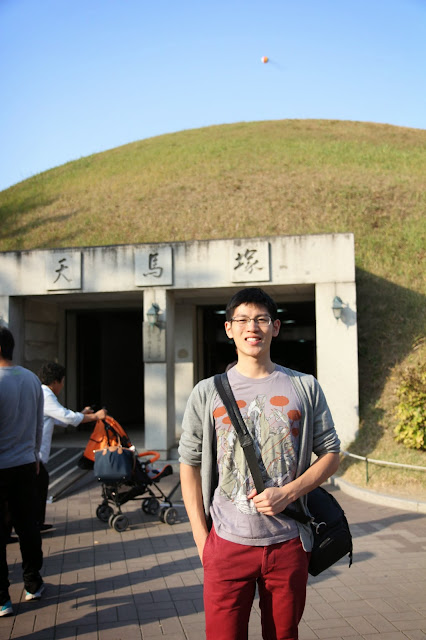
At Cheonmachong. The balloon way in the background is from the 떡 festival.
From there, we walk past a 떡 festival and enter a quiet, secluded park with trees shading the paths and hushing the sounds of the roads. The only sounds are Fulbrighters chatting and Brittany's loud maniacal laughter as she shoots us all with the soap bubble gun she has for some unknown reason.

A path leads us past giant earthen mounds -- more like small hills -- that are all just a little bit too geometrically perfect to be natural. They are tumuli, each one a tomb for some member of the Silla royal family. They look like they would be so much fun to sled down come wintertime, but no one is allowed to step foot on them. No visitors allowed. Only lawnmowers to keep them looking pristine.

The very last one at the end of the path is Cheonmachong (천마총/天馬塚), the Heavenly Horse Tomb. It's named after a painting of a pegasus found during the tomb excavation. Now, visitors are allowed to walk inside to see some neat artifacts from the 6th century, but it's all artificial, like a small museum instead of an actual excavation site.

A lady gives a short introduction to the tomb right outside of the entrance, and asks a trivia question: "Why do you think the king's body was placed facing the east?" I answer without even thinking, "To face the sunrise". To my surprise, the tour guide herself seems surprised, and wonders how I knew that. I shrug; it seemed logical. By then, the afternoon has worn on and it's nearing dinnertime. I'm tired, but in a good way, I think, because although my feet are sore I feel like I've had a really fun, chill day.

Sunday, August 12, 2012

노래방 - Karaoke!

Noraebang, or NLB for the proud speakers of Konglish, is the Korean version of what seems to be an Asian trend: private rooms for friends to rent out for an hour and sing all the latest pop songs (or any song they like, really). They're usually BYOB, so anyone can get over "stage fright" before the evening really gets going. That said, noraebang makes for an excellent party space or just a fun place to chill and hang out.

Julia and I got "토네이도" (Tornado) desserts at Lotteria!
My first experience with a karaoke room was in Taiwan (where it's called 卡拉-OK), but the selection of English songs was paltry. Here in Korea, even the smallest of 노래 연습 방 (Yeah, some of the "classier" NLB are called "singing practice rooms" instead of "singing rooms") has hundreds of hits from the American songbook.

NLB was on my Korea bucket list, and I wanted to knock it out early on -- with friends from Orientation -- especially because I'd need some experience before my principal and co-teachers invite me out to a 회식 (hweshik, or dinner meeting that is commonly followed by 노래방). It was a couple of weeks into Orientation before I finally had the time and energy to spend a night out. It was the night after our placement ceremony, and I wanted to celebrate. My friends and I went into town (tiny little Goesan...) and hit up the Lotteria first. Lotteria is like the Korean version of McDonald's. I really wanted to try a "토네이도" (Tornado), which is like a McFlurry but much, much smaller. In fact, serving sizes of everything in Lotteria were rather meager. But I guess it keeps Koreans from overeating the way Americans do. Non-Olympic athlete Americans, that is.

After Lotteria and a quick round at B&B, it was NLB time! We went to a place called "스카이 노래 연습 방" and got a room for two hours for 30,000원 (a little less than $30). Because there were a dozen of us, it turned out really cheap for us all, so that was great. And then... let the singing begin!
Tyler and Sara jamming to Justin Bieber's "Boyfriend". Yup.
We didn't even try any of the Korean songs, except for one, but I didn't know it, so... oh well. Most of our time was spent in 90's pop, Disney songs, and "Call Me Maybe"-esque fare. My favorites were probably "Lady Marmalade" from Moulin Rouge, Blink 182's "Semi-Charmed Kind of Life" (although mid-way through the song I got really embarrassed because I remembered what the lyrics were actually referring to...) and "Colors of the Wind".

It was almost one in the morning when we finished -- I haven't been awake that late for the past month -- and we walked back to campus, singing Adele and the Pokémon theme song very loudly. All in all, it was tons of fun! Just the kind of thing I needed after a stressful week. I'd like to go again, but I don't think I'll have time, because Orientation is almost over. Who knows what it'll be like if I actually have to go to NLB with my colleagues? I swear it's a thing here. I guess I'll look forward to it, if it's anything close to this!
Toward the end of the night (like... 12:30am-ish), everyone was up and dancing. I forget what song this was, though!

Saturday, August 11, 2012

Peanut Butter

Left: 누텔라. Right: 땅콩버터. So nommable!
It's expensive here. And Nutella does not exist. So this was a treat: my good friend Katelyn brought a jar each of sweet, Western, creamy trans-fat goodness to Korea with her and shared it!

We also had Skittles, beef jerky, cookies, and Korean chocolate. (It doesn't exist in the dark variety here; I do miss my 86% Ghirardelli sometimes...)

So I got comfy with friends in my dorm room and we watched Pokémon: The First Movie together. We ate junk food. We provided background commentary all throughout the film. We spewed Poké-trivia and inducted Julia into the Poké-verse. We relived childhood.

It was bliss.
친구 (chingu)! Friends from left to right: Tyler, Julia, Jason, and Katelyn.

P.S. If you look at the navigation bar at "Friends & Links" on the top of my blog, that page will take you to a bunch of my friends' blogs, including other Fulbright Korea grantees! Check 'em out!

Monday, July 23, 2012

Carved in Stone (동해, pt. 2)

Our Donghae weekend vacation continued on Friday afternoon with a visit to the Mureung Valley (무릉 계곡), a region about an hour's drive from our hotel. It's a park with lots of intense hiking trails and some absolutely beautiful landscapes (경치, kyongchi) that were great to photograph (remember, 사진 찍는것을 좋아해요!).

The purpose of our visit was a continuation of a cultural workshop on Buddhism that we'd sat through earlier in the afternoon. But before we arrived at the Samhwasa Buddhist temple (삼화사), everyone was distracted by this gorgeous portion of the river that we happened across first.
You're looking at a giant slab of rock (people in the photo for comparison) sticking out of a river with Chinese characters carved into it. The biggest are in the center of the photo, but beneath it are hundreds more names in a smaller size.
The river grew very shallow around this giant slab of rock, such that most of it was exposed, dry, and walkable. Carved into the rock in many places, in 한자 (hanja, Chinese characters) large and small, were hundreds of Korean names and family names. I never found out why they were there, but it was very cool to walk around and try to read them. I even found my own family name, 鄭, which in Korean is 정 (jeong, or Jeong/Jung/Chung)! It was fairly common, as were 金 (Kim), 李 (Lee), and 朴 (Park).
Zheng Shou... something! Maybe we're very, very, very distantly related.

After the river -- where most of us wanted to stay forever -- we hiked a bit further up the mountain and arrived at Samhwasa Temple. There was a big drum, a big bell, and a wooden fish instrument used for many ritual purposes in the temple. The big drum immediately made me think of taiko back at Swarthmore. The bell made me think -- oddly, but not that oddly considering Sara, Jason and I bonded over a shared love of Pokémon -- of Pokémopolis and the giant bell that awoke a monster Gengar, as well as the ridiculous looking bell thing to the right. And lastly, the wooden fish was based on an interesting folk tale that involved a monk being turned into a fish with a tree growing out of its back...

Some of us got a chance to ring the bell (eastern bells are rung from the outside, no clapper on the inside), play the drum (in the shape of the Chinese character 心, meaning heart of mind), and knock the inside of the wooden fish. According to the Zen Buddhist tradition, playing these instruments were supposed to generate love and empathy for all living things and the Earth.
Jaeyeon and Bridget try their hand at ringing the giant bell. Everyone and their mother had a camera! Behind them you can see the green and red wooden fish that looks like a dragon.
Another very cool part of the temple was found on the upper level. There were rows upon rows of paper lanterns with what I assume are prayers attached to them. I don't know what the Korean on the lanterns means: 락왕생? If you know, please enlighten me! Regardless, it was a very pretty sight.

[edit] Seven months later... My host parents have informed me that the lantern actually says 극락왕생. I didn't notice the top character first. It means a wish for safe passage into heaven or the afterlife. (극락/geungnak is heaven or paradise, and 왕생/wangsaeng means passing into the next world.)
Paper lanterns with prayers attached to them. I wonder how people feel about having their prayers displayed publicly like this, for anyone to read.
So that was the temple. I enjoyed taking a look around and photographing everything aesthetically pleasing, but I was excited about coming back to this park to tackle one of the many trails the spanned the mountains all around. Below on the left is a photo of me with a pretty part of the river behind me. The next day, I saw a lot of the river... photos to come!
Me at Mureung Valley. Photo taken by Katelyn!
Cecile doing some painting at the temple.

And lastly... a dragonfly! Because there were dragonflies everywhere in the temple, and they kept landing on peoples' heads. But I wasn't quick enough to catch that. Instead, here is one resting on top of a lantern.
A dragonfly! 잠자리 (jamjali)

Translate